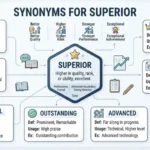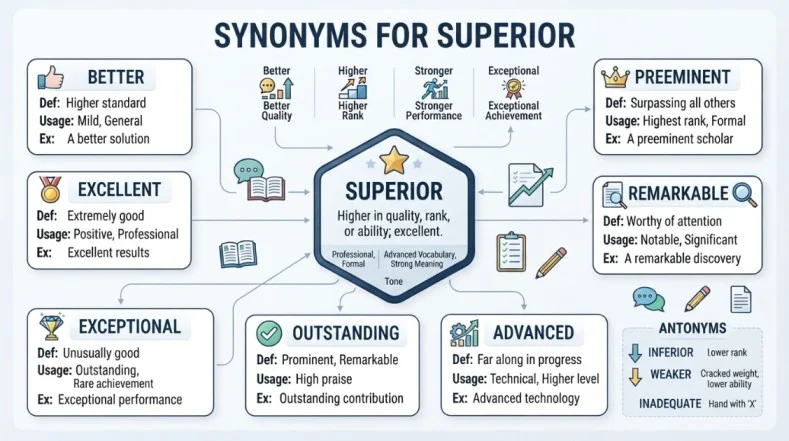
You may use the word “superior” when you want to describe something as better, higher in quality, more advanced, or higher in rank. But repeating the same word can make an essay, email, resume, review, or caption feel predictable.
The right alternative depends on what you mean. “Excellent” can describe quality, while “advanced” emphasizes development and “dominant” suggests a stronger position. “Exceptional” adds praise, while “senior” refers more specifically to rank or position.
This guide explains 25 accurate synonyms for superior, along with their meanings, tones, examples, common mistakes, antonyms, and the situations where each word works best.
What Does “Superior” Mean?
Superior means better in quality, ability, performance, or value, or higher in rank or position. Formal choices include “exceptional” and “advanced,” casual choices include “better,” and professional choices include “outstanding” or “high quality.”
Meaning, Tone and Context
Simple Definition
“Superior” is an adjective that generally means better than another person or thing in quality, ability, performance, status, or position.
For example:
“ This model offers superior performance.”
Here, “superior” means the model performs better than another comparable model.
The word can also describe rank or authority:
“She reports to a superior at work.”
In this context, “superior” refers to someone with a higher position or authority.
Part of Speech
“Superior” is primarily an adjective.
It can describe:
- Higher quality
- Better performance
- Greater ability
- Higher status
- Higher rank
- Greater importance in a particular comparison
“Superior” can also function as a noun when it refers to a person with higher authority.
Example:
“The employee discussed the matter with her superior.”
Tone
The tone of “superior” depends heavily on context.
When describing quality, it can sound positive:
“This material provides superior durability.”
When describing a person who considers themselves better than others, it can sound negative:
“He has a superior attitude.”
When describing workplace hierarchy, it is generally neutral:
“She spoke with her superior about the schedule.”
Formality Level
“Superior” is a moderately formal word. It appears frequently in business writing, academic writing, product descriptions, professional communication, and comparative discussions.
In casual conversation, “better” is often more natural.
Instead of:
“This restaurant has superior food.”
A casual speaker might say:
“This restaurant has better food.”
Common Use Cases
You may encounter “superior” when discussing:
- Product quality
- Academic performance
- Professional skills
- Business results
- Technology
- Workplace hierarchy
- Physical performance
- Customer service
- Materials and construction
- Personal attitudes
Important Word Forms
The main related forms include:
Superior, adjective and noun
Superiority, noun
Inferior, adjective
Inferiority, noun
The noun “superiority” describes the condition of being better or higher in some respect.
Example:
“The company gained a reputation for technological superiority.”
When and How to Use “Superior”
Use “superior” when you need to communicate a meaningful comparison.
It works especially well when one option performs better than another or occupies a higher position.
1. Professional Context
“The updated software provides superior security for business users.”
This works because the sentence compares the quality of security provided by different software options.
2. Personal Context
“She believes her new camera produces superior photos.”
Here, “superior” describes better quality without sounding excessively emotional.
3. Academic Context
“The study found that the revised method produced superior results.”
The word fits academic writing because it communicates a measurable comparison.
4. Emotional Context
“He spoke with a superior attitude toward his coworkers.”
Here, the meaning changes. The phrase suggests arrogance or an attitude of looking down on others.
5. Creative Context
“The mountain village seemed to offer a superior view of the valley.”
The word creates a polished descriptive tone.
6. Social Media Context
“This new phone camera is seriously superior for nighttime photos.”
In a casual caption, “superior” can add emphasis, although “better” or “amazing” may sound more conversational.
7. Email Context
“We selected this option because it offers superior reliability.”
This is appropriate for professional communication when comparing alternatives.
Another Word for “Superior”
The best single replacement depends on what “superior” means in your sentence.
- For professional writing, “outstanding,” “exceptional,” or “high quality” may work well when discussing performance.
- For academic writing, “advanced,” “more effective,” or “better” can communicate comparison clearly.
- For casual conversation, “better” is usually the most natural choice.
- For emotional writing, “exceptional” or “remarkable” can add stronger praise.
- For creative writing, “exquisite,” “extraordinary,” or “preeminent” can create a more elevated tone.
- For resumes and workplace writing, “outstanding,” “exceptional,” and “advanced” are useful when supported by specific evidence.
- For social media captions, “better,” “amazing,” “excellent,” or “top quality” may feel more natural.
- For a stronger meaning, consider “exceptional,” “outstanding,” “preeminent,” or “unmatched,” depending on whether the comparison is justified.
- For a softer meaning, “better,” “improved,” or “higher quality” may sound more measured.
When Not to Use “Superior”
“Superior” is not always the most precise choice.
When the comparison is casual
In everyday conversation, “better” often sounds more natural.
Instead of:
“This coffee is superior to the other one.”
Say:
“This coffee is better than the other one.”
When you mean extremely good
If you simply want to praise something, “excellent” or “outstanding” may communicate your intention more clearly.
“Superior” often suggests comparison, while “excellent” does not necessarily require one.
When you mean advanced technology
“Advanced” may be more precise when discussing technological development.
Example:
“The company uses advanced imaging technology.”
Calling it “superior technology” suggests that it is better than another option, while “advanced technology” focuses on sophistication.
When describing workplace rank
“Senior” may be more precise than “superior.”
For example:
“She is a senior manager.”
This describes position more naturally than:
“She is a superior manager.”
When the word sounds arrogant
When describing people, “superior” can imply that someone considers themselves better than others.
If you simply mean highly skilled, “talented,” “capable,” or “exceptional” may be more appropriate.
Words Commonly Confused With “Superior”
Superior vs. Excellent
“Superior” usually implies comparison. “Excellent” describes very high quality without necessarily comparing two things.
“The newer model is superior to the previous version.”
“The newer model is excellent.”
Superior vs. Advanced
“Superior” means better in a comparison. “Advanced” means highly developed or sophisticated.
“The system delivers superior results.”
“The system uses advanced technology.”
Superior vs. Senior
“Superior” can refer to someone with higher authority. “Senior” commonly describes someone with greater rank, experience, or responsibility.
“She spoke with her superior.”
“She is a senior manager.”
Superior vs. Exceptional
“Exceptional” means unusually good or remarkable. “Superior” generally emphasizes being better than another option.
“Her performance was exceptional.”
“Her performance was superior to that of the other finalists.”
Superior vs. Dominant
“Dominant” suggests having greater power, control, influence, or success within a particular situation.
“Company A has superior battery technology.”
“Company A is dominant in the market.”
Superior vs. Outstanding
“Outstanding” means exceptionally good or impressive. “Superior” can be more explicitly comparative.
“He delivered an outstanding presentation.”
“His presentation was superior to the previous version.”
Best Synonym by Context for “Superior”
| Context | Best Synonym | Why It Works | Example |
|---|---|---|---|
| Formal writing | Exceptional | Polished and strongly positive | The organization provides exceptional service. |
| Academic writing | More effective | Clearly communicates comparative performance | The revised method was more effective. |
| Professional use | Outstanding | Strong praise without sounding excessively dramatic | She delivered outstanding results. |
| Resume | Exceptional | Highlights unusually strong performance | Demonstrated exceptional problem solving ability. |
| Business | High quality | Clear and commercially appropriate | The company offers high quality materials. |
| Casual conversation | Better | Natural and widely understood | This version is better. |
| Creative writing | Exquisite | Adds descriptive richness | The artist created an exquisite design. |
| Emotional tone | Remarkable | Adds admiration and emphasis | Her recovery was remarkable. |
| Strong intensity | Exceptional | Communicates unusually high quality | The team produced exceptional results. |
| Soft or moderate tone | Improved | Sounds measured and factual | The updated process is improved. |
| Social media | Amazing | Natural in informal promotional language | This camera is amazing for travel photos. |
| Technology | Advanced | Focuses on sophistication | The device uses advanced sensors. |
| Workplace rank | Senior | Clearly describes position or experience | She is a senior executive. |
| Competitive performance | Dominant | Emphasizes control or strong success | The team was dominant throughout the season. |
| US professional English | Outstanding | Common and natural in workplace praise | He achieved outstanding results. |
| UK professional English | Excellent | Widely understood and naturally formal | The service was excellent. |
Which Synonym Should You Choose?
Start by asking what “superior” means in your sentence.
- If you mean “better than another option,” use “better,” “more effective,” “higher quality,” or “advanced,” depending on the comparison.
- If you mean “extremely good,” consider “excellent,” “outstanding,” “exceptional,” or “remarkable.”
- If you mean “higher in workplace rank,” use “senior,” “higher ranking,” or “managerial,” depending on the exact situation.
- If you mean “more powerful or successful,” “dominant” may be more precise.
- If you want a creative or elegant tone, “exquisite,” “extraordinary,” or “preeminent” may work.
Always match the synonym to the actual meaning rather than choosing the most impressive sounding word.
Real Life Examples of “Superior” in Sentences
School
“The revised study method produced superior results on the final exam.”
Workplace
“Our new process provides superior efficiency without increasing costs.”
Writing
“The second draft offered a superior explanation of the main argument.”
Conversation
“I think this version is better than the first one.”
Social Media
“Superior image quality makes this camera a great choice for travel.”
Resume
“Delivered exceptional customer service while improving client satisfaction.”
“We recommend the updated model because it provides superior reliability.”
Storytelling
“From the hilltop, they discovered a superior view of the distant coastline.”
25 Synonyms for “Superior”
| Synonym | Simple Meaning | Best Used For | Example Sentence |
|---|---|---|---|
| Better | Higher in quality or performance | Everyday comparisons | This version is better than the previous one. |
| Excellent | Very high quality | General praise | The restaurant provides excellent service. |
| Exceptional | Unusually good | Strong professional praise | She delivered exceptional results this quarter. |
| Outstanding | Extremely impressive or successful | Work and achievement | His outstanding performance earned recognition. |
| Superior | Better than another option | Direct comparison | The newer material offers superior durability. |
| Advanced | Highly developed or sophisticated | Technology and methods | The clinic uses advanced imaging equipment. |
| Superior quality | Higher standard of quality | Products and services | The manufacturer is known for superior quality. |
| High quality | Very good standard | Business and products | Customers expect high quality from the brand. |
| Remarkable | Worthy of attention or admiration | Personal and emotional praise | Her progress has been remarkable. |
| Excellent | Very good in quality | General description | The team provided excellent support. |
| Extraordinary | Far beyond what is usual | Creative and emotional writing | The expedition produced extraordinary results. |
| Exquisite | Extremely beautiful or refined | Creative description | The designer created an exquisite interior. |
| Preeminent | More important or distinguished than others | Formal and academic writing | She is a preeminent researcher in the field. |
| Premier | Among the leading or most respected | Business and public descriptions | The city is home to a premier research center. |
| First rate | Of very high quality | General praise | They provide first rate customer service. |
| Top tier | Among the highest quality or level | Business and casual writing | The university offers top tier programs. |
| Superior performing | Performing at a higher level | Technical and professional writing | The superior performing model uses less energy. |
| More effective | Producing better results | Academic and professional writing | The revised strategy was more effective. |
| More capable | Able to do more or perform better | Technology and skills | The new system is more capable than the older model. |
| Dominant | More powerful or successful | Competition and markets | The company became dominant in the region. |
| Premier | Highly regarded or leading | Formal promotional writing | The institution is a premier destination for research. |
| Elevated | Raised to a higher level or standard | Creative and professional writing | The redesign created an elevated customer experience. |
| Refined | Improved, polished, or sophisticated | Design and creative writing | The updated interface has a more refined appearance. |
| Accomplished | Highly skilled or successful | People and careers | She is an accomplished editor and writer. |
| Distinguished | Respected and notable for achievement | Professional and academic writing | He is a distinguished professor with decades of experience. |
Note: Some choices above are context based alternatives rather than perfect replacements in every sentence. Words such as “dominant,” “senior,” “advanced,” and “accomplished” express specific aspects of superiority and should be selected according to the intended meaning.
Synonym Groups and Usage Differences
Professional vs. Personal Synonyms
Professional writing often benefits from precise terms such as “outstanding,” “exceptional,” “advanced,” “distinguished,” and “more effective.”
Personal communication usually favors simpler choices such as “better,” “excellent,” “amazing,” or “remarkable.”
The simpler word is not necessarily less effective. In many situations, clear language communicates better than an unnecessarily sophisticated synonym.
Formal vs. Conversational Synonyms
Formal writing may use “exceptional,” “preeminent,” “distinguished,” or “more effective.”
Conversational English generally favors “better,” “great,” “excellent,” or “amazing.”
For example:
Formal:
“The revised procedure was more effective.”
Conversational:
“The new process works better.”
Academic Synonyms
Academic writing should emphasize accuracy rather than exaggeration.
Useful choices include:
- More effective
- More capable
- Advanced
- Exceptional
- Distinguished
- Preeminent
Use evidence when making comparative claims.
Instead of writing:
“This is a superior method.”
A stronger academic sentence might be:
“The revised method produced more consistent results in the study.”
The second sentence explains the basis for the comparison.
Professional and Business Synonyms
Business communication often benefits from words such as “outstanding,” “high quality,” “more effective,” “advanced,” and “exceptional.”
For product descriptions, avoid making unsupported superiority claims.
Instead of:
“Our product is superior.”
Consider:
“Our product uses advanced materials and has demonstrated greater durability in testing.”
The second statement gives the reader more useful information.
Creative or Literary Synonyms
Creative writing allows more expressive choices.
Words such as “exquisite,” “extraordinary,” “elevated,” “remarkable,” and “distinguished” can add texture to descriptions.
For example:
“The gallery displayed an exquisite collection of hand painted portraits.”
This creates a richer image than simply saying:
“The gallery displayed a superior collection.”
Slang or Modern Synonyms
There is no exact slang equivalent that works in every context.
In casual modern English, people may say:
“Better”
“Top tier”
“Elite”
“Amazing”
“Next level”
These expressions can work in conversations, captions, reviews, and informal posts.
They are generally less suitable for academic papers, formal reports, and professional documents.
Strongest vs. Weaker Synonyms
A useful intensity scale is:
Mild: improved
Moderate: better
Positive: excellent
Strong: outstanding
Very strong: exceptional
Highly elevated: extraordinary
Extremely distinguished: preeminent
These words are not interchangeable in every sentence. Intensity should match the evidence and purpose of the statement.
Emotional vs. Neutral Synonyms
Neutral choices include “better,” “more effective,” “advanced,” and “higher quality.”
More emotional choices include “remarkable,” “extraordinary,” “exquisite,” and “exceptional.”
Choose neutral language when presenting facts. Choose emotional language when the purpose is appreciation, storytelling, celebration, or personal expression.
Antonyms of “Superior”
| Antonym | Meaning | Example Sentence |
|---|---|---|
| Inferior | Lower in quality or ability | The older material was inferior in durability. |
| Worse | Lower in quality or performance | This version performs worse under heavy use. |
| Lower | Below another level or position | The lower level has fewer features. |
| Weaker | Less strong or capable | The second team was weaker overall. |
| Poor | Low in quality | The product received feedback for poor durability. |
| Deficient | Lacking something necessary | The original design was deficient in several areas. |
| Inadequate | Not sufficient for the purpose | The equipment was inadequate for the task. |
| Substandard | Below an accepted standard | The inspection identified substandard materials. |
| Unskilled | Lacking necessary ability | The unskilled worker needed additional training. |
| Ordinary | Not exceptional or unusual | The result was ordinary rather than remarkable. |
| Mediocre | Only average in quality | The first draft was mediocre and needed revision. |
| Inferior quality | Having a lower standard | The replacement used inferior quality materials. |
| Less effective | Producing weaker results | The older approach was less effective. |
| Junior | Lower in rank or experience | A junior employee assisted the senior manager. |
| Subordinate | Lower in rank or authority | The subordinate position carried fewer responsibilities. |
Comparison: Superior vs. Similar Words
Superior vs. Better
The main difference is formality and precision. “Better” is more common and conversational, while “superior” often sounds more formal and explicitly comparative.
“Better” is usually the more natural choice in everyday speech.
Example:
“This option is better for beginners.”
“The updated system provides superior performance.”
Superior vs. Excellent
“Excellent” means very good. “Superior” generally implies that something is better than another option.
“Excellent” is not necessarily stronger. It simply focuses more directly on quality.
Example:
“She received excellent feedback.”
“Her performance was superior to that of the other candidates.”
Superior vs. Advanced
“Advanced” describes something developed, sophisticated, or modern.
“Superior” describes something as better in comparison.
Example:
“The company uses advanced software.”
“The new software delivers superior performance.”
Superior vs. Exceptional
“Exceptional” means unusually good or impressive.
“Superior” often emphasizes a comparison.
Example:
“She is an exceptional employee.”
“She performed at a level superior to the previous standard.”
Superior vs. Senior
“Senior” usually relates to rank, experience, age, or responsibility.
“Superior” can describe higher authority, but it can also describe better quality.
Example:
“She is a senior manager.”
“She discussed the matter with her superior.”
Superior vs. Dominant
“Dominant” describes power, control, influence, or competitive success.
“Superior” can describe quality, ability, performance, or rank.
Example:
“The team has superior training facilities.”
“The team was dominant throughout the tournament.”
Common Phrases and Expressions with “Superior”
1. Superior Quality
Meaning:
A level of quality that is presented as better than another available option.
Example sentence:
“The company is known for its superior quality materials.”
2. Superior Performance
Meaning:
Performance that exceeds another product, person, system, or standard.
Example sentence:
“The new processor delivers superior performance during demanding tasks.”
3. Superior Service
Meaning:
Service that is presented as better than competing or previous service.
Example sentence:
“Our goal is to provide superior service to every customer.”
4. Superior Results
Meaning:
Results that are better than those produced by another method or option.
Example sentence:
“The revised strategy generated superior results.”
5. Superior Technology
Meaning:
Technology described as better or more capable than alternatives.
Example sentence:
“The company invested in superior technology to improve production.”
6. Superior Skills
Meaning:
Skills that are notably stronger or more developed than those of others.
Example sentence:
“Her superior communication skills helped the team resolve the issue.”
7. Superior Attitude
Meaning:
A manner that suggests someone believes they are better than others.
Example sentence:
“His superior attitude made collaboration difficult.”
8. Superior Officer
Meaning:
An officer with higher rank or authority.
Example sentence:
“The junior officer reported the incident to a superior officer.”
Common Mistakes to Avoid
1. Using “Superior” When “Better” Is More Natural
“Superior” can sound unnecessarily formal in ordinary conversation.
Instead of:
“This restaurant is superior to the one we visited yesterday.”
A natural conversational choice is:
“This restaurant is better than the one we visited yesterday.”
2. Confusing “Superior” With “Excellent”
“Excellent” does not necessarily create a comparison.
If you are simply praising something, “excellent” may be more accurate.
3. Using a Casual Synonym in Formal Writing
Words such as “awesome,” “amazing,” and “top tier” may sound too casual in academic or formal professional documents.
Choose “excellent,” “exceptional,” or “outstanding” when appropriate.
4. Using an Overly Dramatic Synonym
Words such as “extraordinary” and “unmatched” make strong claims.
Do not use them when the evidence only supports a modest improvement.
5. Repeating “Superior” Too Often
Repeated use makes writing feel mechanical.
If the meaning changes, use precise alternatives such as “advanced,” “more effective,” “outstanding,” or “better.”
6. Choosing the Wrong Emotional Tone
“Superior” can describe arrogance when applied to a person’s attitude.
If you mean that someone is highly skilled, “accomplished” or “exceptional” may be better.
7. Using Slang in Academic or Professional Writing
Expressions such as “top tier” or “next level” can be effective in social media or casual communication but may weaken formal writing.
FAQs
What is the best synonym for “superior”?
“Better” is usually the clearest synonym, while “exceptional,” “outstanding,” or “advanced” may be more appropriate when the specific context requires stronger or more precise meaning.
What is a formal synonym for “superior”?
Formal alternatives include “preeminent,” “exceptional,” “distinguished,” “advanced,” and “outstanding,” depending on whether you mean quality, achievement, development, or status.
What is an informal synonym for “superior”?
“Better” is the most natural informal alternative. In casual online writing, people may also use “top tier,” “amazing,” or “next level.”
What is another word for “superior” in professional writing?
Professional alternatives include “outstanding,” “exceptional,” “high quality,” “more effective,” and “advanced,” depending on the specific comparison being made.
What is the difference between “superior” and “excellent”?
“Superior” usually implies that something is better than another option, while “excellent” describes very high quality without necessarily making a comparison.
What is the opposite of “superior”?
Common opposites include “inferior,” “worse,” “substandard,” “inadequate,” “weaker,” and “lower,” depending on the intended meaning.
Conclusion
“Superior” can mean better in quality, performance, ability, or value, and it can also refer to higher rank or authority. Because its meaning changes with context, the best synonym depends on what you actually want to communicate.
Use “better” for everyday comparisons, “excellent” for general praise, “outstanding” for professional achievement, “advanced” for technology or development, and “exceptional” for unusually strong quality.
When describing rank, “senior” may be more precise. When discussing power or competitive control, “dominant” may communicate the idea more accurately.
The most useful vocabulary habit is simple: do not choose a synonym just because it sounds impressive. Choose the word that expresses your exact meaning, matches your audience, and fits the tone of the sentence.
Discover More Post:
- 25+ Synonyms for Dream | Meanings, Examples, and Best …
- 25+ Synonyms for Even Though | Meanings, Examples, and …
- 25+ Synonyms for Yelled | Meanings, Examples, and Best …