Have you ever used the word convince several times in the same email, essay, caption, or conversation? The word is useful, but repeating it can make your writing sound predictable. A more precise word can show exactly how someone was influenced, reassured, persuaded, or moved.
Understanding synonyms for convince helps you choose language that fits the situation. You might persuade a client, reassure a worried friend, influence a decision, or satisfy a reader with strong evidence. This guide explains those differences with simple definitions, natural examples, and practical recommendations for school, work, writing, and everyday communication.
What Does Convince Mean?
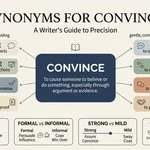
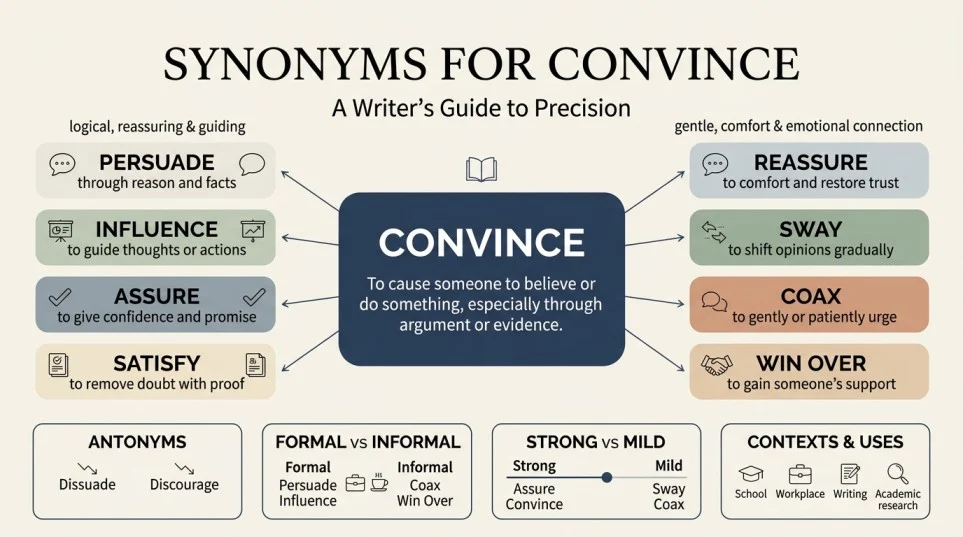
Convince means to cause someone to believe that something is true or to persuade someone to do something. Formal choices include persuade and satisfy, while casual options include talk into and win over.
Meaning, Tone and Context
Simple Definition
Convince means to make someone believe something is true, correct, reasonable, or worthwhile.
It can also mean persuading someone to take an action. The exact meaning depends on what follows the verb.
For example:
I convinced Maya that the plan would work.
Here, convince means causing Maya to believe something.
I convinced Maya to join the project.
Here, convince means persuading Maya to take an action.
Part of Speech
Convince is a verb.
Common forms include:
Convince: present form
Convinced: past form
Convincing: present participle and adjective form
Convincingly: adverb form
Conviction: related noun, although conviction usually refers to a strong belief rather than the act of persuading someone.
Tone
Convince is generally neutral.
It does not automatically suggest that the persuasion was good or bad. The surrounding words create the emotional meaning.
A teacher may convince a student through evidence. A salesperson may convince a customer through a strong presentation. A friend may convince you to try something new.
Formality Level
Convince works well in casual conversation, academic writing, professional communication, emails, essays, and general content.
It is a flexible word, but a more specific synonym can sometimes make your sentence stronger.
For example:
The evidence convinced the committee.
The evidence satisfied the committee.
The second sentence focuses more clearly on evidence meeting a standard of acceptance.
Common Uses
Convince is often used when talking about:
Beliefs and opinions
Decisions
Arguments
Evidence
Persuasion
Business proposals
Personal choices
Academic conclusions
Customer decisions
Emotional reassurance
When and How to Use Convince
Use convince when you want to show that someone changed their belief, accepted an idea, or agreed to take an action because of something you said, showed, or explained.
Professional Context
The presentation convinced the client that the new system could reduce costs.
This sentence works well because the focus is on changing the clients belief through information.
Personal Context
My brother convinced me to try the new restaurant.
Here, convince refers to persuading someone to take an action.
Academic Context
The research findings convinced the students that the original theory needed further testing.
The word fits because evidence caused a change in belief.
Social Media Context
Her story convinced me to give the book a chance.
This sounds natural and conversational.
Another Word for Convince
The best single replacement depends on what you mean.
- If you mean persuading someone to act, persuade is usually the strongest general choice.
- If you mean changing someones opinion, sway or influence may work better.
- If you mean making someone feel certain or comfortable, assure or reassure may be more precise.
Professional Writing
Use persuade, influence, satisfy, or assure depending on the sentence.
The proposal persuaded the board to approve the investment.
The research influenced the companys decision.
The evidence satisfied the review committee.
Academic Writing
Persuade, establish, satisfy, and demonstrate can sometimes replace convince, but they do not all have exactly the same meaning.
Persuade focuses on changing a persons view or decision. Satisfy focuses on meeting a standard of evidence or proof.
Casual Conversation
Win over, talk into, bring around, and coax can sound more natural in everyday speech.
I finally talked my friend into coming with us.
Emotional Writing
Reassure, move, and win over can add emotional meaning.
Her honest apology won him over.
The doctors explanation reassured the family.
Creative Writing
Move, sway, win over, and bring around can create more personality and emotional depth.
The old mans quiet story moved the entire room.
Resume or Workplace Use
Persuade and influence are usually better choices for resumes because they describe useful communication and leadership skills more precisely.
Persuaded a hesitant client to approve the proposal.
Influenced cross team decisions through clear data analysis.
Social Media Captions
Win over, move, inspire, and talk into can sound more natural depending on the message.
One great recommendation and you can win over any movie fan.
Stronger Meaning
Sway, prevail upon, and strongly persuade can suggest more determined influence.
Prevail upon is formal and often sounds more deliberate.
Softer Meaning
Coax, reassure, and appeal to can sound gentler.
Coax suggests patient persuasion. Reassure suggests reducing fear or uncertainty.
When Not to Use Convince
Convince is useful, but it can be too general when your sentence needs a more specific idea.
When Evidence Is the Main Focus
Instead of:
The evidence convinced the scientists.
You may write:
The evidence satisfied the scientists.
Satisfy emphasizes that the evidence met their requirements.
When Someone Is Influenced Without Direct Persuasion
Instead of:
The trend convinced young shoppers.
You may write:
The trend influenced young shoppers.
Influence can describe a broader effect that does not involve direct persuasion.
When the Person Is Emotionally Reassured
Instead of:
The doctor convinced the patient that everything was fine.
You could write:
The doctor reassured the patient that everything was fine.
Reassure makes the emotional purpose clearer.
When the Tone Is Very Casual
In friendly conversation, talk into or win over may sound more natural.
When the Action Is Strongly Persuasive
Persuade is often better when you want to emphasize deliberate communication intended to change someones decision.
Words Commonly Confused With Convince
Convince vs. Persuade
Convince often focuses on causing belief. Persuade often focuses on encouraging action or changing a decision.
I convinced her that the information was accurate.
I persuaded her to accept the offer.
Convince vs. Assure
Convince can involve evidence or reasoning. Assure usually involves giving someone confidence that something is true or safe.
The results convinced us.
The manager assured us that the problem would be fixed.
Convince vs. Influence
Influence is broader. Someone can influence a decision without directly persuading another person.
The report influenced the decision.
The presentation convinced the committee.
Convince vs. Manipulate
Convince does not automatically suggest dishonesty. Manipulate usually suggests controlling someone unfairly or using hidden pressure.
She convinced him through clear evidence.
He manipulated the situation to get what he wanted.
Convince vs. Explain
Explain means making something understandable. Convince means causing someone to accept or believe something.
She explained the process.
She convinced the team that the process was necessary.
Convince vs. Prove
Prove means establishing something as true through sufficient evidence. Convince describes the effect that information or reasoning has on a person.
The experiment proved the theory.
The results convinced the researchers.
Best Synonym by Context for Convince
| Context | Best Synonym | Why It Works | Example |
|---|---|---|---|
| Formal writing | Persuade | Clear and professional | The speaker persuaded the committee to reconsider the proposal. |
| Academic writing | Satisfy | Highlights evidence meeting a standard | The findings satisfied the reviewers. |
| Professional or business use | Influence | Works well for decisions and outcomes | Her analysis influenced the final decision. |
| Resume | Persuade | Shows communication ability | Persuaded prospective clients to adopt new services. |
| Casual conversation | Talk into | Sounds natural and relaxed | I talked my brother into coming with us. |
| Creative writing | Move | Adds emotional depth | Her words moved the audience. |
| Emotional tone | Reassure | Shows comfort and restored confidence | The doctor reassured the family. |
| Strong intensity | Prevail upon | Suggests determined persuasion | The director prevailed upon the team to reconsider. |
| Soft or moderate tone | Coax | Suggests gentle persuasion | She coaxed the child into trying the new food. |
| Social media captions | Win over | Friendly and conversational | This little trick may win over even the toughest critics. |
| Evidence based writing | Satisfy | Focuses on acceptance of evidence | The explanation satisfied the reviewers. |
| Opinion or belief | Sway | Shows a change in viewpoint | The new evidence swayed his opinion. |
Which Synonym Should You Choose?
Choosing the best synonym for convince starts with identifying what actually happened.
- If someone changed their opinion because of your reasoning, persuade or sway may work well.
- If someone made a decision because of your communication, persuade or influence is often better.
- If someone became less worried, choose reassure.
- If someone accepted evidence as sufficient, choose satisfy.
- If someone was gently encouraged, choose coax.
- If someone was emotionally affected, choose move.
- If the situation is casual, talk into, win over, or bring around may sound more natural.
For professional writing, avoid choosing a synonym simply because it sounds impressive. The best word is the one that describes the action accurately.
Real Life Examples of Convince in Sentences
School
The teacher convinced the students that checking their sources would improve their research.
Workplace
The sales manager persuaded the client to review the updated proposal.
Writing
The writer used specific examples to convince readers that the issue deserved more attention.
Conversation
I tried to convince my friend that arriving early would make the trip easier.
Social Media
That before and after photo convinced me to try the new routine.
Resume
Persuaded prospective customers through clear presentations and thoughtful product recommendations.
The detailed cost analysis convinced the team to reconsider the original budget.
Storytelling
Her quiet determination eventually won over everyone in the room.
18 Synonyms for Convince
| Synonym | Simple Meaning | Best Used For | Example Sentence |
|---|---|---|---|
| Persuade | Get someone to agree or act | Professional, academic, general | The manager persuaded the team to test the new process. |
| Sway | Change someones opinion or decision | Opinions, debates, decisions | The new evidence swayed the judges opinion. |
| Influence | Affect a persons thoughts or actions | Business, leadership, general | Her research influenced the final recommendation. |
| Assure | Make someone confident that something is true or safe | Professional and emotional situations | The technician assured us that the repair was complete. |
| Satisfy | Provide enough evidence to meet someones concerns | Academic and evidence based writing | The explanation satisfied the reviewers. |
| Induce | Cause someone to do something through persuasion or circumstances | Formal writing | The offer induced several customers to sign up. |
| Coax | Gently persuade someone | Personal and casual situations | She coaxed her young son into trying the unfamiliar food. |
| Win over | Gradually gain someones support or approval | Casual and creative writing | His honesty eventually won over the skeptical audience. |
| Talk into | Persuade someone to do something | Casual conversation | My friends talked me into joining the weekend trip. |
| Bring around | Persuade someone to accept a different view | Conversational use | We eventually brought her around to our way of thinking. |
| Prevail upon | Persuade someone after effort | Formal writing | The chair prevailed upon the members to reconsider the decision. |
| Reason with | Persuade through calm logic | Personal and professional discussion | I tried to reason with him before he made a quick decision. |
| Appeal to | Use a particular value, need, or feeling to persuade | Formal, creative, and professional use | The campaign appealed to customers desire for simplicity. |
| Move | Affect someone emotionally enough to influence them | Emotional and creative writing | The speakers personal story moved the audience. |
| Convert | Persuade someone to adopt a different belief or position | Beliefs, opinions, and marketing | The demonstration converted several doubtful customers into supporters. |
| Sell | Persuade someone that an idea or product is worthwhile | Business and informal use | She really sold us on the benefits of the new service. |
| Reassure | Remove doubt or fear and restore confidence | Emotional and professional situations | The doctor reassured the patient after reviewing the results. |
| Get someone to agree | Successfully persuade someone to accept an idea | General and conversational use | We finally got the committee to agree to the revised plan. |
Synonym Groups and Usage Differences
Professional vs. Personal Synonyms
Professional writing often benefits from words such as persuade, influence, satisfy, and assure.
These words clearly describe communication, decisions, evidence, or confidence.
Personal conversations can sound more natural with coax, talk into, win over, and bring around.
The right choice depends on the relationship and the level of formality.
Formal vs. Conversational Synonyms
Persuade is appropriate in reports, essays, speeches, presentations, and professional emails.
Prevail upon is more formal and less common in everyday American conversation.
Talk into and win over are much more conversational. They can sound awkward in formal academic writing.
Academic Synonyms
Persuade and satisfy are useful in academic writing, but they describe different ideas.
- Use persuade when discussing arguments designed to change opinions.
- Use satisfy when discussing evidence that meets a requirement or resolves a concern.
- Use influence when discussing factors that affect conclusions or decisions.
Professional and Business Synonyms
Influence is useful when describing leadership, decision making, or strategic communication.
Persuade is useful when describing sales, negotiations, presentations, or client communication.
Assure is useful when someone needs confidence or clarification.
Satisfy works well when a requirement, concern, or evidence standard has been met.
Creative or Literary Synonyms
Move, win over, sway, and bring around can give creative writing more personality.
Move is especially useful when an event, speech, memory, or character creates a strong emotional response.
Sway works well when a character changes an opinion.
Slang or Modern Synonyms
There is no single slang word that perfectly replaces convince in every situation.
Sell is common in informal American English when someone successfully makes an idea sound attractive.
Talk into is also very common in everyday speech.
For example:
My friends talked me into going.
The speaker really sold me on the idea.
These choices are better for conversation than for formal academic work.
Strongest vs. Weaker Synonyms
A simple intensity guide can look like this:
Mild: appeal to
Gentle: coax
Moderate: influence
Direct: persuade
Strong: sway
Very determined: prevail upon
The strength depends on context. A strong word is not always a better word.
Emotional vs. Neutral Synonyms
Neutral choices include convince, persuade, influence, and satisfy.
More emotional choices include move, reassure, and win over.
Coax can suggest patience and gentleness.
Manipulate, although related to persuasion, carries a negative meaning and should not be treated as a neutral synonym.
Antonyms of Convince
Because convince has more than one sense, its opposites can relate to belief, acceptance, or persuasion.
| Antonym | Meaning | Example Sentence |
|---|---|---|
| Disbelieve | Refuse to accept something as true | She disbelieved the claim because there was no evidence. |
| Doubt | Feel uncertain about something | I doubt that the proposal will succeed. |
| Question | Express uncertainty about an idea or claim | The reviewers questioned the accuracy of the report. |
| Distrust | Lack confidence in someone or something | The customer distrusted the company after the mistake. |
| Reject | Refuse to accept an idea or proposal | The committee rejected the recommendation. |
| Resist | Refuse to give in to persuasion or pressure | He resisted the sales pitch. |
| Refuse | Say no to a request or proposal | She refused to change her decision. |
| Dissuade | Persuade someone not to do something | Her parents tried to dissuade her from leaving early. |
| Discourage | Make someone less willing to act | The high cost discouraged new customers. |
| Deter | Prevent someone from taking an action | The warning deterred people from entering the area. |
| Oppose | Act against an idea or decision | Several members opposed the proposal. |
| Challenge | Question whether something is correct or valid | The researcher challenged the earlier conclusion. |
| Contradict | State that something is false or incorrect | The new evidence contradicted his claim. |
| Confuse | Make something difficult to understand or accept | The unclear explanation confused the audience. |
| Mislead | Cause someone to believe something incorrect | The advertisement misled some customers. |
Comparison: Convince vs. Similar Words
Convince vs. Persuade
The main difference is emphasis.
Convince often focuses on belief, while persuade often focuses on action or agreement.
Persuade can sound slightly more purposeful when someone is trying to change a decision.
Example:
The evidence convinced her that the claim was accurate.
The speaker persuaded her to support the proposal.
Convince vs. Influence
Influence has a wider meaning.
You can influence someone without directly trying to persuade them.
Influence is often less direct and can describe long term effects.
Example:
The report influenced the decision.
The report convinced the committee that the plan was practical.
Convince vs. Assure
Assure focuses on confidence.
Convince can involve evidence, reasoning, or argument.
Example:
The manager convinced us that the plan was realistic.
The manager assured us that the team was ready.
Convince vs. Satisfy
Satisfy often means that evidence or an explanation has met a persons concerns or requirements.
Example:
The explanation convinced him to continue.
The evidence satisfied the review board.
Convince vs. Sway
Sway emphasizes changing an opinion or decision.
It is especially useful when someone was undecided.
Example:
The interview convinced voters that she was prepared.
The interview swayed several undecided voters.
Convince vs. Manipulate
Convince is neutral.
Manipulate usually suggests unfair, dishonest, or hidden influence.
Example:
She convinced the team by presenting reliable data.
He manipulated the situation to gain control.
Common Phrases and Expressions with Convince
1. Convince someone that something is true
Meaning:
Use reasoning, evidence, or explanation to cause someone to accept an idea as true.
Example sentence:
The evidence convinced the jury that the explanation was credible.
2. Convince someone to do something
Meaning:
Persuade someone to take a particular action.
Example sentence:
She convinced her colleague to attend the meeting.
3. Convince yourself
Meaning:
Make yourself believe or accept something.
Example sentence:
He tried to convince himself that the mistake was not serious.
4. Be convinced that
Meaning:
Feel certain that something is true.
Example sentence:
I am convinced that the team made the right decision.
5. Hard to convince
Meaning:
Difficult to persuade or make confident about an idea.
Example sentence:
The customer was hard to convince because of a previous bad experience.
6. Fully convinced
Meaning:
Completely persuaded or certain.
Example sentence:
After reviewing the data, the researchers were fully convinced.
7. Almost convinced
Meaning:
Nearly persuaded but still uncertain.
Example sentence:
The presentation left me almost convinced, but I still had one question.
Common Mistakes to Avoid
1. Using Convince When Influence Is More Accurate
If something affects a decision without direct persuasion, influence may be better.
The news influenced her decision sounds more natural than saying the news convinced her when no direct persuasion occurred.
2. Confusing Convince With Assure
Assure is especially useful when someone needs confidence or emotional comfort.
The nurse reassured the patient is more precise than The nurse convinced the patient when the goal was to reduce fear.
3. Using Casual Synonyms in Formal Writing
Talk into and win over can sound too conversational in academic essays or formal reports.
Choose persuade, influence, or satisfy when the context requires a professional tone.
4. Choosing an Overly Dramatic Synonym
Not every simple agreement requires a strong word.
If someone simply accepts an explanation, convince or persuade may be enough. There is no need to use a highly forceful expression.
5. Repeating Convince Too Often
Repeated use can make your writing feel flat.
Replace some instances with persuade, influence, sway, satisfy, reassure, or win over when the meaning truly changes.
6. Choosing a Synonym With the Wrong Emotional Tone
Coax suggests gentle persuasion.
Manipulate suggests questionable or unfair influence.
Move suggests emotional impact.
Make sure the synonym matches the feeling you want readers to understand.
FAQs
What is the best synonym for convince?
Persuade is usually the best general synonym for convince when someone is encouraged to agree, decide, or take action. Sway and influence work for opinions.
What is a formal synonym for convince?
Persuade is a strong formal synonym. Satisfy works well when evidence meets a requirement, while prevail upon is more formal and deliberate.
What is an informal synonym for convince?
Talk into is a common informal alternative. Win over and bring around also work well in casual conversations and friendly writing.
What is another word for convince in professional writing?
Persuade and influence are strong professional choices. Use persuade for deliberate agreement and influence for broader effects on decisions or behavior.
What is the difference between convince and persuade?
Convince often emphasizes changing belief, while persuade often emphasizes encouraging action or agreement. In everyday English, the two words can overlap.
What is the opposite of convince?
Common opposites include doubt, disbelieve, question, reject, resist, dissuade, discourage, and oppose. The best choice depends on the sentence.
Conclusion
Convince is a flexible verb that can describe changing someones belief or persuading someone to take action. The best synonym depends on the exact situation, not simply on finding a stronger sounding word.
Use persuade for direct persuasion, influence for broader effects, satisfy for evidence, reassure for confidence, coax for gentle persuasion, and win over for a more conversational tone.
When choosing synonyms for convince, always check the meaning, formality, emotional tone, and purpose of your sentence. A precise word can make a simple sentence clearer and much more effective.
A useful vocabulary habit is to ask one question before replacing convince: What exactly changed, someones belief, decision, emotion, confidence, or behavior? Once you answer that, the right synonym becomes much easier to choose.
Discover More Post:
- 25+ Synonyms for Superior | Meanings, Examples, and Best …
- 25+ Synonyms for Inspiring | Meanings, Examples, and Best …
- 25+ Synonyms for Overcome | Meanings, Examples, and Best …