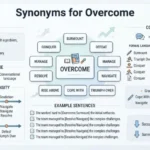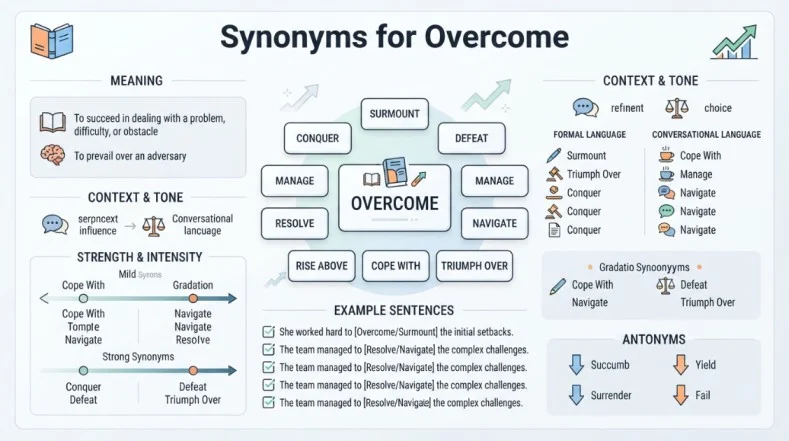
If you keep using the word “overcome” in essays, emails, captions, resumes, or everyday conversations, you have plenty of ways to express the same basic idea with greater precision. The best synonym depends on whether you mean defeating an obstacle, managing difficulty, recovering from hardship, or gaining control.
This guide explains synonyms for overcome in practical US English. You will learn which alternatives sound professional, academic, emotional, conversational, or creative, and how small word choices can make your writing more precise.
What Does “Overcome” Mean?
To overcome means to successfully deal with, defeat, or move beyond a difficulty, obstacle, fear, or problem. Strong alternatives include conquer, surmount, defeat, prevail over, and triumph over, while cope with and manage are softer choices.
Meaning, Tone and Context
Simple Definition
“Overcome” means to successfully deal with something difficult or prevent it from stopping you from reaching a goal.
You can overcome a problem, challenge, fear, obstacle, setback, illness, weakness, or difficult situation.
For example:
“She overcame her fear of public speaking.”
The sentence means that she successfully dealt with the fear and was able to move forward.
Part of Speech
“Overcome” is primarily a verb.
Its forms are:
| Form | Example |
|---|---|
| Present | I overcome challenges through preparation. |
| Past | She overcame several obstacles. |
| Past participle | He has overcome his fear. |
| Present participle | They are overcoming financial difficulties. |
| Noun related form | An overcomer is a person who successfully moves beyond difficulties. |
“Overcome” is an irregular verb because its past form is “overcame” rather than “overcomed.”
Tone
“Overcome” is generally neutral to positive.
It often suggests progress, resilience, achievement, or successful recovery. The word can also carry an emotional tone when describing serious personal struggles.
For example:
“She overcame a difficult childhood.”
This sounds more meaningful and emotional than simply saying:
“She dealt with a difficult childhood.”
Formality Level
“Overcome” works comfortably in casual conversation, professional communication, academic writing, personal essays, resumes, and motivational content.
Its flexibility is one reason it is so common. However, repeating it too frequently can make writing feel predictable.
Common Use Cases
You can use “overcome” when discussing:
- Personal challenges
- Academic difficulties
- Workplace obstacles
- Fear and anxiety
- Physical or emotional hardship
- Financial problems
- Business setbacks
- Social barriers
- Technical problems
- Personal growth
When and How to Use “Overcome”
Use “overcome” when the important idea is successful movement beyond a difficulty.
It is especially useful when the challenge initially creates a barrier but the person eventually makes progress.
Professional
“The team overcame several technical challenges before launching the new platform.”
This emphasizes successful problem solving.
Personal
“I overcame my fear of driving by practicing in quiet neighborhoods.”
The focus is on successfully moving beyond a personal fear.
Academic
“She overcame early difficulties with mathematics through regular practice.”
This works well in essays because it shows progress and persistence.
Emotional
“He eventually overcame the grief associated with the loss.”
Here, “overcame” communicates a gradual process of moving forward emotionally.
Creative
“The traveler overcame every obstacle that stood between him and the distant mountain.”
The word creates a sense of struggle followed by achievement.
Social Media
“One step at a time, I overcame what once seemed impossible.”
This works well for an inspirational caption.
Resume
“Overcame major project delays by reorganizing priorities and improving team communication.”
For a resume, a more specific verb such as “resolved” or “eliminated” may sometimes communicate the achievement more clearly.
Another Word for “Overcome”
The best single replacement depends on what “overcome” means in your sentence.
| Situation | Recommended Word |
|---|---|
| Professional writing | Surmount |
| Academic writing | Overcome |
| Casual conversation | Get past |
| Emotional writing | Triumph over |
| Creative writing | Conquer |
| Resume or workplace use | Resolve |
| Social media captions | Rise above |
| Stronger meaning | Conquer |
| Softer meaning | Manage |
- For professional writing, “surmount” emphasizes successfully dealing with a significant obstacle.
- For academic writing, “overcome” remains useful because it is clear and widely understood.
- For casual conversation, “get past” sounds natural and conversational.
- For emotional writing, “triumph over” emphasizes personal victory.
- For creative writing, “conquer” can create a stronger sense of determination and achievement.
- For resumes, “resolve” can be more precise when the problem has been specifically fixed.
When Not to Use “Overcome”
“Overcome” is not always the most precise word.
If you mean that someone simply handled a routine task, “manage” may be better.
Instead of:
“She overcame the daily customer requests.”
Try:
“She managed the daily customer requests.”
If a problem was completely fixed, “resolve” may be stronger.
Instead of:
“We overcame the software issue.”
Try:
“We resolved the software issue.”
If you mean physically defeating an opponent, “defeat” or “vanquish” may communicate the situation more accurately.
Instead of:
“The army overcame its enemy.”
Try:
“The army defeated its enemy.”
The right synonym should describe the exact action, not merely replace the original word.
Words Commonly Confused With “Overcome”
Overcome vs. Cope
“Overcome” usually suggests successful movement beyond a difficulty.
“Cope” means managing or dealing with a difficult situation, even when the problem continues.
“She overcame her fear of flying.”
“She learned to cope with the stress of flying.”
Overcome vs. Conquer
“Conquer” usually sounds stronger and more forceful.
“Overcome” can describe gradual progress, while “conquer” often suggests complete victory or control.
Overcome vs. Endure
“Endure” means to continue experiencing something difficult without necessarily defeating it.
“He endured years of hardship.”
“He overcame his financial difficulties.”
Overcome vs. Defeat
“Defeat” is commonly used when one person, team, force, or opponent wins against another.
“Overcome” is broader and can describe defeating an internal or external obstacle.
Overcome vs. Manage
“Manage” means successfully handling something.
“Overcome” usually implies that a meaningful obstacle was successfully passed or defeated.
Overcome vs. Resolve
“Resolve” means to solve a problem or settle an issue.
“Overcome” focuses more on successfully moving beyond an obstacle.
Best Synonym by Context for “Overcome”
| Context | Best Synonym | Why It Works | Example |
|---|---|---|---|
| Formal writing | Surmount | Clearly emphasizes a significant obstacle | The organization surmounted several regulatory challenges. |
| Academic writing | Overcome | Clear and broadly appropriate | Students can overcome learning barriers with effective support. |
| Professional or business use | Resolve | Focuses on solving a specific problem | The team resolved the customer service issue. |
| Resume | Conquer | Highlights determination and achievement | Conquered complex implementation challenges during the project. |
| Casual conversation | Get past | Sounds natural and conversational | I finally got past my fear of speaking in public. |
| Creative writing | Conquer | Creates a strong sense of victory | The hero conquered his deepest fears. |
| Emotional tone | Triumph over | Highlights meaningful personal victory | She triumphed over years of self doubt. |
| Strong intensity | Vanquish | Suggests complete defeat | The champion vanquished every major obstacle. |
| Soft or moderate tone | Manage | Suggests practical handling rather than dramatic victory | He managed the pressure successfully. |
| Social media captions | Rise above | Sounds inspirational and personal | Rise above the setbacks and keep moving forward. |
| Workplace communication | Tackle | Focuses on actively addressing a challenge | The team tackled the problem immediately. |
| Long term hardship | Endure | Emphasizes persistence through difficulty | They endured years of uncertainty before conditions improved. |
| Physical resistance | Withstand | Focuses on resisting harmful force or pressure | The structure withstood severe weather. |
| Competition | Defeat | Clearly communicates victory over an opponent | The team defeated its strongest rival. |
| Difficult circumstances | Navigate | Suggests finding a practical path through complexity | She navigated several difficult career transitions. |
Which Synonym Should You Choose?
Start by asking what you actually mean.
- If the sentence is about successfully moving beyond a challenge, “overcome” is often the safest choice.
- If you want to emphasize complete victory, consider “conquer,” “vanquish,” or “defeat.”
- If you mean solving a specific problem, “resolve” may be more precise.
- If you mean continuing to function despite difficulty, “cope with” or “manage” may be better.
- If the writing is inspirational, “rise above” or “triumph over” can add emotional energy.
- If you are writing professionally, choose the word that describes the actual result. Specific language usually sounds stronger than dramatic language.
Real Life Examples of “Overcome” in Sentences
School
“She overcame her difficulty with algebra by attending extra tutoring sessions.”
Workplace
“The department overcame a major scheduling problem before the product launch.”
Writing
“The author describes how the main character overcame personal doubts.”
Conversation
“I was nervous at first, but I eventually overcame my fear of presentations.”
Social Media
“Every challenge you overcome becomes part of your story.”
Resume
“Overcame significant workflow challenges while maintaining project deadlines.”
“We successfully overcame the scheduling conflict and confirmed a new meeting time.”
Storytelling
“After years of setbacks, the athlete overcame his doubts and returned to competition.”
25 Synonyms for “Overcome”
| Synonym | Simple Meaning | Best Used For | Example Sentence |
|---|---|---|---|
| Conquer | Successfully defeat or gain control over something difficult | Strong personal or figurative challenges | She conquered her fear of public speaking. |
| Surmount | Successfully deal with a difficult obstacle | Formal and professional writing | The company surmounted several operational challenges. |
| Defeat | Win against an opponent or opposing force | Competition and conflict | The team defeated its strongest competitor. |
| Triumph over | Achieve victory despite difficulty | Emotional and inspirational writing | He triumphed over years of adversity. |
| Vanquish | Completely defeat something or someone | Strong, formal, or literary contexts | The hero vanquished the force threatening the kingdom. |
| Prevail over | Succeed despite opposition or difficulty | Formal and literary writing | Persistence eventually prevailed over doubt. |
| Get past | Move beyond a difficulty or setback | Casual conversation | She finally got past her fear of interviews. |
| Rise above | Refuse to be controlled by a difficulty | Inspirational and emotional writing | He learned to rise above criticism. |
| Cope with | Manage a difficult situation | Emotional, personal, and practical contexts | She developed healthy ways to cope with stress. |
| Manage | Successfully handle something difficult | Everyday and professional situations | He managed the pressure of the demanding schedule. |
| Tackle | Actively address a difficult problem | Business, academic, and conversational contexts | The engineers tackled the problem immediately. |
| Resolve | Find a solution to a problem | Workplace and professional writing | The support team resolved the technical issue. |
| Handle | Deal successfully with a situation | Casual and professional communication | She handled the unexpected challenge calmly. |
| Navigate | Find a way through a complicated situation | Professional and personal contexts | He navigated several difficult career changes. |
| Withstand | Resist pressure, damage, or harmful conditions | Physical and figurative challenges | The building withstood the powerful storm. |
| Endure | Continue through something painful or difficult | Long term hardship | The community endured years of economic hardship. |
| Beat | Successfully defeat or get beyond something | Casual conversation | She beat her fear and gave the presentation. |
| Master | Gain strong control or skill | Skills, habits, and personal development | He mastered the techniques needed for the job. |
| Outlast | Continue longer than a difficulty or opponent | Competition and prolonged challenges | The small company outlasted several larger competitors. |
| Overpower | Defeat through greater strength or force | Physical or forceful situations | The firefighters overpowered the spreading flames. |
| Transcend | Rise beyond a limitation or ordinary condition | Creative, philosophical, and formal writing | Her work transcended the limitations of its era. |
| Navigate through | Successfully find a path through difficulty | Complex situations | The organization navigated through a period of rapid change. |
| Push through | Continue despite difficulty | Casual and motivational language | She pushed through the final week of training. |
| Work through | Deal with a problem gradually | Personal, professional, and emotional contexts | They worked through their disagreements respectfully. |
| Move beyond | Progress past a limitation or difficult period | Neutral and reflective writing | He moved beyond his earlier mistakes and rebuilt his career. |
Synonym Groups and Usage Differences
Professional vs. Personal Synonyms
Professional writing often benefits from precise verbs such as “resolve,” “surmount,” “navigate,” and “tackle.”
For example:
“The team resolved the customer complaint.”
Personal writing can use more emotionally expressive choices such as “rise above,” “triumph over,” and “get past.”
For example:
“She rose above the criticism and continued pursuing her goals.”
Formal vs. Conversational Synonyms
Formal writing can use “surmount,” “prevail over,” “transcend,” and “vanquish” when the context supports them.
Conversational English usually sounds more natural with “get past,” “handle,” “deal with,” “work through,” and “push through.”
Compare:
“The organization surmounted significant operational obstacles.”
“We got past a few major problems.”
Both communicate progress, but the tone is different.
Academic Synonyms
Academic writing usually benefits from clarity rather than dramatic language.
“Overcome,” “address,” “manage,” “resolve,” “navigate,” and “surmount” can work well depending on the subject.
For example:
“Students may overcome barriers to participation through accessible learning strategies.”
Avoid choosing a highly dramatic synonym merely to sound sophisticated. Academic vocabulary should improve precision, not inflate the sentence.
Professional and Business Synonyms
In business communication, the best synonym often depends on the measurable result.
- Use “resolve” when a problem was solved.
- Use “surmount” when a substantial obstacle was successfully handled.
- Use “navigate” when the situation involved complexity or uncertainty.
- Use “tackle” when emphasizing action.
- Use “manage” when emphasizing effective control.
For example:
“The team resolved the billing issue.”
This is more precise than:
“The team conquered the billing issue.”
Creative or Literary Synonyms
Creative writing gives you more freedom to choose emotionally powerful language.
“Conquer,” “triumph over,” “vanquish,” “rise above,” and “transcend” can create a stronger sense of conflict and achievement.
For example:
“The young traveler rose above every fear that had once held him back.”
The choice creates more emotional depth than a simple statement that the traveler overcame his fears.
Slang or Modern Synonyms
“Beat,” “get past,” and “push through” are informal expressions that can work naturally in everyday speech and social media.
For example:
“I finally beat my fear of heights.”
However, slang and highly casual expressions should generally be avoided in academic essays, formal reports, and professional documents unless the context specifically calls for conversational language.
Strongest vs. Weaker Synonyms
An approximate intensity scale can help when choosing vocabulary:
Manage
Cope with
Handle
Work through
Get past
Tackle
Overcome
Surmount
Conquer
Triumph over
Vanquish
These words are not interchangeable in every sentence. The scale reflects general rhetorical force rather than a strict dictionary ranking.
“Manage” usually sounds practical and moderate.
“Vanquish” sounds forceful and complete.
Choose the level of intensity that matches the situation.
Emotional vs. Neutral Synonyms
Neutral choices include “manage,” “handle,” “resolve,” “navigate,” and “overcome.”
More emotional choices include “triumph over,” “rise above,” “conquer,” and “vanquish.”
Compare:
“She overcame the setback.”
“She triumphed over the setback.”
The first is neutral and straightforward. The second adds a stronger sense of personal victory.
Antonyms of “Overcome”
| Antonym | Meaning | Example Sentence |
|---|---|---|
| Succumb | Give in to a difficulty or force | He refused to succumb to pressure. |
| Surrender | Give up resistance or control | The team surrendered after a long struggle. |
| Yield | Stop resisting or give way | She refused to yield to intimidation. |
| Give in | Stop resisting | He eventually gave in to the pressure. |
| Fail | Not achieve the intended result | The project failed to overcome its major obstacles. |
| Lose | Be defeated or fail to win | The team lost the final match. |
| Retreat | Move away from a challenge or position | The group retreated when conditions became dangerous. |
| Abandon | Give up an effort or objective | They abandoned the project after repeated setbacks. |
| Falter | Lose strength, confidence, or progress | She faltered when the challenge became more difficult. |
| Deteriorate | Become worse | The situation deteriorated instead of improving. |
| Worsen | Become more difficult or severe | His financial problems worsened over time. |
| Collapse | Fail suddenly under pressure | The plan collapsed when funding disappeared. |
| Submit | Accept another force or authority | The group submitted to the new restrictions. |
| Relinquish | Voluntarily give up control or possession | She relinquished control of the project. |
| Succumb to | Be unable to resist a difficulty or influence | He succumbed to the pressure and quit. |
Comparison: “Overcome” vs. Similar Words
“Overcome” vs. “Conquer”
The main difference is intensity.
“Conquer” generally sounds stronger and suggests complete victory or control.
“Overcome” is broader and can describe gradual progress through a problem.
“She overcame her fear of public speaking.”
“She conquered her fear of public speaking.”
The second sentence sounds more forceful.
“Overcome” vs. “Surmount”
Both describe successfully dealing with an obstacle.
“Surmount” is more formal and is especially useful when describing substantial challenges in professional or academic writing.
“The company overcame several challenges.”
“The company surmounted several major challenges.”
The second sentence has a more formal tone.
“Overcome” vs. “Defeat”
“Defeat” usually involves an opponent, competitor, force, or opposing side.
“Overcome” can involve an opponent, but it is also commonly used for fears, habits, setbacks, and obstacles.
“The team defeated its rival.”
“She overcame her fear.”
“Overcome” vs. “Endure”
“Endure” focuses on surviving or continuing through difficulty.
“Overcome” focuses on successfully moving beyond the difficulty.
“They endured years of hardship.”
“They overcame years of hardship.”
The second sentence suggests a successful transition beyond that hardship.
“Overcome” vs. “Cope”
“Cope” means to manage a difficult situation.
It does not necessarily mean the problem has disappeared.
“She learned to cope with stress.”
“She overcame her fear of public speaking.”
The first focuses on management. The second suggests successful progress beyond the fear.
“Overcome” vs. “Resolve”
“Resolve” means to solve or settle a problem.
“Overcome” means to successfully deal with or move beyond an obstacle.
“The technician resolved the software problem.”
“The athlete overcame a difficult setback.”
Use “resolve” when the problem itself has been solved. Use “overcome” when the emphasis is on successfully passing through the challenge.
Common Phrases and Expressions with “Overcome”
1. Overcome an obstacle
Meaning:
Successfully deal with something that blocks progress.
Example sentence:
“The students overcame several obstacles before completing the project.”
2. Overcome a challenge
Meaning:
Successfully handle a difficult task or situation.
Example sentence:
“Our team overcame a major challenge during the product launch.”
3. Overcome adversity
Meaning:
Successfully move beyond difficult circumstances.
Example sentence:
“She overcame adversity and built a successful career.”
4. Overcome fear
Meaning:
Reduce or defeat the effect of fear.
Example sentence:
“He overcame his fear of public speaking through regular practice.”
5. Overcome difficulties
Meaning:
Successfully deal with problems or hardships.
Example sentence:
“The family overcame financial difficulties through careful planning.”
6. Overcome a setback
Meaning:
Recover from a problem that interrupted progress.
Example sentence:
“The company overcame an unexpected setback and completed the project.”
7. Overcome limitations
Meaning:
Move beyond restrictions that prevent progress.
Example sentence:
“The program helped participants overcome limitations that had affected their education.”
Common Mistakes to Avoid
1. Using “Overcome” When a More Precise Word Is Better
“Overcome” is broad.
If you solved a technical problem, “resolve” may be more accurate.
If you won against an opponent, “defeat” may be clearer.
2. Confusing “Overcome” With “Cope”
Do not assume that coping means the problem has been defeated.
“Cope” describes management, while “overcome” generally suggests successful progress beyond a difficulty.
3. Using a Casual Synonym in Formal Writing
Words such as “beat,” “get past,” and “push through” can sound too conversational in academic or highly formal writing.
Choose “overcome,” “surmount,” or another precise formal alternative when appropriate.
4. Using an Overly Dramatic Synonym
“Vanquish” can sound excessive when discussing an ordinary workplace problem.
For example:
“The employee vanquished a scheduling issue.”
This sounds unnecessarily dramatic.
“She resolved the scheduling issue.”
This is more natural.
5. Repeating “Overcome” Too Often
Repeating the same verb can make an article, essay, or personal statement feel monotonous.
Replace some instances with “resolve,” “navigate,” “manage,” “surmount,” or “move beyond” when the meaning remains accurate.
6. Choosing the Wrong Emotional Tone
“Triumph over” creates a strong emotional sense of victory.
“Manage” sounds calmer and more practical.
Match the synonym to the feeling you want the reader to receive.
7. Using Slang in Academic or Professional Writing
“Beat” and “get past” are useful in conversation, but they may sound too casual in research papers, formal reports, and professional documents.
FAQs
What is the best synonym for “overcome”?
The best synonym depends on context. “Conquer” suggests strong victory, “surmount” sounds formal, “manage” is softer, and “resolve” works well for specific problems.
What is a formal synonym for “overcome”?
“Surmount” is a strong formal synonym for overcome when describing successful movement beyond a significant obstacle or difficulty.
What is an informal synonym for “overcome”?
“Get past” is a natural informal alternative. “Beat” and “push through” can also work in casual conversations.
What is another word for “overcome” in professional writing?
“Resolve,” “surmount,” “navigate,” and “tackle” can work in professional writing, depending on whether you solved, handled, or addressed the challenge.
What is the difference between “overcome” and “conquer”?
“Overcome” is broader and often describes progress beyond difficulty. “Conquer” sounds stronger and usually suggests complete victory or control.
What is the opposite of “overcome”?
Common opposites include “succumb,” “surrender,” “yield,” “give in,” “fail,” and “retreat.” The best choice depends on the specific situation.
Conclusion
“Overcome” means to successfully deal with or move beyond a difficulty, obstacle, fear, setback, or challenge. It is versatile enough for everyday speech, academic writing, professional communication, personal essays, and inspirational content.
The best synonyms for overcome depend on your intended meaning. Choose “surmount” for a formal obstacle, “resolve” for a specific problem, “conquer” for strong victory, “manage” for a softer meaning, and “rise above” for an emotional or inspirational tone.
The most useful vocabulary tip is simple: do not replace a word just to sound more sophisticated. Choose the synonym that communicates the exact action, intensity, and feeling you want your reader to understand.
Discover More Post:
- 25+ Synonyms for Dream | Meanings, Examples, and Best …
- 25+ Synonyms for Even Though | Meanings, Examples, and …
- 25+ Synonyms for Yelled | Meanings, Examples, and Best …