Do you keep using “even though” in essays, emails, captions, or everyday conversations? The phrase is useful, but repeating it can make your writing sound predictable.
Learning synonyms for even though helps you express contrast and unexpected results with greater variety. Depending on the sentence, you might choose “although,” “though,” “despite the fact that,” or another concessive expression.
The key is not simply replacing one phrase with another. Good word choice depends on grammar, formality, emphasis, and the relationship between the two ideas.
What Does “Even Though” Mean?
“Even though” introduces a contrast between two ideas, showing that one fact does not prevent another fact from being true. Common alternatives include although, though, despite the fact that, notwithstanding that, and albeit, depending on sentence structure and tone.
Meaning, Tone and Context
Simple Definition
“Even though” means that something happens or remains true despite another fact that might normally be expected to prevent it.
For example:
“Even though it was raining, we went outside.”
The rain created an obstacle, but it did not stop the action.
Part of Speech
“Even though” is a subordinating conjunction. It introduces a dependent clause that provides a contrasting or unexpected condition.
Example:
“Even though she was tired, she finished the project.”
The phrase connects the ideas “she was tired” and “she finished the project.”
Tone
“Even though” is generally neutral. It can be used in casual conversation, academic writing, professional communication, personal writing, and creative work.
It often creates a sense of contrast or unexpected outcome rather than expressing a positive or negative feeling by itself.
Formality Level
“Even though” is versatile and natural in both spoken and written English. In formal writing, “although,” “despite the fact that,” and “notwithstanding that” may sometimes be preferred.
However, a more formal expression is not automatically better. The clearest option should usually be chosen.
Common Use Cases
You can use “even though” when:
- An action happens despite a difficulty.
- A result differs from what readers might expect.
- Two facts seem surprising together.
- You want to emphasize a strong contrast.
- You are explaining a personal experience.
- You are describing an unexpected outcome.
- You want to acknowledge one fact before presenting another.
Related Forms
“Even though” does not have adjective, noun, or verb forms because it is a conjunction phrase.
Related expressions include “although,” “though,” “despite,” “in spite of,” “albeit,” and “notwithstanding.”
When and How to Use “Even Though”
Use “even though” when one fact does not prevent or change the outcome expressed in another clause.
1. Professional Context
“Even though the deadline was tight, the team completed the report on time.”
This works well when explaining how a professional challenge did not prevent success.
2. Personal Context
“Even though I was nervous, I decided to speak in front of the group.”
The phrase highlights a personal obstacle and an unexpected action.
3. Academic Context
“Even though the sample size was limited, the study produced useful observations.”
This structure is useful when acknowledging a limitation before discussing a result.
4. Emotional Context
“Even though she was disappointed, she congratulated her friend.”
The sentence contrasts an emotional state with an action.
5. Creative Context
“Even though the town was quiet, the old theater seemed strangely alive.”
This creates contrast and can add atmosphere to storytelling.
6. Social Media Context
“Even though the trip was short, I made some unforgettable memories.”
The phrase works naturally in captions when describing an unexpected experience.
7. Email Context
“Even though we received the information late, we were able to complete the review.”
This sounds professional while clearly explaining a circumstance.
Another Word for “Even Though”
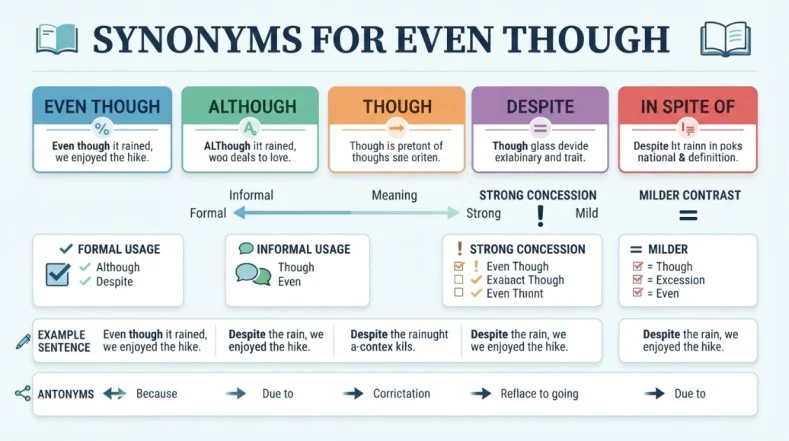
There is no single replacement that works perfectly in every sentence. “Although” is usually the closest direct substitute.
Here are context based choices:
| Context | Recommended Alternative |
|---|---|
| Professional writing | Although |
| Academic writing | Although |
| Casual conversation | Though |
| Emotional writing | Although |
| Creative writing | Though or although |
| Resume or workplace writing | Despite the fact that |
| Social media captions | Though |
| Strong contrast | Even if the fact is that, where grammatically appropriate |
| Softer contrast | Though |
| Formal writing | Notwithstanding that or despite the fact that |
Professional Writing
Use “although” for a clean and professional sentence.
“Although the budget was limited, the team completed the project.”
Academic Writing
“Although” is often more concise than a longer phrase.
“Although the evidence was limited, the researchers identified a consistent pattern.”
Casual Conversation
“Though” often sounds more conversational.
“Though I was tired, I stayed for dinner.”
Emotional Writing
“Although” can provide a calm contrast without sounding overly dramatic.
“Although he felt disappointed, he remained supportive.”
Creative Writing
“Though” can create a slightly more literary rhythm.
“Though the night was cold, the fire kept burning.”
Resume or Workplace Use
For a resume, you often do not need a concessive conjunction at all. A stronger structure may be more direct.
Instead of:
“Even though resources were limited, I completed the project.”
Consider:
“Completed the project despite limited resources.”
Social Media Captions
“Though” can sound natural and compact.
“Though the weekend was short, it was worth every minute.”
Stronger Meaning
“Despite the fact that” can make the obstacle feel more prominent, although it is longer.
Softer Meaning
“Though” can feel lighter and less formal than “despite the fact that.”
When Not to Use “Even Though”
“Even though” is useful, but it is not always the most precise choice.
When the sentence needs brevity
If a sentence is already long, “although” may be cleaner.
Wordy:
“Even though the company faced several unexpected problems, it continued operating.”
More concise:
“Although the company faced several unexpected problems, it continued operating.”
When a noun phrase is more appropriate
“Despite” should normally be followed by a noun phrase or gerund rather than a full clause.
Correct:
“Despite the heavy rain, we continued.”
Incorrect:
“Despite it was raining, we continued.”
Use:
“Even though it was raining, we continued.”
When the writing is highly formal
In certain legal or formal contexts, “notwithstanding” may be more suitable, although it can sound stiff in ordinary communication.
When you want simple conversational language
“Though” may sound more natural in casual speech.
When the contrast is not actually concessive
Do not use “even though” simply because two ideas are different.
For example:
“John likes tea, whereas Maria likes coffee.”
Here, “whereas” expresses a direct contrast between two preferences. “Even though” would change the meaning.
Words Commonly Confused With “Even Though”
Even Though vs. Although
“Although” and “even though” both introduce a contrast. “Even though” often places slightly more emphasis on the surprising nature of the contrast.
“Although it was late, she called.”
“Even though it was very late, she called.”
Even Though vs. Though
“Though” can often replace “even though,” but it is more conversational and can also appear at the end of a sentence.
“I enjoyed the movie, though.”
“Even though I was tired, I watched the movie.”
Even Though vs. Even If
“Even though” refers to a fact or situation that is true.
“Even though he was tired, he worked.”
“Even if” refers to a possibility or hypothetical condition.
“Even if he is tired, he will work.”
Even Though vs. Despite
“Despite” is normally followed by a noun phrase or gerund.
“Even though it was raining, we left.”
“Despite the rain, we left.”
Even Though vs. In Spite Of
“In spite of” works similarly to “despite” and normally takes a noun phrase or gerund.
“Even though she was nervous, she presented.”
“In spite of her nervousness, she presented.”
Even Though vs. Whereas
“Whereas” usually compares two different situations, people, or facts. It does not carry exactly the same concessive meaning.
“Whereas the first plan is inexpensive, the second plan is more flexible.”
Best Synonym by Context for “Even Though”
| Context | Best Synonym | Why It Works | Example |
|---|---|---|---|
| Formal writing | Although | Clear and polished | Although the evidence was limited, the conclusion remained useful. |
| Academic writing | Although | Concise and conventional | Although the results varied, the overall pattern was consistent. |
| Professional use | Although | Natural and precise | Although the deadline was short, we completed the work. |
| Resume use | Despite | Works well with noun phrases | Completed the project despite limited resources. |
| Casual conversation | Though | Relaxed and natural | Though I was tired, I went out. |
| Creative writing | Though | Can create a literary rhythm | Though the road was dark, they continued. |
| Emotional writing | Although | Neutral and controlled | Although she was hurt, she remained kind. |
| Strong contrast | Even though | Emphasizes unexpected contrast | Even though the odds seemed difficult, they continued. |
| Mild contrast | Though | Often sounds softer | Though the task was difficult, it was manageable. |
| Social media captions | Though | Short and conversational | Though the trip was brief, it was unforgettable. |
| US usage | Although or though | Both are widely understood | Although it was late, we stayed. |
| UK usage | Although or though | Both are standard | Though it was raining, they walked. |
Which Synonym Should You Choose?
Start by identifying the grammatical structure.
If you need a conjunction before a complete clause, “although,” “though,” or “even though” will usually work.
If you have a noun phrase, “despite” or “in spite of” may be more appropriate.
If you are discussing a hypothetical possibility, consider “even if” instead.
For formal writing, “although” is usually a safe choice because it is concise and widely accepted.
For casual conversation, “though” often sounds more natural.
For a strong unexpected contrast, “even though” can provide useful emphasis.
For resumes, consider rewriting the sentence instead of simply replacing the conjunction.
Real Life Examples of “Even Though” in Sentences
School
“Even though the assignment was challenging, Maya finished it before class.”
Workplace
“Even though the meeting started late, we covered all the important topics.”
Writing
“Even though the argument sounds convincing, the evidence needs closer examination.”
Conversation
“Even though I do not usually drink coffee, I needed some this morning.”
Social Media
“Even though the weather changed, we still had an amazing day.”
Resume
“Even though the project had a limited budget, I helped deliver it on schedule.”
A more concise resume version would be:
“Delivered the project on schedule despite a limited budget.”
“Even though we received the documents later than expected, we completed the review.”
Storytelling
“Even though the house looked abandoned, a warm light flickered in one upstairs window.”
25 Synonyms for “Even Though”
Some alternatives below are direct substitutes, while others are equivalent concessive constructions that require a change in sentence structure. Grammar matters when choosing among them.
| Synonym | Simple Meaning | Best Used For | Example Sentence |
|---|---|---|---|
| Although | Despite the fact that | Formal and academic writing | Although the task was difficult, she completed it. |
| Though | Despite the fact that | Conversation and creative writing | Though he was tired, he kept working. |
| Despite the fact that | Even with a known fact | Formal explanations | Despite the fact that funding was limited, the program continued. |
| In spite of the fact that | Despite a particular fact | Formal or careful writing | In spite of the fact that the road was closed, they found another route. |
| Notwithstanding that | Despite a stated condition | Formal or legal writing | Notwithstanding that the evidence was incomplete, the review continued. |
| Albeit | Although or even though | Formal and literary writing | Albeit expensive, the equipment was highly effective. |
| Despite | In spite of | Concise writing before a noun or gerund | Despite the delay, the event began successfully. |
| In spite of | Despite | Formal and general writing | In spite of the rain, the players continued. |
| Notwithstanding | Despite or regardless of | Formal writing before a noun phrase | Notwithstanding the difficulties, the team continued. |
| Regardless of the fact that | Without being changed by a fact | Formal explanatory writing | Regardless of the fact that demand fell, the company maintained production. |
| Regardless of | Without being affected by | Professional and general writing | Regardless of the cost, safety remained the priority. |
| In the face of the fact that | Despite a known circumstance | Formal explanatory contexts | In the face of the fact that demand was falling, the company expanded. |
| In the face of | Despite a difficulty or threat | Formal and persuasive writing | In the face of criticism, she continued her work. |
| Against the fact that | Despite an opposing fact | Limited formal usage | The result appeared unusual against the fact that conditions had changed. |
| Even with the fact that | Despite a known circumstance | Explanatory speech or writing | Even with the fact that time was limited, the team made progress. |
| Given that | Considering a stated fact | Reasoning and explanation | Given that resources were limited, the outcome was impressive. |
| While | Although or despite this fact | Context dependent contrast | While the plan was expensive, it offered long term value. |
| Whereas | In contrast with another fact | Direct comparison | Whereas the first option was cheaper, the second was more flexible. |
| When | Considering that or although | Certain conversational contexts | When the weather was poor, they continued the event anyway. |
| For all that | Despite all of that | Literary and formal writing | For all that he had experienced, he remained optimistic. |
| Granted that | Accepting a fact before contrasting it | Formal argument | Granted that the method is simple, it can still produce useful results. |
| Allowing that | Accepting a point for the sake of discussion | Formal argument | Allowing that the estimate is accurate, the conclusion still needs support. |
| Admittedly | Accepting a fact before making a contrast | Formal writing | Admittedly, the approach is expensive, but it saves time. |
| To be sure | Acknowledging one point before another | Formal or rhetorical writing | To be sure, the proposal has limitations, but it offers several benefits. |
| All the same | Despite that | Conversational and literary writing | The journey was exhausting, but all the same, it was worthwhile. |
Important Grammar Note
Not every expression in this table can replace “even though” word for word.
For example, “despite” requires a different grammatical structure:
“Even though it was raining, we left.”
“Despite the rain, we left.”
Likewise, “albeit” usually introduces a phrase rather than a complete finite clause:
“Albeit tired, she continued.”
This distinction is important for accurate English writing.
Synonym Groups and Usage Differences
Professional vs. Personal Synonyms
Professional writing usually benefits from “although,” “despite,” and “despite the fact that.”
Personal writing can comfortably use “though” and “even though.”
Example:
Professional:
“Although the schedule changed, the team met the deadline.”
Personal:
“Even though I was exhausted, I stayed up to watch the movie.”
Formal vs. Conversational Synonyms
“Although” generally sounds more polished and neutral.
“Though” is more conversational.
“Despite” is concise but requires a noun phrase or gerund.
“Notwithstanding” is considerably more formal and can sound unnatural in ordinary conversation.
Academic Synonyms
“Although” is usually one of the strongest choices for academic writing because it clearly signals concession without adding unnecessary complexity.
Example:
“Although the sample was small, the findings provide useful evidence.”
“Despite the fact that” is grammatically acceptable but can make academic sentences longer than necessary.
Professional and Business Synonyms
Business writing should prioritize clarity.
Use “although” for complete clauses:
“Although sales declined in the first quarter, customer retention remained strong.”
Use “despite” with nouns:
“Despite the decline in sales, customer retention remained strong.”
Creative or Literary Synonyms
“Though” can create a smoother literary rhythm.
“Even though” can emphasize a dramatic contrast.
“For all that” and “albeit” can also work in literary contexts, but they should be used carefully.
Example:
“Though the village slept, the lighthouse continued to shine.”
Slang or Modern Synonyms
There is no major slang synonym for “even though” that is appropriate across standard American English.
Informal speakers may use “though” because it is shorter and more conversational.
Avoid replacing it with internet slang in academic, professional, or formal writing.
Strongest vs. Weaker Synonyms
A simple intensity guide is:
Mild contrast: though
Neutral contrast: although
Clear contrast: even though
Strongly emphasized concession: even though, despite the fact that
Formal concession: notwithstanding that
The exact strength depends on the surrounding sentence, so this is a practical usage guide rather than a strict grammatical ranking.
Emotional vs. Neutral Synonyms
“Although” usually feels neutral.
“Even though” can emphasize the emotional or surprising nature of the contrast.
“Though” can sound personal or conversational.
“Despite the fact that” is generally more detached and explanatory.
Antonyms of “Even Though”
“Even though” does not have strict dictionary antonyms because it is a grammatical conjunction rather than a descriptive word. The following are functional opposites because they remove or reverse the concessive relationship.
| Antonym | Meaning | Example Sentence |
|---|---|---|
| Because | Gives a reason | Because it rained, we stayed inside. |
| Since | Introduces a reason | Since the road was closed, we changed our route. |
| Therefore | Shows a resulting conclusion | The road was closed; therefore, we changed our route. |
| Thus | Shows a result | The evidence was incomplete; thus, more research was needed. |
| Consequently | Shows a direct result | The deadline changed; consequently, the schedule was revised. |
| So | Shows a result or reason | It was raining, so we stayed home. |
| As a result | Introduces an outcome | The system failed, and as a result, the process stopped. |
| Accordingly | Shows action based on a fact | The requirements changed, so we acted accordingly. |
| Hence | Indicates a conclusion or result | The evidence was weak, hence the cautious conclusion. |
| For that reason | Gives the reason for an outcome | The road was unsafe, and for that reason, we turned back. |
| As | Introduces a reason | As the weather worsened, the event was postponed. |
| Due to | Attributes something to a cause | The event was canceled due to severe weather. |
| Owing to | Attributes an outcome to a cause | Owing to the delay, the meeting was rescheduled. |
| Therefore, because | Connects cause and conclusion | The evidence was incomplete; therefore, because of this, more research was required. |
| In consequence | Indicates an outcome caused by something | The policy changed and, in consequence, several procedures were revised. |
These are functional contrasts, not strict lexical antonyms. A dictionary would not normally list all of them as direct antonyms of “even though.”
Comparison: “Even Though” vs. Similar Words
Even Though vs. Although
Main difference: Both express concession, but “even though” often emphasizes the unexpected nature of the result.
Stronger: Even though can sound more emphatic.
More formal: Although is usually more concise and formal.
Examples:
“Even though it was difficult, she continued.”
“Although it was difficult, she continued.”
Even Though vs. Though
Main difference: “Though” is often more conversational and can appear at the end of a sentence.
Stronger: Even though usually provides more emphasis.
More formal: Although is generally more formal than both.
Examples:
“Even though I was tired, I stayed.”
“I was tired, though I stayed.”
Even Though vs. Even If
Main difference: “Even though” introduces a fact, while “even if” usually introduces a possibility or hypothetical condition.
Stronger: Neither is universally stronger. They express different meanings.
More formal: Both are standard.
Examples:
“Even though he was tired, he worked.”
“Even if he is tired, he will work.”
Even Though vs. Despite
Main difference: “Even though” introduces a clause, while “despite” normally introduces a noun phrase or gerund.
Stronger: Even though can emphasize the unexpected result more clearly.
More formal: Both are suitable for formal writing.
Examples:
“Even though the weather was bad, we went.”
“Despite the bad weather, we went.”
Even Though vs. In Spite Of
Main difference: “In spite of” has essentially the same concessive function as “despite” but is longer.
Stronger: Neither is inherently stronger.
More formal: Both are standard, although “despite” is often more concise.
Examples:
“Even though she was nervous, she presented.”
“In spite of her nervousness, she presented.”
Even Though vs. Whereas
Main difference: “Whereas” usually contrasts two situations rather than showing that one fact failed to prevent another.
Stronger: The words serve different purposes.
More formal: Whereas often sounds more formal.
Examples:
“Even though the course was difficult, I enjoyed it.”
“Whereas the first course was theoretical, the second was practical.”
Common Phrases and Expressions with “Even Though”
1. Even Though It Was Difficult
Meaning:
Used to show that difficulty did not prevent an action or result.
Example sentence:
“Even though it was difficult, she refused to give up.”
2. Even Though It Was Late
Meaning:
Shows that lateness did not prevent something from happening.
Example sentence:
“Even though it was late, we continued the discussion.”
3. Even Though I Was Tired
Meaning:
Introduces tiredness as an obstacle that did not stop an action.
Example sentence:
“Even though I was tired, I finished the assignment.”
4. Even Though They Knew
Meaning:
Shows that prior knowledge did not prevent a later action.
Example sentence:
“Even though they knew the risks, they decided to continue.”
5. Even Though It Seems
Meaning:
Introduces an apparent fact before presenting a contrasting point.
Example sentence:
“Even though it seems simple, the process requires careful planning.”
6. Even Though It May
Meaning:
Introduces a possible condition before acknowledging another point.
Example sentence:
“Even though it may seem unusual, the approach has practical benefits.”
7. Even Though There Was
Meaning:
Introduces an existing circumstance that did not prevent another outcome.
Example sentence:
“Even though there was little time, the team completed the presentation.”
Common Mistakes to Avoid
1. Using “Even Though” When a More Precise Alternative Is Better
Repeating “even though” throughout an essay can make the writing feel monotonous.
Use “although,” “despite,” or “though” where the grammar and meaning allow.
2. Confusing “Even Though” With “Even If”
“Even though” normally refers to something that is true.
“Even if” generally refers to a possible or hypothetical situation.
3. Using “Despite” Before a Full Clause
Incorrect:
“Despite it was raining, we left.”
Correct:
“Even though it was raining, we left.”
Or:
“Despite the rain, we left.”
4. Using an Overly Formal Expression
“Notwithstanding” can be correct but may sound unnecessarily stiff in a casual email.
Choose the simplest expression that accurately communicates your meaning.
5. Repeating the Same Conjunction
Using “even though” several times in nearby sentences can make writing feel repetitive.
Vary the structure naturally with “although,” “though,” or “despite.”
6. Choosing a Synonym With the Wrong Tone
“Though” can sound conversational, while “notwithstanding” can sound formal or legal.
Match the expression to your audience.
7. Using Slang in Academic or Professional Writing
Informal substitutes may weaken otherwise polished writing.
For essays, reports, applications, and professional emails, standard forms such as “although” are usually safer.
FAQs
What is the best synonym for “even though”?
“Although” is usually the best direct synonym because it preserves the meaning, works with a complete clause, and fits formal, academic, and professional writing.
What is a formal synonym for “even though”?
“Although” is the most practical formal synonym. “Notwithstanding that” is more formal but can sound stiff outside legal or highly formal contexts.
What is an informal synonym for “even though”?
“Though” is the most natural informal alternative. It is common in everyday American English and works well in casual conversation and personal writing.
What is another word for “even though” in professional writing?
“Although” is usually the clearest professional alternative. “Despite the fact that” can also work when you need to emphasize a specific circumstance.
What is the difference between “even though” and “although”?
Both introduce a concessive clause. “Even though” often gives greater emphasis to the unexpected contrast, while “although” is usually more concise.
What is the opposite of “even though”?
“Even though” has no strict lexical antonym. Functional opposites include because, since, therefore, and consequently because they express cause or result rather than concession.
Conclusion
“Even though” is a useful conjunction for showing that one fact does not prevent another fact or action. It is common in everyday speech, academic writing, professional communication, personal writing, and storytelling.
The best synonyms for even though depend on sentence structure and context. “Although” is an excellent general replacement, “though” works well in casual writing, and “despite” is useful when followed by a noun phrase or gerund.
Do not choose a synonym simply because it sounds more sophisticated. Choose the expression that communicates the relationship between your ideas most clearly.
A practical vocabulary tip is to check both meaning and grammar before replacing “even though.” A synonym that looks similar in a dictionary may require a different sentence structure.
For final publication, definitions and grammatical details can be verified with trusted dictionaries such as Cambridge, Oxford, Merriam Webster, Collins, or Britannica.
Discover More Post:
- 25+ Synonyms for Values | Meanings, Examples, and Best …
- 25 Synonyms for Saw | Meanings, Examples, and Best …
- 25+ Synonyms for Dream | Meanings, Examples, and Best …