The word values appears everywhere. You may use it in an essay about personal beliefs, a resume about workplace principles, a caption about what matters to you, or an email about company culture. The problem is that repeating the same word can make otherwise strong writing feel predictable.
Finding the right synonyms for values is not simply about replacing one word with another. The best choice depends on whether you mean beliefs, principles, standards, importance, or monetary worth. A writer who understands that difference can make every sentence more precise, natural, and persuasive.
This guide explains the meaning, tone, context, and practical use of alternatives to values. You will find examples for academic writing, professional communication, resumes, conversations, creative writing, social media, and everyday situations.
What Does “Values” Mean?
Values are beliefs, principles, standards, or ideas that guide decisions and behavior. Depending on context, useful alternatives include principles, beliefs, priorities, standards, ideals, ethics, worth, importance, merit, and significance.
Meaning, Tone and Context
1. Simple Definition
Values commonly refers to beliefs or principles that a person, group, organization, or society considers important.
For example, someone may value honesty, while a company may emphasize values such as teamwork, accountability, and customer service.
The word can also refer to the amount something is worth, especially financially. In that meaning, values can describe prices, monetary worth, or estimated worth.
2. Part of Speech
Values can function as a noun or a verb.
As a plural noun, it refers to beliefs, principles, standards, or worth.
Example:
“Her values influence the way she treats other people.”
As a verb, values means considers something important, appreciates it, or recognizes its worth.
Example:
“The company values creative thinking.”
3. Tone
The tone of values is usually neutral or positive.
When discussing ethics, character, or beliefs, it often creates a thoughtful and positive impression.
When discussing money, the tone is usually factual.
4. Formality Level
Values works in casual, academic, professional, and formal communication.
It is especially common in resumes, company descriptions, essays, speeches, interviews, and discussions about personal development.
5. Common Use Cases
The word appears frequently when discussing:
Personal beliefs
Ethical principles
Family priorities
Workplace culture
Business standards
Social responsibility
Education
Leadership
Money and property
Importance or significance
Decision making
6. Important Word Forms
The noun is value.
The plural noun is values.
The verb is value.
The third person singular verb form is values.
Related words include valuable, valued, valuation, valuation based, and invaluable.
The opposite idea depends on the meaning. For personal principles, possible opposites include disregard, neglect, or indifference. For monetary worth, a more precise opposite may be worthlessness or lack of value.
When and How to Use “Values”
Use values when you want to describe the principles, beliefs, standards, or priorities that influence behavior or decisions.
It is also appropriate when discussing the worth or importance of something.
Professional
“Our company values transparency and responsible decision making.”
This use describes principles that guide an organization.
Personal
“My values have changed as I have gained more life experience.”
Here, values refers to personal beliefs and priorities.
Academic
“Cultural values can influence attitudes toward education and family.”
This sentence uses values to describe shared beliefs within a society or group.
Emotional
“Her values helped her remain confident during a difficult period.”
The word describes deeply held principles.
Creative
“His values were shaped by years of travel, friendship, and uncertainty.”
This gives a character greater depth.
Social Media
“Choose the people and experiences that reflect your values.”
The word works naturally in reflective captions.
Resume
“My leadership approach reflects values of accountability, collaboration, and continuous learning.”
This professional use connects personal principles with workplace behavior.
Another Word for “Values”
There is no single perfect replacement for values because the word has several meanings.
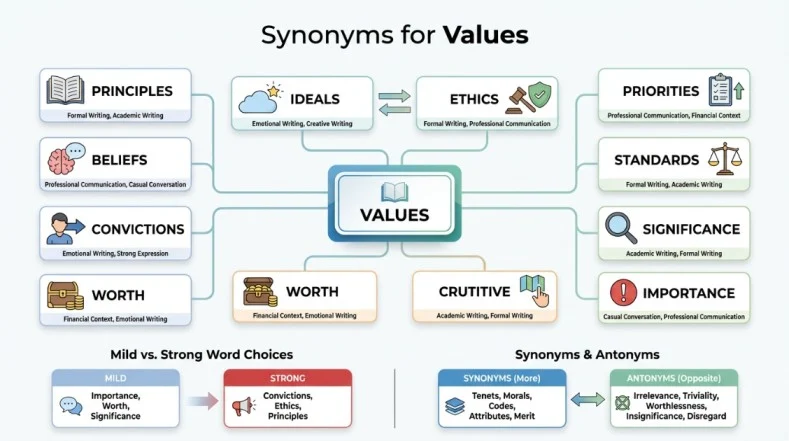
- For professional writing, principles is often the strongest choice when discussing guiding beliefs.
- For academic writing, beliefs, principles, or standards can provide greater precision.
- For casual conversation, priorities or beliefs may sound more natural.
- For emotional writing, ideals or principles can add depth.
- For creative writing, convictions, ideals, or beliefs can create a stronger sense of character.
- For resumes and workplace communication, principles, priorities, standards, or ethics are useful depending on the sentence.
- For social media captions, beliefs, priorities, and what matters often sound conversational.
- For a stronger meaning, consider convictions, principles, or ideals.
- For a softer meaning, consider preferences, priorities, or beliefs, depending on context.
When Not to Use “Values”
Although values is versatile, it can sometimes be too broad.
If you mean a specific ethical rule, principles may be more precise.
Instead of:
“Our team has strong values.”
Try:
“Our team follows clear principles of accountability and transparency.”
If you mean something that matters most to someone, priorities may communicate the idea more clearly.
Instead of:
“Family is one of her values.”
Try:
“Family is one of her highest priorities.”
If you mean monetary worth, use price, worth, or valuation when appropriate.
Instead of:
“The values of the properties increased.”
Try:
“The property values increased.”
If you mean how important something is, significance or importance may be better.
Instead of:
“The values of these findings are considerable.”
Try:
“The significance of these findings is considerable.”
Precision matters more than simply avoiding repetition.
Words Commonly Confused With “Values”
Values vs. Principles
Values are beliefs about what is important or desirable. Principles are guiding rules or standards that influence actions.
A person may value honesty and follow the principle of telling the truth.
Values vs. Beliefs
Beliefs are ideas a person accepts as true or meaningful. Values usually describe what a person considers important or worthwhile.
You can have a belief about the world and a value that guides your behavior.
Values vs. Priorities
Priorities are the things that receive the most attention or importance at a particular time.
Values tend to be more deeply rooted, while priorities can change according to circumstances.
Values vs. Standards
Standards are expectations or criteria used to judge behavior, quality, or performance.
Values influence what you consider important, while standards often define what acceptable performance or behavior looks like.
Values vs. Ethics
Ethics concerns principles about right and wrong behavior.
Values are broader and can include personal preferences, goals, relationships, and cultural ideals.
Values vs. Worth
Worth refers to the importance, usefulness, or monetary value of something.
Values can refer to worth, but they can also refer to personal principles and beliefs.
Best Synonym by Context for “Values”
| Context | Best Synonym | Why It Works | Example |
|---|---|---|---|
| Formal writing | Principles | Clearly communicates guiding ideas | The organization follows principles of fairness. |
| Academic writing | Beliefs | Works well for ideas held by people or groups | Cultural beliefs influence social behavior. |
| Professional or business use | Standards | Connects values with expected conduct or quality | Our standards emphasize accountability. |
| Resume | Principles | Sounds professional and purposeful | My leadership principles emphasize collaboration. |
| Casual conversation | Priorities | Sounds natural when discussing what matters | My priorities have changed over time. |
| Creative writing | Ideals | Adds depth and aspiration | She refused to abandon her ideals. |
| Emotional tone | Convictions | Suggests deeply held beliefs | His convictions guided him through hardship. |
| Strong intensity | Principles | Suggests firm guidance | She refused to compromise her principles. |
| Soft or moderate tone | Priorities | Less rigid and more flexible | Health is one of my current priorities. |
| Social media captions | Beliefs | Simple and relatable | Stay close to people who respect your beliefs. |
| Company culture | Principles | Describes guiding organizational ideas | Trust is one of our core principles. |
| Financial context | Worth | Directly addresses economic value | The artwork has considerable worth. |
| Property context | Price | Useful when discussing a specific selling amount | The asking price reflects the market. |
| Research context | Significance | Explains importance or impact | The study has significant value for educators. |
| Personal development | Priorities | Fits goals and life choices | My priorities are becoming clearer. |
| Ethical discussion | Ethics | Directly connects to right and wrong | Professional ethics guide responsible conduct. |
Which Synonym Should You Choose?
Choosing the best synonym starts with identifying what values means in your sentence.
- If you mean guiding beliefs, choose principles.
- If you mean ideas someone accepts or holds, choose beliefs.
- If you mean what matters most right now, choose priorities.
- If you mean expected levels of behavior or quality, choose standards.
- If you mean moral right and wrong, choose ethics.
- If you mean deeply held beliefs, choose convictions.
- If you mean aspirational beliefs or goals, choose ideals.
- If you mean financial or practical worth, choose worth.
- If you mean importance or impact, choose significance or importance.
Always consider tone before making a substitution. A synonym can be grammatically correct but still sound unnatural if its meaning or emotional strength does not fit the sentence.
Real Life Examples of “Values” in Sentences
School
“Students often develop their personal values through education and experience.”
Workplace
“The company values open communication and accountability.”
Writing
“The author explores how family values influence personal identity.”
Conversation
“My values have changed since I became more independent.”
Social Media
“Live according to your values, not someone else’s expectations.”
Resume
“I bring strong values of integrity, collaboration, and accountability to every project.”
“Our team values your feedback and appreciates the time you spent reviewing the proposal.”
Storytelling
“Years of hardship had changed her values, but they had not weakened her compassion.”
25 Synonyms for “Values”
The following alternatives are grouped by meaning because no synonym works perfectly in every context.
| Synonym | Simple Meaning | Best Used For | Example Sentence |
|---|---|---|---|
| Principles | Guiding rules or beliefs | Ethics, business, leadership | The organization operates according to clear principles. |
| Beliefs | Ideas a person or group accepts or holds | Personal and cultural discussion | Her beliefs shape many of her decisions. |
| Priorities | Things considered most important | Personal goals, work, lifestyle | Family remains one of his highest priorities. |
| Standards | Expected levels of behavior or quality | Professional and formal contexts | The company maintains high standards for customer service. |
| Ideals | Principles or goals considered desirable | Creative and aspirational writing | She continued to pursue her ideals despite criticism. |
| Ethics | Principles concerning right and wrong | Professional and moral contexts | Strong ethics are essential in responsible leadership. |
| Convictions | Strongly held beliefs | Emotional and serious writing | His convictions influenced his decision to speak openly. |
| Morals | Beliefs about right and wrong behavior | Personal and social discussions | Her morals prevent her from taking advantage of others. |
| Virtues | Positive qualities considered morally good | Character and ethical writing | Patience and honesty are important virtues. |
| Standards of conduct | Expected rules for behavior | Workplace and institutional writing | The profession has strict standards of conduct. |
| Commitments | Things someone is firmly dedicated to | Professional and personal contexts | Their commitments include fairness and public service. |
| Principles of conduct | Rules guiding behavior | Formal and professional writing | The team follows clear principles of conduct. |
| Priorities | Matters receiving the greatest attention | Everyday and workplace use | Safety remains one of our main priorities. |
| Preferences | Things someone likes or favors | Softer personal contexts | Her preferences reflect a simple and practical lifestyle. |
| Significance | Importance or meaning | Academic and analytical writing | The discovery has considerable significance for researchers. |
| Importance | The degree to which something matters | General writing | The importance of trust cannot be overlooked. |
| Worth | The usefulness, importance, or monetary value of something | Financial and general contexts | The painting has considerable worth. |
| Merit | Quality or deserving value | Formal evaluation | The proposal has merit and deserves further consideration. |
| Benefit | An advantage or useful result | Business and practical contexts | The program offers significant benefits to employees. |
| Utility | Practical usefulness | Technical and academic contexts | The utility of the tool depends on its design. |
| Cost | The amount required to obtain something | Financial contexts | The cost of the service depends on its features. |
| Price | The amount charged for something | Buying and selling | The price reflects current market conditions. |
| Valuation | An estimate of monetary worth | Finance and property | The company received a higher valuation after the investment. |
| Appraisal | An expert estimate of value | Property and financial contexts | The homeowner requested an appraisal before selling. |
| Esteem | Respect or high regard | People and reputation | She is held in high esteem by her colleagues. |
Synonym Groups and Usage Differences
Professional vs. Personal Synonyms
In professional writing, principles, standards, ethics, and commitments often sound more precise than the broad word values.
For example:
“Our company values teamwork.”
This is clear, but:
“Our company follows principles of collaboration and accountability.”
sounds more specific and formal.
In personal writing, beliefs, priorities, ideals, and morals may feel more natural.
“My priorities have changed since I started working full time.”
This sentence focuses on practical life choices rather than permanent principles.
Formal vs. Conversational Synonyms
Formal writing often benefits from words such as principles, standards, ethics, significance, and merit.
Conversational English usually favors beliefs, priorities, what matters, and preferences.
For example, a research paper might discuss the significance of an issue, while a friend might simply say that something is important.
The best synonym should match the audience as well as the meaning.
Academic Synonyms
Academic writing rewards precision.
- When discussing social groups, beliefs, principles, and ideals can work well.
- When discussing importance, significance is often more precise.
- When discussing quality or usefulness, merit, utility, or benefit may be appropriate.
Avoid replacing values with a more complicated word merely to sound academic. Clear vocabulary is usually stronger than unnecessary complexity.
Professional and Business Synonyms
Business writing frequently uses principles, standards, ethics, priorities, and commitments.
For example:
“Our values include transparency.”
A more specific version is:
“Our business principles emphasize transparency.”
For financial writing, however, use words such as worth, price, valuation, or appraisal when the meaning concerns money.
Creative or Literary Synonyms
Creative writing gives you more freedom.
Words such as ideals, convictions, morals, virtues, and beliefs can reveal personality and emotional depth.
For example:
“She had values.”
This tells the reader very little.
“She clung to her convictions even when everyone around her urged her to surrender.”
This creates a much stronger sense of character.
Slang or Modern Synonyms
There are no universal slang equivalents for values that work well across all situations.
Modern conversational expressions such as what matters, what you stand for, and your priorities can sound natural in informal communication.
For example:
“Know what you stand for.”
This is more conversational than:
“Understand your personal values.”
Use these expressions in captions, conversations, and informal writing rather than academic or highly formal documents.
Strongest vs. Weaker Synonyms
A useful intensity scale can help you choose the right word.
Mild: preferences
Moderate: priorities
Neutral: beliefs
Clear: principles
Strong: convictions
Aspirational: ideals
Moral: ethics
The strongest word is not always the best word. Choose intensity according to the meaning you actually want to communicate.
Emotional vs. Neutral Synonyms
Beliefs, priorities, and standards can remain relatively neutral.
Convictions, ideals, and morals often carry stronger emotional or ethical associations.
If you want an objective tone, use a neutral word.
If you want the reader to feel that a belief is deeply held, convictions may be more effective.
Antonyms of “Values”
Because values has multiple meanings, its antonyms depend heavily on context. The following words represent opposing ideas across personal, ethical, practical, and financial meanings.
| Antonym | Meaning | Example Sentence |
|---|---|---|
| Disregard | Lack of attention or respect | His disregard for safety created unnecessary risks. |
| Neglect | Failure to give proper attention | Neglect of basic standards can damage trust. |
| Indifference | Lack of concern or interest | Her indifference toward the issue surprised everyone. |
| Apathy | Lack of interest or motivation | Public apathy can make social problems harder to address. |
| Rejection | Refusal to accept or support something | His rejection of those principles created conflict. |
| Disapproval | Negative judgment or lack of acceptance | The proposal received strong disapproval from the committee. |
| Worthlessness | Lack of value or usefulness | The damaged item was considered nearly worthless. |
| Insignificance | Lack of importance | The change was treated as insignificant. |
| Meaninglessness | Lack of meaning or purpose | Without context, the result may seem meaningless. |
| Immorality | Behavior contrary to accepted moral standards | The discussion focused on the immorality of the practice. |
| Unethical behavior | Conduct that violates ethical standards | Unethical behavior can harm a company’s reputation. |
| Selfishness | Excessive concern with one’s own interests | His selfishness affected the entire team. |
| Irresponsibility | Failure to act responsibly | Irresponsibility can undermine professional trust. |
| Carelessness | Failure to give adequate attention | Carelessness led to an avoidable mistake. |
| Worthlessness | Absence of practical or financial worth | The damaged equipment had little remaining worth. |
Comparison: “Values” vs. Similar Words
Values vs. Principles
Main difference: Values describe what someone considers important, while principles often describe rules or standards that guide actions.
Which one is stronger: Principles can sound firmer.
Which one is more formal: Principles often sounds more formal.
Values example: “Her values include honesty and kindness.”
Principles example: “She follows principles of honesty and fairness.”
Values vs. Beliefs
Main difference: Beliefs are ideas someone accepts or holds, while values describe what someone considers important or worthwhile.
Which one is stronger: Neither is automatically stronger.
Which one is more formal: Both work in formal writing.
Values example: “His values influence his career choices.”
Beliefs example: “His beliefs influence his view of education.”
Values vs. Priorities
Main difference: Values tend to represent deeper principles, while priorities identify what receives attention or importance.
Which one is stronger: Values can sound more deeply rooted.
Which one is more formal: Both can work professionally.
Values example: “Integrity is one of her core values.”
Priorities example: “Employee safety is our highest priority.”
Values vs. Standards
Main difference: Values express what matters, while standards describe expectations or criteria.
Which one is stronger: Standards can sound more specific.
Which one is more formal: Standards often fits professional contexts well.
Values example: “Respect is one of our core values.”
Standards example: “Our workplace standards require respectful communication.”
Values vs. Ethics
Main difference: Ethics focuses specifically on right and wrong conduct, while values cover a broader range of beliefs and priorities.
Which one is stronger: Ethics can sound more morally specific.
Which one is more formal: Ethics is common in professional and academic contexts.
Values example: “The organization promotes values of fairness and inclusion.”
Ethics example: “Professional ethics require confidentiality.”
Values vs. Worth
Main difference: Values can refer to principles or importance, while worth focuses on importance, usefulness, or monetary value.
Which one is stronger: Neither is inherently stronger.
Which one is more formal: Worth can sound more direct when discussing value.
Values example: “Her values guide her decisions.”
Worth example: “The painting is worth thousands of dollars.”
Common Phrases and Expressions with “Values”
1. Core values
Meaning:
The central principles or beliefs that guide a person, organization, or group.
Example sentence:
“Integrity and accountability are among the company’s core values.”
2. Personal values
Meaning:
The beliefs and principles that influence an individual’s decisions and behavior.
Example sentence:
“Your personal values can influence the career you choose.”
3. Shared values
Meaning:
Beliefs or principles held in common by two or more people or groups.
Example sentence:
“The partnership grew stronger because the two organizations had shared values.”
4. Family values
Meaning:
Beliefs and principles associated with family life, relationships, responsibilities, or conduct.
Example sentence:
“She was raised with strong family values.”
5. Moral values
Meaning:
Principles related to right and wrong behavior.
Example sentence:
“Stories can help children think about moral values.”
6. Cultural values
Meaning:
Beliefs and priorities commonly associated with a particular culture or community.
Example sentence:
“Cultural values can shape attitudes toward work and education.”
7. Value system
Meaning:
A connected set of beliefs and principles that influences decisions and behavior.
Example sentence:
“His value system emphasizes honesty, responsibility, and compassion.”
8. Add value
Meaning:
To provide something useful, beneficial, or meaningful.
Example sentence:
“Her research adds value to the discussion by providing new evidence.”
Common Mistakes to Avoid
1. Using “Values” When a More Precise Word Is Better
“Values” can be broad.
If you mean what someone considers most important at a particular moment, priorities may be more accurate.
2. Confusing Values With Beliefs
A belief is an idea someone accepts or holds.
A value is something someone considers important or worthwhile.
They overlap, but they are not always interchangeable.
3. Using a Casual Synonym in Formal Writing
Expressions such as what matters or what you stand for can sound natural in conversation but may be too informal for an academic paper.
Use principles, beliefs, or standards when appropriate.
4. Using an Overly Dramatic Synonym
Convictions can imply deeply held beliefs.
Using it for a simple preference may make the sentence sound exaggerated.
5. Repeating “Values” Too Often
Repeating the same word can make writing feel monotonous.
However, do not replace every occurrence automatically. Keep values when it is the clearest word and change it only when another term adds precision.
6. Choosing the Wrong Emotional Tone
Convictions, morals, and ideals can carry more emotional weight than priorities or preferences.
Make sure the synonym matches the feeling you want.
7. Using Slang in Academic or Professional Writing
Informal expressions can make professional communication sound less polished.
Use clear, established vocabulary in resumes, research papers, business reports, and formal emails.
FAQs
What is the best synonym for “values”?
The best synonym depends on context. Principles works well for guiding beliefs, while priorities, beliefs, standards, and worth fit other meanings.
What is a formal synonym for “values”?
Principles, standards, ethics, and ideals can serve as formal alternatives when discussing beliefs, conduct, or organizational standards.
What is an informal synonym for “values”?
In casual conversation, beliefs, priorities, or what matters can sound more natural than values, depending on the intended meaning.
What is another word for “values” in professional writing?
Principles, standards, ethics, priorities, and commitments are useful professional alternatives, depending on the specific context.
What is the difference between “values” and “principles”?
Values describe what someone considers important, while principles are guiding rules or standards that influence behavior and decisions.
What is the opposite of “values”?
There is no single opposite in every context. Disregard, indifference, neglect, worthlessness, and insignificance can express opposing meanings.
Conclusion
Values can describe personal beliefs, ethical principles, priorities, standards, or the worth of something. Because the word covers several meanings, the best alternative depends on the sentence and the audience.
Use principles for guiding rules, beliefs for ideas someone holds, priorities for matters receiving attention, standards for expectations, and ethics for right and wrong conduct. For financial meaning, consider worth, price, valuation, or appraisal.
The most useful vocabulary tip is simple: do not choose a synonym merely because it looks different. Choose the word that communicates your exact meaning, intended tone, and level of formality.
For definitions and final publication checks, verify word meanings with trusted dictionaries such as Cambridge, Oxford, Merriam Webster, Collins, or Britannica.
Discover More Post:
- 25+ Synonyms for Real | Meanings, Examples, and Best …
- 25+ Synonyms for Determine | Meanings, Examples, and Best …
- 25+ Synonyms for Determine | Meanings, Examples, and Best …