Have you ever used the word compassionate repeatedly in an essay, professional email, social media caption, or everyday conversation? Although it is a meaningful word, using it too often can make your writing sound repetitive. Choosing the right alternative can help you express kindness, empathy, and genuine concern more naturally.
Understanding synonyms for compassionate involves more than finding words with similar definitions. Each alternative carries a slightly different emotional meaning. Some describe understanding another person’s struggles, while others emphasize generosity, sympathy, or a willingness to help. This guide explores practical alternatives, explains their differences, and shows how to use them confidently in academic, personal, creative, and professional communication.
What Does “Compassionate” Mean?
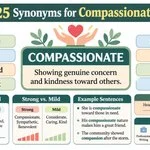
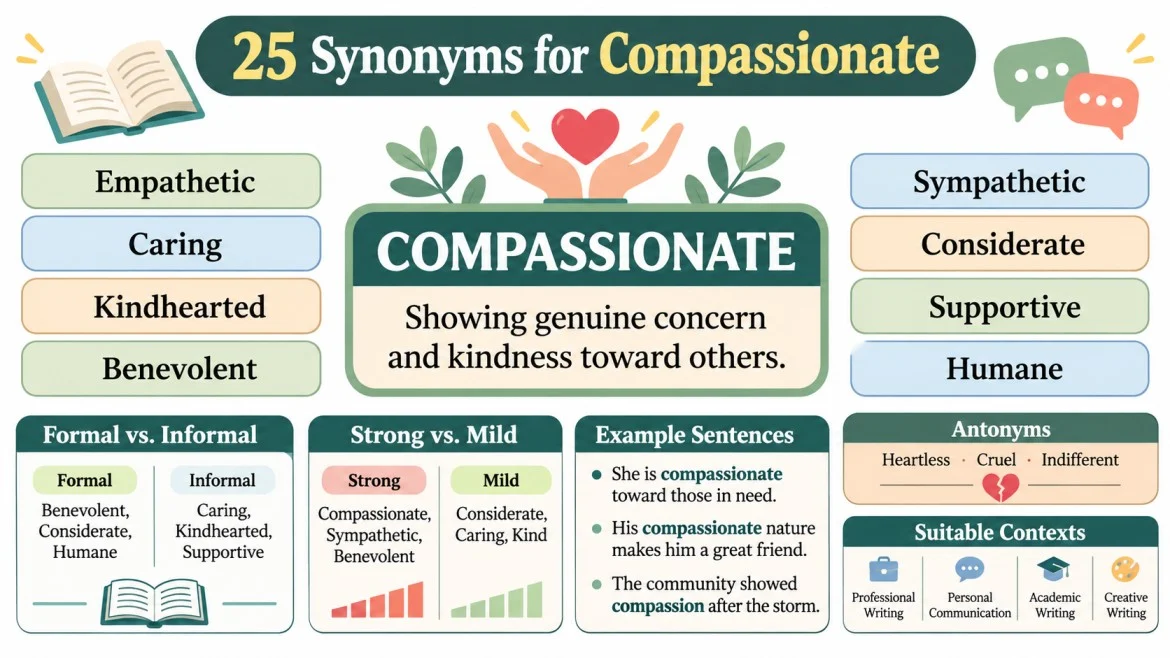
Compassionate means showing genuine concern for someone else’s suffering and wanting to help. Common synonyms include empathetic, caring, kindhearted, sympathetic, considerate, benevolent, humane, and understanding, depending on the situation.
Meaning, Tone and Context
Simple Definition
Compassionate describes someone who recognizes another person’s difficulties, feels concern for their well being, and often wants to provide comfort or assistance.
A compassionate person does not simply notice that someone is struggling. They respond with kindness, understanding, and a willingness to help.
Part of Speech
Compassionate is primarily an adjective.
Examples:
- The compassionate teacher supported students who were struggling.
- Her compassionate response made everyone feel respected.
- The organization is known for its compassionate approach to community service.
Tone and Connotation
Compassionate has a positive and emotionally meaningful tone. It communicates warmth, humanity, kindness, and concern for others.
| Feature | Explanation |
|---|---|
| Tone | Positive and caring |
| Formality | Suitable for formal and informal communication |
| Emotional strength | Moderate to strong |
| Common usage | Personal relationships, healthcare, education, leadership, and social work |
| Main message | Concern for others combined with a desire to help |
Common Word Forms
| Word | Part of Speech | Meaning |
|---|---|---|
| Compassion | Noun | Concern for another person’s suffering |
| Compassionate | Adjective | Showing concern and kindness |
| Compassionately | Adverb | In a caring and understanding manner |
| Compassionlessness | Noun | Lack of compassion, uncommon usage |
When and How to Use “Compassionate”
Use compassionate when describing someone who responds to another person’s difficulties with genuine concern, understanding, and kindness.
Here are seven realistic examples.
- Professional: Our manager demonstrated a compassionate leadership style during a difficult company transition.
- Personal: My grandmother has always been compassionate toward people who need support.
- Academic: The study examines the importance of compassionate communication in healthcare.
- Emotional: Her compassionate words helped me feel less alone during a difficult period.
- Workplace: Employers should create a compassionate environment where employees feel valued.
- Social Media: A compassionate heart can make a meaningful difference in someone’s life.
- Email: Thank you for your compassionate response and continued understanding during this challenging time.
Another Word for “Compassionate”
The best single replacement for compassionate is usually empathetic when you want to emphasize understanding another person’s feelings.
However, the right choice depends on the message.
| Context | Recommended Alternative |
|---|---|
| Professional writing | Considerate |
| Academic writing | Empathetic |
| Casual conversation | Caring |
| Emotional writing | Kindhearted |
| Creative writing | Tenderhearted |
| Resume or workplace | Supportive |
| Social media captions | Bighearted |
| Stronger meaning | Benevolent |
| Softer meaning | Understanding |
Quick recommendation: Choose empathetic when emotional understanding matters, caring when you want simple everyday language, and benevolent when describing generous actions toward others.
When Not to Use “Compassionate”
Although compassionate is useful, it does not fit every situation.
Sometimes a more specific word communicates your meaning more accurately.
| Situation | Less Precise Sentence | Better Alternative |
|---|---|---|
| Understanding feelings | She is compassionate toward her friends. | She is empathetic toward her friends. |
| Offering assistance | He is compassionate at work. | He is supportive at work. |
| Showing generosity | They are compassionate donors. | They are generous donors. |
| Treating people fairly | The manager is compassionate. | The manager is considerate. |
| Helping vulnerable people | She is compassionate toward the elderly. | She is benevolent toward the elderly. |
Avoid using compassionate simply to describe someone who is polite. Compassion usually suggests a deeper concern for another person’s difficulties.
Words Commonly Confused With “Compassionate”
Several words are closely related to compassionate, but their meanings are not identical.
1. Empathetic
Empathetic means understanding or sharing another person’s feelings. It focuses on emotional understanding rather than necessarily taking action.
2. Sympathetic
Sympathetic describes someone who feels concern for another person’s difficult situation. It may involve emotional support without fully understanding their experience.
3. Kind
Kind describes someone who treats others pleasantly and thoughtfully. It is broader and less emotionally specific than compassionate.
4. Benevolent
Benevolent means wanting to do good or help others. It often emphasizes generosity and positive intentions.
5. Considerate
Considerate describes someone who thinks about other people’s needs and feelings before acting.
6. Humane
Humane means showing kindness, respect, and concern for human welfare, particularly when people are vulnerable or suffering.
Best Synonym by Context for “Compassionate”
The most effective synonym depends on the audience, purpose, and emotional tone of your sentence.
| Context | Best Synonym | Why It Works | Example |
|---|---|---|---|
| Formal writing | Benevolent | Expresses goodwill and generosity | The benevolent leader supported the community. |
| Academic writing | Empathetic | Emphasizes emotional understanding | Empathetic communication improves patient relationships. |
| Professional use | Considerate | Sounds respectful and workplace appropriate | She is a considerate supervisor. |
| Resume | Supportive | Demonstrates helpful workplace behavior | Maintained a supportive environment for team members. |
| Casual conversation | Caring | Simple and natural | He is a caring friend. |
| Creative writing | Tenderhearted | Adds emotional depth | The tenderhearted woman rescued the injured bird. |
| Emotional writing | Kindhearted | Expresses genuine warmth | Her kindhearted nature inspired everyone. |
| Strong intensity | Bighearted | Suggests generous concern for others | A bighearted volunteer helped struggling families. |
| Soft or moderate tone | Understanding | Emphasizes patience and acceptance | My teacher was understanding about the situation. |
| Social media captions | Warmhearted | Communicates warmth and affection | Stay warmhearted in a world that needs kindness. |
| Healthcare | Empathetic | Highlights understanding of patient experiences | Empathetic nurses make patients feel heard. |
| Community service | Altruistic | Emphasizes helping without expecting rewards | Altruistic volunteers supported local families. |
Which Synonym Should You Choose?
Choosing the right alternative requires understanding what you want your sentence to communicate.
Consider these five factors:
1. Meaning: Use empathetic for emotional understanding, benevolent for generosity, and supportive for practical assistance.
2. Formality: Choose considerate, humane, or benevolent for professional and formal writing. Use caring or kind in everyday conversations.
3. Emotional intensity: Tenderhearted and bighearted create stronger emotional impressions than understanding or considerate.
4. Professional value: Supportive, empathetic, and considerate are useful when describing leadership, teamwork, communication, and customer service.
5. Sentence context: Read the entire sentence before replacing compassionate. A synonym should preserve the original meaning, not simply sound impressive.
Real Life Examples of “Compassionate” in Sentences
These examples demonstrate how different synonyms work across everyday situations.
| Situation | Example Sentence |
|---|---|
| School | An empathetic teacher understands the challenges students face. |
| Workplace | Our supervisor creates a supportive environment for every employee. |
| Writing | Her kindhearted actions inspired the main character. |
| Conversation | You are such a caring person. |
| Social media | A little kindness can brighten someone’s day. |
| Resume | Demonstrated empathetic communication while assisting customers. |
| I appreciate your considerate response and understanding. | |
| Storytelling | The benevolent king provided shelter to struggling families. |
25 Synonyms for “Compassionate”
Here are 25 useful alternatives, including formal, conversational, emotional, academic, and professional vocabulary.
| Synonym | Simple Meaning | Best Used For | Example Sentence |
|---|---|---|---|
| 1. Empathetic | Understanding others’ feelings | Emotional understanding | She is an empathetic counselor. |
| 2. Sympathetic | Feeling concern for others | Emotional support | He was sympathetic toward his colleague. |
| 3. Kind | Friendly and thoughtful | Everyday conversation | She is kind to everyone. |
| 4. Caring | Showing concern and affection | Personal relationships | He is a caring father. |
| 5. Kindhearted | Naturally kind and generous | Personality descriptions | My neighbor is kindhearted. |
| 6. Benevolent | Wanting to do good | Formal writing | The benevolent donor funded the shelter. |
| 7. Considerate | Thinking about others’ needs | Workplace communication | She is a considerate manager. |
| 8. Humane | Respecting human welfare | Ethics and social issues | The organization promotes humane treatment. |
| 9. Tenderhearted | Emotionally gentle and sensitive | Creative writing | The tenderhearted child rescued the kitten. |
| 10. Warmhearted | Friendly and affectionate | Personal descriptions | Everyone appreciated her warmhearted personality. |
| 11. Supportive | Providing help and encouragement | Professional settings | My coworkers are supportive. |
| 12. Understanding | Patient and accepting | Relationships and education | The teacher was understanding about my absence. |
| 13. Altruistic | Helping without expecting rewards | Academic writing | Her altruistic efforts benefited the community. |
| 14. Charitable | Generous toward people in need | Philanthropy | They support charitable causes. |
| 15. Bighearted | Generous and caring | Informal descriptions | A bighearted volunteer organized the event. |
| 16. Thoughtful | Showing consideration | Everyday communication | That was a thoughtful gesture. |
| 17. Gentle | Mild and tender in behavior | Personal descriptions | She used a gentle approach with children. |
| 18. Generous | Willing to give or share | Community and personal use | He is generous with his time. |
| 19. Nurturing | Encouraging growth and well being | Parenting and education | The nurturing environment helped students thrive. |
| 20. Merciful | Showing forgiveness or leniency | Moral and religious contexts | The judge made a merciful decision. |
| 21. Gracious | Showing kindness and courtesy | Formal communication | She offered a gracious response. |
| 22. Selfless | Putting others before yourself | Personal qualities | His selfless actions helped the family. |
| 23. Compassionate minded | Inclined to show concern for others | Descriptive writing | She is compassionate minded in her approach to service. |
| 24. Benevolent minded | Having generous intentions | Character descriptions | The benevolent minded leader supported local causes. |
| 25. Attentive | Paying close attention to others’ needs | Healthcare and service | The attentive nurse noticed the patient’s discomfort. |
Usage note: Some alternatives are context specific rather than exact replacements. For example, merciful emphasizes forgiveness, altruistic emphasizes selfless service, and attentive emphasizes noticing someone’s needs.
The expressions compassionate minded and benevolent minded are descriptive phrases, not standard one word synonyms. For precise writing, empathetic, caring, considerate, or benevolent are usually better choices.
Synonym Groups and Usage Differences
Professional vs. Personal Synonyms
Professional communication benefits from words that describe observable behavior.
Considerate, supportive, empathetic, and understanding are particularly useful in workplace evaluations, leadership descriptions, and customer service communication.
Personal writing allows more emotional alternatives, including kindhearted, tenderhearted, warmhearted, and bighearted.
Formal vs. Conversational Synonyms
Formal language works best when communicating with professional or academic audiences.
- Formal alternatives:
- Benevolent
- Humane
- Altruistic
- Charitable
- Considerate
- Conversational alternatives:
- Caring
- Kind
- Thoughtful
- Warmhearted
- Gentle
For example, write “She is a benevolent community leader” in a formal profile, but “She is such a caring person” in casual conversation.
- Academic Synonyms
Academic writing often requires precise vocabulary rather than emotional exaggeration.
The most useful alternatives include:
- Empathetic
- Altruistic
- Humane
- Sympathetic
- Benevolent
For example:
“Empathetic communication can improve the quality of interactions between healthcare professionals and patients.”
This sounds more precise than repeatedly describing every positive interaction as compassionate.
Professional and Business Synonyms
In business communication, compassionate often describes leadership, customer relationships, employee support, and workplace culture.
Consider these alternatives:
| Word | Professional Application |
|---|---|
| Supportive | Teamwork and leadership |
| Considerate | Workplace relationships |
| Empathetic | Customer communication |
| Understanding | Employee management |
| Humane | Ethical business practices |
| Attentive | Customer service |
Resume example:
“Demonstrated empathetic communication and supportive leadership while helping team members resolve workplace challenges.”
Creative or Literary Synonyms
Creative writing benefits from vocabulary that communicates personality and emotion.
Try these alternatives:
- Tenderhearted
- Warmhearted
- Kindhearted
- Gentle
- Bighearted
- Gracious
For example:
“Her tenderhearted nature made even the most troubled strangers feel welcome.”
This creates a more vivid impression than simply writing that she was compassionate.
Slang or Modern Synonyms
There is no widely accepted slang word that perfectly replaces compassionate.
However, casual expressions can communicate similar ideas.
| Expression | Meaning | Best Context |
|---|---|---|
| Got a big heart | Very caring and generous | Casual conversation |
| Has a heart of gold | Naturally kind | Informal descriptions |
| Has your back | Offers support | Friends and coworkers |
| There for others | Available to help | Everyday conversation |
| Good soul | A genuinely kind person | Informal writing |
Avoid these expressions in academic papers, formal reports, and professional resumes unless the writing style specifically allows conversational language.
Strongest vs. Weaker Synonyms
The following scale shows differences in emotional emphasis. It is a practical guide, not an exact linguistic ranking.
| Intensity | Synonym | Meaning |
|---|---|---|
| Mild | Considerate | Thinks about others |
| Mild | Thoughtful | Shows attention and care |
| Moderate | Kind | Treats others well |
| Moderate | Caring | Shows genuine concern |
| Moderate | Empathetic | Understands feelings |
| Strong | Kindhearted | Has a naturally kind personality |
| Strong | Tenderhearted | Emotionally sensitive and gentle |
| Strong | Bighearted | Generous and caring |
| Strong | Altruistic | Helps without personal benefit |
Emotional vs. Neutral Synonyms
Some synonyms communicate deeper feelings, while others describe behavior more objectively.
Emotional alternatives:
- Tenderhearted
- Kindhearted
- Warmhearted
- Sympathetic
- Bighearted
More neutral alternatives:
- Considerate
- Attentive
- Supportive
- Understanding
- Humane
Choose emotional words for storytelling and personal messages. Use more neutral alternatives when describing professional conduct or practical behavior.
Antonyms of “Compassionate”
Antonyms describe a lack of kindness, understanding, sympathy, or concern for other people’s difficulties.
| Antonym | Meaning | Example Sentence |
|---|---|---|
| 1. Cruel | Intentionally causing suffering | The cruel man ignored their pain. |
| 2. Heartless | Showing no sympathy | His heartless response upset everyone. |
| 3. Unkind | Not treating others nicely | Her unkind remarks hurt his feelings. |
| 4. Callous | Emotionally insensitive | The callous response showed little concern. |
| 5. Unsympathetic | Not showing understanding or concern | The manager was unsympathetic toward the employee. |
| 6. Indifferent | Not interested or concerned | He remained indifferent to their struggles. |
| 7. Selfish | Focused mainly on personal interests | Her selfish decision affected the entire team. |
| 8. Harsh | Unnecessarily severe or unkind | The teacher gave a harsh response. |
| 9. Unfeeling | Lacking emotional sensitivity | His unfeeling comments caused distress. |
| 10. Inconsiderate | Ignoring other people’s needs | It was inconsiderate to interrupt her. |
| 11. Ruthless | Showing no pity | The ruthless leader ignored the consequences. |
| 12. Merciless | Showing no mercy | The merciless treatment shocked the community. |
| 13. Hostile | Unfriendly or aggressive | His hostile attitude discouraged discussion. |
| 14. Mean | Intentionally unpleasant or hurtful | That was a mean thing to say. |
| 15. Apathetic | Showing little interest or concern | The apathetic response disappointed the volunteers. |
Comparison: Compassionate vs. Similar Words
Understanding the differences between related words helps you select the most accurate alternative.
Compassionate vs. Empathetic
Both words describe concern for other people’s feelings.
However, empathetic specifically emphasizes understanding another person’s emotional experience, while compassionate also suggests concern and a desire to help.
Which is stronger? Compassionate often communicates a more action oriented response.
Which is more formal? Both are suitable for professional and academic writing.
Examples:
- Compassionate: The doctor provided compassionate care.
- Empathetic: The doctor was empathetic toward the patient’s fears.
Compassionate vs. Sympathetic
Sympathetic describes feeling concern for another person’s difficulties.
Compassionate generally communicates a deeper willingness to respond with kindness or assistance.
Which is stronger? Compassionate often suggests greater involvement.
Which is more formal? Both work in formal writing.
Examples:
- Compassionate: She offered compassionate support.
- Sympathetic: He was sympathetic toward his friend’s problems.
Compassionate vs. Kind
Kind describes general friendliness and good behavior.
Compassionate focuses more specifically on concern for people experiencing pain or hardship.
Which is stronger? Compassionate has a more specific emotional meaning.
Which is more formal? Compassionate sounds more suitable for formal descriptions.
Examples:
- Compassionate: The nurse showed compassion toward struggling patients.
- Kind: The nurse was kind to every patient.
Compassionate vs. Benevolent
Benevolent describes someone who wants to do good, often through generosity or charitable actions.
Compassionate emphasizes concern for suffering and a desire to help.
Which is stronger? Neither is universally stronger. Their meanings emphasize different qualities.
Which is more formal? Benevolent often sounds more formal.
Examples:
- Compassionate: She provided compassionate assistance.
- Benevolent: The benevolent organization funded a local shelter.
Compassionate vs. Considerate
Considerate means thinking about other people’s feelings and needs.
Compassionate suggests a deeper concern for another person’s suffering.
Which is stronger? Compassionate generally has greater emotional depth.
Which is more formal? Both are suitable for professional communication.
Examples:
- Compassionate: He was compassionate toward the struggling family.
- Considerate: He was considerate of his coworkers’ schedules.
Compassionate vs. Humane
Humane emphasizes kindness, dignity, and respect for living beings.
Compassionate emphasizes concern for another person’s difficulties.
Which is stronger? The words express different qualities rather than different levels of intensity.
Which is more formal? Humane is especially common in ethical and institutional discussions.
Examples:
- Compassionate: The doctor treated every patient compassionately.
- Humane: The organization supports humane treatment of animals.
Common Phrases and Expressions with “Compassionate”
These expressions are useful in everyday writing, professional communication, and personal descriptions.
1. Compassionate Care
Meaning: Care that considers a person’s emotional and physical needs.
Example: The hospital is committed to providing compassionate care to every patient.
2. Compassionate Leadership
Meaning: Leadership that balances organizational responsibilities with concern for employees.
Example: Compassionate leadership helps employees feel respected and supported.
3. Compassionate Response
Meaning: A thoughtful reaction to another person’s difficulties.
Example: Her compassionate response made the difficult conversation easier.
4. Compassionate Heart
Meaning: A personality characterized by genuine concern for others.
Example: He has a compassionate heart and always looks for ways to help.
5. Compassionate Approach
Meaning: A method that considers people’s feelings and challenges.
Example: Teachers should adopt a compassionate approach when supporting struggling students.
6. Compassionate Treatment
Meaning: Respectful and caring treatment of someone experiencing difficulties.
Example: Every patient deserves compassionate treatment.
7. Compassionate Community
Meaning: A community that supports people facing hardship.
Example: Volunteers helped build a compassionate community through local outreach programs.
Common Mistakes to Avoid
Even familiar words can be used incorrectly when their meanings are too similar.
Here are seven mistakes to watch for.
1. Treating Every Synonym as an Exact Replacement
Empathetic, generous, and considerate have different meanings. Select a word that communicates the specific quality you want to describe.
2. Confusing Compassionate With Sympathetic
Sympathy involves concern for someone’s difficulties, while compassion often includes a desire to help. Consider the intended meaning before choosing.
3. Using Casual Expressions in Formal Writing
Phrases such as “has a heart of gold” may sound natural in conversation but are generally unsuitable for academic research or formal business reports.
4. Choosing Overly Emotional Vocabulary
Tenderhearted and bighearted can sound exaggerated when describing ordinary professional behavior. Considerate or supportive may be more appropriate.
5. Repeating Compassionate Too Often
Using the same adjective throughout an article can make your writing repetitive. Alternate it with accurate contextual synonyms.
6. Choosing the Wrong Emotional Tone
Calling someone sympathetic when you mean they actively support others may weaken your message. Supportive or compassionate might communicate the intended action more clearly.
7. Using Unnecessary Complicated Words
A sophisticated synonym does not automatically improve writing. Simple words such as caring and kind can communicate your meaning effectively.
FAQs
1. What is the best synonym for compassionate?
Empathetic is one of the best synonyms because it describes understanding another person’s feelings. Caring, kindhearted, and benevolent are also useful alternatives.
2. What is a formal synonym for compassionate?
Benevolent, humane, considerate, and empathetic are suitable formal alternatives. Choose benevolent when emphasizing generosity and humane when discussing ethical treatment.
3. What is an informal synonym for compassionate?
Caring, kind, thoughtful, and warmhearted are natural informal alternatives. They work well in everyday conversations, personal messages, and social media captions.
4. What is another word for compassionate in professional writing?
Supportive, empathetic, considerate, and understanding work well in professional communication, especially when describing leadership, teamwork, employee relationships, and customer service.
5. What is the difference between compassionate and empathetic?
Empathetic emphasizes understanding another person’s feelings, while compassionate includes concern for their suffering and often a willingness to provide assistance.
6. What is the opposite of compassionate?
Common antonyms include heartless, cruel, callous, indifferent, unkind, and unsympathetic. Each describes a different form of lacking concern for others.
Conclusion
Compassionate describes someone who genuinely cares about other people’s struggles and wants to help them. The best alternatives include empathetic, caring, kindhearted, benevolent, considerate, supportive, and humane.
However, these words are not interchangeable in every situation. Empathetic works well when discussing emotional understanding, benevolent emphasizes generosity, and supportive describes practical encouragement.
The most useful vocabulary tip is to consider the exact quality you want to communicate before selecting a synonym. A precise word makes your writing more natural, meaningful, and effective.
Discover More Post:
- 50+ Synonyms for Luxury | From Understated Elegance to …
- 50+ Synonyms for Phenomenon | From Everyday Events to …