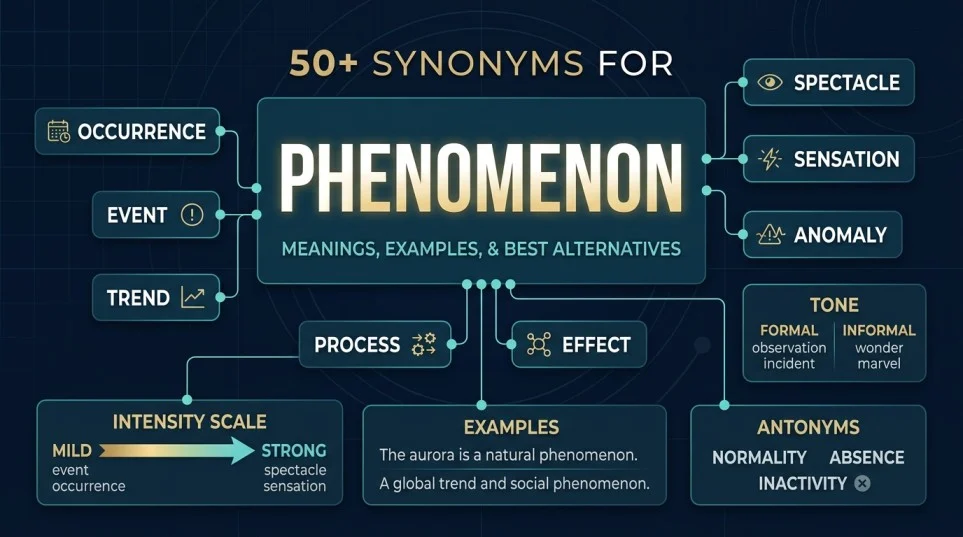
Have you ever used the word phenomenon several times in an essay, research paper, blog post, or professional report? Although it is a useful word, repeating it can make your writing feel less natural. Choosing a more precise alternative can help readers understand exactly what you mean.
The best synonyms for phenomenon depend on the situation. You might use occurrence for something that happens, event for a particular happening, trend for a developing pattern, or spectacle for something impressive to watch. In academic writing, terms such as process and observable effect may be more suitable. This guide explains the meaning of phenomenon, its closest alternatives, and how to use each word naturally in everyday conversation, schoolwork, creative writing, and professional communication.
What Does Phenomenon Mean?
A phenomenon is an observable event, fact, process, or situation that attracts attention or needs explanation. Common synonyms include occurrence, event, happening, development, and observable effect. Academic writing may favor process or effect, while everyday conversation often uses event or unusual occurrence.
Meaning, Tone and Context
What Does Phenomenon Mean?
The word phenomenon describes something that happens or exists and can be observed, experienced, or studied. It may be natural, social, scientific, cultural, or unusual.
For example, a rainbow is a natural phenomenon, a sudden rise in online popularity is a social phenomenon, and changing weather patterns can be studied as environmental phenomena.
Part of Speech
Phenomenon is a noun. Its plural form is phenomena.
- Singular: The northern lights are a remarkable natural phenomenon.
- Plural: Scientists study several atmospheric phenomena.
Remember that phenomenon refers to one observable event or situation, while phenomena refers to more than one.
Tone and Formality
Phenomenon is generally neutral and moderately formal. It is common in academic papers, science articles, news reports, business discussions, and thoughtful everyday conversation.
The word can also suggest that something is unusual, surprising, widespread, or worth studying. However, this meaning depends on context. Not every phenomenon is rare or extraordinary.
Common Uses
- Science: A physical or natural occurrence.
- Society: A behavior or pattern affecting people.
- Business: A change in markets or customer behavior.
- Technology: A new digital development.
- Culture: A popular movement or widespread interest.
- Everyday life: An unusual or interesting experience.
Word Forms
| Word | Meaning | Example |
|---|---|---|
| Phenomenon | One observable event or situation | This phenomenon occurs during winter. |
| Phenomena | More than one observable event or situation | Researchers examined several natural phenomena. |
| Phenomenal | Extraordinary or exceptionally good | The team delivered a phenomenal performance. |
| Phenomenally | In an extraordinary or exceptional way | The product sold phenomenally well. |
A useful distinction is that phenomenal usually expresses praise or exceptional quality, while phenomenon names something that can be observed or studied.
When and How to Use Phenomenon
Use phenomenon when you want to describe something observable that attracts interest, requires explanation, or reflects a wider pattern.
The word is especially helpful when the cause or meaning of something is not fully understood.
1. Academic Context
The researcher investigated the phenomenon of memory loss after sleep deprivation.
Here, phenomenon refers to an observable effect that deserves scientific study.
2. Professional Context
The sudden increase in customer demand has become an important business phenomenon.
This sentence describes a noticeable change in customer behavior.
3. Social Media Context
The video became a global phenomenon within a few days.
The word emphasizes how widely the video attracted attention.
4. Natural Context
The formation of a rainbow is a beautiful natural phenomenon.
The word describes an observable event in nature.
Another Word for Phenomenon
The best single replacement for phenomenon is often occurrence when you mean something that happens. However, event, trend, effect, and spectacle can be better choices when they express your intended meaning more precisely.
Here are the best alternatives by context.
| Context | Recommended synonym | Example |
|---|---|---|
| Professional writing | Development | This development changed customer expectations. |
| Academic writing | Observable effect | The study measured an observable effect of heat. |
| Casual conversation | Thing that happens | That is an unusual thing to happen. |
| Emotional writing | Wonder | The night sky was a wonder to behold. |
| Creative writing | Marvel | The glowing cave was a natural marvel. |
| Resume or workplace | Achievement or development | The product launch marked a major achievement. |
| Social media captions | Sensation | The new dance became an online sensation. |
| Stronger meaning | Marvel | The waterfall was a remarkable marvel of nature. |
| Softer meaning | Occurrence | The occurrence was recorded during the trial. |
Important: These alternatives are not interchangeable in every sentence. An achievement describes a successful result, while a phenomenon describes something observable. Choose the word that preserves the original meaning.
When Not to Use Phenomenon
Although phenomenon is versatile, it can sound unnecessarily formal or vague when a more specific word is available.
1. When You Mean a Specific Happening
Less precise: The phenomenon happened at noon.
Better: The event happened at noon.
Event sounds more natural when you are referring to a particular happening at a known time.
2. When You Mean a Repeated Pattern
Less precise: The phenomenon is growing among young consumers.
Better: The trend is growing among young consumers.
Trend is more suitable when something develops or becomes increasingly common over time.
3. When You Mean a Scientific Cause and Result
Less precise: The phenomenon increased the temperature.
Better: The process increased the temperature.
Use process when you are describing a sequence of actions or changes that produces a result. Use effect when you mean the result itself.
4. When You Mean Something Impressive
Less precise: The singer is a musical phenomenon.
Alternative: The singer is a musical sensation.
Sensation emphasizes widespread attention and popularity. Phenomenon can still be correct when describing the singer’s unusual success or exceptional influence.
5. When Simple Language Is Better
Less natural: We observed an interesting phenomenon during lunch.
More natural: We noticed something unusual during lunch.
In casual conversation, simple language often sounds warmer and more direct.
Words Commonly Confused With Phenomenon
Several related words overlap with phenomenon, but each has a different emphasis.
| Word | Main difference | Best use |
|---|---|---|
| Event | A particular happening | Meetings, celebrations, incidents |
| Occurrence | Something that happens | General or recorded happenings |
| Trend | A pattern or direction of change | Fashion, business, social behavior |
| Process | A series of actions or changes | Science, production, learning |
| Effect | A result or consequence | Experiments, decisions, causes |
| Spectacle | Something impressive to watch | Performances, displays, natural scenes |
For example, a meteor shower is a natural phenomenon. The appearance of a particular meteor is an event, the process describes how meteors enter the atmosphere, and the spectacle describes the impressive sight.
Best Synonym by Context for Phenomenon
The right synonym depends on what you want readers to notice. Use the following table as a practical word choice guide.
| Context | Best synonym | Why it works | Example |
|---|---|---|---|
| Formal writing | Occurrence | Neutral and precise | The occurrence was documented. |
| Academic writing | Effect | Useful for results | The effect was measured carefully. |
| Scientific research | Process | Describes changes over time | The process requires further study. |
| Business communication | Development | Highlights a change | This development affects demand. |
| Resume writing | Achievement | Highlights a successful result | The launch was a major achievement. |
| Casual conversation | Event | Familiar and clear | That was an unusual event. |
| Creative writing | Marvel | Adds a sense of wonder | The cave was a natural marvel. |
| Emotional writing | Wonder | Expresses admiration | The night sky filled us with wonder. |
| Strong intensity | Sensation | Emphasizes widespread excitement | The performance became a sensation. |
| Mild or neutral tone | Occurrence | Avoids dramatic language | The occurrence was recorded. |
| Social media captions | Sensation | Highlights popularity | The recipe became an online sensation. |
| Environmental writing | Natural event | Emphasizes nature | The eruption was a major natural event. |
| Social research | Social trend | Highlights a developing pattern | The study examined a social trend. |
| News reporting | Incident | Focuses on a specific happening | Officials investigated the incident. |
| Technology | Innovation | Highlights a new idea or method | The innovation transformed the industry. |
| Historical writing | Historical event | Identifies a past happening | The historical event changed the region. |
These recommendations are context dependent. For example, an incident often suggests a specific occurrence that needs attention, while innovation emphasizes something new and useful.
Which Synonym Should You Choose?
Use these five questions to find the most accurate replacement for phenomenon.
1. What do you mean? Choose event for a particular happening, trend for a developing pattern, process for a sequence of changes, and effect for a result.
2. How formal is your writing? Use occurrence, development, or effect in formal writing. Choose event or something unusual in casual conversation.
3. How much emotion do you want to express? Use marvel or wonder to suggest admiration. Choose occurrence when you want a neutral description.
4. What do you want to emphasize? Use sensation for popularity, spectacle for a striking sight, and innovation for a new idea or method.
5. Who will read your sentence? Academic readers may need scientific precision, while social media audiences may respond better to familiar, direct language.
The best synonym is not necessarily the most sophisticated word. It is the word that communicates your meaning clearly.
Real Life Examples of Phenomenon in Sentences
These examples show how related words can make writing clearer across everyday and professional situations.
School
Original: The phenomenon of plant growth interested the class.
Improved: The process of plant growth interested the class.
Why it works: Process describes the stages through which a plant grows.
Workplace
Original: The phenomenon affected employee productivity.
Improved: The development affected employee productivity.
Why it works: Development is useful when a workplace change influences performance.
Academic Writing
Original: The researchers examined the phenomenon.
Improved: The researchers examined the observable effect.
Why it works: Observable effect is more specific when the study investigates a measurable result.
Everyday Conversation
Original: That phenomenon was strange.
Improved: That occurrence was unusual.
Why it works: Occurrence sounds neutral and natural.
Social Media
Original: The new challenge became a phenomenon.
Improved: The new challenge became an online sensation.
Why it works: Sensation emphasizes popularity and public attention.
Resume Writing
Original: I helped create a phenomenon in the market.
Improved: I helped launch a product that attracted widespread attention.
Why it works: The improved sentence explains the actual achievement instead of relying on a vague label.
Original: We need to understand this phenomenon before making changes.
Improved: We need to understand this trend before making changes.
Why it works: Trend works if the email discusses a pattern that is becoming more common.
Storytelling
Original: A strange phenomenon appeared over the hills.
Improved: A mysterious spectacle appeared over the hills.
Why it works: Spectacle creates a stronger visual impression, particularly in descriptive writing.
18 Synonyms for Phenomenon
The following 18 alternatives cover common, formal, scientific, professional, and creative contexts. Some are close synonyms, while others are suitable replacements only when the surrounding sentence supports their meaning.
| Synonym | Simple Meaning | Best Used For | Example Sentence |
|---|---|---|---|
| 1. Occurrence | Something that happens | General writing | The occurrence was recorded in the report. |
| 2. Event | A particular happening | Daily life and news | The event attracted hundreds of visitors. |
| 3. Happening | Something that takes place | Casual conversation | The unexpected happening surprised everyone. |
| 4. Incident | A specific happening, often unusual | Reports and investigations | The incident prompted a safety review. |
| 5. Development | A change or new situation | Business and news | This development changed the market outlook. |
| 6. Trend | A pattern of change | Social and business research | The trend continued throughout the year. |
| 7. Process | A series of changes or actions | Science and education | The process occurs naturally in the soil. |
| 8. Effect | A result or consequence | Research and analysis | The effect was visible after several hours. |
| 9. Manifestation | A visible sign of something | Formal and academic writing | The behavior was a manifestation of stress. |
| 10. Observation | Something noticed or recorded | Scientific work | The observation led to another experiment. |
| 11. Occurrence pattern | A repeated way something happens | Technical discussion | The occurrence pattern changed after rainfall. |
| 12. Spectacle | An impressive sight | Descriptive writing | The aurora was a breathtaking spectacle. |
| 13. Sensation | Something that attracts widespread interest | Media and entertainment | The new series became a global sensation. |
| 14. Marvel | Something inspiring wonder | Creative writing | The ancient structure remains a marvel. |
| 15. Wonder | Something remarkable or amazing | Emotional and descriptive writing | The waterfall filled visitors with wonder. |
| 16. Anomaly | Something that differs from what is expected | Science and data analysis | The unusual reading was treated as an anomaly. |
| 17. Occurrence of interest | A happening worth examining | Explanatory writing | The occurrence of interest required closer study. |
| 18. Natural event | Something that happens in nature | Environmental writing | The eruption was a powerful natural event. |
Accuracy note: Occurrence, event, development, and happening are among the closest general alternatives. Other entries express a more specific meaning. For example, anomaly describes an unusual deviation, while sensation emphasizes public attention. Occurrence pattern and occurrence of interest are descriptive phrases rather than established one word synonyms.
Synonym Groups and Usage Differences
Professional vs. Personal Synonyms
Professional writing benefits from precise, neutral words. Occurrence, development, effect, and trend can help explain changes without adding unnecessary emotion.
Personal writing can use wonder, marvel, spectacle, or sensation when the goal is to communicate surprise, excitement, or admiration.
Compare these sentences:
Professional: The development attracted attention from industry experts.
Personal: The spectacular display filled us with wonder.
The first sentence reports a change. The second expresses an emotional response.
Formal vs. Conversational Synonyms
Formal writing often uses occurrence, manifestation, development, and effect. These words work well in reports, research papers, presentations, and carefully written emails.
Conversational writing usually benefits from event, happening, or something unusual. These alternatives sound direct and easy to understand.
Formal: The occurrence was documented by the research team.
Conversational: Something unusual happened during the experiment.
Both sentences communicate a similar general idea, but the second is more relaxed.
Academic Synonyms
Academic writing requires accuracy rather than impressive vocabulary. The best replacement depends on the research question.
- Occurrence works for something that happens.
- Process describes a sequence of changes.
- Effect describes a result.
- Manifestation describes a visible sign of an underlying condition.
- Anomaly identifies a result that differs from an expected pattern.
Example: Instead of writing that researchers studied a phenomenon, explain whether they studied a process, measured an effect, or investigated an anomaly.
That small change can make the research question much clearer.
Professional and Business Synonyms
In business writing, phenomenon is useful when discussing broad market behavior or unusual customer responses. However, more precise terms often make reports and emails easier to understand.
Use development for a new situation, trend for a growing pattern, event for a particular happening, and achievement for a successful result.
Example: The rapid adoption of digital payments has become a major market trend.
This sentence tells readers exactly what kind of phenomenon is being discussed.
Creative or Literary Synonyms
Creative writing often benefits from words that create a picture or emotion.
- Marvel suggests admiration.
- Wonder emphasizes amazement.
- Spectacle describes a striking sight.
- Sensation suggests widespread excitement.
- Mystery emphasizes something unexplained.
Example: The glowing forest became a spectacle beneath the moonlight.
This sentence gives readers a more vivid image than the general phrase unusual phenomenon.
Slang or Modern Synonyms
There is no single slang word that accurately replaces phenomenon in every context. Modern expressions such as viral hit, internet sensation, and big thing may work when discussing online popularity.
For example, The game became an internet sensation is suitable for a casual blog or social media post.
However, these expressions are not good replacements in most scientific papers. Use phenomenon, trend, or observable effect when accuracy and formality matter.
Strongest vs. Weaker Synonyms
The following scale reflects expressive force, not scientific importance. The words are not exact equivalents.
| Intensity | Word or phrase | Typical effect |
|---|---|---|
| Mild | Occurrence | Neutral and factual |
| Mild | Event | Clear and straightforward |
| Moderate | Development | Highlights change |
| Moderate | Trend | Suggests a broader pattern |
| Strong | Spectacle | Creates a vivid impression |
| Strong | Marvel | Expresses admiration |
| Strong | Sensation | Emphasizes popularity |
| Strong in a different sense | Anomaly | Highlights an unexpected deviation |
Choose a stronger word only when the situation supports it. A routine event does not automatically qualify as a spectacle or sensation.
Emotional vs. Neutral Synonyms
Neutral words are useful when the goal is to explain or report. Occurrence, event, process, and effect generally allow the reader to focus on the facts.
Emotional or expressive alternatives include wonder, marvel, spectacle, and sensation. They add admiration, excitement, or a sense of importance.
Neutral: The natural event was observed by several scientists.
Expressive: The natural spectacle amazed everyone who saw it.
The second sentence adds an emotional response that is absent from the first.
Antonyms of Phenomenon
Phenomenon does not have one exact antonym because it can refer to many different types of observable events and situations. The most suitable opposite depends on whether you mean something observable, something that happens, or something unusual.
The following 15 words and phrases are contextual opposites rather than universal dictionary antonyms.
| Antonym or Opposing Concept | Meaning | Example Sentence |
|---|---|---|
| 1. Nonoccurrence | The absence of an expected occurrence | The nonoccurrence of rain surprised the farmers. |
| 2. Absence | A lack of something | The absence of evidence limited the study. |
| 3. Inactivity | A lack of activity | The system remained in inactivity overnight. |
| 4. Stillness | A state without movement | Complete stillness filled the room. |
| 5. Stability | A condition that remains steady | The market showed stability throughout the quarter. |
| 6. Constancy | The quality of remaining unchanged | The constancy of the readings supported the result. |
| 7. Normality | A usual or expected state | Normality returned after the disruption. |
| 8. Routine | An ordinary, repeated pattern | The procedure became part of the daily routine. |
| 9. Predictability | The quality of being expected | The system’s predictability made testing easier. |
| 10. Uniformity | A lack of noticeable variation | Uniformity appeared across the measurements. |
| 11. Regularity | A consistent and expected pattern | Regularity in the data improved the analysis. |
| 12. Equilibrium | A balanced state | The chemical reaction reached equilibrium. |
| 13. Continuity | An uninterrupted state or sequence | Continuity in the process reduced errors. |
| 14. Invisibility | The state of not being visible | The effect’s invisibility made detection difficult. |
| 15. Unremarkableness | The quality of being ordinary or unnoticeable | The event’s unremarkableness attracted little attention. |
Usage tip: If you mean an unusual phenomenon, normality or routine may express the opposite idea. If you mean an observable event, nonoccurrence or absence may be more appropriate. Choose the opposite based on the sentence, not merely the dictionary definition.
Comparison: Phenomenon vs. Similar Words
Phenomenon vs. Event
Main difference: Phenomenon often describes something observable or worthy of explanation. Event usually refers to a particular happening.
Which is stronger? Neither is always stronger. Phenomenon can suggest greater complexity, while event is more direct.
Which is more formal? Both work in formal writing, but phenomenon is especially common in scientific discussions.
Examples:
- Phenomenon: Scientists investigated the phenomenon of ocean warming.
- Event: The conference was an important event for the industry.
Phenomenon vs. Occurrence
Main difference: Phenomenon often suggests something that can be observed or studied. Occurrence simply means something that happens.
Which is stronger? Phenomenon may suggest greater interest or significance.
Which is more formal? Both are suitable for formal writing.
Examples:
- Phenomenon: The researchers studied a rare atmospheric phenomenon.
- Occurrence: The occurrence was noted in the daily report.
Phenomenon vs. Trend
Main difference: Phenomenon is broad, while trend specifically describes a pattern or direction of change.
Which is stronger? Phenomenon may sound more significant, but the terms are not directly comparable in intensity.
Which is more formal? Both are formal enough for research and business writing.
Examples:
- Phenomenon: The researchers examined a cultural phenomenon.
- Trend: The researchers identified a growing cultural trend.
Phenomenon vs. Process
Main difference: Phenomenon names something observable. Process describes the steps or changes through which something happens.
Which is stronger? Neither is inherently stronger.
Which is more formal? Both are common in academic and technical writing.
Examples:
- Phenomenon: The aurora is a natural phenomenon.
- Process: The process involves interactions between charged particles and Earth’s atmosphere.
Phenomenon vs. Effect
Main difference: Phenomenon can refer to an event, pattern, or situation. Effect refers to a result or consequence.
Which is stronger? Neither is inherently stronger.
Which is more formal? Both work in scientific and professional contexts.
Examples:
- Phenomenon: The team studied an unusual weather phenomenon.
- Effect: The team measured the effect of temperature on plant growth.
Phenomenon vs. Anomaly
Main difference: Phenomenon is a broad term for something observable. Anomaly specifically refers to something that differs from what is expected.
Which is stronger? Anomaly is more specific about unusual results, but not necessarily more intense.
Which is more formal? Both are formal, particularly in scientific research.
Examples:
- Phenomenon: The scientists examined the atmospheric phenomenon.
- Anomaly: The scientists investigated an unexpected temperature anomaly.
Common Phrases and Expressions with Phenomenon
1. Natural Phenomenon
Meaning: An observable event or process that occurs in nature.
Example sentence: A solar eclipse is a natural phenomenon that attracts widespread attention.
2. Social Phenomenon
Meaning: A behavior, pattern, or situation involving people and society.
Example sentence: The popularity of online learning has become an important social phenomenon.
3. Cultural Phenomenon
Meaning: Something that gains importance or attention within a culture.
Example sentence: The television series became a cultural phenomenon among young viewers.
4. Global Phenomenon
Meaning: Something that attracts attention or occurs across many countries.
Example sentence: The sport developed into a global phenomenon over several decades.
5. Rare Phenomenon
Meaning: An event or situation that occurs infrequently.
Example sentence: The researchers recorded a rare phenomenon in the upper atmosphere.
6. Unusual Phenomenon
Meaning: Something that differs from what people normally expect.
Example sentence: The unusual phenomenon prompted further investigation.
7. Scientific Phenomenon
Meaning: An observable event or process examined through scientific methods.
Example sentence: Scientists designed an experiment to understand the scientific phenomenon.
8. Widespread Phenomenon
Meaning: Something observed or experienced across many people or places.
Example sentence: Remote work has become a widespread phenomenon in many industries.
Common Mistakes to Avoid
1. Using Phenomenon for Every Situation
Phenomenon is broad, but it is not always the clearest choice.
Instead of writing The phenomenon occurred yesterday, write The event occurred yesterday if you mean a particular happening.
2. Confusing Phenomenon With Phenomena
Phenomenon is singular, while phenomena is plural.
Correct: This phenomenon requires further study.
Correct: These phenomena require further study.
Using phenomena for a single occurrence is a common grammar mistake.
3. Confusing Phenomenon With Phenomenal
Phenomenon is a noun. Phenomenal is an adjective that describes something exceptional.
Correct: The phenomenon attracted attention.
Correct: The performance was phenomenal.
4. Using an Overly Dramatic Synonym
A routine event is not necessarily a marvel, spectacle, or sensation.
Choose expressive words only when the situation genuinely inspires wonder, looks impressive, or attracts widespread attention.
5. Repeating the Same Word Too Often
Repeatedly using phenomenon can make a paragraph sound awkward.
Replace it with event, process, trend, effect, or occurrence when the intended meaning supports the change.
6. Choosing an Inaccurate Scientific Term
Do not replace phenomenon with effect when you are describing a complete event rather than its result. Likewise, do not use anomaly unless something differs from an expected pattern.
Precision matters more than variety in academic writing.
FAQs
1. What is the best synonym for phenomenon?
Occurrence is a strong general alternative. Event works for a specific happening, trend for a developing pattern, and effect for a result that can be measured.
2. What is a formal synonym for phenomenon?
Occurrence, manifestation, and development can work in formal writing. The best choice depends on whether you describe a happening, a visible sign, or a change.
3. What is an informal synonym for phenomenon?
Event or happening can sound more conversational. For simple everyday situations, the phrase something unusual may communicate the meaning more naturally.
4. What is another word for phenomenon in professional writing?
Development is useful for describing a change, while trend describes a growing pattern. Use occurrence when you need a neutral term for something that happened.
5. What is the difference between phenomenon and event?
An event usually refers to a particular happening. A phenomenon is broader and often describes an observable event, pattern, or situation that attracts attention or requires explanation.
6. What is the opposite of phenomenon?
There is no single universal opposite. Nonoccurrence may fit when something expected does not happen, while normality can contrast with an unusual phenomenon.
Conclusion
Phenomenon describes an observable event, process, pattern, or situation that attracts attention or deserves explanation. Its best alternatives include occurrence, event, trend, development, process, and effect, depending on the intended meaning.
For academic writing, prioritize accuracy. Business communication, choose words that explain a change or result. For creative writing, use expressive alternatives such as marvel or spectacle when they fit the scene.
The simplest vocabulary tip is to identify exactly what you mean before choosing a synonym. A precise word will make your writing clearer, more natural, and more useful to your readers.
Discover More Post:
- 50+ Synonyms for Investigate | Meanings, Examples, and Best …
- 50+ Synonyms for Other | Meanings, Examples, and Best …
- 50+ Synonyms for Truly | Meanings, Examples, and Best …




5 thoughts on “50+ Synonyms for Phenomenon | From Everyday Events to Extraordinary Discoveries 2026”