Have you ever written the word “investigate” several times in an essay, email, report, or article and felt that your writing sounded repetitive? Choosing a more precise alternative can make your language clearer and more professional.
The best synonym depends on what you are actually doing. You might examine evidence, research a topic, inspect a problem, analyze information, probe a claim, or look into a complaint.
This guide explains synonyms for investigate with practical examples, tone differences, formal alternatives, casual choices, professional vocabulary, and common mistakes. The goal is to help you choose the right word instead of simply replacing one word with another.
What Does Investigate Mean?
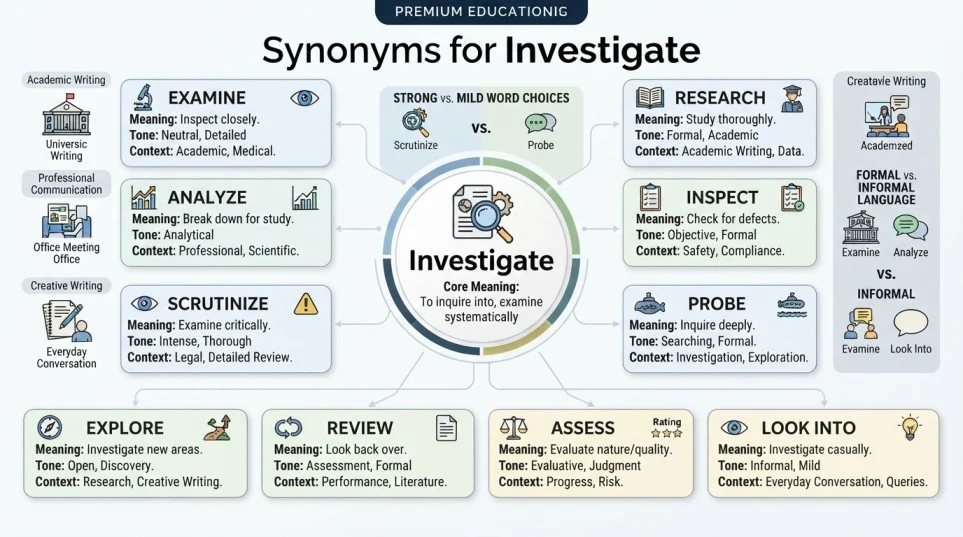
To investigate means to examine something carefully to discover facts, causes, or truth. Formal choices include examine and scrutinize, academic choices include research and analyze, while casual choices include look into and check out.
Meaning, Tone and Context
Simple Definition
To investigate means to examine a person, situation, event, problem, claim, or subject carefully in order to discover information, understand what happened, or determine the truth.
For example:
“The company will investigate the complaint.”
This means the company will carefully examine the complaint and gather information before reaching a conclusion.
Part of Speech
Investigate is a verb.
Common forms include:
Investigate
Investigates
Investigated
Investigating
Investigation is the related noun.
Investigator is the related noun for a person who investigates.
Investigative is the related adjective.
Tone
Investigate is generally neutral. It does not automatically communicate approval or criticism.
However, the context can make it sound serious. Investigating a crime, allegation, safety problem, or financial issue usually suggests careful and formal attention.
Formality
Investigate is suitable for both everyday and professional English.
It is especially common in journalism, law, business, education, science, government, workplace communication, and formal reports.
Common Use Cases
You can investigate:
A complaint
A crime
An allegation
A problem
A cause
An incident
A scientific question
A business issue
A suspicious activity
A research topic
A customer concern
A workplace report
Related Word Forms
The noun is investigation.
Example: “The investigation revealed several problems.”
The person who investigates is an investigator.
Example: “The investigator interviewed several witnesses.”
The adjective is investigative.
Example: “She works as an investigative journalist.”
When and How to Use Investigate
Use investigate when the action involves deliberate examination and information gathering.
It usually suggests that you do not yet have all the facts and need to discover more before making a conclusion.
Professional
“Our compliance team will investigate the reported issue.”
This sounds appropriate for workplace, legal, financial, and organizational communication.
Academic
“Researchers investigated the relationship between sleep and academic performance.”
Here, investigate describes systematic academic study.
Personal
“I am going to investigate why my computer keeps shutting down.”
This is understandable, although “find out” or “look into” may sound more natural in casual conversation.
News or Journalism
“Journalists investigated the claims before publishing the story.”
The word suggests careful fact gathering and verification.
Another Word for Investigate
The best single replacement depends on the exact meaning.
For professional writing, examine is often a safe and versatile choice.
For academic writing, research or analyze may be more precise.
For casual conversation, look into sounds natural.
For detailed or suspicious situations, probe or scrutinize can communicate deeper examination.
For creative writing, explore can work when the investigation involves ideas, possibilities, experiences, or unfamiliar subjects.
Professional Writing
Best choices: examine, assess, review, analyze
Example:
“The committee will examine the reported concerns.”
Academic Writing
Best choices: research, analyze, examine, study
Example:
“The study analyzed the effects of social media use.”
Casual Conversation
Best choices: look into, check, find out
Example:
“I will look into the problem tonight.”
Emotional Writing
Best choices: explore, examine, uncover, probe
Example:
“She began to explore the reasons behind her fear.”
Creative Writing
Best choices: explore, uncover, probe, examine
Example:
“The detective began to uncover the hidden truth.”
Resume or Workplace Use
Best choices: analyze, assess, review, examine
Example:
“Analyzed customer complaints to identify recurring service problems.”
Social Media Captions
Best choices: explore, look into, uncover
Example:
“Exploring the story behind this historic neighborhood.”
Stronger Meaning
Best choices: scrutinize, probe
These words suggest particularly careful or penetrating examination.
Softer Meaning
Best choices: explore, review, look into
These can sound less forceful and less accusatory.
When Not to Use Investigate
Investigate can sound unnecessarily serious when the situation only requires a quick check.
For example:
“I will investigate what time the store closes.”
This is grammatically possible, but it sounds overly formal.
A more natural sentence is:
“I will check what time the store closes.”
Similarly, “investigate the menu” may sound strange when you simply mean that you want to read it.
Use “review” or “look at” when the task does not involve finding hidden facts or determining a cause.
You should also avoid using investigate when you already know the answer and are simply describing a routine review.
Words Commonly Confused With Investigate
Investigate vs. Examine
Investigate usually involves finding facts or discovering a cause.
Examine usually means looking at something carefully.
Example:
“The police investigated the incident.”
“The doctor examined the patient.”
Investigate vs. Research
Research usually involves gathering information about a subject, especially for academic, scientific, or professional purposes.
Investigate often focuses on discovering what happened or determining the truth.
Investigate vs. Analyze
Analyze means breaking information into parts to understand relationships, patterns, or meaning.
Investigate is broader and can include gathering evidence before analysis.
Investigate vs. Inspect
Inspect means checking something closely, often to identify defects, damage, or problems.
Investigate usually involves a deeper search for facts or causes.
Investigate vs. Explore
Explore often suggests learning about possibilities, ideas, subjects, or experiences.
Investigate usually sounds more focused on facts, evidence, or a specific question.
Investigate vs. Inquire
Inquire means asking for information.
Investigate usually involves a broader process that can include questions, documents, observation, research, and evidence.
Best Synonym by Context for Investigate
Which Synonym Should You Choose?
Start by asking what kind of investigation you mean.
If you are carefully looking at evidence, choose examine.
If you are studying a subject systematically, choose research.
If you are breaking information into parts, choose analyze.
If you are checking an object, document, or process for problems, choose inspect.
If you are reviewing a workplace issue, choose review or assess.
If you are speaking casually, choose look into or find out.
If you want to emphasize very close examination, choose scrutinize.
If you want a softer and more exploratory tone, choose explore.
The strongest synonym is not always the best synonym. Precision matters more than intensity.
Real Life Examples of Investigate in Sentences
School
“The students investigated the causes of water pollution for their science project.”
Workplace
“The manager investigated the reason for the repeated customer complaints.”
Writing
“The article investigates how technology has changed modern education.”
Conversation
“I will investigate the issue and let you know what I find.”
For casual conversation, “I will look into it” may sound more natural.
Social Media
“This documentary investigates the history behind a famous historical mystery.”
Resume
“Investigated customer feedback to identify recurring service concerns.”
“We are currently investigating the reported issue and will provide an update soon.”
Storytelling
“The detective investigated every detail before revealing the truth.”
18 Synonyms for Investigate
Synonym Groups and Usage Differences
Professional vs. Personal Synonyms
Professional writing often benefits from precise verbs such as examine, analyze, assess, review, and investigate.
Personal conversations usually sound more natural with look into, check, or find out.
Compare:
“The department will investigate the complaint.”
“I will look into the problem.”
Both sentences communicate investigation, but the first has a more institutional tone.
Formal vs. Conversational Synonyms
For reports, essays, official statements, and business documents, examine, scrutinize, analyze, assess, and inquire into are useful choices.
For texts, casual emails, and everyday conversation, check, look into, and find out are generally more natural.
Academic Synonyms
Academic writing often requires precision.
Research works well when you conduct systematic study.
Analyze works well when you interpret data or evidence.
Examine works well when you carefully consider an issue.
Explore works well when discussing ideas, themes, possibilities, or relationships.
Professional and Business Synonyms
Business communication often uses review, assess, analyze, examine, and investigate.
For example:
“The management team reviewed the complaint.”
“The analyst assessed the financial risk.”
“The department investigated the reported violation.”
Each word communicates a slightly different action.
Creative or Literary Synonyms
Creative writing gives you more freedom.
Explore can suggest curiosity and discovery.
Uncover can suggest revealing something hidden.
Probe can create a sense of intensity.
Delve into can suggest deep attention to a subject.
Slang or Modern Synonyms
There is no strong slang equivalent that directly replaces investigate in every situation.
Words such as check and look into are common informal alternatives.
Avoid forcing slang into serious writing simply to sound modern. Natural language is more effective than artificial informality.
Strongest vs. Weaker Synonyms
A useful intensity scale is:
Mild: check
Moderate: review
Moderate: examine
Moderate: study
Strong: investigate
Strong: probe
Very strong: scrutinize
The exact intensity depends on context. Scrutinize often implies particularly close or critical attention.
Emotional vs. Neutral Synonyms
Investigate is generally neutral.
Examine and review are also relatively neutral.
Explore can sound thoughtful or curious.
Probe can sound more intense.
Scrutinize can suggest suspicion or criticism.
Uncover can create a dramatic sense of discovery.
Antonyms of Investigate
Because investigate describes an active search for information, its most useful opposites describe ignoring, avoiding, accepting without examination, or failing to seek information.
Comparison: “Investigate” vs. Similar Words
Investigate vs. Examine
The main difference is purpose.
Investigate usually means searching for facts, causes, or truth.
Examine means looking at something carefully.
Investigate is generally stronger when the goal is discovery.
Example:
“The police investigated the incident.”
“The doctor examined the patient.”
Investigate vs. Research
Research focuses on gathering knowledge about a subject.
Investigate often focuses on determining facts about a particular matter.
Research is especially common in academic and scientific contexts.
Example:
“The students researched climate change.”
“The agency investigated the complaint.”
Investigate vs. Analyze
Analyze means breaking information into parts and interpreting it.
Investigate is broader because it can involve collecting evidence before analysis.
Example:
“The team investigated the cause of the failure.”
“The team analyzed the failure data.”
Investigate vs. Inspect
Inspect usually means checking something closely for damage, defects, quality, or compliance.
Investigate usually goes beyond visual or routine checking.
Example:
“The engineer inspected the bridge.”
“The authorities investigated the accident.”
Investigate vs. Explore
Explore often has a more open and curious meaning.
Investigate usually has a more focused goal of discovering facts.
Example:
“The article explores different views of success.”
“The committee investigated the allegations.”
Investigate vs. Scrutinize
Scrutinize means examining something extremely carefully.
It often implies critical attention.
Investigate can be broad, while scrutinize emphasizes the depth and precision of examination.
Example:
“The company investigated the complaint.”
“The auditors scrutinized every transaction.”
Common Phrases and Expressions with Investigate
1. Investigate a Claim
Meaning:
Examine a statement or assertion to determine whether it is supported by evidence.
Example sentence:
“The journalist investigated the claim before publishing the article.”
2. Investigate a Complaint
Meaning:
Examine a reported problem or concern.
Example sentence:
“The company promised to investigate the customer complaint.”
3. Investigate the Matter
Meaning:
Look carefully into a specific issue or situation.
Example sentence:
“We will investigate the matter and provide a response.”
4. Investigate Thoroughly
Meaning:
Examine something carefully and completely.
Example sentence:
“The team investigated the problem thoroughly before making changes.”
5. Investigate the Cause
Meaning:
Try to discover why something happened.
Example sentence:
“Engineers are investigating the cause of the system failure.”
6. Investigate Allegations
Meaning:
Examine claims that someone may have acted improperly.
Example sentence:
“The organization agreed to investigate the allegations.”
7. Investigate Further
Meaning:
Continue examining something to obtain additional information.
Example sentence:
“The initial findings suggest that we need to investigate further.”
Common Mistakes to Avoid
1. Using Investigate for a Simple Check
“I will investigate the meeting time” sounds overly serious.
“I will check the meeting time” is more natural.
2. Confusing Investigate With Research
Research usually focuses on gaining knowledge about a subject.
Investigate often focuses on discovering facts about a particular issue.
3. Using Casual Synonyms in Formal Writing
Words such as check and find out may sound too casual in an academic report or official document.
Choose examine, analyze, assess, or investigate when the context requires formality.
4. Using an Overly Dramatic Synonym
Scrutinize or probe can sound excessive for a routine task.
Do not say “the assistant scrutinized the schedule” when “reviewed the schedule” communicates the situation more naturally.
5. Repeating Investigate Too Often
Repeating the same verb can make a paragraph feel mechanical.
Use examine, analyze, review, research, explore, or assess when the meaning remains accurate.
6. Choosing the Wrong Emotional Tone
Scrutinize can suggest suspicion or criticism.
Explore usually sounds more open and curious.
Choose the synonym that matches the emotional message you want to communicate.
FAQs
What is the best synonym for investigate?
Examine is one of the most versatile alternatives. For casual situations, look into works well, while analyze, research, or scrutinize may be more precise in specialized contexts.
What is a formal synonym for investigate?
Examine, scrutinize, inquire into, analyze, and assess can work as formal alternatives. The best choice depends on whether you are studying evidence, causes, risks, or claims.
What is an informal synonym for investigate?
Look into and find out are natural informal alternatives. Check can also work when the task involves a simple review rather than a detailed investigation.
What is another word for investigate in professional writing?
Examine, review, assess, analyze, and investigate itself are strong professional choices. Use the word that accurately describes the specific task being performed.
What is the difference between investigate and research?
Investigate often means finding facts about a specific issue or event. Research generally means systematically gathering knowledge about a subject or question.
What is the opposite of investigate?
Useful opposites include ignore, neglect, overlook, disregard, dismiss, assume, guess, and accept without question. These describe avoiding or skipping careful examination.
Conclusion
Investigate means to examine something carefully in order to discover facts, causes, information, or truth. It is a useful neutral verb, but the best alternative depends on your exact purpose.
Use examine for careful consideration, research for systematic study, analyze for detailed interpretation, inspect for close checking, review for professional evaluation, and look into for casual communication.
For stronger language, scrutinize and probe suggest deeper examination. For a softer or more exploratory tone, explore can be a better choice.
The most useful vocabulary habit is to choose a synonym based on meaning first and tone second. Do not replace investigate simply to avoid repetition. Replace it when another word communicates your exact idea more clearly.
Discover More Post:
- 25+ Synonyms for Access | Meanings, Examples, and Best …
- 25+ Synonyms for Acknowledge | Meanings, Examples, and …
- 25+ Synonyms for Attention | Meanings, Examples, and Best …