Do you keep using the word “traditional” in essays, emails, captions, or professional writing? The word is useful, but repeating it can make your writing feel predictable.
The best alternative depends on what you mean. You might need a formal word such as “conventional,” a cultural word such as “customary,” or a stronger descriptive phrase such as “longstanding.”
This guide explains synonyms for traditional with clear meanings, natural examples, tone differences, and practical advice for choosing the right word.
What Does “Traditional” Mean?
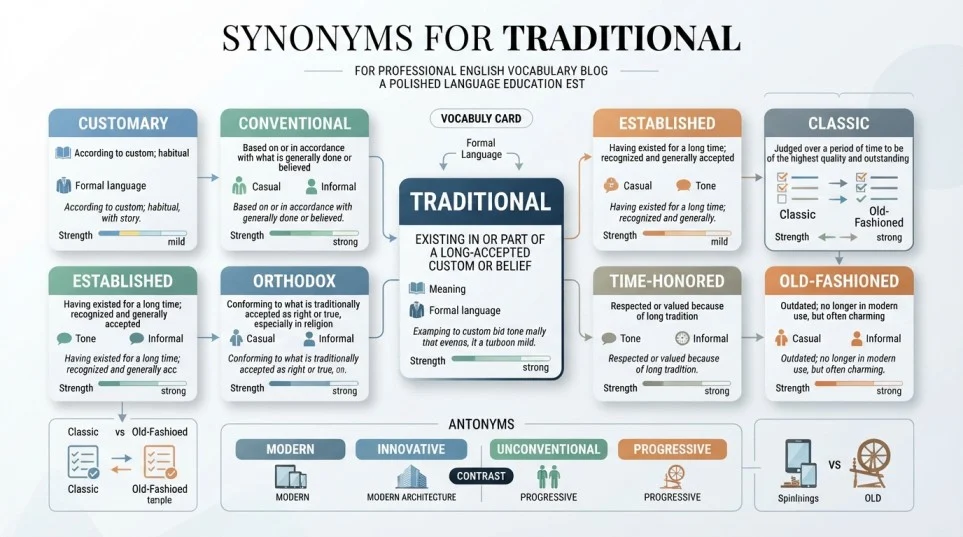
Traditional describes something based on customs, beliefs, methods, or practices that have been followed for a long time. Depending on context, useful alternatives include customary, conventional, established, classic, orthodox, longstanding, and old fashioned.
Meaning, Tone and Context
Simple Definition
Traditional means connected with customs, practices, beliefs, styles, or methods that have been followed or accepted over a long period.
For example:
“Her family prepares a traditional meal every Thanksgiving.”
Here, traditional means a practice associated with an established custom.
Part of Speech
“Traditional” is primarily an adjective.
It commonly describes:
• Traditional clothing
• Traditional food
• Traditional values
• Traditional methods
• Traditional beliefs
• Traditional ceremonies
• Traditional architecture
• Traditional education
The related noun is “tradition.”
Tone
Traditional is generally neutral. However, its emotional effect depends on the sentence.
It can suggest respect, continuity, cultural identity, stability, or familiarity.
In some contexts, it can also suggest resistance to change or preference for older methods.
Formality Level
Traditional works in casual conversation, academic writing, professional communication, journalism, essays, and creative writing.
Because it is widely understood, it is usually a safe choice. A more specific synonym can make your writing more precise.
Common Use Cases
Traditional commonly appears when discussing:
• Culture and heritage
• Family customs
• Religious practices
• Food and cooking
• Clothing
• Art and architecture
• Education
• Business methods
• Social values
• Established beliefs
Related Word Forms
Noun: tradition
Adjective: traditional
Related noun: traditionalism
Person associated with the preference for tradition: traditionalist
Opposite ideas include modern, contemporary, innovative, unconventional, and experimental.
When and How to Use “Traditional”
Use “traditional” when you want to emphasize continuity with established customs, practices, beliefs, or styles.
Professional Example
“Our company still follows a traditional approach to customer service.”
This works when the method has been established over time.
Personal Example
“My family follows a traditional recipe that has been passed down for generations.”
Here, traditional highlights family continuity.
Academic Example
“Traditional teaching methods often rely heavily on direct instruction.”
The word works well when comparing established educational practices with newer approaches.
Social Media Example
“Celebrating a traditional holiday with family always feels special.”
Traditional adds a sense of cultural or personal continuity.
Another Word for “Traditional”
There is no single replacement that works in every sentence. The best synonym depends on the specific meaning you want to communicate.
Professional Writing
Use “conventional” or “established” when describing accepted methods or business practices.
Academic Writing
“Conventional” and “orthodox” can work when discussing accepted theories, methods, or approaches.
Casual Conversation
“Old fashioned” or “classic” may sound more natural depending on the subject.
Emotional Writing
“Time honored” can emphasize respect, continuity, and emotional significance.
Creative Writing
“Ancestral,” “age old,” or “heritage based” can add cultural or historical depth when the context supports them.
Resume or Workplace Use
“Established” is often more useful than traditional because it can communicate experience, reliability, and an accepted process.
Social Media Captions
“Classic,” “old fashioned,” and “customary” can work depending on the tone.
Stronger Meaning
“Orthodox” can suggest strict adherence to an accepted belief or established doctrine.
Softer Meaning
“Classic” or “customary” can sound less critical when describing something familiar and established.
When Not to Use “Traditional”
Do not automatically use “traditional” when you simply mean old.
For example, “an old computer” does not necessarily mean “a traditional computer.” Traditional usually implies a recognized method, style, belief, or custom.
Also avoid using “traditional” when a more precise word explains your meaning.
Instead of:
“The company uses a traditional system.”
Consider:
“The company uses an established system.”
“Established” tells readers that the system has already been adopted and recognized.
Likewise, “conventional” may be better when you mean a commonly accepted method rather than a cultural tradition.
Words Commonly Confused With “Traditional”
Traditional vs. Conventional
Traditional often connects with customs, history, or long established practices.
Conventional usually means commonly accepted or standard.
Traditional vs. Classic
Traditional emphasizes continuity with established practices.
Classic often describes something widely admired, enduring, or representative of a recognized style.
Traditional vs. Old Fashioned
Traditional can be neutral or positive.
Old fashioned can suggest that something belongs to an earlier period and may sometimes imply that it is outdated.
Traditional vs. Orthodox
Traditional can describe established customs generally.
Orthodox usually refers to accepted beliefs, doctrines, or established views, especially in religious or intellectual contexts.
Traditional vs. Established
Traditional emphasizes continuity and custom.
Established emphasizes something already accepted, proven, or firmly in place.
Traditional vs. Conservative
Traditional describes a connection with established customs or practices.
Conservative can describe a preference for preserving existing conditions and avoiding significant change.
Best Synonym by Context for “Traditional”
| Context | Best Synonym | Why It Works | Example |
|---|---|---|---|
| Formal writing | Conventional | Clearly communicates accepted practice | The conventional approach remains widely used. |
| Academic writing | Orthodox | Useful for established theories or accepted views | The orthodox interpretation dominated the field. |
| Professional use | Established | Emphasizes a proven or accepted process | We use an established review procedure. |
| Resume | Established | Highlights recognized methods or systems | Managed established client service procedures. |
| Casual conversation | Old fashioned | Sounds natural when discussing earlier styles | My grandparents prefer old fashioned cooking. |
| Creative writing | Ancestral | Adds cultural or family depth | She wore an ancestral necklace. |
| Emotional writing | Time honored | Suggests respect and continuity | They continued a time honored family ritual. |
| Strong intensity | Orthodox | Suggests strict adherence to accepted beliefs | He follows an orthodox interpretation. |
| Mild or moderate | Classic | Can sound positive and familiar | She chose a classic design. |
| Social media | Classic | Concise and accessible | A classic family recipe never gets old. |
| Cultural context | Customary | Focuses on established customs | It is customary to greet guests warmly. |
| Historical context | Age old | Emphasizes great age | The village preserves an age old ceremony. |
| Business process | Conventional | Describes commonly accepted practice | The company used a conventional sales model. |
| Education | Established | Works well for recognized teaching methods | The school uses established assessment methods. |
| Fashion | Classic | Describes enduring styles | A classic suit remains versatile. |
| Food | Traditional | Directly connects food with cultural custom | They served traditional Mexican dishes. |
| US usage | Traditional | Common and widely understood | The restaurant serves traditional American dishes. |
| UK usage | Traditional | Equally natural in British English | The hotel offers traditional afternoon tea. |
Which Synonym Should You Choose?
Start by asking what “traditional” means in your sentence.
- If you mean a common or accepted method, choose “conventional.”
- If you mean something firmly established, choose “established.”
- If you mean a cultural or family practice, choose “customary,” “ancestral,” or “time honored.”
- If you mean an enduring style, “classic” may be more natural.
- If you mean strict adherence to an accepted belief, “orthodox” is more precise.
Always consider tone. A word can be technically related to traditional while creating a different emotional impression.
Real Life Examples of “Traditional” in Sentences
School
“The course examines traditional approaches to teaching mathematics.”
Workplace
“The company combines traditional management practices with newer digital tools.”
Writing
“The author contrasts traditional storytelling with experimental techniques.”
Conversation
“My parents still enjoy traditional holiday celebrations.”
Social Media
“Nothing beats a traditional family dinner on a Sunday evening.”
Resume
“Experienced in both traditional and digital marketing methods.”
“We can review the traditional process before considering alternative options.”
Storytelling
“The village gathered each spring to celebrate a traditional festival that had shaped the community for generations.”
18 Synonyms for “Traditional”
| Synonym | Simple Meaning | Best Used For | Example Sentence |
|---|---|---|---|
| Customary | Normally done according to custom | Social and cultural practices | It is customary to welcome guests with a meal. |
| Conventional | Commonly accepted or standard | Academic and professional writing | The company chose a conventional approach to training. |
| Established | Accepted or firmly in place | Business, education, and systems | The school follows an established curriculum. |
| Orthodox | Consistent with accepted beliefs or doctrine | Religion, ideas, and academic discussions | The scholar presented an orthodox interpretation. |
| Classic | Enduring, familiar, and widely recognized | Fashion, design, food, and culture | She wore a classic black dress. |
| Standard | Commonly accepted as a normal level or method | Professional and technical contexts | The team followed the standard procedure. |
| Usual | Normally occurring or expected | Everyday conversation | We ordered our usual traditional meal. |
| Habitual | Done regularly through habit | Personal behavior and routines | His habitual morning routine included tea. |
| Longstanding | Existing for a long period | Organizations, relationships, and practices | The restaurant has a longstanding family recipe. |
| Time honored | Respected because it has continued for a long time | Cultural and emotional writing | The community follows a time honored ceremony. |
| Old fashioned | Associated with an earlier period | Styles, habits, and attitudes | She enjoys old fashioned handwritten letters. |
| Age old | Extremely old and preserved over time | Historical and cultural writing | The region is known for its age old traditions. |
| Ancestral | Connected with ancestors and inherited heritage | Family and cultural contexts | The family returned to its ancestral home. |
| Inherited | Received from earlier generations | Customs, property, traits, and practices | The recipe was an inherited family tradition. |
| Conservative | Favoring established practices over major change | Politics, business, design, and social ideas | The organization took a conservative approach to expansion. |
| Ritualistic | Characterized by repeated formal rituals | Ceremonies and repeated practices | The ceremony followed a highly ritualistic pattern. |
| Custom bound | Strongly governed by established customs | Cultural and social descriptions | The community remains deeply custom bound. |
| Heritage based | Built around cultural or historical heritage | Tourism, food, culture, and branding | The museum promotes heritage based crafts. |
Synonym Groups and Usage Differences
Professional vs. Personal Synonyms
In professional writing, “established,” “conventional,” and “standard” often communicate information clearly without adding unnecessary emotion.
In personal writing, “customary,” “classic,” “old fashioned,” and “time honored” can create a warmer sense of familiarity or continuity.
Formal vs. Conversational Synonyms
“Conventional,” “orthodox,” and “established” are suitable for formal contexts.
“Classic,” “usual,” and “old fashioned” can feel more conversational, depending on the sentence.
Academic Synonyms
Academic writing benefits from precision.
“Conventional” works for widely accepted methods. “Orthodox” is useful for established schools of thought. “Established” works when discussing recognized practices or theories.
Professional and Business Synonyms
“Established,” “standard,” and “conventional” are usually practical choices for workplace communication.
For example:
“The team follows an established quality control process.”
This is more precise than simply saying:
“The team follows a traditional process.”
Creative or Literary Synonyms
Creative writing gives you more room to emphasize history and emotion.
“Ancestral,” “age old,” and “time honored” can suggest heritage, memory, continuity, and cultural identity.
Slang or Modern Synonyms
Traditional does not have a direct slang equivalent that works across contexts.
Words such as “old school” can sometimes communicate a similar idea in casual American English, but the expression is informal.
For example:
“He prefers an old school approach to music.”
Avoid this expression in formal academic or professional writing unless the context is intentionally conversational.
Strongest vs. Weaker Synonyms
A useful intensity scale depends on the meaning.
Mild: usual
Moderate: classic
Established: conventional
Strong: orthodox
Very strong cultural or historical emphasis: age old, ancestral, time honored
These words are not interchangeable in every sentence. Intensity should be considered together with meaning.
Emotional vs. Neutral Synonyms
Neutral choices include conventional, established, standard, and customary.
More emotional choices include time honored, ancestral, and age old.
“Old fashioned” can carry either affection or criticism depending on context.
Antonyms of “Traditional”
| Antonym | Meaning | Example Sentence |
|---|---|---|
| Modern | Characteristic of the present period | The restaurant uses a modern interior design. |
| Contemporary | Existing or popular at the present time | The gallery features contemporary artwork. |
| Innovative | Introducing new ideas or methods | The company developed an innovative training system. |
| Novel | New or unusual | Researchers proposed a novel solution. |
| Unconventional | Different from commonly accepted practice | She took an unconventional approach to the problem. |
| Unorthodox | Contrary to established beliefs or methods | The scientist proposed an unorthodox explanation. |
| Experimental | Based on testing new ideas or methods | The team adopted an experimental technique. |
| Progressive | Favoring development or significant change | The organization introduced progressive policies. |
| Avant garde | Highly innovative and ahead of established styles | The designer is known for avant garde fashion. |
| Original | New and independently created | The artist developed an original style. |
| Revolutionary | Producing a major and dramatic change | The invention had revolutionary effects on communication. |
| Radical | Significantly different from established ideas | The proposal represented a radical change. |
| Futuristic | Suggesting advanced ideas or future conditions | The building has a futuristic design. |
| Nonconformist | Not following accepted customs or practices | His nonconformist style attracted attention. |
| New | Recently created or introduced | The company launched a new approach to customer support. |
Comparison: “Traditional” vs. Similar Words
Traditional vs. Conventional
The main difference is that traditional often connects with customs and continuity, while conventional means commonly accepted or standard.
“Traditional” can carry cultural meaning. “Conventional” is often more neutral and practical.
Example:
“The restaurant serves traditional food.”
“The restaurant uses a conventional cooking method.”
Traditional vs. Classic
Traditional focuses on customs or established practices.
Classic focuses on something enduring, recognized, or widely admired.
Example:
“She wore traditional clothing for the ceremony.”
“She chose a classic black dress for the event.”
Traditional vs. Old Fashioned
Traditional is generally neutral.
Old fashioned often suggests something associated with an earlier era and can sometimes imply that it is outdated.
Example:
“They prepared a traditional family recipe.”
“He prefers old fashioned communication by handwritten letter.”
Traditional vs. Established
Traditional emphasizes continuity with the past.
Established emphasizes acceptance, stability, or proven existence.
Example:
“The festival follows traditional customs.”
“The company has an established hiring process.”
Traditional vs. Orthodox
Traditional is broader.
Orthodox is more specific and often relates to accepted doctrines, beliefs, or established schools of thought.
Example:
“The community follows traditional customs.”
“The scholar defended an orthodox interpretation.”
Traditional vs. Conservative
Traditional refers to established customs, methods, or styles.
Conservative describes a preference for preserving existing practices or limiting major change.
Example:
“The restaurant serves traditional cuisine.”
“The company adopted a conservative investment strategy.”
Common Phrases and Expressions with “Traditional”
1. Traditional Values
Meaning:
Beliefs or principles associated with established social or cultural customs.
Example sentence:
“The organization emphasizes traditional values such as responsibility and community.”
2. Traditional Approach
Meaning:
A familiar method that has been used for a long time.
Example sentence:
“The teacher combines a traditional approach with digital resources.”
3. Traditional Method
Meaning:
An established way of performing a task.
Example sentence:
“The chef still uses a traditional method for preparing the bread.”
4. Traditional Culture
Meaning:
The customs, beliefs, practices, and expressions associated with a community or society.
Example sentence:
“The museum celebrates the region’s traditional culture.”
5. Traditional Clothing
Meaning:
Clothing associated with a particular culture, region, period, or custom.
Example sentence:
“Visitors wore traditional clothing during the cultural festival.”
6. Traditional Family
Meaning:
A phrase describing a family structure or values viewed as conventional within a particular social context.
Example sentence:
“The article examines changing ideas about the traditional family.”
7. Traditional Art
Meaning:
Art connected with established cultural styles or techniques.
Example sentence:
“The exhibition features traditional art from several regions.”
Common Mistakes to Avoid
1. Using Traditional When You Mean Old
Something can be old without being traditional.
Use “traditional” when the thing has a connection with an established custom, method, style, or belief.
2. Confusing Traditional With Conventional
Conventional means commonly accepted.
Traditional usually adds an idea of continuity with established customs or practices.
3. Using Casual Synonyms in Formal Writing
Words such as “old school” may work in conversation but can sound too casual in an academic essay or business report.
4. Using an Overly Dramatic Synonym
“Revolutionary” is not a normal replacement for traditional.
It describes something that causes or represents major change.
5. Repeating Traditional Too Often
If the same word appears repeatedly, replace it only when the alternative preserves the exact meaning.
Good writing prioritizes precision over forced variety.
6. Choosing the Wrong Emotional Tone
“Old fashioned” can sound affectionate in one sentence and critical in another.
Use “classic” or “time honored” when you want a more positive impression.
7. Using Slang in Academic or Professional Writing
Expressions such as “old school” can be effective in casual writing but should be used carefully in formal contexts.
FAQs
What is the best synonym for traditional?
The best synonym depends on context. “Conventional” works for accepted methods, while “customary,” “classic,” and “established” fit different meanings.
What is a formal synonym for traditional?
“Conventional,” “established,” and “orthodox” can serve as formal alternatives when their specific meanings match the sentence.
What is an informal synonym for traditional?
“Old fashioned” or “old school” can work in casual conversation, although “old school” is considerably more informal.
What is another word for traditional in professional writing?
“Established,” “conventional,” or “standard” often works well in professional writing because each can describe accepted methods clearly.
What is the difference between traditional and conventional?
Traditional emphasizes continuity with established customs, while conventional emphasizes what is commonly accepted or standard in a particular context.
What is the opposite of traditional?
Common opposites include modern, contemporary, innovative, unconventional, experimental, novel, and unorthodox, depending on the intended meaning.
Conclusion
Traditional describes something connected with established customs, practices, beliefs, methods, or styles.
The best synonym depends on what you want to emphasize. Choose “conventional” for accepted practices, “established” for proven systems, “customary” for social customs, “classic” for enduring styles, and “orthodox” for accepted beliefs or doctrines.
When searching for the best synonym for traditional, do not choose a replacement simply because it looks similar in a thesaurus. Check the meaning, formality, emotional tone, and sentence context.
A precise synonym makes your writing clearer without making it sound unnatural.
Before publishing vocabulary content, verify definitions and nuanced usage with trusted dictionaries such as Cambridge, Oxford, Merriam Webster, Collins, or Britannica.
Discover More Post:
- 25+ Synonyms for Access | Meanings, Examples, and Best …
- 25+ Synonyms for Acknowledge | Meanings, Examples, and …
- 25+ Synonyms for Attention | Meanings, Examples, and Best …