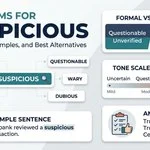
Have you ever used the word suspicious several times in an essay, email, story, or social media caption? Finding a better word can make your writing clearer and more interesting. Depending on the situation, you might mean doubtful, distrustful, questionable, shady, or simply unsure about something.
Understanding synonyms for suspicious helps you express doubt without making your message sound too harsh or too vague. For example, a suspicious transaction may be questionable, while a suspicious person may seem untrustworthy. In a mystery story, the same person might appear secretive or sinister.
This guide explains the meaning of suspicious, its most useful alternatives, and how each word changes the tone of a sentence. You will also find practical examples, comparisons, antonyms, and recommendations for academic, professional, personal, and creative writing.
What Does Suspicious Mean?
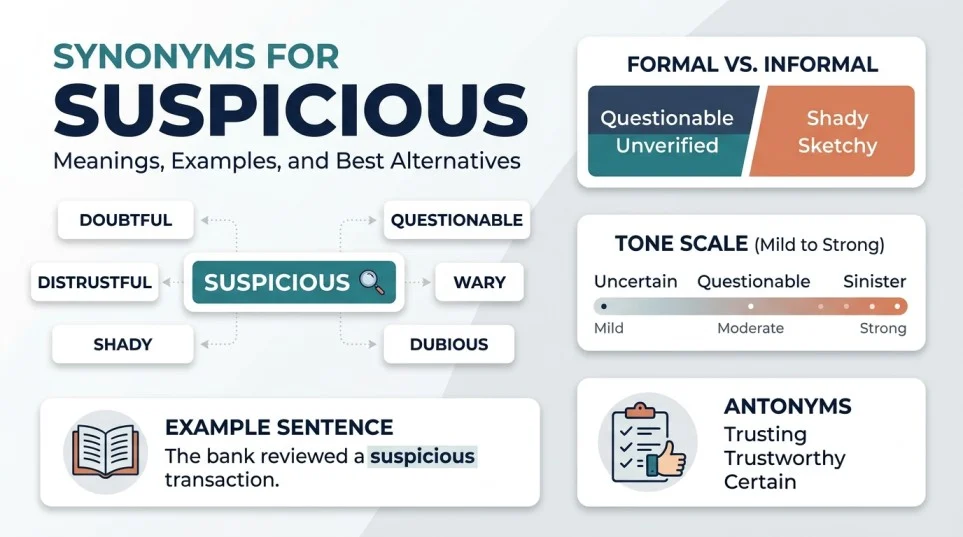
Suspicious means feeling doubt about someone or something, or believing that something may be dishonest, unsafe, or wrong. Common synonyms include doubtful, distrustful, questionable, dubious, wary, and shady. The best choice depends on whether you describe a feeling, behavior, situation, or possible threat.
Meaning, Tone and Context
What does suspicious mean?
The word suspicious describes a feeling of doubt or a belief that something may not be as it seems. It can refer to a person who distrusts others or to something that appears dishonest, unusual, or potentially dangerous.
For example, a suspicious email may contain a misleading link. A suspicious neighbor may seem unwilling to explain their behavior. A suspicious sound might make someone wonder whether something is wrong.
Part of speech
Suspicious is an adjective. It describes a noun, such as a person, action, message, activity, or situation.
Related word forms include:
| Word | Part of Speech | Meaning |
|---|---|---|
| Suspicious | Adjective | Causing or showing doubt |
| Suspicion | Noun | A feeling or belief that something may be wrong |
| Suspect | Verb | To believe something may be true or wrong |
| Suspect | Noun | A person believed to be involved in a crime |
| Suspiciously | Adverb | In a way that creates or shows suspicion |
| Unsuspecting | Adjective | Unaware of possible danger or deception |
Tone and formality
Suspicious usually has a negative or cautious tone. However, it does not always mean that someone has done something wrong.
The word is common in everyday conversation, professional reports, news writing, academic discussions, and fiction. Its strength depends on context. Describing a payment as suspicious suggests a possible problem, while calling a person suspicious can sound like an accusation.
Common situations where suspicious is used
- Personal relationships, when someone’s behavior creates doubt.
- Cybersecurity and finance, when an email, payment, or transaction may be fraudulent.
- Academic writing, when evidence raises questions.
- Fiction and storytelling, when a character’s actions create tension.
- Everyday conversation, when something seems unusual or difficult to explain.
When and How to Use Suspicious
Use suspicious when something gives you a reason to question honesty, safety, motives, or facts. Choose a more specific synonym when you know exactly what seems wrong.
1. Professional context: The finance team flagged a suspicious payment for review.
2. Personal context: She became suspicious when her friend changed the subject.
3. Academic context: The researcher found suspicious gaps in the reported data.
4. Creative writing: A suspicious stranger waited outside the old bookstore after dark.
These examples show that suspicious can describe a person’s feelings, another person’s behavior, or an event that deserves closer attention.
Another Word for Suspicious
The best single replacement for suspicious depends on what you want to communicate. Doubtful works well for uncertainty, distrustful describes a lack of trust, and questionable suggests that something may be wrong or unacceptable.
Here are useful choices for different situations.
| Context | Best Alternative | Example |
|---|---|---|
| Professional writing | Questionable | The auditor identified a questionable expense. |
| Academic writing | Dubious | The paper relies on dubious assumptions. |
| Casual conversation | Shady | That deal sounds shady to me. |
| Emotional writing | Distrustful | He grew distrustful after repeated lies. |
| Creative writing | Ominous | An ominous silence filled the room. |
| Resume or workplace use | Unverified | The team reviewed the unverified claim. |
| Social media captions | Sketchy | That website looks sketchy. |
| Stronger meaning | Sinister | The stranger had a sinister expression. |
| Softer meaning | Uncertain | I am uncertain about the explanation. |
Remember that these alternatives are not interchangeable in every sentence. A questionable decision is not necessarily a sinister decision, and feeling uncertain is not the same as distrusting someone.
When Not to Use Suspicious
Suspicious is useful, but it can be too general when you need to explain the exact problem.
When you mean uncertain: Use doubtful or uncertain if you have questions but no reason to suspect dishonesty.
Example: I am doubtful that the plan will work.
When you mean dishonest or misleading: Use deceptive when someone or something gives a false impression.
Example: The advertisement used deceptive language.
When you mean unusual: Use unusual if something is different without necessarily being dangerous or dishonest.
Example: We noticed an unusual pattern in the results.
When you mean unsafe or potentially fraudulent: Use potentially fraudulent or unsafe when the evidence supports that specific concern.
Example: The bank reviewed a potentially fraudulent transaction.
When you want a neutral professional tone: Use questionable, unverified, or unexplained when these words accurately describe the evidence. Avoid labeling a person as shady or sinister in formal reports without strong justification.
The goal is to describe what you know, not to make a stronger accusation than the facts support.
Words Commonly Confused With Suspicious
Several similar words describe doubt or concern, but each has a different emphasis.
| Word | Main Difference | Best Used When |
|---|---|---|
| Doubtful | Expresses uncertainty or disbelief | You are unsure that something is true |
| Distrustful | Shows a lack of trust | You do not trust someone’s intentions |
| Questionable | Suggests a possible problem | An action, claim, or decision needs review |
| Dubious | Expresses serious doubt about truth or reliability | A claim or explanation seems unreliable |
| Wary | Means cautious and alert | You want to avoid a possible risk |
| Shady | Informal word suggesting dishonesty | Something seems dishonest or untrustworthy |
| Secretive | Describes someone who keeps information private | A person avoids sharing details |
| Sinister | Suggests an evil or threatening quality | A person or situation feels menacing |
A key distinction is that suspicious can describe either a feeling or something that causes doubt. Wary focuses on caution, while secretive describes behavior and does not automatically imply wrongdoing.
Best Synonym by Context for Suspicious
The following table helps you select the right word for a specific audience and purpose.
| Context | Best Synonym | Why It Works | Example |
|---|---|---|---|
| Formal writing | Questionable | Sounds measured and professional | The report identified questionable expenses. |
| Academic writing | Dubious | Highlights concerns about reliability | The conclusion rests on dubious evidence. |
| Business communication | Unverified | Focuses on a claim that lacks confirmation | The company investigated an unverified complaint. |
| Resume or workplace review | Inconsistent | Describes information that does not match | The applicant’s records contained inconsistent dates. |
| Casual conversation | Shady | Sounds natural and informal | That offer seems shady. |
| Creative writing | Ominous | Creates a feeling of danger | An ominous figure appeared in the doorway. |
| Emotional writing | Distrustful | Emphasizes a lack of trust | She became distrustful of his promises. |
| Strong intensity | Sinister | Suggests an evil or threatening quality | A sinister smile crossed his face. |
| Mild concern | Uncertain | Expresses doubt without accusation | I am uncertain about his explanation. |
| Social media captions | Sketchy | Short, casual, and expressive | This link looks sketchy. |
| Legal or investigative writing | Suspect | Signals a possible connection or concern | Investigators examined a suspect transaction. |
| Financial security | Potentially fraudulent | Identifies a possible fraud risk | The bank blocked a potentially fraudulent payment. |
| Personal relationships | Untrusting | Focuses on difficulty trusting someone | He grew untrusting after the argument. |
| News reporting | Questionable | Avoids stating unproven wrongdoing as fact | Officials reviewed the questionable claim. |
| Mystery and suspense | Cryptic | Suggests a puzzling or unclear message | She received a cryptic note. |
| British or American informal English | Dodgy | Informal term for something unreliable or unsafe | The seller offered a dodgy deal. |
A note on regional usage: dodgy is especially familiar in British English, but American readers may also understand it. In formal US writing, questionable, dubious, or potentially fraudulent is often more suitable, depending on the evidence.
Which Synonym Should You Choose?
Choosing the best synonym for suspicious becomes easier when you ask five simple questions.
1. What do you mean? If you lack confidence in a claim, use doubtful or dubious. If you question someone’s honesty, use distrustful or untrustworthy.
2. How formal should it sound? Use questionable or unverified in professional communication. Save shady and sketchy for casual conversation.
3. How serious is the concern? Uncertain expresses mild doubt. Wary suggests caution. Sinister adds a strong sense of threat.
4. Are you describing a person or a thing? A person may be distrustful or secretive. A payment may be questionable or potentially fraudulent. A strange message may be cryptic.
5. What evidence do you have? Use words that match the facts. An unusual event is not automatically dishonest, and an unverified claim is not necessarily false.
A practical rule is to choose the most precise word that communicates your concern without exaggerating it.
Real Life Examples of Suspicious in Sentences
These examples show how related words work in everyday situations.
School: The teacher questioned the dubious information in the student’s essay.
Workplace: The manager reviewed a questionable expense before approving reimbursement.
Writing: The author replaced suspicious with ominous to create tension in the scene.
Conversation: That website looks sketchy, so I would not enter my personal details.
Social media: A suspicious message appeared in my inbox from an unknown account.
Resume and hiring: The recruiter noticed inconsistent dates and requested clarification.
Email: Please review the unverified request before transferring any funds.
Storytelling: The detective grew wary when the witness avoided a simple question.
Personal relationships: After several broken promises, she became distrustful of his explanations.
Cybersecurity: The system flagged a potentially fraudulent login attempt.
Each alternative communicates a different kind of concern. Use that difference to make your writing more accurate and natural.
18 Synonyms for Suspicious
These 18 words offer useful alternatives for formal, informal, academic, professional, emotional, and creative writing. Some describe a person’s feelings, while others describe questionable behavior or a possible threat.
| Synonym | Simple Meaning | Best Used For | Example Sentence |
|---|---|---|---|
| 1. Doubtful | Unsure or unconvinced | Everyday uncertainty | I am doubtful about the promise. |
| 2. Distrustful | Not willing to trust | Relationships and emotions | She became distrustful after the betrayal. |
| 3. Questionable | Possibly wrong or unacceptable | Business and formal writing | The manager rejected the questionable expense. |
| 4. Dubious | Seeming unreliable or unlikely | Academic and analytical writing | The claim relies on dubious evidence. |
| 5. Wary | Careful because of possible danger | Safety and personal judgment | He remained wary of the stranger. |
| 6. Shady | Seeming dishonest | Informal conversation | The seller offered a shady deal. |
| 7. Sketchy | Seeming unreliable or unsafe | Casual speech and online safety | That download site looks sketchy. |
| 8. Untrustworthy | Not deserving of trust | People and organizations | The source proved untrustworthy. |
| 9. Secretive | Unwilling to share information | Behavior and relationships | His secretive behavior raised questions. |
| 10. Dubitable | Open to doubt | Formal or specialized discussion | The conclusion is dubitable without stronger evidence. |
| 11. Fishy | Seeming strange or dishonest | Informal speech | Something feels fishy about the offer. |
| 12. Dodgy | Seeming unreliable or unsafe | Informal, especially British English | They avoided the dodgy service. |
| 13. Uncertain | Not sure or settled | Mild doubt | We remain uncertain about the result. |
| 14. Unverified | Not confirmed as true | Reports and professional communication | The team removed the unverified claim. |
| 15. Deceptive | Giving a false impression | Misleading actions or messages | The website used deceptive wording. |
| 16. Ominous | Suggesting something bad may happen | Creative writing | An ominous shadow crossed the wall. |
| 17. Sinister | Suggesting evil or harmful intent | Suspense and dramatic writing | The character gave a sinister laugh. |
| 18. Cryptic | Difficult to understand | Puzzling messages or behavior | His cryptic reply confused everyone. |
A usage note: these words are related alternatives, not exact replacements in every sentence. For example, cryptic means difficult to understand, while deceptive suggests that something misleads people. Choose according to the meaning you want.
Synonym Groups and Usage Differences
Professional vs. Personal Synonyms
Professional writing benefits from precise, neutral words. Questionable, unverified, inconsistent, and dubious help describe concerns without sounding overly emotional.
Personal writing allows more direct expressions. Distrustful describes a lack of trust, while wary suggests that someone is being careful. Shady and fishy work well in relaxed conversations.
Compare these sentences:
Professional: The analyst identified questionable details in the report.
Personal: I thought his explanation sounded fishy.
Both express doubt, but the second sounds more conversational.
Formal vs. Conversational Synonyms
Formal synonyms are useful in reports, essays, presentations, and business emails. Conversational synonyms fit texts, casual discussions, and social media posts.
| Formal Word | Conversational Alternative | Example |
|---|---|---|
| Questionable | Fishy | The deal seems fishy. |
| Dubious | Shady | His explanation sounds shady. |
| Unverified | Sketchy | That website looks sketchy. |
| Distrustful | Wary | I am wary of the offer. |
| Potentially fraudulent | Possibly a scam | This could be a scam. |
Use informal words when the audience and situation allow them. In a formal complaint or research paper, explain the concern clearly instead of relying on slang.
Academic Synonyms
Academic writing should explain why something deserves doubt. The best word depends on whether you are questioning evidence, a claim, a method, or a conclusion.
- Dubious: Useful for claims that lack convincing support.
- Questionable: Suitable for methods, assumptions, decisions, or interpretations that need review.
- Unverified: Appropriate when information has not been confirmed.
- Unsubstantiated: Useful when a claim lacks supporting evidence.
- Inconsistent: Best when details conflict with each other.
- Unreliable: Suitable for sources, measurements, or methods that cannot be trusted consistently.
Example: The researcher treated the unsubstantiated claim with caution until additional evidence became available.
This wording is more precise than simply calling the claim suspicious.
Professional and Business Synonyms
In the workplace, a synonym should describe the concern without making an unsupported accusation.
Use questionable for a decision that may violate a rule, unverified for information that needs confirmation, inconsistent for conflicting records, and potentially fraudulent for a transaction that may involve fraud.
Example: The accounting team placed the unverified payment request on hold until the sender’s identity was confirmed.
For resumes and performance reviews, focus on observable behavior rather than personal judgments. Instead of writing that a colleague seemed suspicious, describe the missing records, unexplained changes, or conflicting information.
Creative or Literary Synonyms
Creative writing often needs words that create atmosphere or reveal a character’s feelings.
- Ominous: Suggests that something bad may happen.
- Sinister: Suggests evil or harmful intent.
- Cryptic: Makes a message or action difficult to interpret.
- Shifty: Describes behavior that appears evasive or dishonest.
- Foreboding: Expresses a sense that something unpleasant may happen.
Example: The old house stood in ominous silence, and every unanswered question made the visitor more uneasy.
These choices help readers feel uncertainty instead of simply being told that something is suspicious.
Slang or Modern Synonyms
Shady, sketchy, fishy, and dodgy are informal alternatives. They are common in relaxed conversation and can make dialogue sound natural.
Example: That online seller seems sketchy, so I will check the reviews before ordering.
These words are less suitable for academic papers, formal reports, and serious workplace complaints. In those settings, describe the actual concern and choose a more neutral term.
Strongest vs. Weaker Synonyms
The following scale is a practical guide to tone, not a fixed ranking. The strength of a word changes with context.
Mild
Uncertain, doubtful
Expresses questions without implying wrongdoing.
Moderate
Questionable, dubious, wary
Suggests concern or a reason to investigate.
Strong
Shady, untrustworthy, sinister
Suggests dishonesty, harmful intent, or a serious threat.
Use stronger words only when the context supports them. Sinister creates a much darker impression than doubtful, so it may sound exaggerated in a routine business discussion.
Emotional vs. Neutral Synonyms
Emotional synonyms communicate how a person feels or how a situation appears.
Distrustful suggests a lack of trust. Wary suggests caution. Sinister adds a sense of danger. Shady often communicates personal disapproval.
Neutral alternatives focus on facts. Unverified means something has not been confirmed. Inconsistent means details do not agree. Questionable suggests that a decision or claim deserves closer examination.
For professional communication, neutral wording is often the safer starting point. Use emotional or dramatic alternatives when the feeling itself is important.
Antonyms of Suspicious
The opposite of suspicious depends on whether you mean a person’s feeling of doubt or the appearance of a situation. The following words express trust, confidence, openness, or a lack of concern.
| Antonym | Meaning | Example Sentence |
|---|---|---|
| 1. Trusting | Willing to trust others | She is trusting of her close friends. |
| 2. Trustful | Showing trust | He gave a trustful response. |
| 3. Trustworthy | Deserving of trust | The organization is trustworthy. |
| 4. Confident | Certain or assured | She felt confident about the explanation. |
| 5. Certain | Free from doubt | I am certain that the record is accurate. |
| 6. Assured | Feeling sure or secure | He sounded assured during the meeting. |
| 7. Reassured | Made less worried | The clear explanation reassured the customer. |
| 8. Credulous | Too ready to believe | The credulous buyer accepted every claim. |
| 9. Gullible | Easily tricked or deceived | A gullible shopper might fall for the scam. |
| 10. Unsuspecting | Unaware of possible danger or deception | The unsuspecting visitor opened the door. |
| 11. Innocent | Not guilty of wrongdoing | The evidence showed that she was innocent. |
| 12. Honest | Truthful and sincere | He gave an honest answer. |
| 13. Frank | Open and direct | She was frank about the mistake. |
| 14. Transparent | Open and easy to understand | The company maintained a transparent process. |
| 15. Open | Willing to share information or consider ideas | He was open about his concerns. |
Not all these words are exact opposites in every situation. Trustworthy describes a quality, while trusting describes an attitude. Gullible and credulous suggest excessive belief, so they are useful contrasts with suspicion but are not always positive traits.
Comparison: Suspicious vs. Similar Words
These six comparisons explain how suspicious differs from closely related words.
Suspicious vs. Doubtful
Suspicious often suggests that something may be wrong or dishonest. Doubtful usually expresses uncertainty about whether something is true or likely.
Suspicious can sound more accusatory. Doubtful is often softer and works well in ordinary discussions.
Examples:
- Suspicious: The customer noticed a suspicious charge.
- Doubtful: I am doubtful that the plan will succeed.
Suspicious vs. Distrustful
Suspicious describes doubt about someone or something. Distrustful focuses on a person’s lack of trust in another person.
Distrustful is more direct about a relationship or attitude. Both words are common in personal and professional contexts.
Examples:
- Suspicious: She became suspicious when the story changed.
- Distrustful: She became distrustful after several broken promises.
Suspicious vs. Questionable
Suspicious often implies possible wrongdoing. Questionable suggests that something may be wrong, unfair, unreliable, or difficult to justify.
Questionable is generally more neutral and suitable for formal writing.
Examples:
- Suspicious: The officer examined the suspicious package.
- Questionable: The manager challenged the questionable decision.
Suspicious vs. Dubious
Suspicious may describe a feeling or an appearance that raises concern. Dubious often expresses doubt about truth, quality, or reliability.
Dubious can sound more analytical or formal, especially when discussing evidence and claims.
Examples:
- Suspicious: His behavior made the team suspicious.
- Dubious: The report made several dubious claims.
Suspicious vs. Wary
Suspicious means that something raises doubt. Wary means being careful because a risk may exist.
Wary emphasizes a cautious response rather than a belief that someone is dishonest.
Examples:
- Suspicious: The buyer found the seller suspicious.
- Wary: The buyer remained wary until the payment was confirmed.
Suspicious vs. Shady
Suspicious is suitable for both formal and informal settings. Shady is informal and suggests dishonesty, unfair behavior, or questionable dealings.
Shady usually sounds more judgmental and is best reserved for casual speech or natural dialogue.
Examples:
- Suspicious: The team investigated a suspicious payment.
- Shady: My friend said the seller seemed shady.
Common Phrases and Expressions With Suspicious
1. Look suspicious
Meaning: To appear unusual or potentially dishonest.
Example sentence: The package looked suspicious, so the staff reported it.
2. Become suspicious
Meaning: To start doubting someone or something.
Example sentence: I became suspicious when the explanation changed twice.
3. Act suspiciously
Meaning: To behave in a way that raises questions.
Example sentence: The visitor acted suspiciously near the locked office.
4. A suspicious person
Meaning: Someone whose behavior or circumstances create concern.
Example sentence: The security guard reported a suspicious person near the entrance.
5. A suspicious transaction
Meaning: A payment or financial activity that may require investigation.
Example sentence: The bank reviewed a suspicious transaction before approving further activity.
6. A suspicious email
Meaning: An email that may contain misleading information, fraud, or harmful links.
Example sentence: I deleted the suspicious email without opening its attachment.
7. A suspicious look
Meaning: A facial expression that suggests doubt or distrust.
Example sentence: She gave him a suspicious look when he avoided the question.
Common Mistakes to Avoid
1. Using suspicious when you only mean uncertain
Suspicious can imply that something is wrong. If you simply do not know the answer, uncertain or doubtful may be more accurate.
Better: I am uncertain about the final result.
2. Confusing suspicious with secretive
Secretive describes someone who keeps information private. Suspicious describes doubt or an appearance that raises concern.
A private person is not necessarily dishonest.
3. Using casual synonyms in formal writing
Words such as shady, sketchy, and fishy can sound unprofessional in reports and business emails.
Better: The review identified questionable financial activity.
4. Choosing an overly dramatic synonym
Sinister and ominous can make a simple situation sound threatening.
Better: Use questionable for a decision that needs review rather than sinister.
5. Repeating suspicious too often
Repeated use can make writing feel dull. Replace it with a precise alternative when the meaning supports the change.
Example: The suspicious message contained a questionable link and an unverified claim.
6. Treating suspicion as proof
Calling a person deceptive or untrustworthy makes a stronger claim than saying their behavior seems suspicious. Explain the evidence before making a judgment.
Better: The records contained inconsistencies that required further review.
FAQs About Synonyms for Suspicious
1. What is the best synonym for suspicious?
Questionable is a useful general choice for actions or situations. Doubtful works for uncertainty, while distrustful describes a lack of trust in another person.
2. What is a formal synonym for suspicious?
Questionable, dubious, and unverified are useful formal alternatives. Choose questionable for a decision, dubious for an unreliable claim, and unverified for information that needs confirmation.
3. What is an informal synonym for suspicious?
Shady, sketchy, and fishy are common informal alternatives. They work in casual conversations and dialogue but may sound unsuitable in academic writing or professional reports.
4. What is another word for suspicious in professional writing?
Questionable is useful for decisions and activities that need review. Unverified suits unconfirmed information, while inconsistent describes records or statements that do not agree.
5. What is the difference between suspicious and doubtful?
Suspicious often suggests possible dishonesty, danger, or wrongdoing. Doubtful usually expresses uncertainty about truth, accuracy, or likelihood without necessarily suggesting bad intentions.
6. What is the opposite of suspicious?
Trusting is a useful opposite when suspicious describes a person’s attitude. Trustworthy is suitable when describing someone who deserves confidence, while certain expresses freedom from doubt.
Conclusion
Suspicious describes doubt about someone or something that may be dishonest, unsafe, or wrong. Its best synonyms include doubtful, distrustful, questionable, dubious, wary, and shady, but each word has a different meaning and tone.
For professional writing, choose precise alternatives such as questionable, unverified, or inconsistent. For casual conversation, shady and sketchy sound more natural. Creative writing, ominous and sinister can create a stronger atmosphere.
The most useful vocabulary tip is to identify exactly what makes you suspicious before choosing a replacement. This helps you communicate clearly, avoid unfair accusations, and make your writing more natural.
Discover More Post:
- 25+ Synonyms for Feeling | Meanings, Examples, and Best …
- 25+ Synonyms for Superior | Meanings, Examples, and Best …
- 25+ Synonyms for Anxious | Meanings, Examples, and Best …