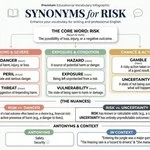
We use the word risk constantly, from discussing a risky business decision to warning someone about a health concern, financial loss, or uncertain outcome. If the same word keeps appearing in your emails, essays, captions, reports, or conversations, a more precise alternative can make your writing clearer.
The best synonym depends on what you mean. You may need danger when harm is likely, hazard when something creates a possible threat, uncertainty when the outcome is unclear, or exposure when something is placed in a vulnerable position. This guide explains how these choices work in real English, so you can choose a word that fits your meaning, tone, and audience.
What Does Risk Mean?
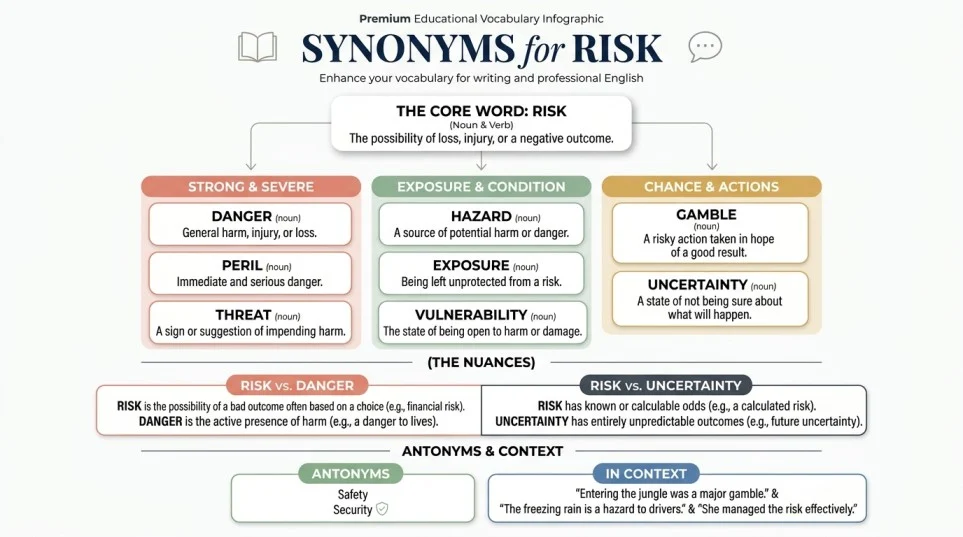
Risk means the possibility that something harmful, unwanted, or uncertain may happen. Depending on context, useful synonyms include danger in formal writing, uncertainty in academic work, hazard in professional settings, gamble in casual speech, and exposure in technical writing.
Meaning, Tone and Context
1. Simple Definition
Risk is the possibility of loss, harm, damage, failure, or another unwanted result.
For example, driving too fast creates a risk of an accident. Investing money in an uncertain business also involves risk because the result is not guaranteed.
The word can describe something that may cause harm, or the possibility of experiencing an unwanted outcome.
2. Part of Speech
Risk is mainly used as a noun and a verb.
As a noun:
There is a serious risk of flooding.
As a verb:
They decided to risk losing the investment.
The noun usually describes a possibility or source of danger. The verb describes choosing to expose someone or something to a possible negative result.
3. Positive, Negative, or Neutral Tone
Risk is usually neutral to negative.
It becomes negative when the possible result involves injury, loss, failure, damage, or trouble.
However, risk is not always presented negatively. In business, investing, sports, and creative work, taking a calculated risk can suggest courage, ambition, or innovation.
4. Formality Level
Risk is a common and flexible word.
It works naturally in casual conversations, school assignments, professional reports, business meetings, emails, resumes, news writing, and academic discussions.
Because it is so common, a more specific synonym can sometimes make your writing stronger.
5. Common Use Cases
Risk appears in many areas, including:
- Financial decisions
- Business planning
- Workplace safety
- Health and safety discussions
- Academic research
- Insurance
- Investing
- Personal decisions
- Technology and cybersecurity
- Environmental discussions
- Sports
- Storytelling
6. Important Word Forms
Risk is a noun and a verb.
Related forms include risky, risked, risking, and riskiness.
Risky is the common adjective used to describe something involving significant risk.
For example:
That was a risky decision.
Risk assessment is a common professional phrase for examining possible threats and their effects.
When and How to Use Risk
Use risk when you want to discuss a possible negative outcome, especially when the result is uncertain.
The word works well when the exact type of problem is not yet known or when you want a broad term.
Professional
The company identified a significant risk to the project schedule.
Personal
I knew there was a risk that I might miss the last train.
Academic
The study examines the risk of inaccurate results when the sample size is too small.
Social Media
Starting something new always involves some risk.
In each example, risk works because the speaker is discussing the possibility of an unwanted or uncertain outcome.
Another Word for Risk
The best single replacement for risk depends on its exact meaning.
- For professional writing, hazard, exposure, vulnerability, threat, or uncertainty may work better.
- For academic writing, uncertainty, possibility, probability, or potential loss can provide greater precision.
- For casual conversation, danger, gamble, chance, or downside may sound more natural.
- For emotional writing, danger, threat, fear, or peril can create stronger feeling.
- For creative writing, peril, hazard, gamble, or jeopardy can add drama.
- For resumes and workplace writing, challenge, uncertainty, exposure, or calculated gamble may work when the context supports them.
- For social media captions, gamble, danger, chance, or uncertainty can create a more conversational tone.
- For a stronger meaning, danger, threat, peril, or jeopardy may be appropriate.
- For a softer meaning, uncertainty, possibility, concern, or downside may sound less dramatic.
When Not to Use Risk
Risk can become too general when you already know the exact problem.
For example:
There is a risk of falling.
This sentence is correct, but danger may be more direct if the situation clearly involves immediate physical harm.
There is a danger of falling.
Similarly, uncertainty may be better when the main issue is that the result cannot be predicted.
The project has a risk about its future.
This sounds vague.
The project faces uncertainty about its future.
The second sentence tells the reader more about the actual problem.
Avoid replacing risk with a dramatic word when the situation is minor.
Calling a small scheduling problem a peril can sound exaggerated. Good vocabulary is not simply about using stronger words. It is about choosing the word that matches the situation.
Words Commonly Confused With Risk
Risk vs. Danger
Risk describes the possibility of harm or loss. Danger usually refers to a situation, condition, or source that can cause harm.
There is a risk of injury on the trail.
The damaged bridge is a danger to pedestrians.
Risk vs. Hazard
A hazard is something that can cause harm. Risk is the possibility and potential impact of that harm.
Wet floors can be a hazard.
The risk of slipping increases when the floor is wet.
Risk vs. Threat
A threat usually refers to something that could cause harm, especially when the source is identifiable.
The company faces a cybersecurity threat.
The risk of data loss remains high.
Risk vs. Uncertainty
Uncertainty focuses on not knowing what will happen. Risk often includes uncertainty plus the possibility of a negative consequence.
The uncertainty concerns next year’s sales.
The risk is that lower sales could cause financial losses.
Risk vs. Chance
Chance can refer to any possibility, including a positive result. Risk usually highlights a possible unwanted result.
There is a chance that we will win.
There is a risk that we will lose.
Risk vs. Gamble
A gamble suggests a deliberate decision to accept uncertainty, often with the possibility of a significant reward or loss.
Launching the new product was a calculated gamble.
The decision involved financial risk.
Best Synonym by Context for Risk
| Context | Best Synonym | Why It Works | Example |
|---|---|---|---|
| Formal writing | Danger | Clear and direct when harm is involved | The policy addresses the danger of unsafe equipment. |
| Academic writing | Uncertainty | Useful when an outcome cannot be predicted | The research considers uncertainty in the results. |
| Professional or business use | Exposure | Useful when a person or organization is vulnerable to loss | The company reduced its exposure to market changes. |
| Resume | Challenge | Softer and more constructive when describing difficult work | I managed challenges during a major transition. |
| Casual conversation | Gamble | Natural when someone knowingly accepts uncertainty | Starting the business was a gamble. |
| Creative writing | Peril | Creates a stronger dramatic feeling | The traveler moved deeper into peril. |
| Emotional tone | Threat | Highlights a serious possible source of harm | The news felt like a threat to their future. |
| Strong intensity | Danger | Suggests a serious possibility of harm | The storm created real danger for residents. |
| Soft or moderate tone | Uncertainty | Less dramatic than danger or peril | The decision involves some uncertainty. |
| Social media captions | Gamble | Short, expressive, and conversational | Sometimes growth requires a gamble. |
| Safety communication | Hazard | Identifies something that can cause harm | The chemical is a workplace hazard. |
| Financial writing | Exposure | Describes vulnerability to financial change | The fund has limited exposure to foreign markets. |
Which Synonym Should You Choose?
Start by asking what you actually mean.
- If you mean possible physical or serious harm, choose danger or peril.
- If you mean something capable of causing harm, choose hazard.
- If you mean a possible source of intentional or identifiable harm, choose threat.
- If you mean not knowing what will happen, choose uncertainty.
- If you mean accepting uncertainty in search of a possible reward, choose gamble.
- If you mean vulnerability to loss, choose exposure.
- If you want a softer and more neutral expression, choose possibility, concern, or uncertainty.
- If you want a stronger emotional effect, choose danger, peril, or jeopardy.
The best synonym is the one that preserves the original meaning while improving precision.
Real Life Examples of Risk in Sentences
School
Students should understand the risk of relying on unreliable sources for an important assignment.
Workplace
The manager reviewed the risk before approving the new procedure.
Writing
The author explores the danger of making decisions based on incomplete information.
Conversation
I knew it was a gamble, but I thought the opportunity was worth it.
Social Media
Every big change comes with some uncertainty.
Resume
I identified potential risks and helped the team create practical solutions.
We should review the potential exposure before moving forward with the proposal.
Storytelling
The travelers knew they were entering a place filled with danger.
18 Synonyms for Risk
| Synonym | Simple Meaning | Best Used For | Example Sentence |
|---|---|---|---|
| Danger | Possibility of serious harm | Safety, personal situations, formal writing | The storm created serious danger for nearby communities. |
| Hazard | Something that can cause harm | Safety, workplaces, technical writing | The exposed wire is a serious hazard. |
| Threat | A possible source of harm | Security, business, personal situations | The attack remains a threat to the system. |
| Uncertainty | Lack of knowledge about what will happen | Academic, financial, professional writing | Economic uncertainty affected the companys plans. |
| Exposure | Being vulnerable to harm or loss | Finance, business, security | The company reduced its exposure to market changes. |
| Gamble | A deliberate choice involving uncertainty | Casual, business, personal decisions | Opening a store in that area was a gamble. |
| Peril | Serious or immediate danger | Creative and emotional writing | The explorers continued despite the obvious peril. |
| Jeopardy | A state of being in danger | Formal, dramatic, legal, professional writing | The delay placed the entire project in jeopardy. |
| Vulnerability | A weakness that can be exploited or harmed | Technology, security, personal situations | The audit revealed a major vulnerability in the system. |
| Possibility | Something that may happen | Neutral and general writing | There is a possibility of further delays. |
| Chance | The possibility of an event occurring | Casual, general, conversational writing | There is a chance that the plan will succeed. |
| Liability | Legal or financial responsibility or exposure | Business, legal, professional writing | The company could face liability if the equipment fails. |
| Downside | A negative aspect or possible disadvantage | Casual, business, decision making | The main downside is the higher operating cost. |
| Unpredictability | Difficulty knowing what will happen | Academic, professional, creative writing | The unpredictability of the market makes planning difficult. |
| Concern | Something that may cause worry or difficulty | Professional, personal, general writing | Data privacy is a growing concern for customers. |
| Uncertainty | Lack of confidence about an outcome | Research and analysis | The forecast contains considerable uncertainty. |
| Vulnerability | Exposure to possible harm because of weakness | Security and technology | The software has a vulnerability that needs attention. |
| Stake | Something valuable that can be gained or lost | Business, competition, decision making | The company has a large financial stake in the project. |
Note: Some words above overlap with risk rather than functioning as perfect replacements in every sentence. Context matters. For example, liability, stake, vulnerability, and concern describe specific aspects of risk rather than the complete concept in every situation.
Synonym Groups and Usage Differences
Professional vs. Personal Synonyms
Professional writing often benefits from precise terms such as exposure, liability, hazard, threat, uncertainty, and vulnerability.
Personal conversations can use danger, chance, gamble, downside, or concern more naturally.
For example, a financial report may discuss market exposure, while a friend may simply talk about the risk of losing money.
Formal vs. Conversational Synonyms
Formal writing can use jeopardy, exposure, liability, vulnerability, uncertainty, and hazard when they accurately describe the situation.
Conversational English often favors danger, chance, gamble, downside, or concern.
The formal choice is not always the better choice. Clear everyday language is often stronger than an unnecessarily complex word.
Academic Synonyms
Academic writing benefits from precision.
Uncertainty, probability, possibility, exposure, vulnerability, and unpredictability can be useful when they describe the specific idea being studied.
Avoid choosing an impressive sounding synonym if it changes the meaning.
For example, uncertainty may be correct in a research discussion, while danger may sound too strong.
Professional and Business Synonyms
Business writing frequently uses risk itself because it is widely understood.
When greater precision is needed, exposure, liability, uncertainty, vulnerability, hazard, and threat can be useful.
For example, financial exposure tells readers that an organization could be affected by a financial event.
Creative or Literary Synonyms
Creative writing can use peril, jeopardy, danger, threat, gamble, and vulnerability to create stronger imagery or emotion.
Peril usually sounds more dramatic than risk.
Jeopardy can suggest that something valuable is in danger of being lost.
Slang or Modern Synonyms
There is no single slang replacement for risk that works in every situation.
Casual expressions such as gamble, chance, downside, and bet can work in everyday speech.
They should be used carefully in academic papers, formal reports, resumes, and professional documents.
Strongest vs. Weaker Synonyms
A useful intensity scale is:
Mild: possibility, chance, concern
Moderate: uncertainty, downside, exposure, vulnerability
Strong: hazard, threat, danger
Very strong or dramatic: jeopardy, peril
This scale is not absolute. Context can change the emotional strength of a word.
Emotional vs. Neutral Synonyms
Neutral choices include possibility, uncertainty, exposure, and chance.
More emotional choices include danger, threat, peril, and jeopardy.
Choose a neutral term when your goal is objective analysis. Choose an emotional term when the writing needs urgency or dramatic impact.
Antonyms of Risk
Some words are contextual opposites rather than perfect dictionary antonyms. They describe safety, certainty, protection, or a low likelihood of harm.
| Antonym | Meaning | Example Sentence |
|---|---|---|
| Safety | Freedom from danger or harm | The new system improved workplace safety. |
| Security | Protection from danger, loss, or attack | Strong security protects sensitive information. |
| Certainty | A state of being sure about an outcome | There is no certainty that the plan will succeed. |
| Assurance | Confidence that something will happen or remain safe | The manager gave customers assurance about the service. |
| Protection | Action that prevents harm or loss | The equipment provides protection for workers. |
| Stability | A condition that is steady and unlikely to change suddenly | Financial stability helped the company plan ahead. |
| Predictability | The quality of being reasonably easy to anticipate | The systems predictability makes planning easier. |
| Confidence | Strong belief that an outcome will be successful | Her confidence grew after several successful trials. |
| Surety | A strong guarantee or assurance | The agreement provided surety for the payment. |
| Guarantee | A promise that something will happen or meet a condition | The company offered a guarantee on the product. |
| Immunity | Protection from a particular harm or effect | The treatment can provide immunity against the disease. |
| Harmlessness | The quality of causing little or no harm | The harmlessness of the substance was confirmed. |
| Caution | Care taken to avoid danger or mistakes | The driver used caution on the icy road. |
| Prudence | Careful judgment that avoids unnecessary danger | Financial prudence helped the family avoid serious losses. |
| Reliability | The quality of being dependable and consistent | The machines reliability reduced unexpected problems. |
Comparison: Risk vs. Similar Words
Risk vs. Danger
Risk describes the possibility of an unwanted result.
Danger emphasizes the potential for harm.
Danger is usually stronger and more direct than risk.
Example:
There is a risk of injury.
The damaged structure is a danger to visitors.
Risk vs. Hazard
A hazard is a source of possible harm.
Risk describes the possibility and potential consequences associated with that hazard.
Example:
The wet floor is a hazard.
There is a risk of slipping on the wet floor.
Risk vs. Threat
A threat usually has a more identifiable source or cause.
Risk can exist without an identifiable source.
Example:
Cyberattacks are a threat to the company.
Data loss is a risk associated with poor security.
Risk vs. Uncertainty
Uncertainty focuses on limited knowledge or an unpredictable outcome.
Risk usually adds the possibility of a negative consequence.
Example:
There is uncertainty about future prices.
There is a risk that rising prices will reduce demand.
Risk vs. Chance
Chance is neutral and can describe a positive or negative possibility.
Risk usually points toward an unwanted result.
Example:
There is a chance that we will win.
There is a risk that we will lose.
Risk vs. Gamble
A gamble usually involves an active choice to accept uncertainty.
Risk can exist even when nobody deliberately chooses it.
Example:
Investing in the new company involved financial risk.
Choosing to invest so early was a gamble.
Common Phrases and Expressions with Risk
1. Take a Risk
Meaning:
To choose an action even though there may be a negative result.
Example sentence:
She decided to take a risk and apply for the position.
2. At Risk
Meaning:
In a situation where harm, loss, or failure is possible.
Example sentence:
Older buildings may be at risk during severe storms.
3. Risk Factor
Meaning:
Something that increases the possibility of an unwanted outcome.
Example sentence:
Lack of preparation can be a major risk factor for project failure.
4. Risk Assessment
Meaning:
A careful examination of possible dangers and their consequences.
Example sentence:
The team completed a risk assessment before starting construction.
5. Reduce the Risk
Meaning:
To make an unwanted outcome less likely or less serious.
Example sentence:
Regular backups can reduce the risk of losing important files.
6. High Risk
Meaning:
Having a relatively strong possibility of serious loss, harm, or failure.
Example sentence:
The investment is considered high risk.
7. Manage Risk
Meaning:
To identify, evaluate, and control possible problems.
Example sentence:
Good managers know how to manage risk without avoiding every opportunity.
8. Calculated Risk
Meaning:
A decision that involves uncertainty but is made after considering the possible benefits and losses.
Example sentence:
The expansion was a calculated risk based on strong customer demand.
Common Mistakes to Avoid
1. Using Risk When a More Precise Word Is Better
Risk is broad.
If you know that the issue is a physical hazard, financial exposure, or legal liability, use the more precise term.
2. Confusing Risk With Danger
Risk is about possibility.
Danger usually emphasizes the harmful condition or source.
The two words overlap, but they are not identical.
3. Using a Casual Synonym in Formal Writing
Words such as gamble or bet can sound too conversational in an academic paper or formal report.
Choose uncertainty, exposure, vulnerability, or hazard when they accurately express your meaning.
4. Using an Overly Dramatic Synonym
Peril and jeopardy can sound dramatic.
Do not use them for a small inconvenience or ordinary uncertainty.
5. Repeating Risk Too Often
Repeating the same word can make writing feel flat.
However, do not replace every instance with a synonym. Repetition is acceptable when risk is the clearest and most accurate term.
6. Choosing the Wrong Emotional Tone
Danger and peril can create urgency.
Uncertainty sounds more neutral.
Make sure your synonym matches the feeling you want the reader to receive.
FAQs
What is the best synonym for risk?
The best synonym depends on meaning. Danger works for possible harm, uncertainty for unpredictable outcomes, hazard for harmful sources, and gamble for deliberate uncertainty.
What is a formal synonym for risk?
Useful formal choices include exposure, uncertainty, vulnerability, hazard, liability, and jeopardy. The best choice depends on the exact professional or academic context.
What is an informal synonym for risk?
Gamble, chance, downside, and bet can work in casual conversation. Gamble is especially useful when someone deliberately accepts uncertainty.
What is another word for risk in professional writing?
Professional alternatives include exposure, hazard, threat, vulnerability, liability, and uncertainty. Choose the word that identifies the specific type of risk.
What is the difference between risk and danger?
Risk describes the possibility of an unwanted outcome, while danger usually emphasizes a situation or source that can cause harm.
What is the opposite of risk?
Contextual opposites include safety, security, certainty, protection, stability, predictability, and assurance. The best opposite depends on the sentence.
Conclusion
Risk is a flexible word for the possibility of harm, loss, failure, or another unwanted outcome. Because it covers many situations, the best synonym depends on what you want to emphasize.
Use danger for possible harm, hazard for a source of harm, threat for an identifiable source of danger, uncertainty for an unclear outcome, exposure for vulnerability, and gamble for a deliberate choice involving uncertainty.
When choosing synonyms for risk, focus on meaning first and tone second. A precise word will usually make your writing clearer than a complicated word that only sounds impressive.
A practical vocabulary tip is to ask one question before replacing risk: am I describing possible harm, a source of harm, uncertainty, vulnerability, or a deliberate gamble? Your answer will usually point you toward the strongest word choice.
Discover More Post:
- 25+ Synonyms for Superior | Meanings, Examples, and Best …
- 25+ Synonyms for Inspiring | Meanings, Examples, and Best …
- 25+ Synonyms for Overcome | Meanings, Examples, and Best …