Have you ever used the word progress several times in an essay, email, resume, caption, or work update? It is a useful word, but repeating it can make your writing feel predictable. Choosing a more precise alternative can make the same idea clearer and more engaging.
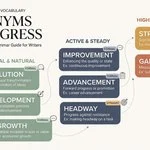
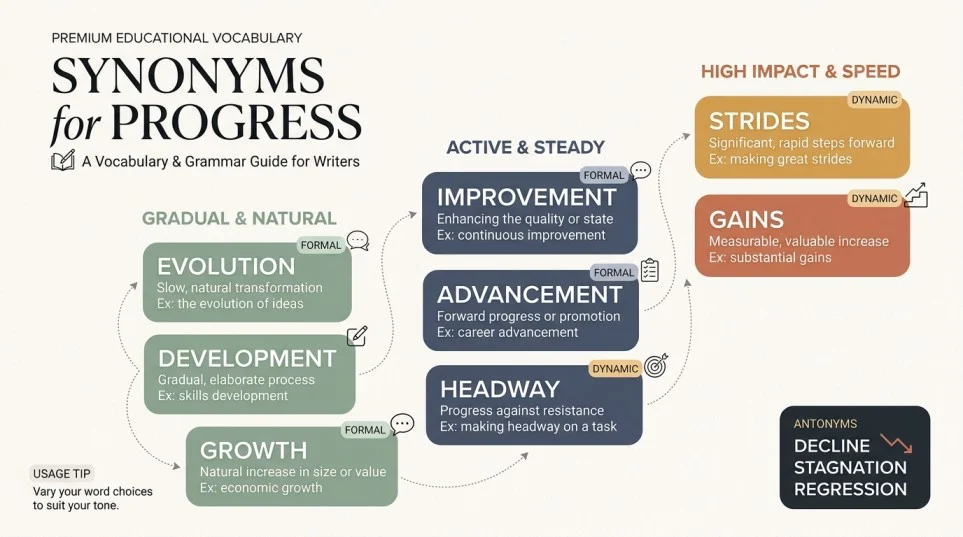
The best synonym depends on what kind of progress you mean. You might need advancement for professional writing, improvement for quality, growth for business or personal development, or headway for everyday conversation. This guide explains the differences so you can choose the right word naturally.
What Does Progress Mean?
Progress means movement toward a goal, improvement, or development over time. Formal choices include advancement and development, casual choices include headway and movement, academic choices include improvement and progression, and professional choices include growth and gains.
Meaning, Tone and Context
Simple Definition
Progress means movement toward a desired result, goal, condition, or level of development.
It can describe physical movement, personal improvement, academic development, business growth, technological change, or movement toward completing a task.
For example:
The project is making progress.
This sentence means the project is moving forward and getting closer to completion.
Progress can also describe a gradual improvement in quality, ability, performance, or condition.
For example:
She has made significant progress in her writing.
Here, progress refers to improvement in her ability.
Part of Speech
Progress is commonly used as both a noun and a verb.
As a noun, it refers to movement or improvement.
Example:
The team has made good progress.
As a verb, it means to move forward or develop.
Example:
The research is progressing well.
Tone
Progress usually has a positive or neutral tone.
It often suggests improvement, forward movement, or successful development. However, the word itself does not guarantee a positive result.
For example:
The negotiations made little progress.
The sentence is neutral in structure but communicates disappointment because the expected movement did not happen.
Formality Level
Progress works well in almost every level of communication.
It is appropriate in casual conversation, academic writing, professional reports, business emails, resumes, presentations, and social media.
Because it is so versatile, it can sometimes feel too general. A more specific synonym can make your meaning stronger.
Common Use Cases
Progress is frequently used when discussing:
- Education and learning
- Career development
- Business growth
- Project completion
- Personal development
- Scientific research
- Technology
- Health and recovery
- Creative work
- Social change
- Skills development
- Long term goals
Important Word Forms
The noun is progress.
The verb is progress.
The related adjective progressive can describe something that supports development or change.
The adverb progressively describes something that develops gradually.
The opposite idea can be expressed with words such as decline, regression, stagnation, or deterioration, depending on the situation.
When and How to Use Progress
Use progress when you want to describe movement toward a goal, improvement over time, or development from one stage to another.
It is especially useful when the exact type of improvement is not the main focus.
Professional Example
The marketing team has made steady progress on the new campaign.
This sounds natural in workplace communication because progress refers to movement toward completion.
Academic Example
Students showed measurable progress throughout the semester.
Here, progress refers to development in knowledge or academic ability.
Personal Example
I have made good progress with my writing skills this year.
The word works well because the sentence focuses on gradual personal improvement.
Social Media Example
Small steps still count as progress.
This use is common in motivational captions because progress suggests personal growth without requiring a specific measurement.
Another Word for Progress
The best single replacement depends on the meaning you want to communicate.
For general improvement, improvement is usually the safest choice.
For professional development, advancement is often stronger.
For business or financial development, growth may be more suitable.
For everyday conversation, headway sounds natural.
For academic writing, development or progression can provide greater precision.
Professional Writing
Use advancement, development, growth, or improvement.
Example:
The company has achieved strong growth in international markets.
Academic Writing
Use development, progression, advancement, improvement, or evolution.
Example:
The study examines the development of language skills among adult learners.
Casual Conversation
Use headway, movement, or improvement.
Example:
We are finally making some headway with the project.
Emotional Writing
Use growth, recovery, improvement, or strides.
Example:
She has made remarkable strides since beginning her new chapter.
Creative Writing
Use evolution, growth, advancement, movement, or unfolding development.
Example:
The character undergoes a quiet evolution throughout the story.
Resume or Workplace Use
Use advancement, growth, development, gains, or achievements when the context supports them.
Example:
Demonstrated significant growth in client retention.
Social Media Captions
Use growth, strides, improvement, movement, or forward movement.
Example:
Proud of the progress I have made this year.
Stronger Meaning
Use advancement, strides, breakthrough, or major gains when the context clearly shows substantial movement.
Breakthrough is not a general replacement for progress. It works best when an important obstacle has been overcome.
Softer Meaning
Use movement, development, gradual improvement, or small gains when the change is limited or still developing.
When Not to Use Progress
Progress can become too vague when readers need to know exactly what changed.
For example:
The company made progress.
This sentence does not tell the reader whether sales increased, costs decreased, customers grew, or a project moved closer to completion.
A more precise sentence could be:
The company increased customer retention by 12 percent.
The second sentence provides measurable information instead of using a broad term.
Progress can also sound too weak when a major achievement deserves stronger language.
For example:
The researchers made progress.
If they discovered something important, you might write:
The researchers achieved a significant breakthrough.
On the other hand, breakthrough would sound excessive if the team simply completed another routine step.
Words Commonly Confused With Progress
Progress vs. Advancement
Progress is a broad term for movement or improvement.
Advancement usually suggests movement toward a higher level, position, stage, or degree of development.
Use advancement when upward development is important.
Progress vs. Improvement
Improvement focuses specifically on becoming better.
Progress can describe movement toward a goal even when the result is not necessarily better in every sense.
For example, a project can make progress by reaching the next stage.
Progress vs. Growth
Growth usually suggests an increase in size, ability, influence, quantity, or maturity.
Progress focuses more directly on movement toward a goal.
A company can experience growth in revenue while making progress toward a broader business goal.
Progress vs. Development
Development emphasizes the process of becoming more advanced, complete, mature, or capable.
Progress emphasizes movement toward an objective.
Development is especially useful in academic, professional, technological, and personal contexts.
Progress vs. Movement
Movement simply means a change in position or direction.
Progress implies movement toward something desirable or intended.
A project can have movement without making meaningful progress.
Progress vs. Achievement
Achievement refers to something successfully accomplished.
Progress refers to movement toward that accomplishment.
You can make progress without reaching the final goal.
Best Synonym by Context for Progress
Which Synonym Should You Choose?
Start by identifying what kind of progress you are describing.
If something is becoming better, improvement is usually the clearest choice.
If something is becoming larger or more successful, growth may be better.
If something is moving toward a higher level, advancement is a strong option.
If a skill, idea, person, or system is changing over time, development or evolution may be more precise.
If you are speaking casually about getting closer to a goal, headway sounds natural.
If the improvement is substantial, strides can communicate stronger intensity.
If the change is small, movement or gradual development may be more accurate.
Always consider the audience. A word that sounds natural in a conversation may not be the best choice for a research paper or business report.
Real Life Examples of Progress in Sentences
School
The student has made noticeable progress in mathematics.
Her academic development became more consistent after she changed her study routine.
Workplace
The team has made steady progress on the project.
The department achieved significant gains in customer satisfaction.
Writing
My writing has improved through regular practice.
The author shows clear development in her storytelling style.
Conversation
We are making good headway on the renovation.
I feel like I am finally moving forward.
Social Media
Every small step is still progress.
This year has been about growth, patience, and consistency.
Resume
Led initiatives that supported the advancement of internal training programs.
Improved customer response times through process development.
I wanted to share a quick update on our progress.
We have made good headway and expect to complete the remaining work soon.
Storytelling
Over the years, the character undergoes a gradual evolution.
Her emotional growth becomes clear as the story unfolds.
18 Synonyms for Progress
Synonym Groups and Usage Differences
Professional vs. Personal Synonyms
Professional writing often benefits from advancement, development, growth, gains, and improvement.
These words work well because they can describe measurable changes in performance, skills, business results, or career development.
Personal writing can use growth, improvement, recovery, strides, and maturation.
These choices can sound warmer and more reflective when discussing personal goals or life changes.
Formal vs. Conversational Synonyms
Formal writing often favors advancement, development, progression, enhancement, and evolution.
These words work well in reports, essays, research papers, presentations, and formal communication.
Conversational English often favors progress, improvement, headway, movement, and growth.
For example:
We are making good headway.
This sounds more conversational than:
We are achieving significant advancement.
Both can be correct, but the tone is different.
Academic Synonyms
Academic writing benefits from precise words.
Development is useful for skills, theories, ideas, and processes.
Progression works well when something moves through identifiable stages.
Advancement can describe progress in knowledge, research, technology, or a field of study.
Evolution works when the focus is gradual change over time.
Improvement is best when the quality or performance itself becomes better.
Professional and Business Synonyms
Business writing frequently uses growth, advancement, development, gains, improvement, and expansion.
Growth is particularly useful for revenue, customers, market share, teams, or business operations.
Expansion emphasizes increased size or reach.
Advancement can refer to career development, technology, processes, or strategic goals.
Gains usually suggest measurable positive results.
Creative or Literary Synonyms
Creative writing gives you more freedom.
Evolution can describe the changing identity of a character, relationship, organization, or idea.
Growth can communicate emotional development.
Maturation can suggest that a character becomes more experienced or emotionally developed.
Movement can create a subtle sense of change without making the development sound dramatic.
Slang or Modern Synonyms
Progress does not have many true slang equivalents.
Words such as headway and strides can sound relaxed in everyday speech, but they are not slang.
Expressions such as moving forward are also common in modern professional and social communication.
Avoid forcing trendy language into formal writing when a simple word such as progress or improvement already communicates the idea clearly.
Strongest vs. Weaker Synonyms
A useful intensity scale can help you choose the right word.
Breakthrough is best treated as a stronger context specific expression rather than a direct synonym in every sentence.
Emotional vs. Neutral Synonyms
Growth often carries a positive and personal feeling.
Recovery can carry emotional meaning because it suggests returning from a difficult condition.
Strides can sound encouraging and motivational.
Development is more neutral and factual.
Progress is also relatively neutral and can work in both positive and objective contexts.
Improvement usually has a clearly positive meaning because something has become better.
Antonyms of Progress
The following words can express the opposite of progress depending on the context. Some are direct opposites, while others describe specific forms of losing forward movement.
Comparison: Progress vs. Similar Words
Progress vs. Advancement
The main difference is focus.
Progress is broad and can describe any movement toward a goal.
Advancement usually suggests movement toward a higher level.
Advancement is often more formal.
Progress example:
The project is making steady progress.
Advancement example:
The advancement of medical technology has improved treatment options.
Progress vs. Improvement
Improvement specifically means becoming better.
Progress can simply mean moving closer to a goal.
Improvement is stronger when quality or performance is the main focus.
Progress example:
We are making progress toward completing the project.
Improvement example:
We have seen a major improvement in project quality.
Progress vs. Growth
Growth emphasizes increase, expansion, or maturity.
Progress emphasizes forward movement.
Growth is particularly useful in business, personal development, finance, and organizations.
Progress example:
The team is making progress toward its annual goal.
Growth example:
The company achieved strong growth in revenue.
Progress vs. Development
Development focuses on the process of becoming more advanced, complete, or capable.
Progress focuses on movement toward a goal.
Development often sounds more academic or professional.
Progress example:
She is making progress in her studies.
Development example:
Her language development has accelerated this year.
Progress vs. Movement
Movement is a general term for change or activity.
Progress suggests that the movement is heading toward a desired result.
Progress is therefore more goal focused.
Progress example:
The negotiations are making progress.
Movement example:
There has been some movement in the negotiations.
Progress vs. Achievement
Progress is the journey toward a goal.
Achievement is the successful result of reaching or completing something.
Progress example:
The team has made significant progress.
Achievement example:
Completing the project was a major achievement.
Common Phrases and Expressions with Progress
1. Make Progress
Meaning:
To move closer to a goal or improve over time.
Example sentence:
She continues to make progress in her writing.
2. Make Steady Progress
Meaning:
To improve or move forward consistently.
Example sentence:
The team is making steady progress toward completion.
3. Show Progress
Meaning:
To demonstrate evidence of improvement or development.
Example sentence:
The student is showing clear progress in reading comprehension.
4. Measure Progress
Meaning:
To evaluate how much development or improvement has occurred.
Example sentence:
The manager uses monthly reports to measure progress.
5. Track Progress
Meaning:
To regularly observe or record development over time.
Example sentence:
We track progress throughout the training program.
6. Progress Toward a Goal
Meaning:
Movement in the direction of a desired result.
Example sentence:
Small actions can create meaningful progress toward a long term goal.
7. Progress in Something
Meaning:
Improvement or development in a particular area.
Example sentence:
He has made impressive progress in public speaking.
8. Progress Report
Meaning:
A report that explains current development, results, or movement toward completion.
Example sentence:
The teacher sent a progress report to the parents.
Common Mistakes to Avoid
1. Using Progress When a More Precise Word Is Better
Progress is useful, but it can be vague.
Instead of saying:
The company made progress.
You could say:
The company increased sales by 15 percent.
Specific language gives readers more useful information.
2. Confusing Progress With Achievement
Progress describes movement toward a result.
Achievement describes the result itself.
You can make progress without achieving the final goal.
3. Using a Casual Synonym in Formal Writing
Headway works well in everyday communication.
However, advancement, development, or improvement may sound more suitable in a formal report.
Always consider your audience.
4. Using an Overly Dramatic Synonym
Words such as strides and breakthrough suggest noticeable or substantial change.
Do not use them for a small routine improvement.
For a minor change, progress or movement may be more accurate.
5. Repeating Progress Too Often
Repeating the same word can make writing feel flat.
Use appropriate alternatives such as improvement, development, growth, advancement, or headway when the meaning remains accurate.
6. Choosing the Wrong Emotional Tone
Growth may sound encouraging.
Development sounds more neutral.
Regression sounds negative.
Choose the word that matches the actual feeling and meaning of your sentence.
FAQs
What Is the Best Synonym for Progress?
The best synonym depends on context. Improvement works for becoming better, advancement for moving higher, growth for expansion, and headway for casual discussion.
What Is a Formal Synonym for Progress?
Advancement is a strong formal synonym for progress. Development, progression, and improvement can also work well in academic and professional writing.
What Is an Informal Synonym for Progress?
Headway is a natural informal alternative, especially when discussing movement toward a goal. Movement and getting somewhere can also work conversationally.
What Is Another Word for Progress in Professional Writing?
Advancement, development, growth, improvement, and gains are useful professional alternatives. The best choice depends on whether you mean skills, results, size, or performance.
What Is the Difference Between Progress and Improvement?
Progress means movement toward a goal, while improvement specifically means becoming better. Something can make progress without improving every aspect of its condition.
What Is the Opposite of Progress?
Common opposites include decline, regression, stagnation, deterioration, setback, reversal, and standstill. The most accurate choice depends on the situation.
Conclusion
Progress describes movement toward a goal, improvement, or development over time. It is a flexible word that works in everyday conversation, academic writing, workplace communication, resumes, emails, and social media.
The best synonym depends on your intended meaning. Use advancement for formal development, improvement for becoming better, growth for expansion, development for gradual change, headway for casual communication, and strides for noticeable gains.
Before replacing progress, ask what actually changed. Did something become better, larger, more advanced, more mature, or simply closer to completion? That small distinction can help you choose a more accurate word and make your writing clearer.
Discover More Post:
- 25+ Synonyms for Superior | Meanings, Examples, and Best …
- 25+ Synonyms for Inspiring | Meanings, Examples, and Best …
- 25+ Synonyms for Overcome | Meanings, Examples, and Best …