We use okay constantly. It can appear in texts, emails, conversations, essays, captions, workplace messages, and even professional documents.
The problem is that okay can mean several different things. It can show agreement, acceptance, permission, satisfaction, or that something is simply good enough.
Choosing a more precise word can make your writing sound clearer and more intentional. A professional email may need acceptable, a casual conversation may call for fine, and an enthusiastic response may be better expressed with great.
This guide explains the meaning of okay, its tone, accurate alternatives, common mistakes, and the best synonym for different situations.
What Does “Okay” Mean?
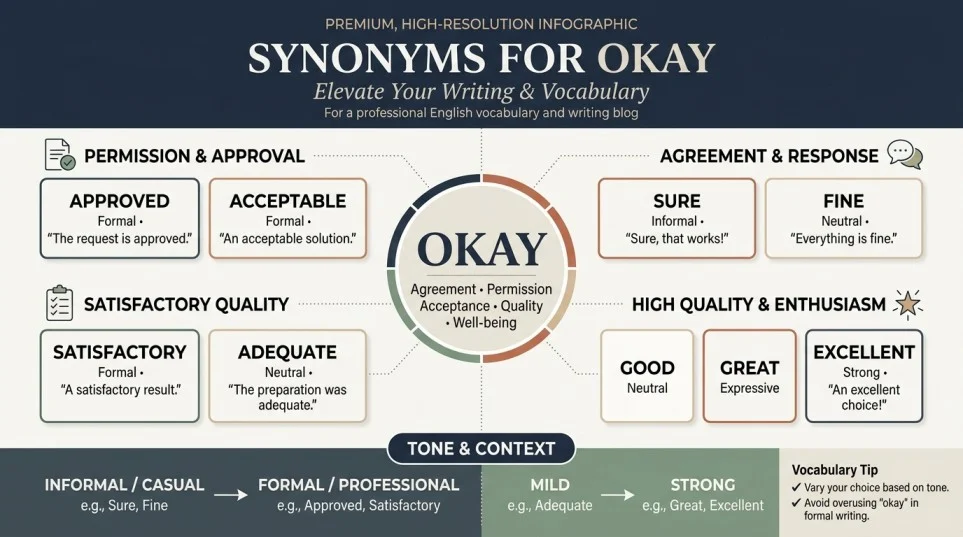
Okay generally means acceptable, satisfactory, permitted, agreed upon, or in an acceptable condition. Formal alternatives include acceptable and satisfactory, casual choices include fine and sure, while stronger choices include great and excellent.
Meaning, Tone and Context
1. Simple Definition
Okay means acceptable, satisfactory, suitable, or agreeable depending on the situation.
For example:
The proposal is okay.
This could mean the proposal is acceptable, although it does not necessarily suggest that it is excellent.
In another context, okay can express agreement:
Okay, I will send it tonight.
Here, the word means something closer to agreed, sure, or all right.
Okay can also describe someone’s condition:
Are you okay?
In this sentence, it asks whether someone is safe, healthy, or emotionally well.
2. Part of Speech
Okay can function in several ways.
- As an adjective, it can describe something acceptable or satisfactory.
The results are okay.
- As an interjection, it can express agreement, acknowledgment, or acceptance.
Okay, I understand.
- As a verb, it can mean to approve or authorize something.
The manager okayed the request.
The related noun form is okayness, although it is less common and usually unnecessary in polished writing.
3. Positive, Negative, or Neutral Tone
Okay is usually neutral, but its tone depends heavily on context and delivery.
The presentation was okay.
This may sound mildly positive, but it can also suggest that the presentation was merely adequate.
Okay, that works for me.
This sounds accepting and positive enough for ordinary conversation.
Are you okay?
This can sound caring and concerned when directed toward someone who may be upset or hurt.
4. Formality Level
Okay is common in everyday American English and is generally conversational.
It works well in texts, casual emails, friendly conversations, and ordinary workplace communication.
For formal reports, academic writing, legal documents, or highly polished professional communication, a more precise alternative may be preferable.
For example:
The results are okay.
A more precise professional version could be:
The results are acceptable.
5. Common Use Cases
Okay commonly appears when people want to express:
- Agreement
- Acceptance
- Permission
- Satisfactory quality
- Safety or well being
- Understanding
- Acknowledgment
- Emotional reassurance
- Approval
- A neutral reaction
Because the word has so many meanings, the best synonym depends on what you actually want to communicate.
When and How to Use “Okay”
Use okay when the situation is informal or when a broad, neutral expression is appropriate.
Professional
Okay, I will review the document before the meeting.
For a more formal email, you could write:
I will review the document before the meeting.
Personal
Are you okay after the long drive?
Here, okay refers to someone’s physical or emotional condition.
Academic
Okay is acceptable in a classroom discussion, but a more precise term may be better in an academic essay.
Emotional
It is okay to feel disappointed after receiving difficult news.
Here, okay communicates reassurance and emotional acceptance.
Social Media
Okay, this might be my favorite photo of the year.
The word adds a conversational and enthusiastic tone.
Casual
Okay, let us meet at seven.
Here, okay simply signals agreement or acknowledgment.
Another Word for “Okay”
There is no single replacement that works in every sentence. The best alternative depends on the intended meaning.
Professional Writing
Use acceptable, satisfactory, or approved when you need a precise professional meaning.
The revised proposal is acceptable.
Academic Writing
Use acceptable, adequate, or satisfactory when discussing quality or standards.
The evidence provides adequate support for the conclusion.
Casual Conversation
Use fine, sure, alright, or all right.
Sure, I can help you with that.
Emotional Writing
Use fine, safe, well, or alright depending on the intended meaning.
She wanted everyone to know that she was safe.
Creative Writing
Words such as well, fine, content, satisfied, or at ease can create a more specific emotional effect.
Resume or Workplace Use
Avoid vague statements such as:
Okay communication skills
Instead, use precise descriptions such as:
Strong communication skills
or:
Effective communication skills
Social Media Captions
Casual alternatives such as fine, great, perfect, sure, and alright can work depending on the mood.
Stronger Meaning
If okay means more than merely acceptable, use good, great, excellent, or outstanding.
Softer Meaning
If you want to sound cautious rather than enthusiastic, use acceptable, adequate, or satisfactory.
When Not to Use “Okay”
Okay can be too vague when the reader needs precise information.
For example:
The project is okay.
This does not tell the reader whether the project is satisfactory, approved, complete, successful, or simply not terrible.
A clearer sentence would be:
The project meets the required standards.
Okay can also sound too casual in highly formal writing.
Instead of:
The application is okay.
Use:
The application is acceptable.
Another issue is emotional ambiguity.
I am okay.
Depending on the situation, this could mean the speaker is healthy, emotionally stable, safe, satisfied, or simply unwilling to explain further.
A more precise statement may communicate the intended meaning better.
Words Commonly Confused With “Okay”
Okay vs. Fine
Okay and fine often overlap, especially when describing an acceptable situation.
However, fine can sometimes communicate a stronger sense of satisfaction.
The meal was okay.
This suggests an average experience.
The meal was fine.
This can also mean average, but may sound slightly more accepting.
Okay vs. Good
Good generally communicates a positive evaluation.
Okay often means acceptable but not especially impressive.
The movie was okay.
The movie was good.
The second sentence gives a more clearly positive evaluation.
Okay vs. Acceptable
Acceptable is more precise and formal.
The quality is acceptable.
This sounds appropriate for professional or academic contexts.
The quality is okay.
This sounds more conversational and less specific.
Okay vs. Approved
Approved means officially accepted or authorized.
The budget was approved.
This is much more specific than:
The budget is okay.
Okay vs. Alright
Alright is commonly used as a conversational alternative to okay.
Alright, let us begin.
It can also describe a satisfactory condition.
I am alright.
In formal writing, okay, acceptable, or another precise term may be preferable depending on the sentence.
Okay vs. Fine
Both can describe a satisfactory condition, but fine can sometimes carry emotional implications.
I am okay.
This may simply report a condition.
I am fine.
Depending on tone, this may genuinely reassure someone or suggest that the speaker does not want to discuss the issue further.
Best Synonym by Context for “Okay”
| Context | Best Synonym | Why It Works | Example |
|---|---|---|---|
| Formal writing | Acceptable | Clear and appropriately formal | The proposal is acceptable. |
| Academic writing | Adequate | Indicates that a standard has been met | The sample size was adequate for the study. |
| Professional or business use | Satisfactory | Clearly evaluates quality | The final results were satisfactory. |
| Resume | Effective | Describes useful performance more precisely | She demonstrated effective communication skills. |
| Casual conversation | Fine | Natural and familiar | I am fine with that plan. |
| Creative writing | Content | Adds a specific emotional meaning | He felt content with his decision. |
| Emotional tone | Well | Focuses on condition or health | She is doing well now. |
| Strong intensity | Excellent | Clearly expresses high quality | The final presentation was excellent. |
| Soft or moderate tone | Adequate | Suggests sufficiency without exaggeration | The explanation was adequate. |
| Social media captions | Great | Sounds energetic and positive | Great, another weekend adventure. |
| Permission | Approved | Clearly expresses authorization | Your request has been approved. |
| Agreement | Sure | Natural for accepting a request | Sure, I can join the meeting. |
| Safety | Safe | More precise when discussing danger | Everyone is safe. |
| Quality | Satisfactory | Useful for evaluations | The service was satisfactory. |
| Understanding | Understood | Clearly communicates comprehension | Understood, I will make the change. |
| Approval | Approved | Indicates formal authorization | The plan was approved by the committee. |
Which Synonym Should You Choose?
Choosing an alternative to okay starts with identifying what okay actually means in your sentence.
- If you mean acceptable quality, choose acceptable, adequate, or satisfactory.
- If you mean agreement, choose sure, agreed, or certainly.
- If you mean permission, choose approved, authorized, or permitted.
- If you mean good quality, choose good, great, excellent, or outstanding.
- If you mean physical or emotional well being, choose well, fine, or safe, depending on the situation.
- If you mean understanding, use understood or got it in casual conversation.
The most effective synonym is not necessarily the most sophisticated word. It is the word that communicates your exact meaning with the right tone.
Real Life Examples of “Okay” in Sentences
School
The answer is okay, but you should explain your reasoning more clearly.
A more precise academic alternative is:
The answer is acceptable, but your reasoning needs further explanation.
Workplace
Okay, I will send the updated report this afternoon.
A more formal workplace version is:
Certainly, I will send the updated report this afternoon.
Writing
The opening paragraph is okay, but the main idea could be clearer.
A stronger editorial version is:
The opening paragraph is adequate, but the main idea could be clearer.
Conversation
Okay, I will meet you outside the restaurant.
Here, okay naturally communicates agreement.
Social Media
Okay, this sunset is incredible.
Here, okay works as a conversational expression of excitement.
Resume
Instead of:
Okay customer service skills
write:
Effective customer service skills
The second version gives the reader meaningful information about your ability.
Okay, I received your message.
A more professional option is:
Thank you, I received your message.
Storytelling
He paused and asked whether everyone was okay.
Here, okay creates a natural conversational tone and communicates concern for the characters.
18 Synonyms for “Okay”
Because okay has several meanings, the following words are accurate alternatives only in particular contexts. They should not be treated as interchangeable in every sentence.
| Synonym | Simple Meaning | Best Used For | Example Sentence |
|---|---|---|---|
| Acceptable | Good enough to meet a standard | Formal evaluation | The revised proposal is acceptable. |
| Adequate | Sufficient for a purpose | Academic and professional contexts | The evidence was adequate for the report. |
| Satisfactory | Meets expectations | Reviews and evaluations | The final results were satisfactory. |
| Fine | Acceptable or satisfactory | Casual conversation | Fine, I will handle it. |
| Alright | Acceptable, well, or agreed | Casual conversation | Alright, let us get started. |
| Good | Positive or satisfactory | General evaluation | The results look good. |
| Great | Very good | Positive conversation | Great, I will see you tomorrow. |
| Excellent | Extremely good | Strong positive evaluation | Her presentation was excellent. |
| Outstanding | Exceptionally good | Professional praise | His performance was outstanding. |
| Sure | Agreeing or accepting | Requests and conversation | Sure, I can help you. |
| Agreed | Accepting a proposal or opinion | Discussion and business | Agreed, that is the best approach. |
| Certainly | Definitely, or yes | Polite professional communication | Certainly, I can send the details. |
| Approved | Officially accepted | Permission and authorization | The request was approved. |
| Authorized | Officially permitted | Business and legal contexts | The payment was authorized. |
| Permitted | Allowed | Rules and permission | Visitors are permitted to enter. |
| Understood | Comprehended or acknowledged | Workplace communication | Understood, I will revise the document. |
| Well | In good health or condition | Personal and emotional contexts | She is feeling well today. |
| Content | Satisfied and at ease | Emotional and creative writing | He was content with the final decision. |
Synonym Groups and Usage Differences
Professional vs. Personal Synonyms
Professional communication usually benefits from precision.
Instead of:
The results are okay.
you could write:
The results are satisfactory.
Personal conversations allow more flexibility.
Okay, I will call you later.
Here, replacing okay with a formal term would sound unnatural.
Formal vs. Conversational Synonyms
For reports, academic assignments, and formal correspondence, consider:
- Acceptable
- Adequate
- Satisfactory
- Approved
- Authorized
- Permitted
For everyday conversations and texts, consider:
- Fine
- Alright
- Sure
- Great
- Good
The right choice depends on both the audience and the intended meaning.
Academic Synonyms
Academic writing usually benefits from precision rather than casual wording.
Instead of:
The sample was okay.
write:
The sample was adequate for the analysis.
Instead of:
The explanation was okay.
write:
The explanation was satisfactory but could be expanded.
Professional and Business Synonyms
Workplace communication often requires a clear distinction between acceptance, approval, quality, and agreement.
- Use approved for official authorization.
- Use acceptable for meeting a standard.
- Use satisfactory for evaluating quality.
- Use understood for acknowledging instructions.
- Use certainly for polite agreement.
Creative or Literary Synonyms
Creative writing gives you more freedom to choose a word based on emotion and characterization.
Content can suggest peaceful satisfaction.
Fine can sound restrained or emotionally guarded.
Well can describe physical or emotional condition.
Great can create an enthusiastic voice.
The best choice depends on the personality and mood of the character.
Slang or Modern Synonyms
Casual expressions such as yep, sure, got it, and no problem can sometimes replace okay in conversation.
They are useful in texts, chats, and informal speech.
However, they may be inappropriate in academic essays, formal reports, resumes, and highly professional correspondence.
Strongest vs. Weaker Synonyms
A useful intensity scale is:
Adequate → Acceptable → Satisfactory → Good → Great → Excellent → Outstanding
This scale is approximate because the words measure slightly different qualities.
Adequate suggests that something is sufficient.
Acceptable suggests that it meets a standard.
Satisfactory suggests that expectations have been met.
Good expresses clear positive value.
Great expresses stronger enthusiasm.
Excellent signals a high level of quality.
Outstanding suggests exceptional performance.
Emotional vs. Neutral Synonyms
Neutral choices include:
- Acceptable
- Adequate
- Satisfactory
- Approved
More emotionally positive choices include:
- Great
- Excellent
- Outstanding
More personal or emotional choices include:
- Fine
- Well
- Content
A synonym can therefore change not only the meaning but also the emotional impression of your sentence.
Antonyms of “Okay”
Okay has several meanings, so its opposites also depend on context.
| Antonym | Meaning | Example Sentence |
|---|---|---|
| Unacceptable | Not suitable or approved | The proposal was unacceptable. |
| Inadequate | Not sufficient | The evidence was inadequate. |
| Unsatisfactory | Failing to meet expectations | The service was unsatisfactory. |
| Poor | Low in quality | The results were poor. |
| Bad | Not good | The weather was bad. |
| Terrible | Extremely bad | The experience was terrible. |
| Awful | Very unpleasant or poor | The food was awful. |
| Excellent | Exceptionally good when contrasting quality | The first draft was weak, but the final version was excellent. |
| Unwell | Not healthy | She felt unwell after the trip. |
| Unsafe | Not free from danger | The area was unsafe after dark. |
| Unapproved | Not officially accepted | The expense was unapproved. |
| Unauthorized | Not officially permitted | The transaction was unauthorized. |
| Forbidden | Not allowed | Photography was forbidden inside the building. |
| Disagree | To have a different opinion | I disagree with that conclusion. |
| Refuse | To decline or reject | He refused the offer. |
Some of these are contextual opposites rather than direct dictionary opposites. For example, excellent contrasts with okay when okay means merely adequate, while unsafe contrasts with okay when okay means safe.
Comparison: “Okay” vs. Similar Words
Okay vs. Fine
Main difference: Both can mean acceptable, but fine often sounds slightly more positive or more personally reassuring.
Which one is stronger: Fine can sound somewhat more positive.
Which one is more formal: Neither is especially formal.
Examples:
The plan is okay.
The plan is fine.
Okay vs. Good
Main difference: Good normally expresses a clearer positive evaluation.
Which one is stronger: Good is generally stronger.
Which one is more formal: Neither is highly formal, although good is common in many professional contexts.
Examples:
The results are okay.
The results are good.
Okay vs. Acceptable
Main difference: Acceptable specifically indicates that something meets a required standard.
Which one is stronger: Acceptable is more precise, not necessarily stronger.
Which one is more formal: Acceptable is more formal.
Examples:
The quality is okay.
The quality is acceptable.
Okay vs. Adequate
Main difference: Adequate means sufficient for a particular purpose.
Which one is stronger: Neither is inherently stronger, but adequate is more precise about sufficiency.
Which one is more formal: Adequate is more formal.
Examples:
The explanation is okay.
The explanation is adequate for the assignment.
Okay vs. Approved
Main difference: Approved means officially accepted or authorized.
Which one is stronger: Approved is more specific.
Which one is more formal: Approved is more formal in administrative contexts.
Examples:
Is the plan okay?
Has the plan been approved?
Okay vs. Alright
Main difference: Alright is a common conversational alternative that can mean acceptable, well, or agreed.
Which one is stronger: Neither is consistently stronger.
Which one is more formal: Neither is highly formal.
Examples:
Okay, I understand.
Alright, I understand.
Common Phrases and Expressions with “Okay”
1. Okay with
Meaning:
To be accepting or comfortable with something.
Example sentence:
Are you okay with changing the meeting time?
2. Okay, then
Meaning:
A conversational way to acknowledge a decision or move forward.
Example sentence:
Okay, then, we will meet tomorrow.
3. Is that okay?
Meaning:
A way to ask whether something is acceptable.
Example sentence:
Is it okay if I send the report tomorrow?
4. It is okay
Meaning:
A reassurance that something is acceptable or not a problem.
Example sentence:
It is okay to make mistakes while learning.
5. Are you okay?
Meaning:
A question about someone’s physical, emotional, or general condition.
Example sentence:
You seem quiet today. Are you okay?
6. Okay for now
Meaning:
Acceptable at the present time, even if it may not be ideal permanently.
Example sentence:
This temporary solution is okay for now.
7. Okay to proceed
Meaning:
Permission or approval to continue.
Example sentence:
Once the client confirms the details, we will be okay to proceed.
Common Mistakes to Avoid
1. Using Okay When a Precise Word Is Better
The application is okay.
This does not clearly communicate whether the application is approved, complete, or satisfactory.
Better:
The application has been approved.
2. Confusing Okay With Good
Okay often means acceptable, while good usually communicates stronger approval.
The presentation was okay.
does not necessarily mean:
The presentation was good.
Choose based on the level of praise you intend.
3. Using Casual Language in Formal Writing
Words such as fine, sure, and alright may sound too conversational in some formal contexts.
For professional or academic writing, consider acceptable, satisfactory, or another precise term.
4. Using an Overly Dramatic Synonym
Do not replace okay with outstanding when the situation only calls for mild approval.
The report was outstanding.
is much stronger than:
The report was okay.
The synonym should match the actual level of quality.
5. Repeating Okay Too Often
Frequent repetition can make writing sound flat.
Instead of:
The plan is okay. The timing is okay. The budget is okay.
Try:
The plan is acceptable. The timing works well, and the budget meets our requirements.
6. Choosing the Wrong Emotional Tone
I am great.
does not always communicate the same thing as:
I am okay.
If someone is checking whether you are safe or emotionally stable, great can sound overly positive or simply answer a different question.
7. Using Slang in Academic or Professional Writing
Expressions such as yep, no problem, or got it can be natural in conversation but inappropriate in some formal documents.
Always consider the audience before choosing a casual alternative.
FAQs
What is the best synonym for okay?
The best synonym depends on meaning. Use acceptable for standards, fine for casual conversation, approved for authorization, and great for stronger positive reactions.
What is a formal synonym for okay?
Acceptable, adequate, and satisfactory are useful formal alternatives when okay means that something meets a required standard.
What is an informal synonym for okay?
Common informal alternatives include fine, alright, sure, and great. Choose based on whether you mean acceptance, agreement, or positive evaluation.
What is another word for okay in professional writing?
Professional alternatives include acceptable, satisfactory, approved, authorized, and understood, depending on the specific meaning.
What is the difference between okay and fine?
Both can mean acceptable, but fine can sound somewhat more positive or reassuring. Okay is often more neutral and broadly applicable.
What is the opposite of okay?
The opposite depends on meaning. Unacceptable, inadequate, unsatisfactory, unsafe, unapproved, and unwell can all contrast with different uses of okay.
Conclusion
Okay is one of the most flexible words in everyday English, but that flexibility can also make it vague. It may communicate acceptance, agreement, permission, satisfactory quality, safety, or well being.
For formal writing, acceptable, adequate, and satisfactory are useful choices. For casual conversation, fine, alright, and sure often sound natural. Stronger praise, consider good, great, excellent, or outstanding.
The best synonym for okay is the one that communicates your exact meaning and matches your audience. Before replacing a familiar word with a more sophisticated alternative, ask what you actually want the reader to understand.
Read More Related Articles:
- 25+ Synonyms for Access | Meanings, Examples, and Best …
- 25+ Synonyms for Definitely | Meanings, Examples, and Best …
- 25+ Synonyms for Broken | Meanings, Examples, and Best …