Do you keep using extraordinary to describe impressive people, achievements, experiences, or ideas? The word is powerful, but repeating it can make your writing feel predictable.
Whether you are writing an essay, resume, email, caption, review, or story, the right synonym can make your message more precise. This guide explains which alternatives fit formal, academic, professional, emotional, casual, and creative situations.
What Does “Extraordinary” Mean?
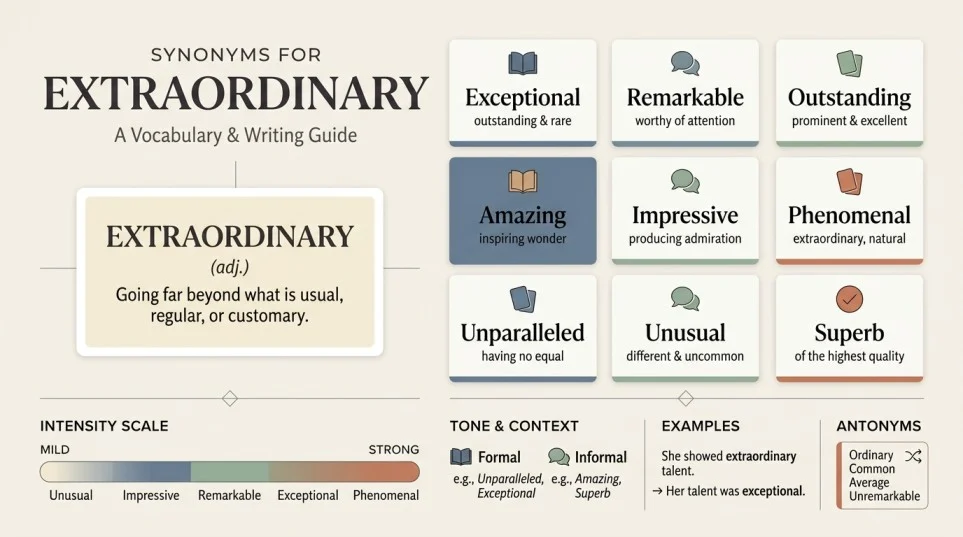
Extraordinary means unusually remarkable, impressive, or far beyond what is ordinary or expected. Depending on context, strong alternatives include exceptional, remarkable, outstanding, phenomenal, amazing, impressive, superb, unusual, and unparalleled.
Meaning, Tone and Context
Simple Definition
Extraordinary describes something that is noticeably different from what is normal, expected, or usual. It often suggests a high level of quality, ability, importance, or achievement.
For example, saying “She showed extraordinary leadership” means her leadership was far better or more remarkable than normally expected.
Part of Speech
Extraordinary is an adjective.
It describes a person, thing, experience, achievement, quality, event, or situation.
Tone
The word is usually positive, especially when it describes talent, success, beauty, courage, intelligence, or achievement.
However, it can also be neutral when it simply means unusual or outside the normal range.
Formality
Extraordinary works in both formal and informal English. It is common in academic writing, professional communication, journalism, speeches, reviews, and everyday conversation.
Common Use Cases
You can use extraordinary to describe:
- Exceptional talent
- Remarkable achievements
- Unusual circumstances
- Outstanding performance
- Exceptional courage
- Remarkable beauty
- Rare opportunities
- Impressive experiences
- Unusual events
- Exceptional qualities
Word Forms and Related Words
Extraordinary is an adjective.
Related expressions include ordinarily, ordinary, and extraordinarily.
The most common opposite is ordinary, meaning normal, usual, or not especially remarkable.
When and How to Use “Extraordinary”
Use extraordinary when something clearly stands apart from the ordinary. It is especially useful when you want to emphasize exceptional quality or an unusual degree of something.
Professional
“The company achieved extraordinary growth during the past year.”
Personal
“She showed extraordinary patience while helping her younger brother.”
Academic
“The study produced extraordinary results compared with previous experiments.”
Creative
“The travelers witnessed an extraordinary sunset over the desert.”
Another Word for “Extraordinary”
The best single replacement depends on what you want to emphasize.
| Situation | Recommended Word |
|---|---|
| Professional writing | Exceptional |
| Academic writing | Remarkable |
| Casual conversation | Amazing |
| Emotional writing | Incredible |
| Creative writing | Phenomenal |
| Resume or workplace use | Outstanding |
| Social media captions | Amazing |
| Stronger meaning | Unparalleled |
| Softer meaning | Unusual |
If you want a safe general replacement, remarkable is one of the most versatile choices.
When Not to Use “Extraordinary”
Avoid extraordinary when you need to communicate a very specific quality.
For example, “She had an extraordinary performance” is positive but broad. In a professional review, outstanding performance may communicate the intended praise more precisely.
Likewise, calling every enjoyable meal, interesting idea, or successful meeting “extraordinary” can weaken the impact of the word.
Choose exceptional for superior quality, unusual for something uncommon, remarkable for something worthy of attention, and phenomenal for very strong praise.
Words Commonly Confused With “Extraordinary”
Extraordinary vs. Exceptional
Both describe something significantly above normal. Exceptional usually emphasizes superior quality, ability, or performance.
Extraordinary vs. Unusual
Unusual means uncommon or different. It does not necessarily mean excellent.
Extraordinary vs. Remarkable
Remarkable describes something worthy of attention or notice. It is often slightly more neutral than extraordinary.
Extraordinary vs. Incredible
Incredible can mean extremely impressive in everyday speech. It can also mean difficult to believe.
Extraordinary vs. Exceptional
Exceptional is particularly useful when evaluating performance, ability, quality, or achievement.
Extraordinary vs. Phenomenal
Phenomenal is highly enthusiastic and often suggests an extremely impressive result, performance, or experience.
Best Synonym by Context for “Extraordinary”
| Context | Best Synonym | Why It Works | Example |
|---|---|---|---|
| Formal writing | Exceptional | Sounds polished and precise | She demonstrated exceptional judgment. |
| Academic writing | Remarkable | Fits analytical descriptions | The researchers observed remarkable changes. |
| Professional or business use | Outstanding | Clearly communicates superior performance | The team delivered outstanding results. |
| Resume | Exceptional | Highlights valuable ability | Demonstrated exceptional problem solving skills. |
| Casual conversation | Amazing | Natural and familiar | That concert was amazing. |
| Creative writing | Phenomenal | Adds energy and intensity | A phenomenal storm transformed the landscape. |
| Emotional tone | Incredible | Expresses strong personal reaction | Her courage was incredible. |
| Strong intensity | Unparalleled | Suggests nothing compares | The artist achieved unparalleled success. |
| Soft or moderate tone | Unusual | Focuses on difference rather than praise | We noticed an unusual pattern. |
| Social media captions | Amazing | Short, familiar, and expressive | What an amazing view! |
| US usage | Remarkable | Natural across formal and casual settings | It was a remarkable achievement. |
| UK usage | Exceptional | Widely understood and suitably formal | She gave an exceptional performance. |
Which Synonym Should You Choose?
Start with the exact meaning you want to express.
Use unusual when something is simply different from normal. Choose remarkable when it deserves attention. Use exceptional when quality or ability is unusually high.
For strong praise, consider outstanding, phenomenal, superb, incredible, or unparalleled.
For professional communication, avoid exaggerated language unless the achievement genuinely deserves it. Words such as exceptional, outstanding, remarkable, and impressive usually sound credible.
For creative or emotional writing, stronger words can create more energy and personality.
Real Life Examples of “Extraordinary” in Sentences
School
“The student produced an extraordinary research project that demonstrated careful analysis.”
Workplace
“Her extraordinary leadership helped the team complete the project ahead of schedule.”
Writing
“The memoir tells the extraordinary story of a family rebuilding its life after a difficult journey.”
Conversation
“That was an extraordinary experience.”
Social Media
“An extraordinary view from the top of the mountain.”
Resume
“Delivered extraordinary customer service while managing a high volume of daily requests.”
“Thank you for your extraordinary support during this important project.”
Storytelling
“An extraordinary discovery changed the direction of his entire journey.”
18 Synonyms for “Extraordinary”
| Synonym | Simple Meaning | Best Used For | Example Sentence |
|---|---|---|---|
| Exceptional | Much better than usual | Performance and ability | She showed exceptional leadership. |
| Remarkable | Worthy of attention | Achievements and results | The team made remarkable progress. |
| Outstanding | Extremely good | Work and performance | His presentation was outstanding. |
| Amazing | Very impressive | Casual speech and captions | We had an amazing time. |
| Incredible | Extremely impressive | Emotional reactions | Her recovery was incredible. |
| Phenomenal | Exceptionally impressive | Strong praise | The company experienced phenomenal growth. |
| Unparalleled | Having no equal | High level achievements | The athlete achieved unparalleled success. |
| Superb | Excellent in quality | Performance and craftsmanship | The restaurant provided superb service. |
| Magnificent | Extremely impressive or beautiful | Beauty and grandeur | The palace had a magnificent interior. |
| Astonishing | Extremely surprising | Unexpected results | The experiment produced astonishing results. |
| Spectacular | Very impressive to see | Events and scenery | The fireworks were spectacular. |
| Extraordinary | Far beyond ordinary | General emphasis | She made an extraordinary contribution. |
| Incredible | Hard to believe or highly impressive | Emotional and casual contexts | It was an incredible opportunity. |
| Impressive | Producing admiration | Professional and general use | His results were impressive. |
| Phenomenal | Remarkably excellent | Results and achievements | Her performance was phenomenal. |
| Uncommon | Not frequently encountered | Neutral descriptions | The region has an uncommon climate. |
| Rare | Not often found or experienced | Opportunities and qualities | She possesses a rare combination of skills. |
| Unusual | Different from what is normal | Neutral descriptions | The building has an unusual design. |
Synonym Groups and Usage Differences
Professional vs. Personal Synonyms
Professional writing usually benefits from words that sound specific and credible.
Exceptional, outstanding, remarkable, impressive, and superb work well when discussing achievements, performance, leadership, or results.
Personal communication can be more expressive. Amazing, incredible, phenomenal, and awesome can sound more natural in casual conversations.
Formal vs. Conversational Synonyms
For formal reports, essays, and professional documents, prefer exceptional, remarkable, outstanding, or unparalleled.
For texts, conversations, and casual emails, amazing, incredible, or awesome may feel more natural.
Academic Synonyms
Academic writing should generally favor precise language over exaggerated praise.
Remarkable, significant, exceptional, notable, and unusual can work well when their meaning matches the evidence.
For example:
“The researchers observed a remarkable increase in participation.”
This sounds more measured than simply calling the result “amazing.”
Professional and Business Synonyms
For business communication, exceptional and outstanding are particularly useful.
“Exceptional customer service” emphasizes quality, while “outstanding results” emphasizes performance.
Remarkable growth can also work well when the growth genuinely stands out.
Creative or Literary Synonyms
Creative writing gives you more freedom to use expressive vocabulary.
Magnificent, spectacular, phenomenal, astonishing, and incredible can create stronger imagery or emotional impact.
Choose the word according to the mood of the scene rather than simply selecting the strongest synonym.
Slang or Modern Synonyms
Awesome is a common informal alternative in American English.
It works well in casual conversation and social media, but it is generally too informal for academic essays, formal reports, resumes, and professional documents.
Strongest vs. Weaker Synonyms
A useful intensity scale is:
Unusual → Uncommon → Impressive → Remarkable → Exceptional → Outstanding → Phenomenal → Unparalleled
This is not an absolute ranking because context changes the strength of each word. Still, it provides a practical guide when you want to control the level of praise.
Emotional vs. Neutral Synonyms
Amazing, incredible, phenomenal, astonishing, and magnificent usually carry stronger emotional energy.
Unusual, uncommon, rare, and notable can sound more neutral.
If you are writing an analytical report, neutral vocabulary may be more appropriate.
Antonyms of “Extraordinary”
| Antonym | Meaning | Example Sentence |
|---|---|---|
| Ordinary | Normal or usual | It was an ordinary afternoon. |
| Average | Typical in quality or amount | His performance was average. |
| Normal | Within the usual range | The results were normal. |
| Typical | Representative of what is usual | This is typical behavior for the species. |
| Common | Frequently encountered | The plant is common in this region. |
| Regular | Usual or routine | She followed her regular schedule. |
| Conventional | Following established practices | They chose a conventional approach. |
| Standard | Meeting an expected level | The service was standard. |
| Routine | Happening regularly | It was a routine procedure. |
| Unremarkable | Not especially notable | The results were unremarkable. |
| Mediocre | Only average in quality | The movie received mediocre reviews. |
| Mundane | Ordinary and lacking excitement | He became tired of his mundane routine. |
| Typical | Normal for a particular group | The weather was typical for the season. |
| Familiar | Well known or commonly experienced | The neighborhood looked familiar. |
| Inferior | Lower in quality | The replacement material was inferior. |
Comparison: Extraordinary vs. Similar Words
Extraordinary vs. Exceptional
Main difference: Both describe something above normal, but exceptional often focuses more directly on quality or ability.
Which one is stronger: Usually similar, although extraordinary can sound more dramatic.
Which one is more formal: Exceptional often sounds slightly more professional.
Examples:
“Her extraordinary courage inspired everyone.”
“She demonstrated exceptional leadership.”
Extraordinary vs. Remarkable
Main difference: Remarkable emphasizes being worthy of notice.
Which one is stronger: Extraordinary often carries slightly more intensity.
Which one is more formal: Remarkable is highly suitable for formal and academic writing.
Examples:
“He made an extraordinary contribution.”
“She made remarkable progress.”
Extraordinary vs. Unusual
Main difference: Unusual means uncommon, while extraordinary often suggests something especially impressive.
Which one is stronger: Extraordinary.
Which one is more formal: Both can work in formal writing.
Examples:
“She has an extraordinary talent.”
“She has an unusual talent.”
Extraordinary vs. Amazing
Main difference: Amazing is highly common in everyday speech and often expresses personal enthusiasm.
Which one is stronger: Depends on context, but extraordinary can sound more polished.
Which one is more formal: Extraordinary.
Examples:
“The results were extraordinary.”
“The results were amazing.”
Extraordinary vs. Outstanding
Main difference: Outstanding specifically emphasizes superior performance or quality.
Which one is stronger: Both are strong, but outstanding is often more precise for performance.
Which one is more formal: Both work well professionally.
Examples:
“She made an extraordinary contribution.”
“She delivered an outstanding presentation.”
Extraordinary vs. Phenomenal
Main difference: Phenomenal is highly enthusiastic and strongly positive.
Which one is stronger: Phenomenal often sounds more emphatic.
Which one is more formal: Extraordinary is generally more versatile.
Examples:
“The organization achieved extraordinary growth.”
“The organization achieved phenomenal growth.”
Common Phrases and Expressions with “Extraordinary”
1. Extraordinary Achievement
Meaning: A result that is far above what is normally expected.
Example sentence: Winning the award was an extraordinary achievement for the young researcher.
2. Extraordinary Talent
Meaning: An unusually high level of natural or developed ability.
Example sentence: The musician displayed extraordinary talent from an early age.
3. Extraordinary Circumstances
Meaning: Situations that are highly unusual or outside normal conditions.
Example sentence: The policy may be reconsidered under extraordinary circumstances.
4. Extraordinary Effort
Meaning: An unusually high level of work or dedication.
Example sentence: The volunteers made an extraordinary effort to support the community.
5. Extraordinary Opportunity
Meaning: A rare and valuable chance.
Example sentence: The internship gave her an extraordinary opportunity to learn from experienced professionals.
6. Extraordinary Courage
Meaning: An unusually strong ability to face danger, difficulty, or fear.
Example sentence: The firefighter showed extraordinary courage during the rescue.
7. Extraordinary Experience
Meaning: An experience that is far from ordinary.
Example sentence: Visiting the ancient city was an extraordinary experience.
Common Mistakes to Avoid
1. Using “Extraordinary” for Everything
If every positive experience is extraordinary, the word loses its impact. Save it for situations that genuinely stand apart.
2. Confusing “Unusual” With “Excellent”
Something can be unusual without being good.
For example, an unusual design may be creative, strange, or impractical. Use exceptional when you specifically mean superior quality.
3. Using Casual Synonyms in Formal Writing
Words such as awesome may sound natural in conversation but can weaken a formal essay or business document.
4. Overusing Dramatic Vocabulary
Words such as phenomenal and unparalleled make strong claims. Use them when the context supports that level of praise.
5. Repeating the Same Word
Replacing every instance of extraordinary with another synonym is not necessary. Sometimes rewriting the sentence is more natural than forcing a synonym.
6. Choosing the Wrong Emotional Tone
Unusual is relatively neutral, while amazing is enthusiastic. Select a word that matches your intended reaction.
FAQs
What is the best synonym for extraordinary?
Remarkable is one of the best general alternatives because it works naturally in professional, academic, personal, and creative writing.
What is a formal synonym for extraordinary?
Exceptional is an excellent formal synonym for extraordinary, especially when describing performance, ability, achievements, quality, or professional results.
What is an informal synonym for extraordinary?
Amazing is a natural informal alternative. Awesome is even more casual and works best in conversations, texts, and social media.
What is another word for extraordinary in professional writing?
Exceptional, outstanding, remarkable, and impressive are strong professional alternatives. Choose based on the specific quality being praised.
What is the difference between extraordinary and remarkable?
Both describe something notable, but extraordinary can suggest something far beyond normal expectations, while remarkable emphasizes that something deserves attention.
What is the opposite of extraordinary?
The most direct opposite is ordinary. Other alternatives include normal, typical, average, routine, conventional, and unremarkable, depending on context.
Conclusion
Extraordinary describes something unusually impressive, remarkable, or far beyond what is normal. Its best alternatives include exceptional, remarkable, outstanding, impressive, amazing, phenomenal, and unparalleled.
The best synonym depends on your purpose. Use exceptional for professional praise, remarkable for versatile formal writing, amazing for casual communication, and phenomenal when you want stronger enthusiasm.
The practical vocabulary tip is simple: do not choose a synonym just because it sounds impressive. Choose the word that communicates the exact meaning, intensity, and tone your reader needs.
Discover More Post:
- 25+ Synonyms for Attention | Meanings, Examples, and Best …
- 25+ Synonyms for Marginalized | Meanings, Examples, and Best …
- 25+ Synonyms for Access | Meanings, Examples, and Best …