Do you keep using the word “persistent” in your essays, emails, resumes, captions, or everyday conversations? The word is useful, but repeating it can make your writing feel less precise.
The best alternative depends on what you mean. Someone can be determined, tenacious, steady, relentless, consistent, or simply persistent. Each word carries a slightly different tone and level of intensity.
This guide explains the meaning of persistent, its common synonyms and antonyms, and the best choices for professional, academic, personal, emotional, and creative writing. You will also find practical examples to help you choose the right word naturally.
What Does “Persistent” Mean?
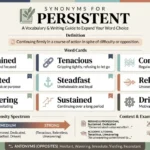
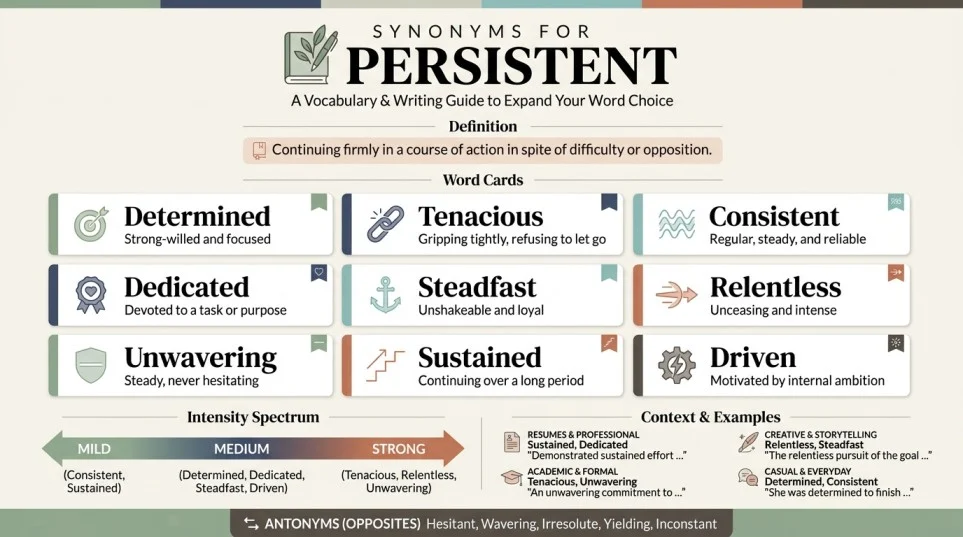
Persistent means continuing firmly despite difficulty, delay, or opposition. Strong alternatives include determined and tenacious, while steady and consistent work well for neutral contexts. Relentless is stronger, while dedicated sounds more positive and professional.
Meaning, Tone and Context
Simple Definition
Persistent describes someone or something that continues for a long time without giving up or stopping.
A persistent person keeps working toward a goal even when progress is slow or obstacles appear.
The word can also describe something that continues repeatedly, such as persistent noise, persistent problems, or persistent symptoms.
Part of Speech
“Persistent” is an adjective.
Examples:
- She is a persistent student.
- The team made persistent efforts to improve.
- We experienced persistent technical problems.
The related noun is “persistence.”
Example:
“His persistence helped him complete the project.”
The related adverb is “persistently.”
Example:
“She persistently worked toward her goal.”
Tone
“Persistent” is usually neutral or positive when describing determination.
It can become negative when it describes something unwanted or repetitive.
Positive:
“She was persistent in pursuing her career goals.”
Negative:
“The persistent interruptions made the meeting difficult.”
Formality Level
Persistent works well in casual, academic, professional, and formal writing.
It is especially useful when you want to describe continued effort without sounding overly emotional.
Common Use Cases
You can use persistent to describe:
- A person who does not give up
- Continued effort
- Repeated behavior
- Long lasting problems
- Ongoing attempts
- Repeated requests
- Determination toward a goal
- Problems that refuse to disappear
When and How to Use “Persistent”
Use persistent when you want to emphasize continued effort or continued existence.
The word is especially useful when something continues despite difficulty, resistance, or time.
Professional
“Her persistent effort helped the team complete the project ahead of schedule.”
Personal
“He remained persistent while learning to play the guitar.”
Academic
“Persistent study habits can improve long term academic performance.”
“Thank you for your persistent follow up regarding this issue.”
The meaning changes slightly depending on the subject. Persistent effort is usually positive, while persistent complaints or persistent interruptions can sound negative.
Another Word for “Persistent”
The best single replacement for persistent is often determined when describing a person who refuses to give up.
However, determined is not always interchangeable with persistent.
Professional Writing
Use determined, dedicated, consistent, or tenacious.
Academic Writing
Use persistent, sustained, continued, or tenacious, depending on the exact meaning.
Casual Conversation
Use stubborn, steady, or not giving up when the situation is informal.
Emotional Writing
Use determined, tenacious, or unwavering when you want to emphasize emotional strength.
Creative Writing
Use relentless, unyielding, tenacious, or dogged for stronger descriptive effect.
Resume or Workplace Use
Use determined, dedicated, tenacious, consistent, or resilient.
For example:
Instead of:
“She is persistent in solving difficult problems.”
A resume could say:
“She is a determined problem solver who consistently tackles complex challenges.”
Social Media Captions
For captions, determined, unstoppable, dedicated, or driven can sound more natural.
Stronger Meaning
Use relentless, unyielding, or dogged when persistence is especially intense.
Softer Meaning
Use steady, consistent, dedicated, or committed when you want a more positive and moderate tone.
When Not to Use “Persistent”
Persistent is not always the most precise choice.
If you mean someone has a clear goal and strong motivation, determined may be better.
“Persistent” can also sound negative when describing repeated unwanted behavior.
For example:
“The customer was persistent.”
This sentence is unclear. It could mean the customer was admirably determined or annoyingly repetitive.
A more precise version would be:
“The customer was determined to resolve the problem.”
Or:
“The customer repeatedly contacted the support team.”
Use a more specific synonym when the exact type of persistence matters.
Words Commonly Confused With “Persistent”
Persistent vs. Determined
Persistent emphasizes continuing despite difficulty. Determined emphasizes having a strong decision or intention.
“She remained persistent despite repeated failures.”
“She was determined to succeed.”
Persistent vs. Consistent
Persistent focuses on continuing. Consistent focuses on maintaining the same quality, behavior, or pattern.
“He made persistent efforts to improve.”
“She delivered consistent results.”
Persistent vs. Stubborn
Persistent is often positive or neutral. Stubborn usually suggests refusing to change an opinion or behavior.
“She was persistent in pursuing her goal.”
“He was stubborn about changing his decision.”
Persistent vs. Tenacious
Tenacious suggests strong determination and an unwillingness to let go.
Persistent is broader and more neutral.
Persistent vs. Relentless
Relentless is stronger. It suggests continuing with little or no reduction in intensity.
Persistent can describe moderate continued effort.
Persistent vs. Persevering
Persevering focuses strongly on continuing through difficulty.
Persistent can describe people, efforts, problems, sounds, requests, and many other things.
Best Synonym by Context for “Persistent”
| Context | Best Synonym | Why It Works | Example |
|---|---|---|---|
| Formal writing | Tenacious | Shows strong continued effort | Her tenacious approach produced results. |
| Academic writing | Sustained | Clearly describes continued effort | The study required sustained attention. |
| Professional or business use | Determined | Positive and direct | She is a determined team leader. |
| Resume | Dedicated | Highlights commitment positively | Dedicated professional with strong problem solving skills. |
| Casual conversation | Steady | Natural and moderate | He has been steady in his efforts. |
| Creative writing | Relentless | Creates stronger imagery | The relentless rain continued through the night. |
| Emotional tone | Unwavering | Suggests strong emotional commitment | Her unwavering support gave him confidence. |
| Strong intensity | Relentless | Suggests very strong continuation | Their relentless pursuit finally paid off. |
| Soft or moderate tone | Consistent | Sounds balanced and professional | His consistent effort improved the results. |
| Social media captions | Driven | Short, positive, and energetic | Stay driven and keep moving forward. |
| US usage | Persistent | Common and natural | She remained persistent throughout the process. |
| UK usage | Persistent | Also natural and widely understood | His persistent efforts were recognized. |
Which Synonym Should You Choose?
Start by asking what kind of persistence you want to describe.
- If someone keeps working toward a goal, choose determined, dedicated, or tenacious.
- If someone maintains regular effort, choose consistent or steady.
- If someone continues despite serious difficulty, choose persevering or unwavering.
- If the behavior is extremely intense, choose relentless or unyielding.
- If you want a professional and positive word, dedicated and determined are usually safe choices.
- If the behavior is annoying or unwanted, words such as insistent, stubborn, or relentless may communicate the negative tone more clearly.
Real Life Examples of “Persistent” in Sentences
School
“The persistent student continued studying until she understood the difficult concept.”
Workplace
“His persistent efforts helped the company solve a complicated customer problem.”
Writing
“The writer took a persistent approach to researching the subject.”
Conversation
“She is persistent when she believes something is worth pursuing.”
Social Media
“Persistent effort can turn a small goal into a major achievement.”
Resume
“Persistent and dedicated professional with a strong record of meeting challenging goals.”
“Thank you for your persistent attention to this matter.”
Storytelling
“Despite the storm, the persistent traveler continued toward the distant village.”
18 Synonyms for “Persistent”
| Synonym | Simple Meaning | Best Used For | Example Sentence |
|---|---|---|---|
| Determined | Strongly decided to achieve something | Goals and personal effort | She was determined to finish the course. |
| Tenacious | Holding firmly despite difficulty | Strong professional or personal effort | His tenacious approach impressed the entire team. |
| Persistent | Continuing without giving up | General situations | Her persistent work eventually produced results. |
| Persevering | Continuing despite problems | Difficult goals and challenges | The persevering student refused to quit. |
| Relentless | Continuing with great intensity | Very strong effort or pressure | Their relentless pursuit of excellence paid off. |
| Unwavering | Not changing or weakening | Loyalty, belief, support, or commitment | She showed unwavering confidence in her team. |
| Steadfast | Firm and dependable | Formal and personal contexts | He remained steadfast during the crisis. |
| Dedicated | Giving serious time and effort | Work, study, and professional settings | She is a dedicated employee. |
| Consistent | Continuing in a regular way | Performance and habits | His consistent effort improved his writing. |
| Committed | Strongly devoted to a goal | Workplace and personal goals | They are committed to improving customer service. |
| Dogged | Continuing despite difficulty | Strong, determined effort | Her dogged pursuit of the truth impressed everyone. |
| Unyielding | Refusing to give way or change | Strong resistance or determination | His unyielding determination carried him forward. |
| Insistent | Continuing to demand or emphasize something | Requests and opinions | The customer was insistent about receiving an explanation. |
| Stubborn | Refusing to change or stop | Informal and often negative situations | He was too stubborn to accept helpful advice. |
| Enduring | Continuing for a long time | Conditions, qualities, and relationships | Their enduring friendship survived many challenges. |
| Sustained | Continuing over a period of time | Academic and professional writing | The project required sustained attention. |
| Unstoppable | Seemingly impossible to stop | Informal, motivational, and creative writing | Her unstoppable energy inspired the whole team. |
| Driven | Highly motivated to succeed | Careers, goals, and modern professional language | He is a driven entrepreneur with ambitious goals. |
Synonym Groups and Usage Differences
Professional vs. Personal Synonyms
Professional writing usually benefits from positive and precise words.
Use dedicated, determined, committed, consistent, and tenacious when describing workplace behavior.
Personal writing can be more expressive.
Words such as steadfast, unwavering, and unstoppable can add stronger emotion.
Formal vs. Conversational Synonyms
Formal writing favors words such as persistent, sustained, tenacious, steadfast, and unyielding.
Casual conversation often sounds more natural with determined, stubborn, steady, or driven.
For example:
Formal:
“The researcher demonstrated sustained effort.”
Conversational:
“She kept going and did not give up.”
Academic Synonyms
Academic writing should favor precise and neutral language.
Useful choices include persistent, sustained, continued, consistent, and tenacious.
“Sustained” is particularly useful when discussing effort, attention, research, activity, or engagement over time.
Professional and Business Synonyms
In workplace communication, positive wording is usually better.
Choose dedicated, committed, determined, consistent, or driven when describing an employee.
For difficult negotiations or strong follow up, persistent or tenacious may be more appropriate.
Creative or Literary Synonyms
Creative writing allows stronger imagery.
Relentless, unyielding, dogged, steadfast, and unwavering can make a character or situation feel more powerful.
For example:
“The relentless wind battered the empty house.”
Slang or Modern Synonyms
There is no exact slang replacement for persistent that works in every situation.
Words such as unstoppable and driven are common in modern motivational language.
They are suitable for captions and informal posts but may sound exaggerated in academic writing.
Strongest vs. Weaker Synonyms
A useful intensity scale is:
Steady → Consistent → Persistent → Determined → Dedicated → Tenacious → Persevering → Unwavering → Dogged → Relentless → Unyielding
This is not an absolute ranking because context changes the strength of each word.
For example, “unwavering” is especially strong for loyalty or belief, while “relentless” is stronger for continuous pressure or action.
Emotional vs. Neutral Synonyms
Neutral choices include persistent, consistent, sustained, and continued.
More emotional choices include unwavering, steadfast, dogged, and relentless.
Choose the emotional option only when you want the reader to feel the strength of the behavior.
Antonyms of “Persistent”
| Antonym | Meaning | Example Sentence |
|---|---|---|
| Inconsistent | Not regular or steady | His inconsistent effort affected the results. |
| Uncommitted | Not dedicated to a goal | She seemed uncommitted to the project. |
| Indifferent | Not interested or concerned | He remained indifferent to the outcome. |
| Careless | Not giving enough attention | A careless approach caused several errors. |
| Hesitant | Unsure about taking action | She was hesitant to make a decision. |
| Reluctant | Unwilling to act | He was reluctant to try again. |
| Passive | Not actively taking action | The passive approach produced little progress. |
| Unmotivated | Lacking desire to act | The student felt unmotivated after several setbacks. |
| Flexible | Willing to change direction | She was flexible when the original plan failed. |
| Yielding | Willing to give way | He took a yielding position during the negotiation. |
| Fickle | Frequently changing interests or decisions | His fickle attention made planning difficult. |
| Unstable | Not steady or dependable | The unstable routine made progress difficult. |
| Neglectful | Failing to give proper attention | His neglectful approach created additional problems. |
| Quitter | A person who gives up easily | Nobody wants to be known as a quitter. |
| Temporary | Lasting for a limited time | The improvement was temporary rather than lasting. |
Comparison: “Persistent” vs. Similar Words
Persistent vs. Determined
Main difference: Persistent emphasizes continuing, while determined emphasizes having a strong intention.
Which one is stronger: Determined can sound stronger when describing personal motivation.
Which one is more formal: Both are suitable for formal writing.
Persistent: “She remained persistent despite several setbacks.”
Determined: “She was determined to achieve her goal.”
Persistent vs. Consistent
Main difference: Persistent means continuing, while consistent means maintaining a regular pattern or standard.
Which one is stronger: Persistent usually suggests more resistance to obstacles.
Which one is more formal: Both work well in professional and academic writing.
Persistent: “He made persistent efforts to solve the problem.”
Consistent: “He produced consistent results throughout the year.”
Persistent vs. Tenacious
Main difference: Tenacious suggests a particularly strong ability to hold on and continue.
Which one is stronger: Tenacious usually sounds stronger.
Which one is more formal: Both are appropriate, although tenacious can sound more descriptive.
Persistent: “She remained persistent in her studies.”
Tenacious: “She showed a tenacious commitment to her research.”
Persistent vs. Relentless
Main difference: Relentless suggests intense continuation with little or no pause.
Which one is stronger: Relentless is considerably stronger.
Which one is more formal: Both can appear in formal writing, but relentless is more emotionally charged.
Persistent: “He made persistent efforts to improve.”
Relentless: “The team faced relentless pressure throughout the competition.”
Persistent vs. Stubborn
Main difference: Persistent usually concerns continuing effort. Stubborn usually concerns refusing to change.
Which one is stronger: Stubborn can feel stronger negatively.
Which one is more formal: Persistent is safer for formal writing.
Persistent: “She was persistent in finding a solution.”
Stubborn: “He was stubborn about changing his approach.”
Persistent vs. Persevering
Main difference: Persevering strongly suggests continuing through difficulty.
Which one is stronger: Persevering can sound more inspirational.
Which one is more formal: Both are suitable for formal contexts.
Persistent: “His persistent work improved the project.”
Persevering: “Her persevering attitude helped her overcome repeated setbacks.”
Common Phrases and Expressions with “Persistent”
1. Persistent Effort
Meaning: Continued effort toward a goal.
Example sentence:
“Persistent effort is often necessary when progress is slow.”
2. Persistent Problem
Meaning: A problem that continues despite attempts to solve it.
Example sentence:
“The company is working to resolve a persistent technical problem.”
3. Persistent Efforts
Meaning: Repeated and continued attempts to achieve something.
Example sentence:
“Her persistent efforts eventually earned the team a major opportunity.”
4. Persistent Attention
Meaning: Continued focus on something.
Example sentence:
“The project requires persistent attention to detail.”
5. Persistent Request
Meaning: A request that is repeated several times.
Example sentence:
“After several persistent requests, the manager agreed to review the proposal.”
6. Persistent Belief
Meaning: A belief that remains strong over time.
Example sentence:
“His persistent belief in the idea encouraged the team.”
7. Persistent Growth
Meaning: Growth that continues over time.
Example sentence:
“The business has shown persistent growth in recent years.”
Common Mistakes to Avoid
1. Using Persistent When a More Precise Word Is Better
“Persistent” is broad.
If you mean strong motivation, “determined” may communicate the idea more clearly.
2. Confusing Persistent With Stubborn
Persistence can be positive.
Stubbornness usually suggests refusing to change even when change may be sensible.
3. Using Casual Synonyms in Formal Writing
Words such as “unstoppable” may work well in a social media caption but can sound exaggerated in a research paper.
4. Choosing an Overly Dramatic Synonym
“Relentless” is powerful.
Do not use it when “consistent” or “steady” communicates the idea more accurately.
5. Repeating Persistent Too Often
If you use persistent several times in the same paragraph, replace some instances with contextually accurate alternatives.
This improves vocabulary variety without forcing unnatural synonyms.
6. Choosing the Wrong Emotional Tone
Calling someone “stubborn” can sound insulting.
Calling someone “tenacious” usually sounds complimentary.
Always consider how the word will affect the reader.
FAQs
What is the best synonym for persistent?
The best synonym depends on context. “Determined” is excellent for goals, while “consistent,” “tenacious,” and “relentless” fit different levels of intensity.
What is a formal synonym for persistent?
“Tenacious,” “steadfast,” “sustained,” and “unyielding” can work as formal alternatives. The best choice depends on the exact meaning and sentence.
What is an informal synonym for persistent?
In casual conversation, “determined,” “steady,” “stubborn,” and “unstoppable” can work. Choose based on whether the tone should be positive or negative.
What is another word for persistent in professional writing?
“Dedicated,” “determined,” “committed,” “consistent,” and “tenacious” are strong professional choices, especially for resumes and workplace communication.
What is the difference between persistent and determined?
Persistent focuses on continuing despite difficulty. Determined focuses on having a strong intention to achieve something.
What is the opposite of persistent?
Common opposites include inconsistent, uncommitted, hesitant, reluctant, passive, unmotivated, and quitter, depending on the context.
Conclusion
Persistent means continuing with effort, attention, or action despite difficulty or delay. It is useful in everyday speech, academic writing, workplace communication, resumes, and creative writing.
The best synonym depends on your intended meaning. Choose determined for strong motivation, consistent for regular effort, dedicated for professional commitment, tenacious for strong determination, and relentless for intense continuation.
The most useful vocabulary tip is simple: do not replace persistent just to sound different. Choose a synonym because it expresses a more precise meaning, tone, or level of intensity.
Before publishing important vocabulary content, verify definitions and usage with trusted dictionaries such as Cambridge, Oxford, Merriam Webster, Collins, or Britannica.
Read More Related Articles:
- 25+ Synonyms for Access | Meanings, Examples, and Best …
- 25+ Synonyms for Definitely | Meanings, Examples, and Best …
- 25+ Synonyms for Broken | Meanings, Examples, and Best …