Have you ever written “definitely” several times in the same email, essay, caption, or conversation? The word is useful, but repeating it can make your writing sound predictable.
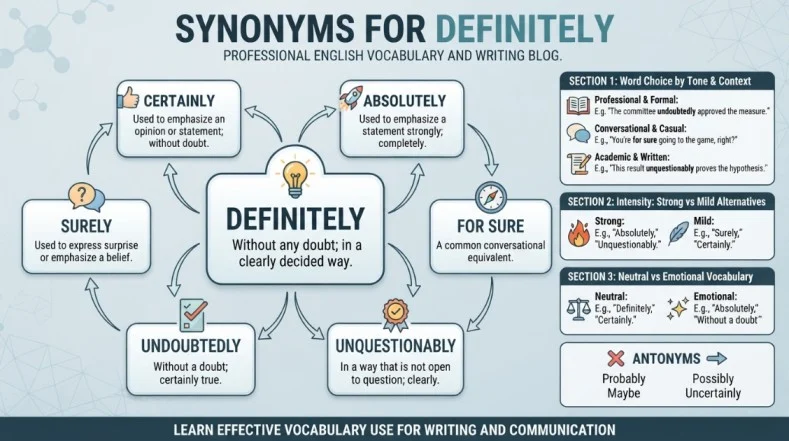
Learning synonyms for definitely helps you express certainty with more precision. You might need a formal expression for a report, a natural phrase for conversation, or a stronger choice when you want to emphasize complete confidence.
What Does “Definitely” Mean?
“Definitely” means with certainty, without doubt, or in a way that leaves little or no uncertainty. Formal options include certainly and unquestionably, while casual choices include surely and for sure.
Meaning, Tone and Context
Simple Definition
Definitely is used when someone feels certain that something is true, will happen, or should happen. It communicates a high level of confidence.
For example:
“I will definitely attend the meeting.”
This tells the reader that the speaker has made a firm commitment.
Part of Speech
Definitely is an adverb. It modifies a verb, adjective, or entire statement by adding a sense of certainty.
Example:
“She definitely understood the instructions.”
Here, definitely emphasizes the speaker’s confidence that she understood them.
Tone
Definitely usually has a confident and positive or neutral tone. Its emotional effect depends on the sentence.
“I definitely want to help” sounds enthusiastic.
“He definitely made a mistake” sounds firm and can sound critical because of the surrounding context.
Formality Level
Definitely is common in both everyday and professional English. It works well in conversations, emails, essays, presentations, and many workplace situations.
For highly formal writing, certainly, unquestionably, unequivocally, or without question may sometimes sound more deliberate.
Common Use Cases
Definitely frequently appears when expressing:
- Certainty about facts
- Strong agreement
- Firm intentions
- Confident predictions
- Strong recommendations
- Personal decisions
- Emphasis in conversation
Important Word Forms
Definitely is related to the adjective definite.
The adjective definite means clear, certain, or established.
The noun definiteness refers to the quality of being definite or certain.
The adverb definitely expresses certainty.
The opposite idea is uncertainty, which describes a lack of confidence or knowledge.
When and How to Use “Definitely”
Use definitely when you want to communicate strong confidence without necessarily sounding excessively formal.
1. Professional
“I will definitely send the revised proposal by Friday.”
The word communicates a clear commitment.
2. Personal
“I definitely want to visit that restaurant again.”
It expresses strong personal preference.
3. Academic
“The study definitely provides useful evidence for the proposed explanation.”
In academic writing, however, a more carefully qualified statement may be preferable when the evidence is not conclusive.
4. Emotional
“I definitely appreciate everything you have done for me.”
Here, definitely strengthens the sincerity of the statement.
5. Creative
“She definitely knew something was wrong the moment she entered the room.”
The word adds confidence to the narrator’s observation.
6. Social Media
“I am definitely trying this recipe again.”
This sounds natural and conversational for a caption or post.
7. Email
“I would definitely be interested in discussing the opportunity further.”
This communicates genuine interest while remaining professional.
Another Word for “Definitely”
The best single replacement is usually certainly because it expresses strong confidence and works naturally in both formal and professional English.
The right alternative still depends on your intended tone.
| Situation | Recommended Alternative |
|---|---|
| Professional writing | Certainly |
| Academic writing | Certainly or unquestionably |
| Casual conversation | Surely or for sure |
| Emotional writing | Absolutely |
| Creative writing | Unquestionably or assuredly |
| Resume or workplace use | Certainly |
| Social media captions | For sure or absolutely |
| Stronger meaning | Unequivocally |
| Softer meaning | Certainly, depending on context |
When Not to Use “Definitely”
Definitely can sound too strong when you do not actually have enough evidence to support complete certainty.
Instead of:
“The new strategy will definitely increase sales.”
Consider:
“The new strategy will likely increase sales.”
The second sentence is more appropriate when the outcome is a prediction rather than an established fact.
Definitely can also become repetitive. If several sentences contain the same adverb, replace some instances with a more precise expression or remove the word when the sentence is already clear.
For example:
- “I definitely agree. I definitely support the idea. I will definitely attend.”
A more varied version could be:
“I certainly agree. I fully support the idea, and I will be there.”
Words Commonly Confused With “Definitely”
Definitely vs. Defiantly
Definitely expresses certainty.
Defiantly describes behavior that openly resists authority, rules, or expectations.
“I definitely agree.”
“She defiantly refused to apologize.”
Definitely vs. Certainly
Both express certainty. Certainly is often slightly more polished in formal writing.
“I will definitely call you.”
“I will certainly call you.”
Both are natural, but the second can sound more formal.
Definitely vs. Surely
Surely can express certainty, but it can also communicate surprise, expectation, or a rhetorical question.
“You will definitely enjoy the book.”
“Surely you are not serious.”
Definitely vs. Absolutely
Absolutely often expresses complete agreement, strong approval, or strong emphasis.
“I definitely want to go.”
“I absolutely love this restaurant.”
Definitely vs. Undoubtedly
Undoubtedly expresses certainty and often sounds more formal or authoritative.
“She is definitely qualified for the position.”
“She is undoubtedly qualified for the position.”
Best Synonym by Context for “Definitely”
| Context | Best Synonym | Why It Works | Example |
|---|---|---|---|
| Formal writing | Certainly | Polished and broadly accepted | The results certainly support the conclusion. |
| Academic writing | Unquestionably | Strong and formal when evidence is compelling | The finding is unquestionably significant. |
| Professional or business use | Certainly | Confident without sounding overly dramatic | We will certainly review your proposal. |
| Resume | Demonstrably | Emphasizes something that can be shown through evidence | She has demonstrably improved customer retention. |
| Casual conversation | For sure | Natural and relaxed | I will be there for sure. |
| Creative writing | Assuredly | Adds a literary and confident tone | The traveler would assuredly remember the night. |
| Emotional tone | Absolutely | Adds enthusiasm and conviction | I absolutely appreciate your support. |
| Strong intensity | Unequivocally | Communicates complete and unambiguous certainty | The company unequivocally rejected the allegation. |
| Mild or moderate tone | Certainly | Confident without unnecessary intensity | This is certainly worth considering. |
| Social media captions | For sure | Sounds natural and conversational | I am trying this again for sure. |
| Agreement | Absolutely | Clearly communicates strong agreement | Absolutely, I agree with you. |
| Formal commitment | Without question | Creates a firm, deliberate tone | She is the right person for the role, without question. |
| Evidence based statement | Indisputably | Suggests that the point cannot reasonably be disputed | The discovery is indisputably important. |
| Firm decision | Positively | Can emphasize a definite intention or answer | I positively intend to finish the project. |
| US usage | Definitely | Extremely common and natural in American English | I will definitely call tomorrow. |
| UK usage | Certainly | Also common and natural in British English | I will certainly contact them tomorrow. |
Which Synonym Should You Choose?
Start with the level of certainty you actually mean.
If you are completely confident, definitely, certainly, unquestionably, or unequivocally may work.
If you are writing professionally, certainly is often a safe choice because it sounds confident without being excessively dramatic.
For academic writing, consider whether the evidence truly supports absolute certainty. When it does not, words such as probably, generally, or likely may be more accurate.
- For casual conversation, surely and for sure sound natural.
- For strong emotional emphasis, absolutely can add enthusiasm or conviction.
- For an especially formal statement, unquestionably or unequivocally can create a more authoritative tone.
Real Life Examples of “Definitely” in Sentences
School
“I will definitely finish my research paper before the deadline.”
Workplace
“We should definitely discuss the new project timeline.”
General Writing
“This experience definitely changed the way she approached the problem.”
Conversation
“Are you coming tonight?”
“Definitely.”
Social Media
“I am definitely making this dessert again.”
Resume
“Her experience definitely demonstrates strong project management skills.”
For a resume, however, evidence based wording is often stronger than relying on definitely alone.
“I would definitely welcome the opportunity to speak with you.”
Storytelling
“He definitely sensed that something unusual had happened before he entered the room.”
25 Synonyms for “Definitely”
Some alternatives below are direct substitutes in many contexts, while others are close expressions that emphasize certainty in particular situations. Always consider sentence meaning before replacing the word.
| Synonym | Simple Meaning | Best Used For | Example Sentence |
|---|---|---|---|
| Certainly | With confidence or certainty | Formal and professional writing | I will certainly review the document. |
| Surely | Without reasonable doubt | Conversation and rhetorical statements | Surely you can see the difference. |
| Undoubtedly | Without doubt | Formal and emphatic writing | She is undoubtedly a talented researcher. |
| Unquestionably | Beyond reasonable question | Formal and academic contexts | The discovery is unquestionably important. |
| Assuredly | Certainly or confidently | Formal and literary writing | The decision will assuredly affect the outcome. |
| Absolutely | Completely or with total agreement | Strong emphasis and conversation | I absolutely agree with your point. |
| Positively | Certainly, especially when stressing an answer or intention | Firm statements | I positively intend to finish the work. |
| Indubitably | Without any doubt | Very formal or rhetorical writing | The result was indubitably important to the field. |
| Categorically | In an absolute and unqualified way | Formal statements and denials | The spokesperson categorically rejected the claim. |
| Unequivocally | In a completely clear and unambiguous way | Official and professional statements | The organization unequivocally supports the policy. |
| Indisputably | In a way that cannot reasonably be disputed | Evidence based writing | The invention was indisputably influential. |
| Incontrovertibly | In a way that cannot be successfully challenged | Highly formal writing | The evidence incontrovertibly establishes the sequence of events. |
| Decidedly | Clearly and noticeably | Formal description and emphasis | The new design is decidedly more practical. |
| Unmistakably | In a way that is impossible to mistake | Description and strong observation | Her voice was unmistakably familiar. |
| For certain | With certainty | Conversation and general writing | We know for certain that the meeting is tomorrow. |
| For sure | Certainly | Informal conversation and social media | I will call you for sure. |
| Without a doubt | Completely without doubt | Conversation and emphatic writing | She is the best candidate without a doubt. |
| Without question | With no reasonable doubt | Formal and emphatic statements | He is qualified for the position without question. |
| Beyond doubt | Past any reasonable uncertainty | Formal writing | The evidence places the event beyond doubt. |
| Beyond question | Not reasonably open to doubt | Formal and rhetorical writing | Her contribution is beyond question. |
| No doubt | Certainly or very probably, depending on context | Conversation and general writing | No doubt, the experience taught him a valuable lesson. |
| Most certainly | Very definitely | Strong but natural emphasis | I most certainly remember meeting her. |
| With certainty | In a completely confident way | Formal and analytical writing | We cannot identify the cause with certainty. |
| As a certainty | As something regarded as certain | Formal discussion | The outcome should not be treated as a certainty. |
| In all certainty | With complete confidence | Formal or literary contexts | In all certainty, the decision will require further discussion. |
Synonym Groups and Usage Differences
Professional vs. Personal Synonyms
Professional writing usually benefits from calm, precise expressions such as certainly, undoubtedly, and unequivocally.
Personal communication allows more expressive choices such as absolutely, surely, and for sure.
Compare:
“Absolutely, I would love to join you.”
“We will certainly review the proposal.”
The first feels personal and enthusiastic. The second sounds professional and measured.
Formal vs. Conversational Synonyms
Formal writing can use certainly, unquestionably, undoubtedly, unequivocally, and without question.
Casual speech often favors definitely, surely, absolutely, and for sure.
In a text message, “For sure” sounds natural. In a formal report, “Certainly” is usually more appropriate.
Academic Synonyms
Academic writing requires careful attention to evidence. Certainly and undoubtedly can work when the evidence supports a confident statement.
Unquestionably, indisputably, and incontrovertibly are much stronger. They should not be used simply to make an argument sound authoritative.
When evidence is limited, avoid replacing definitely with another absolute expression.
Professional and Business Synonyms
Certainly is especially useful in workplace emails because it communicates confidence without sounding overly forceful.
Unequivocally and categorically are better reserved for situations where a company or individual needs to make a firm, unambiguous statement.
For example:
“We certainly appreciate your feedback.”
“The company unequivocally rejects the allegation.”
Creative or Literary Synonyms
Creative writing gives you more freedom to use words such as assuredly, undoubtedly, and unmistakably.
These choices can influence the narrator’s voice and create a more deliberate tone.
“Assuredly” can sound literary, while “for sure” creates a much more conversational voice.
Slang or Modern Synonyms
There is no major slang equivalent that precisely replaces definitely in every context.
Expressions such as “for sure” are informal rather than true slang. They work well in texts, conversations, comments, and casual captions.
Avoid overly casual expressions in academic essays, formal reports, and professional documents.
Strongest vs. Weaker Synonyms
A useful practical scale is:
Mild confidence: certainly
Strong confidence: definitely
Very strong confidence: undoubtedly
Complete or unambiguous certainty: unequivocally, unquestionably
Highly emphatic or formal certainty: incontrovertibly, indubitably
This scale is approximate because context affects perceived strength.
Emotional vs. Neutral Synonyms
Definitely and certainly can remain relatively neutral.
Absolutely often adds enthusiasm or emotional emphasis.
For example:
“I definitely understand.”
“I absolutely understand.”
The second version can sound more emphatic, especially in conversation.
Antonyms of “Definitely”
There is no single perfect opposite in every sentence. The following expressions communicate uncertainty, possibility, doubt, or lack of commitment.
| Antonym | Meaning | Example Sentence |
|---|---|---|
| Maybe | Possibly | Maybe I will attend the event. |
| Perhaps | Possibly or potentially | Perhaps she will call later. |
| Possibly | Something may happen or be true | It could possibly rain tonight. |
| Probably | More likely than not | He will probably arrive soon. |
| Uncertainly | Without confidence or certainty | The issue remains uncertainly resolved. |
| Doubtfully | With doubt or hesitation | She looked doubtfully at the proposal. |
| Questionably | In a way that raises doubt | The claim was questionably supported. |
| Tentatively | With limited confidence or as a provisional decision | We tentatively scheduled the meeting for Tuesday. |
| Unlikely | Not expected to happen | It is unlikely that the store will open today. |
| Uncertain | Not known or established | The final outcome remains uncertain. |
| In doubt | Not certain | His participation is still in doubt. |
| Not necessarily | Not inevitably or certainly | A high price does not necessarily mean better quality. |
| With reservations | With doubts or qualifications | She accepted the offer with reservations. |
| Conceivably | Possibly, even if not especially likely | The plan could conceivably succeed. |
| Arguably | Open to reasonable discussion or interpretation | The decision was arguably the most practical option. |
Comparison: “Definitely” vs. Similar Words
Definitely vs. Certainly
The main difference is small because both words express strong certainty.
Certainly can sound slightly more polished in formal contexts, while definitely is extremely natural in everyday American English.
Neither is inherently stronger in every sentence.
“Definitely, I will attend.”
“Certainly, I will attend.”
Definitely vs. Surely
Surely can express certainty, but it may also show expectation, surprise, or disbelief.
Definitely is more straightforward when you simply want to state certainty.
“You should definitely apply.”
“Surely you have heard the news.”
Definitely vs. Absolutely
Absolutely often carries stronger emotional emphasis or agreement.
Definitely is more neutral.
“I definitely support the plan.”
“I absolutely support the plan.”
Definitely vs. Undoubtedly
Undoubtedly has a more formal and authoritative tone.
Definitely works comfortably in conversation and professional communication.
“She is definitely experienced.”
“She is undoubtedly experienced.”
Definitely vs. Unquestionably
Unquestionably suggests that something cannot reasonably be questioned.
It is more formal and often stronger than ordinary definitely.
“The method is definitely useful.”
“The method is unquestionably useful.”
Definitely vs. Positively
Positively can express certainty, particularly when confirming an answer or emphasizing an intention.
Definitely is more common in ordinary modern English.
“I definitely remember the conversation.”
“I positively remember the conversation.”
The second sounds more emphatic and somewhat formal.
Common Phrases and Expressions with “Definitely”
1. Definitely yes
Meaning:
An emphatic way to agree or confirm.
Example sentence:
“Would you recommend this course?”
“Definitely yes.”
2. Definitely not
Meaning:
A strong and clear refusal or denial.
Example sentence:
“I would definitely not make that decision without more information.”
3. Most definitely
Meaning:
A stronger form of definitely that emphasizes complete confidence.
Example sentence:
“She is most definitely qualified for the position.”
4. Definitely worth it
Meaning:
Used to say that something is certainly valuable or worthwhile.
Example sentence:
“The museum is definitely worth visiting.”
5. Definitely worth considering
Meaning:
A confident recommendation that something deserves attention.
Example sentence:
“The revised proposal is definitely worth considering.”
6. Definitely interested
Meaning:
A strong expression of genuine interest.
Example sentence:
“I am definitely interested in learning more about the opportunity.”
7. Definitely recommend
Meaning:
A strong recommendation based on a positive opinion or experience.
Example sentence:
“I would definitely recommend this book to students.”
8. Definitely the right choice
Meaning:
A strong statement that something appears appropriate for a particular situation.
Example sentence:
“For this project, that approach is definitely the right choice.”
Common Mistakes to Avoid
1. Using “Definitely” When Evidence Is Limited
Do not use definitely for a prediction when the evidence only suggests that something may happen.
Instead of claiming certainty, use probably or likely when appropriate.
2. Confusing “Definitely” With “Defiantly”
These words look and sound somewhat similar, but their meanings are completely different.
Definitely means with certainty. Defiantly describes resistance or deliberate disobedience.
3. Using a Casual Synonym in Formal Writing
“For sure” is perfectly natural in conversation but can sound too casual in a formal report.
Use certainly when you need a more professional tone.
4. Using an Overly Dramatic Synonym
Incontrovertibly may be technically suitable in a highly formal argument, but it can sound excessive in an ordinary email.
Choose the simplest accurate word.
5. Repeating “Definitely” Too Often
Repeated use makes writing predictable.
Replace some instances with certainly, absolutely, undoubtedly, or a more precise phrase when the meaning remains accurate.
6. Choosing the Wrong Emotional Tone
Absolutely can sound enthusiastic, while unquestionably can sound authoritative.
Make sure your synonym matches the emotional effect you want.
7. Using Informal Expressions in Academic or Professional Writing
Phrases such as for sure are useful in casual settings.
For essays, research writing, reports, and formal correspondence, choose a more appropriate expression such as certainly.
FAQs
1. What is the best synonym for definitely?
Certainly is one of the most versatile alternatives. It communicates confidence clearly and works especially well in professional, academic, and formal writing.
2. What is a formal synonym for definitely?
Unquestionably, undoubtedly, certainly, and unequivocally are formal alternatives. The best choice depends on how strong and authoritative the statement needs to sound.
3. What is an informal synonym for definitely?
For sure is a natural informal alternative. Surely and absolutely can also work in casual conversations, depending on the sentence and intended emphasis.
4. What is another word for definitely in professional writing?
Certainly is usually a reliable professional alternative. Undoubtedly and unequivocally can work when the context genuinely supports stronger certainty.
5. What is the difference between definitely and certainly?
Both express certainty. Definitely is especially common in everyday American English, while certainly can sound slightly more polished in formal or professional contexts.
6. What is the opposite of definitely?
Common opposites include maybe, perhaps, possibly, probably, uncertain, and in doubt. The correct choice depends on the level and type of uncertainty.
Conclusion
Definitely means with certainty or without doubt, and it is one of the most useful adverbs for expressing strong confidence.
The best synonym depends on the situation. Choose certainly for professional writing, unquestionably or undoubtedly for strong formal statements, absolutely for emotional emphasis, and for sure for casual conversation.
The key vocabulary lesson is simple: do not choose a synonym only because it sounds stronger. Choose the word that accurately matches your meaning, evidence, audience, and tone.
When you understand those differences, your writing becomes more precise and natural without losing the confidence that definitely provides.
Discover More Post:
- 25+ Synonyms for God | Meanings, Examples, and Best …
- 25+ Synonyms for Action | Meanings, Examples, and Best …
- 25+ Synonyms for Anxiety | Meanings, Examples, and Best …