The word “action” appears everywhere. You may use it in an essay, write it in a work email, add it to a resume, or repeat it in a social media caption without realizing how often it appears.
Choosing a more precise alternative can make your writing clearer and more engaging. The best synonym depends on whether you mean a deed, activity, decision, movement, effort, initiative, or legal proceeding.
This guide explains synonyms for action by meaning, tone, formality, and situation, so you can choose words that sound natural in American English.
What Does “Action” Mean?
Action means something done, a process of doing something, a movement, or a step taken to achieve a result. Depending on context, useful alternatives include deed, activity, step, measure, initiative, effort, movement, operation, conduct, and response.
Meaning, Tone and Context
Simple Definition
Action generally refers to something that is done or something that happens through activity or movement. It can describe a single deed, a series of activities, or a deliberate step toward a goal.
For example, “Taking action can solve the problem” means doing something to address the problem.
Part of Speech
Action is primarily a noun.
Example:
“The team took immediate action.”
The related verb is act.
Example:
“She acted quickly when the situation changed.”
The adjective active describes someone or something involved in action or activity.
Example:
“He is an active member of the organization.”
Tone
Action is usually neutral.
It can sound positive when it suggests progress, courage, or responsibility.
Example:
“Her quick action prevented further problems.”
It can also have a negative meaning when describing harmful behavior.
Example:
“His careless action caused unnecessary damage.”
Formality Level
Action works in casual, academic, professional, and formal writing. It is a flexible word, which is one reason it can become repetitive.
More precise alternatives can improve the sentence when the exact type of action matters.
Common Use Cases
Action commonly appears in:
- Workplace communication
- Academic writing
- Legal language
- Personal conversations
- Storytelling
- News writing
- Social media
- Resumes
- Business reports
- Instructions and recommendations
Important Word Forms
Noun: action
Verb: act
Adjective: active
Adverb: actively
Related noun: activity
Opposite concepts: inaction, inactivity, passivity, hesitation
When and How to Use “Action”
Use action when you are talking about something being done, a response to a situation, a deliberate step, or activity in general.
1. Professional Context
“The manager took immediate action after reviewing the report.”
Here, action means a deliberate response or measure.
2. Personal Context
“Her kind action made the difficult day easier.”
Here, action refers to a particular deed.
3. Academic Context
“Government action can influence public behavior.”
Here, action refers broadly to steps or measures taken by an institution.
4. Emotional Context
“His thoughtful action showed how much he cared.”
A more specific synonym such as deed may emphasize the personal quality of what happened.
5. Creative Context
“The hero finally sprang into action.”
Here, action creates a sense of movement, energy, and urgency.
6. Social Media Context
“Small actions can create meaningful change.”
The word works naturally because the statement refers broadly to things people can do.
7. Workplace Email Context
“Please review the document and take action before Friday.”
In this setting, action means completing an appropriate step or response.
Another Word for “Action”
The best single replacement depends on what you mean.
- For professional writing, measure, initiative, or step can sound more precise.
- For academic writing, activity, process, response, or conduct may work depending on the sentence.
- For casual conversation, act, move, step, or deed can be natural alternatives.
- For emotional writing, gesture, deed, or act can communicate personal meaning.
- For creative writing, movement, deed, conduct, or exploit can add descriptive depth.
- For resumes, initiative, achievement, effort, and contribution may communicate professional value more clearly.
- For social media captions, move, step, effort, and gesture can create a more conversational tone.
- For a stronger meaning, consider intervention, initiative, campaign, or offensive when the context supports them.
- For a softer meaning, consider step, gesture, measure, or response.
When Not to Use “Action”
Action can be too general when the reader needs to know exactly what happened.
For example:
“Sarah took action to improve the project.”
This sentence does not explain what Sarah actually did.
A more precise version is:
“Sarah introduced a new review process to improve the project.”
Here, introduced communicates the specific action.
Action can also sound overly formal in ordinary conversation.
Instead of:
“I will take action regarding your message.”
A natural conversational choice is:
“I will handle your message.”
The right replacement depends on the situation, audience, and intended meaning.
Words Commonly Confused With “Action”
Action vs. Activity
Action usually emphasizes something being done or a specific step.
Activity often describes something people do as part of a broader process.
Example:
“The company took action.”
“The students participated in several activities.”
Action vs. Act
An act usually refers to one specific deed or behavior.
Action can refer to a broader process, response, or series of steps.
Example:
“Helping the stranger was a generous act.”
“The organization took action to support the community.”
Action vs. Behavior
Behavior describes how someone usually acts or responds.
Action usually refers to something specific that someone does.
Example:
“His behavior was respectful.”
“His action helped the team.”
Action vs. Movement
Movement focuses on physical motion or a change in position.
Action can involve movement, but it can also describe decisions, measures, and responses.
Example:
“The dancer made a graceful movement.”
“The manager took action.”
Action vs. Effort
Effort emphasizes the energy or work invested in achieving something.
Action emphasizes what was actually done.
Example:
“Her effort was impressive.”
“Her action solved the problem.”
Action vs. Initiative
Initiative suggests a purposeful effort that someone starts independently.
Action is broader and does not necessarily imply leadership or independence.
Example:
“The employee showed initiative by creating a new system.”
“The employee took action after noticing the problem.”
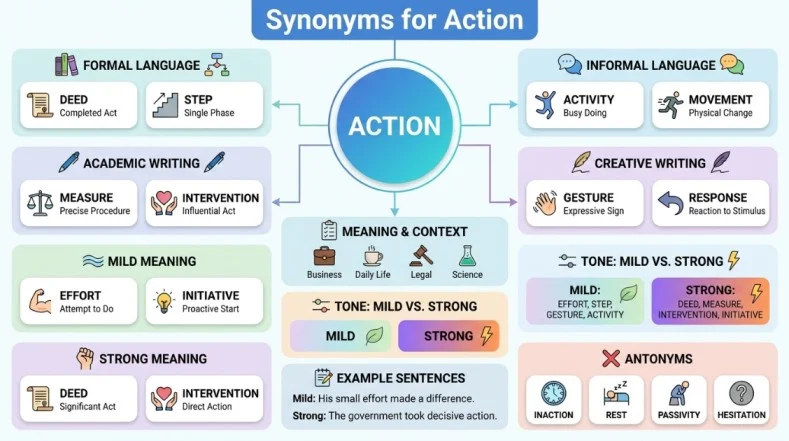
Best Synonym by Context for “Action”
| Context | Best Synonym | Why It Works | Example |
|---|---|---|---|
| Formal writing | Measure | Suggests a deliberate step or policy | The agency adopted a new measure. |
| Academic writing | Activity | Fits research and analytical contexts | The study examined classroom activity. |
| Professional use | Initiative | Suggests purposeful effort | Her initiative improved team performance. |
| Resume | Achievement | Highlights a meaningful result | The achievement increased customer retention. |
| Casual conversation | Move | Sounds natural and conversational | That was a smart move. |
| Creative writing | Deed | Gives a literary sense of behavior | His brave deed inspired the village. |
| Emotional writing | Gesture | Highlights personal meaning | Her small gesture meant a lot. |
| Strong intensity | Intervention | Suggests active involvement to change a situation | The intervention prevented further damage. |
| Soft or moderate tone | Step | Suggests a manageable action | This is the first step toward improvement. |
| Social media captions | Effort | Emphasizes personal work and intention | Every effort counts. |
| Legal context | Proceeding | Fits formal legal situations | The proceeding continued after the hearing. |
| Physical context | Movement | Focuses on motion | The movement was quick and controlled. |
| Business strategy | Measure | Suggests a planned response | The company introduced corrective measures. |
| Problem solving | Response | Focuses on reaction to a situation | Her response was immediate. |
| Leadership | Initiative | Highlights independent action | His initiative helped the department grow. |
Which Synonym Should You Choose?
Start by asking what action means in your sentence.
- If you mean something someone did, choose act, deed, or conduct.
- If you mean a planned response, choose measure, step, or response.
- If you mean purposeful leadership, choose initiative.
- If you mean physical motion, choose movement.
- If you mean work invested in a goal, choose effort.
- If you want emotional meaning, choose gesture or deed.
- If you are writing professionally, prioritize precision over simply replacing the word action.
A good synonym should preserve the original meaning while making the sentence more specific.
Real Life Examples of “Action” in Sentences
School
“The teacher encouraged students to turn their ideas into action.”
A more precise alternative could be implementation when discussing how an idea becomes reality.
Workplace
“The company took action after receiving customer feedback.”
Here, measures may be more precise if several specific steps were introduced.
Writing
“Strong writing combines thoughtful ideas with purposeful action.”
The word works because the sentence discusses doing rather than merely thinking.
Conversation
“That was a smart action.”
In everyday speech, “That was a smart move” sounds more natural.
Social Media
“Small actions can make a big difference.”
This is effective because action refers broadly to things people can do.
Resume
“I took action to improve the customer experience.”
A stronger resume sentence would name the specific achievement rather than relying on the general word action.
“Please take action on the items listed below.”
In business communication, address or complete may sometimes be clearer.
Storytelling
“The sudden action changed everything.”
Depending on the story, event, movement, or turning point may provide a more vivid description.
25 Synonyms for “Action”
| Synonym | Simple Meaning | Best Used For | Example Sentence |
|---|---|---|---|
| Act | A specific thing someone does | General and personal situations | Her act of kindness touched everyone. |
| Deed | A particular action, often meaningful | Moral, emotional, or literary writing | His courageous deed saved the traveler. |
| Activity | Something that people do | School, work, and general contexts | The students completed a group activity. |
| Step | A particular measure taken toward a goal | Plans and problem solving | The first step is to review the evidence. |
| Measure | A deliberate step taken to address something | Formal and professional writing | The company adopted a safety measure. |
| Initiative | A purposeful effort started by someone | Business and leadership | Her initiative improved the team’s workflow. |
| Effort | Energy or work put into doing something | Personal and professional contexts | His effort helped complete the project. |
| Movement | Physical motion or a broader organized change | Physical and social contexts | The movement was difficult to detect. |
| Response | Something done because of a situation | Business, communication, and problems | The response addressed the customer’s concern. |
| Reaction | A response to something that happens | Emotional and conversational contexts | Her reaction surprised everyone. |
| Operation | An organized activity or procedure | Business, medicine, military, and technical contexts | The operation required careful planning. |
| Process | A series of connected activities | Academic and professional contexts | The process takes several weeks. |
| Procedure | An established way of doing something | Formal and workplace contexts | The procedure must be followed carefully. |
| Conduct | The way someone behaves or acts | Formal, academic, and professional writing | His conduct remained professional throughout the meeting. |
| Behavior | The way a person or group acts | Psychology, education, and general description | The child’s behavior improved over time. |
| Gesture | An action that communicates a feeling or intention | Emotional and social contexts | Her thoughtful gesture made him smile. |
| Intervention | Deliberate involvement intended to change a situation | Medical, social, and professional contexts | Early intervention improved the outcome. |
| Engagement | Active involvement in something | Business, education, and social contexts | Student engagement increased during the activity. |
| Performance | The way an action or task is carried out | Work, sports, and entertainment | His performance impressed the judges. |
| Campaign | An organized series of actions for a purpose | Marketing, politics, and social causes | The campaign raised public awareness. |
| Exploit | A notable or daring deed | Literary and historical contexts | The novel celebrates the hero’s exploits. |
| Proceeding | A formal action or course of activity | Legal and official contexts | The legal proceeding continued as scheduled. |
| Response measure | A planned step taken in reaction to a problem | Professional and organizational writing | The team introduced a response measure. |
| Contribution | Something done that helps a person, group, or project | Workplace and academic contexts | Her contribution strengthened the final report. |
| Accomplishment | Something successfully achieved through action | Resumes and professional writing | Completing the project was a major accomplishment. |
Synonym Groups and Usage Differences
Professional vs. Personal Synonyms
Professional writing often benefits from words such as initiative, measure, response, procedure, and contribution.
Personal writing can sound more natural with act, deed, gesture, effort, and move.
The difference is mainly about precision and tone. Professional language often emphasizes outcomes and processes, while personal language may emphasize intention and emotion.
Formal vs. Conversational Synonyms
Formal writing can use measure, proceeding, conduct, procedure, and intervention.
Conversational English usually favors move, step, act, effort, and reaction.
For example, “The company took corrective measures” sounds more formal than “The company made a few changes.”
Academic Synonyms
Academic writing should favor precise words rather than unnecessary repetition.
Depending on context, useful choices include activity, process, behavior, conduct, response, and procedure.
The best academic synonym depends on the subject. A psychology paper may prefer behavior, while a scientific report may use process or procedure.
Professional and Business Synonyms
Business writing often uses initiative, measure, response, procedure, operation, and contribution.
These words can explain what happened more clearly than the general word action.
Instead of saying, “The manager took action,” specify the measure, response, or initiative whenever possible.
Creative or Literary Synonyms
Creative writing benefits from words that create a clearer image or emotional impression.
Deed, exploit, gesture, movement, and act can add personality and atmosphere.
For example, “His brave deed changed the course of the story” carries more literary weight than “His action changed the story.”
Slang or Modern Synonyms
Words such as move can function as informal alternatives to action.
For example:
“That was a smart move.”
This is natural in casual American English, but it may be too conversational for an academic paper or formal report.
Strongest vs. Weaker Synonyms
A useful intensity scale is:
Step: mild and practical
Gesture: mild and personal
Effort: moderate and focused on work
Act: neutral and specific
Initiative: purposeful and proactive
Measure: deliberate and formal
Intervention: strong and purposeful
Campaign: sustained and organized
The strongest word is not always the best word. Choose based on meaning rather than intensity alone.
Emotional vs. Neutral Synonyms
Neutral alternatives include activity, process, step, measure, and procedure.
More emotional alternatives include deed, gesture, effort, and act.
Compare:
“She took a measure to help.”
“She made a heartfelt gesture to help.”
The second sentence adds emotional meaning.
Antonyms of “Action”
Because action has several meanings, its opposites vary by context.
| Antonym | Meaning | Example Sentence |
|---|---|---|
| Inaction | Failure to do something | His inaction allowed the problem to grow. |
| Inactivity | Lack of activity | Long periods of inactivity can reduce productivity. |
| Passivity | Lack of active involvement | Her passivity made it difficult to resolve the issue. |
| Idleness | A state of doing nothing useful | The team could not afford continued idleness. |
| Stillness | Lack of physical movement | The forest was filled with complete stillness. |
| Rest | A period without activity | The athlete needed time for rest. |
| Hesitation | Delay caused by uncertainty | His hesitation slowed the decision. |
| Delay | Postponement of an action | The delay affected the schedule. |
| Avoidance | Deliberately staying away from something | Avoidance will not solve the problem. |
| Neglect | Failure to give necessary attention | Neglect can cause small issues to become serious. |
| Withdrawal | Moving away from involvement | His withdrawal changed the team’s dynamic. |
| Restraint | Controlled refusal to act | Her restraint prevented an unnecessary argument. |
| Silence | Absence of verbal response or expression | His silence surprised the group. |
| Inertia | Lack of movement or progress | Organizational inertia can prevent useful changes. |
| Inactivity | Lack of active participation | Continued inactivity reduced the team’s momentum. |
Comparison: “Action” vs. Similar Words
Action vs. Act
Main difference: Action is broad, while act usually identifies one specific deed.
Which one is stronger: Neither is inherently stronger.
Which one is more formal: Both can be formal, but act is often more precise.
Example:
“Taking action can solve the problem.”
“His act of generosity impressed everyone.”
Action vs. Activity
Main difference: Activity refers to something people do, while action often emphasizes a specific deed, response, or step.
Which one is stronger: Action can sound more purposeful.
Which one is more formal: Both work in formal writing.
Example:
“The team took action.”
“The team participated in a training activity.”
Action vs. Step
Main difference: A step is one part of a plan or process.
Which one is stronger: Action is broader.
Which one is more formal: Step is often simpler and clearer.
Example:
“We need immediate action.”
“The next step is to contact the client.”
Action vs. Effort
Main difference: Effort emphasizes energy and work, while action emphasizes what was done.
Which one is stronger: Action can sound more decisive.
Which one is more formal: Both are widely accepted.
Example:
“She made an effort to improve.”
“She took action to improve the situation.”
Action vs. Behavior
Main difference: Behavior describes a person’s manner of acting, while action often refers to a particular thing done.
Which one is stronger: Neither is inherently stronger.
Which one is more formal: Behavior is common in academic contexts.
Example:
“His action solved the problem.”
“His behavior was respectful.”
Action vs. Initiative
Main difference: Initiative suggests proactive and purposeful action.
Which one is stronger: Initiative often sounds more proactive.
Which one is more formal: Initiative works especially well in professional writing.
Example:
“She took action after noticing the issue.”
“She showed initiative by solving the issue before being asked.”
Common Phrases and Expressions with “Action”
1. Take action
Meaning:
To do something in response to a situation or problem.
Example sentence:
“The organization decided to take action after reviewing the results.”
2. Spring into action
Meaning:
To begin doing something quickly and energetically.
Example sentence:
“The emergency team sprang into action immediately.”
3. Put into action
Meaning:
To begin using a plan, idea, or decision.
Example sentence:
“The team put the new strategy into action.”
4. In action
Meaning:
Currently working, moving, or performing.
Example sentence:
“We watched the new system in action.”
5. Course of action
Meaning:
A plan or approach chosen for a particular situation.
Example sentence:
“The manager considered several possible courses of action.”
6. Action plan
Meaning:
A detailed plan describing what should be done.
Example sentence:
“The department created an action plan for improving customer service.”
7. Legal action
Meaning:
A formal step taken through the legal system.
Example sentence:
“The company considered legal action after the dispute continued.”
8. Action speaks louder than words
Meaning:
What someone does can communicate more strongly than what they say.
Example sentence:
“Her consistent support proved that action speaks louder than words.”
Common Mistakes to Avoid
1. Using “Action” When a More Precise Word Is Available
“The manager took action.”
This is correct but vague.
“The manager introduced a new review procedure.”
The second sentence tells the reader exactly what happened.
2. Confusing Action With Activity
Activity describes something being done or something people participate in.
Action often emphasizes a specific deed, decision, or response.
3. Using a Casual Synonym in Formal Writing
Words such as move can sound natural in conversation but may be too informal for an academic paper.
Use step, measure, or initiative when the context requires greater formality.
4. Using an Overly Dramatic Synonym
Not every simple action is an intervention or campaign.
Choose strong words only when the situation genuinely involves significant involvement or organized effort.
5. Repeating “Action” Too Often
Repeated use can make writing sound flat.
Instead of using action several times, identify whether you mean a step, response, activity, effort, measure, or initiative.
6. Choosing a Synonym With the Wrong Emotional Tone
A deed can sound personal or moral.
A procedure sounds formal and systematic.
A gesture suggests emotional or social meaning.
Always consider the feeling your word creates.
7. Using Slang in Academic or Professional Writing
Informal words such as move can be excellent in conversation but may weaken formal writing.
Choose vocabulary that matches the audience.
FAQs
What is the best synonym for action?
The best synonym depends on context. Act works for a specific deed, step for a planned measure, initiative for proactive work, and movement for physical motion.
What is a formal synonym for action?
Formal alternatives include measure, procedure, conduct, proceeding, intervention, and initiative. The best choice depends on the exact meaning of action in your sentence.
What is an informal synonym for action?
Move is a natural informal alternative when action means a decision or step. Act, effort, and gesture can also work in casual contexts.
What is another word for action in professional writing?
Professional alternatives include initiative, measure, response, procedure, operation, and contribution. Choose the word that describes the specific workplace action.
What is the difference between action and activity?
Action often refers to something done, a response, or a deliberate step. Activity usually refers to something people do as part of a broader set of actions.
What is the opposite of action?
Common opposites include inaction, inactivity, passivity, hesitation, delay, idleness, neglect, and inertia. The appropriate antonym depends on the intended meaning.
Conclusion
The word action is useful because it can describe a deed, activity, response, movement, measure, or deliberate step. However, its broad meaning can sometimes make writing less precise.
- For professional communication, consider initiative, measure, or response. For academic writing, activity, process, or conduct may fit better. For emotional and creative writing, deed, gesture, or act can add depth.
The most effective vocabulary choice is not always the most sophisticated word. Choose the synonym that communicates exactly what happened, matches your tone, and feels natural to your reader.
A simple vocabulary tip is to replace action only when another word gives your sentence more specific meaning. Precision is more valuable than forcing a synonym.
Discover More Post:
- 25+ Synonyms for Affect | Meanings, Examples, and Best …
- 25+ Synonyms for Achieve | Meanings, Examples, and Best …
- 25+ Synonyms for Real | Meanings, Examples, and Best …