Using the same word repeatedly can make an essay, email, caption, resume, or conversation sound flat. The word affect is especially easy to repeat because it can describe influence, change, emotional impact, or an effect on someone or something.
The good news is that choosing another word for affect does not simply mean swapping one word for another. The best choice depends on what kind of influence you mean, how strong it is, and whether your writing is academic, professional, personal, emotional, or casual.
This guide explains synonyms for affect with practical examples, tone differences, common mistakes, and context based recommendations. You will learn which alternatives sound natural in everyday English and which are better suited to formal or professional writing.
What Does “Affect” Mean?
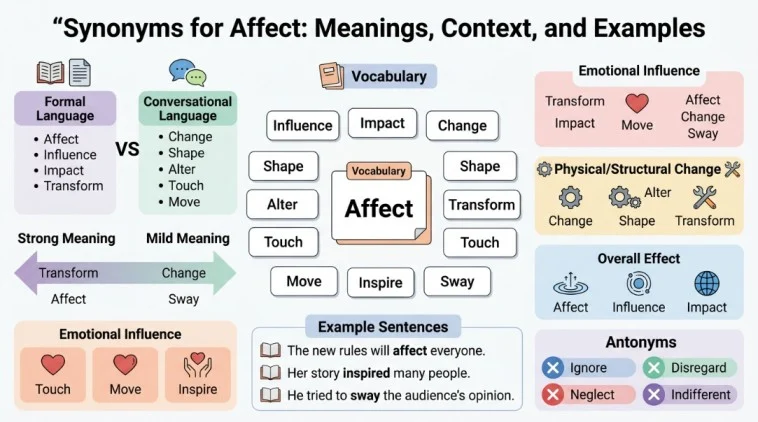
Affect usually means to influence, change, or have an impact on someone or something. Depending on context, useful alternatives include influence, impact, change, alter, shape, sway, touch, move, and transform.
Meaning, Tone and Context
1. Simple Definition
As a verb, affect means to influence someone or something, often by causing a change in behavior, condition, feelings, performance, or results.
For example:
“The weather affected our travel plans.”
Here, affected means that the weather influenced or changed the plans.
2. Part of Speech
Affect is most commonly used as a verb.
Verb example:
“Stress can affect your concentration.”
There is also a specialized noun use in psychology. In that context, affect refers to the observable expression of emotion.
Noun example:
“The patient showed a restricted affect.”
For most everyday vocabulary questions, however, people asking for synonyms for affect mean the verb.
3. Tone
Affect is generally neutral in tone. It does not automatically sound positive or negative.
For example:
“Exercise affected her energy levels.”
The sentence simply describes an influence. The result could be positive, negative, or neutral depending on the context.
4. Formality Level
Affect is appropriate in casual, academic, professional, and formal writing.
It is particularly common in research, business reports, essays, news writing, workplace communication, and analytical discussions.
5. Common Use Cases
You can use affect when discussing:
- Decisions
- Results
- Behavior
- Emotions
- Health
- Education
- Business performance
- Relationships
- Technology
- Social issues
- Environmental conditions
- Personal experiences
6. Important Word Forms
Related forms include:
Affect: verb meaning to influence or change something.
Affected: past tense or past participle of affect.
Affecting: present participle of affect.
Affect: specialized noun referring to visible emotional expression.
A major vocabulary distinction is between affect and effect. Affect is usually the action of influencing something, while effect is usually the result produced by that influence.
When and How to Use “Affect”
Use affect when you want to show that one person, event, condition, or decision influences another person or thing.
The word works especially well when the exact nature of the influence is already clear from the sentence.
1. Professional Context
“The new policy may affect employee productivity.”
Here, affect describes an influence on workplace performance.
2. Personal Context
“Her kind words affected me more than she realized.”
The word describes an emotional influence.
3. Academic Context
“Sleep quality can affect academic performance.”
This is appropriate for an essay or research based discussion.
4. Emotional Context
“The loss deeply affected his family.”
Here, affected communicates significant emotional influence.
5. Creative Context
“The quiet landscape affected her mood.”
A more expressive alternative could be “The quiet landscape shaped her mood.”
6. Social Media Context
“Small acts of kindness can affect someone’s entire day.”
Affect works naturally when the message is thoughtful but still conversational.
7. Email Context
“Changes to the schedule may affect your availability.”
This is clear, neutral, and professional.
Another Word for “Affect”
The best single replacement for affect is usually influence when you mean that something changes or shapes another person’s behavior, thinking, decisions, or condition.
However, context matters.
- Professional writing: influence or impact
- Academic writing: influence, alter, shape, or impact
- Casual conversation: change or influence
- Emotional writing: touch or move
- Creative writing: shape, transform, touch, or move
- Resume and workplace use: improve, influence, strengthen, or shape
- Social media captions: touch, inspire, move, or change
- Stronger meaning: transform, reshape, alter, or profoundly influence
- Softer meaning: influence, contribute to, shape, or relate to
The strongest choice is not always the most dramatic word. A precise synonym is usually better than an impressive sounding one.
When Not to Use “Affect”
Affect is useful, but it can sometimes be too general.
If you know exactly how something changed, a more precise verb can make your writing stronger.
For example:
“The training affected employee performance.”
This is correct, but vague.
“The training improved employee performance.”
Improved tells the reader exactly what happened.
Another example:
“Her speech affected the audience.”
This does not explain the emotional response.
“Her speech moved the audience.”
Moved gives the sentence a clearer emotional meaning.
Use a more specific synonym when you want to communicate direction, intensity, or emotional tone.
Words Commonly Confused With “Affect”
Affect vs. Effect
Affect is usually a verb meaning to influence.
Effect is usually a noun meaning the result of something.
Example:
“Lack of sleep can affect your concentration.”
“The effect of poor sleep can last throughout the day.”
Affect vs. Influence
Influence means to have an effect on someone’s actions, thoughts, or decisions.
Affect is broader and can describe changes to conditions, systems, results, emotions, or people.
Affect vs. Impact
Impact often suggests a noticeable or significant effect.
Affect can describe a small or major influence.
Affect vs. Change
Change means making something different.
Affect means influencing it, which does not always mean completely changing it.
Affect vs. Alter
Alter means to make a modification.
Affect can simply mean influencing something without directly modifying it.
Affect vs. Influence
These words are often interchangeable, but influence frequently focuses on behavior, opinions, choices, or development, while affect has a broader range of uses.
Best Synonym by Context for “Affect”
| Context | Best Synonym | Why It Works | Example |
|---|---|---|---|
| Formal writing | Influence | Clear and professional | The decision may influence future policy. |
| Academic writing | Influence | Common in analytical writing | Sleep can influence memory. |
| Professional use | Impact | Suggests a measurable result | The change could impact productivity. |
| Resume | Improve | Shows a positive result | Improved customer satisfaction through better service. |
| Casual conversation | Change | Simple and natural | That experience changed me. |
| Creative writing | Shape | Suggests gradual development | Her childhood shaped her personality. |
| Emotional tone | Move | Clearly expresses emotion | His story moved the audience. |
| Strong intensity | Transform | Shows major change | The experience transformed her outlook. |
| Soft tone | Influence | Neutral and moderate | Friends can influence our choices. |
| Social media | Inspire | Works well for positive emotional influence | Her journey inspired thousands. |
| Business writing | Impact | Concise and result focused | Rising costs impacted revenue. |
| Personal writing | Touch | Suggests emotional connection | Her message touched my heart. |
| Behavioral context | Sway | Suggests changing someone’s decision | The evidence swayed the jury. |
| Physical condition | Alter | Emphasizes modification | The medication may alter sleep patterns. |
| Development | Shape | Suggests long term influence | Education shapes future opportunities. |
Which Synonym Should You Choose?
Start by identifying what affect means in your sentence.
- If you mean general influence, choose influence.
- If you mean a noticeable result, choose impact.
- If you mean making something different, choose change or alter.
- If you mean long term development, choose shape.
- If you mean a major transformation, choose transform.
- If you mean an emotional response, choose touch or move.
- If you mean changing someone’s opinion or decision, choose sway.
The best synonym should preserve the original meaning while improving precision, tone, and readability.
Real Life Examples of “Affect” in Sentences
School
“Poor sleep can affect a student’s ability to concentrate.”
A stronger alternative is:
“Poor sleep can impair a student’s ability to concentrate.”
Workplace
“Communication problems can affect team performance.”
A more precise option is:
“Communication problems can undermine team performance.”
Writing
“Word choice affects how readers understand a message.”
Another option is:
“Word choice shapes how readers understand a message.”
Conversation
“Your advice really affected my decision.”
A natural alternative is:
“Your advice really influenced my decision.”
Social Media
“Your story affected more people than you know.”
A warmer alternative is:
“Your story touched more people than you know.”
Resume
“My leadership affected team productivity.”
A stronger resume version is:
“Improved team productivity through effective leadership.”
“The schedule change may affect our meeting.”
A clearer version is:
“The schedule change may impact our meeting.”
Storytelling
“The experience affected how she viewed success.”
A more descriptive version is:
“The experience transformed how she viewed success.”
25 Synonyms for “Affect”
| Synonym | Simple Meaning | Best Used For | Example Sentence |
|---|---|---|---|
| Influence | To have an effect on something | General and professional writing | Parents can influence a child’s habits. |
| Impact | To have a noticeable effect | Business and formal contexts | The delay impacted the project timeline. |
| Change | To make something different | Everyday language | The experience changed his perspective. |
| Alter | To modify something | Formal and academic writing | The treatment may alter the results. |
| Shape | To influence development over time | Personal, academic, and creative writing | Early experiences shape our beliefs. |
| Modify | To make limited changes | Technical and formal contexts | The update modified the way the system works. |
| Transform | To change something significantly | Strong and positive or dramatic contexts | Education can transform a person’s future. |
| Sway | To influence a decision or opinion | Opinions and choices | The evidence swayed her judgment. |
| Move | To cause an emotional reaction | Emotional and literary writing | The performance moved everyone in the room. |
| Touch | To create an emotional connection | Personal and emotional writing | Her kindness touched me deeply. |
| Inspire | To encourage strong positive feelings or action | Motivation and social content | His story inspired young entrepreneurs. |
| Motivate | To encourage action | Workplace, education, and personal growth | The coach motivated the players to improve. |
| Encourage | To give someone confidence or support | Personal and professional communication | Her feedback encouraged him to continue. |
| Impress | To create admiration | Social and professional situations | Her presentation impressed the entire team. |
| Disturb | To cause discomfort or concern | Negative emotional situations | The news disturbed many residents. |
| Upset | To cause emotional distress | Casual and personal language | The unexpected decision upset the staff. |
| Trouble | To cause worry or difficulty | Conversational contexts | The uncertainty troubled investors. |
| Influence | To guide or shape behavior | Behavioral contexts | Social pressure can influence decisions. |
| Determine | To strongly influence an outcome | Formal and analytical writing | Several factors determine the final result. |
| Govern | To control or strongly influence | Formal and technical contexts | These rules govern how the system operates. |
| Control | To determine what happens | Strong influence or authority | The company controls the distribution process. |
| Modify | To change part of something | Technical and academic writing | Temperature can modify the reaction. |
| Reshape | To change the structure or direction | Strong creative and formal writing | Technology reshaped modern communication. |
| Guide | To influence direction or decisions | Professional and educational contexts | Good mentors guide career decisions. |
| Undermine | To weaken something gradually | Negative professional or formal contexts | Poor communication can undermine trust. |
Synonym Groups and Usage Differences
Professional vs. Personal Synonyms
Professional writing usually benefits from neutral and precise choices such as influence, impact, alter, shape, determine, and modify.
Personal writing can use more emotionally expressive alternatives such as touch, move, inspire, and upset.
Compare:
“The announcement affected employee morale.”
Professional and neutral.
“The announcement hurt employee morale.”
More direct and emotionally negative.
Formal vs. Conversational Synonyms
Formal writing often favors influence, alter, modify, determine, govern, and impact.
Conversational English tends to favor change, move, upset, touch, and guide.
For example:
“Economic conditions influenced consumer behavior.”
Formal and analytical.
“The economy changed what people bought.”
Conversational and simple.
Academic Synonyms
Academic writing should prioritize accuracy over vocabulary variety.
Useful choices include:
Influence: when describing a relationship between factors.
Impact: when emphasizing a significant result.
Alter: when describing a modification.
Shape: when discussing development.
Determine: when something strongly contributes to an outcome.
Avoid replacing affect with an unusual word simply to sound sophisticated.
Professional and Business Synonyms
Business communication often requires concise and measurable language.
Useful choices include:
Impact: for business results.
Influence: for decisions and behavior.
Improve: for positive outcomes.
Undermine: for negative effects.
Shape: for strategy or development.
Determine: for factors that strongly control an outcome.
For a resume, specific achievement language is usually better than simply saying something “affected” results.
Creative or Literary Synonyms
Creative writing often benefits from words that communicate emotional depth or imagery.
Touch suggests an emotional connection.
Move suggests a strong emotional response.
Shape suggests gradual influence.
Transform suggests major change.
Reshape suggests that something has fundamentally changed direction or structure.
Example:
“The memory affected her.”
More vivid:
“The memory shaped the way she saw the world.”
Slang or Modern Synonyms
There are few true slang synonyms for affect because the word is already common and neutral.
Casual expressions such as change, hit, get to, or mess with can sometimes communicate a similar idea, but they are not interchangeable in every sentence.
For example:
“That movie really got to me.”
This can mean that the movie affected the speaker emotionally.
However, “get to” is too informal for most academic or professional writing.
Strongest vs. Weaker Synonyms
A useful intensity scale is:
Influence: mild to moderate
Guide: mild to moderate
Shape: moderate and gradual
Impact: moderate to strong
Sway: moderate influence on a decision
Alter: moderate change
Reshape: strong structural change
Transform: very strong change
Undermine: strong negative influence
The correct intensity depends on the facts. Do not use transform when the change was minor.
Emotional vs. Neutral Synonyms
Neutral choices include:
Influence
Impact
Alter
Modify
Shape
Emotional choices include:
Move
Touch
Inspire
Upset
Disturb
Impress
If your sentence is factual, choose a neutral word. If emotional response is part of the meaning, an expressive synonym can be more effective.
Antonyms of “Affect”
Because affect can mean influence or change, its antonyms depend on the exact context.
| Antonym | Meaning | Example Sentence |
|---|---|---|
| Ignore | To pay no attention to | She ignored the criticism. |
| Neglect | To fail to give proper attention | They neglected the warning signs. |
| Preserve | To keep something unchanged | The policy preserves existing protections. |
| Maintain | To keep something in its current state | The company maintained stable prices. |
| Protect | To keep something safe from harm | The shield protects the equipment. |
| Stabilize | To make something steady | The treatment helped stabilize the condition. |
| Sustain | To keep something continuing | The program sustained community support. |
| Leave | To let something remain as it is | They left the original design unchanged. |
| Disregard | To deliberately ignore something | The manager disregarded the complaint. |
| Resist | To oppose an influence | She resisted pressure from her peers. |
| Prevent | To stop something from happening | The barrier prevented further damage. |
| Avoid | To stay away from an influence or situation | He avoided negative distractions. |
| Counteract | To reduce or oppose an effect | The new policy counteracted the previous problem. |
| Reverse | To change something back to an earlier condition | The company reversed the decision. |
| Restore | To return something to a previous condition | The repairs restored the building. |
Comparison: Affect vs. Similar Words
Affect vs. Influence
Main difference: Both mean to have an effect, but influence often focuses on behavior, choices, opinions, or development.
Which one is stronger: Neither is automatically stronger.
Which one is more formal: Both are suitable for formal writing.
Affect example: “Stress can affect your health.”
Influence example: “Stress can influence your daily decisions.”
Affect vs. Impact
Main difference: Impact often emphasizes a noticeable or significant result.
Which one is stronger: Impact often sounds stronger.
Which one is more formal: Both work in formal writing.
Affect example: “The decision affected employees.”
Impact example: “The decision significantly impacted employees.”
Affect vs. Change
Main difference: Change directly indicates that something became different. Affect only indicates influence.
Which one is stronger: Change can imply a clearer result.
Which one is more formal: Affect is often more natural in analytical writing.
Affect example: “The experience affected his attitude.”
Change example: “The experience changed his attitude.”
Affect vs. Alter
Main difference: Alter means to modify something, while affect can describe influence without direct modification.
Which one is stronger: Alter suggests a more direct change.
Which one is more formal: Alter often sounds more formal.
Affect example: “The medication affected her sleep.”
Alter example: “The medication altered her sleep pattern.”
Affect vs. Shape
Main difference: Shape often describes gradual influence that contributes to development.
Which one is stronger: Shape can imply deeper or longer term influence.
Which one is more formal: Both are suitable for formal writing.
Affect example: “Education affects career choices.”
Shape example: “Education shapes career choices.”
Affect vs. Move
Main difference: Move specifically describes emotional influence.
Which one is stronger: Move can communicate a stronger emotional response.
Which one is more formal: Affect is more neutral.
Affect example: “The story affected the audience.”
Move example: “The story moved the audience.”
Common Phrases and Expressions with “Affect”
1. Affect the Outcome
Meaning:
To influence the final result of something.
Example sentence:
“Small decisions can affect the outcome of a project.”
2. Affect Performance
Meaning:
To influence how well someone or something performs.
Example sentence:
“Lack of preparation can affect performance.”
3. Affect Decision Making
Meaning:
To influence the process of making choices.
Example sentence:
“Emotions can affect decision making.”
4. Affect Mental Health
Meaning:
To influence emotional or psychological well being.
Example sentence:
“Long periods of stress can affect mental health.”
5. Affect Relationships
Meaning:
To influence how people interact with each other.
Example sentence:
“Poor communication can affect relationships.”
6. Affect Productivity
Meaning:
To influence how efficiently work gets done.
Example sentence:
“Workplace distractions can affect productivity.”
7. Affect Public Opinion
Meaning:
To influence what a group of people thinks about an issue.
Example sentence:
“News coverage can affect public opinion.”
Common Mistakes to Avoid
1. Using Affect When a More Precise Word Is Better
“Affect” can be vague.
Instead of:
“The training affected performance.”
Consider:
“The training improved performance.”
The second sentence tells readers exactly what happened.
2. Confusing Affect With Effect
Remember the common distinction:
Affect is usually a verb.
Effect is usually a noun.
Example:
“The weather affected the event.”
“The weather had an effect on the event.”
3. Using a Casual Synonym in Formal Writing
Words such as “get to” may work in conversation but can sound too informal in an academic essay.
Use affect, influence, impact, or another precise alternative instead.
4. Using an Overly Dramatic Synonym
Do not use transform when you simply mean influence.
“The meeting transformed my schedule” sounds much stronger than “The meeting affected my schedule.”
5. Repeating Affect Too Often
Repeated use can make writing monotonous.
Instead of:
“The policy affected workers and affected productivity.”
Try:
“The policy influenced workers and reduced productivity.”
6. Choosing the Wrong Emotional Tone
Affect is neutral, while words such as upset, disturb, touch, and move carry emotional meaning.
Choose the synonym according to the feeling you want to communicate.
7. Using Slang in Academic or Professional Writing
Expressions such as “mess with” or “get to” can sound natural in conversation but usually weaken formal writing.
Use precise standard English instead.
FAQs
What is the best synonym for affect?
The best synonym for affect is usually influence when you mean to have an effect on someone or something. Impact, change, shape, and alter may be better depending on context.
What is a formal synonym for affect?
Influence, impact, alter, modify, determine, and shape can work as formal synonyms for affect. The best choice depends on the exact relationship being described.
What is an informal synonym for affect?
Change is one of the simplest informal alternatives to affect. In emotional contexts, touch or move can also sound natural in everyday conversation.
What is another word for affect in professional writing?
Influence and impact are strong professional alternatives. Improve is better when you want to communicate a positive result rather than a general influence.
What is the difference between affect and influence?
Affect means to have an effect on something, while influence often emphasizes changing behavior, opinions, decisions, or development. The two words frequently overlap.
What is the opposite of affect?
There is no single antonym for every meaning of affect. Depending on context, useful opposites include ignore, maintain, preserve, resist, prevent, protect, and stabilize.
Conclusion
Affect is a versatile word that usually means to influence, change, or have an impact on someone or something. Because it is broad and neutral, the best replacement depends on the exact meaning you want to communicate.
- For general influence, choose influence. For noticeable results, consider impact. For direct modification, use alter or change. For gradual development, choose shape. For emotional writing, touch or move can be more expressive, while transform works when the change is substantial.
The most useful vocabulary tip is simple: do not choose a synonym just because it sounds more advanced. Choose the word that communicates the exact meaning, strength, and tone you intend. That approach makes your writing clearer, more natural, and more effective.
For publishing, definitions and specialized usage should be verified against trusted dictionaries such as Cambridge, Oxford, Merriam Webster, Collins, or Britannica.
Discover More Post:
- 25+ Synonyms for Determine | Meanings, Examples, and Best …
- 25+ Synonyms for Saying | Meanings, Examples, and Best …
- 25+ Synonyms for Compassion | Meanings, Examples, and …