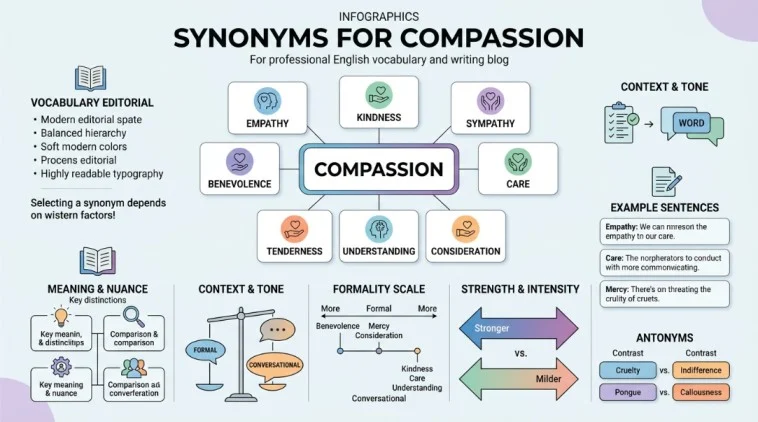
You may use the word compassion perfectly, but repeating it in every essay, caption, email, or professional message can make your writing feel predictable. The right alternative can make the same idea warmer, more precise, more formal, or more emotionally powerful.
This guide explains synonyms for compassion by meaning, tone, intensity, and context. You will learn which words work best in academic writing, professional communication, casual conversation, emotional writing, creative work, resumes, and social media.
The goal is not simply to replace one word with another. Good vocabulary means choosing a word that communicates exactly what you intend.
What Does “Compassion” Mean?
Compassion means a sympathetic concern for someone who is suffering, usually accompanied by a desire to help. Common alternatives include empathy for understanding feelings, kindness for gentle care, mercy for forgiveness, and benevolence for generous concern.
Meaning, Tone and Context
Simple definition
Compassion is a noun that describes a deep concern for another person’s suffering, combined with a willingness or desire to help.
For example:
“Her compassion for injured animals inspired her to volunteer at the shelter.”
The word suggests more than simply noticing that someone is struggling. It usually involves caring about their situation and wanting to ease their difficulty.
Part of speech
Compassion is primarily a noun.
Example:
“His compassion helped the family through a difficult time.”
The related adjective is compassionate.
Example:
“She is a compassionate teacher who listens carefully to her students.”
The related adverb is compassionately.
Example:
“The doctor spoke compassionately to the patient.”
Tone
Compassion has a strongly positive tone. It generally communicates warmth, humanity, concern, and kindness.
It is especially useful when discussing suffering, hardship, illness, loss, social problems, caregiving, leadership, or supportive relationships.
Formality level
Compassion is neutral to formal and works comfortably in most types of English.
It can appear in everyday conversation, academic essays, workplace communication, professional profiles, speeches, journalism, and creative writing.
Common use cases
Compassion is commonly used when discussing:
- Helping people in difficult situations
- Supporting someone who is grieving
- Caring for animals
- Healthcare and caregiving
- Teaching and education
- Leadership and workplace culture
- Charity and community service
- Social justice and humanitarian work
- Personal relationships
- Emotional or literary writing
Important word forms
Compassion: noun
Compassionate: adjective
Compassionately: adverb
A useful distinction is that compassion describes the feeling or quality, while compassionate describes a person, action, attitude, or response that shows compassion.
When and How to Use “Compassion”
Use compassion when you want to emphasize concern for suffering and a desire to respond with care.
Professional
“A compassionate manager understands that employees sometimes need flexibility during difficult circumstances.”
Personal
“She showed compassion when her friend was going through a painful breakup.”
Academic
“Compassion can influence how communities respond to vulnerable populations.”
Emotional
“His compassion gave the grieving family comfort when they needed it most.”
Creative
“Her compassion was a quiet light during the darkest period of his life.”
Social media
“Small acts of compassion can make someone’s difficult day a little easier.”
“Thank you for your compassion and understanding during this challenging situation.”
Another Word for “Compassion”
There is no single perfect replacement for compassion in every sentence. The best synonym depends on what part of the meaning you want to emphasize.
- Professional writing: empathy, consideration, understanding, sensitivity
- Academic writing: empathy, benevolence, humanitarian concern
- Casual conversation: kindness, care, sympathy
- Emotional writing: tenderness, empathy, warmth, mercy
- Creative writing: tenderness, humanity, fellow feeling
- Resume or workplace use: empathy, sensitivity, consideration, understanding
- Social media captions: kindness, care, empathy, love
- Stronger meaning: mercy, benevolence, humanitarian concern
- Softer meaning: kindness, care, understanding
A particularly important distinction is between compassion and empathy. Empathy focuses on understanding or sharing another person’s feelings. Compassion goes further by expressing concern and often motivating helpful action.
When Not to Use “Compassion”
Compassion can sometimes be too broad when your sentence requires a more precise word.
For example:
“Her compassion for the student’s opinion was impressive.”
If you mean that she understood the student’s feelings, empathy or understanding may be more accurate.
“She showed empathy for the student’s anxiety.”
If you mean generosity toward people in need, benevolence may be more precise.
“His benevolence supported several community programs.”
If you mean forgiveness toward someone who has done something wrong, mercy is usually a better choice.
“The judge showed mercy.”
If you simply mean friendly treatment, kindness is more natural.
“Her kindness made the new employee feel welcome.”
The best synonym is therefore the one that preserves the intended meaning rather than simply changing the vocabulary.
Words Commonly Confused With “Compassion”
Compassion vs. Empathy
Empathy involves understanding or experiencing another person’s feelings from their perspective.
Compassion involves concern for someone’s suffering and often includes a desire to help.
Compassion vs. Sympathy
Sympathy means feeling concern or sorrow for another person’s difficulty.
Compassion usually suggests a stronger impulse to help or relieve suffering.
Compassion vs. Pity
Pity involves feeling sorrow for someone’s suffering. It can sometimes imply that the observer feels separate or superior to the person.
Compassion generally carries a warmer and more respectful tone.
Compassion vs. Kindness
Kindness means being considerate, helpful, or pleasant toward others.
Compassion is more specifically connected to suffering, hardship, or vulnerability.
Compassion vs. Mercy
Mercy involves choosing not to punish, harm, or treat someone harshly.
Compassion involves caring about suffering and wanting to reduce it.
Compassion vs. Benevolence
Benevolence means a disposition to do good or promote the welfare of others.
Compassion is more emotionally connected to recognizing and responding to suffering.
Best Synonym by Context for “Compassion”
| Context | Best Synonym | Why It Works | Example |
|---|---|---|---|
| Formal writing | Benevolence | Sounds polished and emphasizes a desire to promote others’ welfare | Her benevolence benefited the local community. |
| Academic writing | Empathy | Useful when discussing emotional understanding | Empathy can improve communication between students. |
| Professional or business use | Consideration | Emphasizes respectful awareness of others’ circumstances | The manager showed consideration for the employee’s situation. |
| Resume | Empathy | Communicates interpersonal awareness and people skills | Demonstrated empathy when supporting customers. |
| Casual conversation | Kindness | Natural and familiar in everyday speech | Her kindness made everyone feel comfortable. |
| Creative writing | Tenderness | Adds emotional depth and warmth | He remembered her tenderness during his illness. |
| Emotional tone | Mercy | Strong when suffering, forgiveness, or hardship is central | They pleaded for mercy. |
| Strong intensity | Benevolence | Can suggest sustained generosity toward others | Her benevolence supported families for years. |
| Soft or moderate tone | Care | Simple and gentle | He showed genuine care for his neighbor. |
| Social media captions | Kindness | Short, familiar, and positive | Choose kindness whenever you can. |
| US usage | Compassion | Common, natural, and widely understood | The nurse treated every patient with compassion. |
| UK usage | Compassion | Equally natural and widely understood | The organization promotes compassion and dignity. |
Which Synonym Should You Choose?
Start by asking what you really mean.
- If you mean understanding another person’s feelings, choose empathy.
- If you mean feeling sorry about someone’s difficulty, choose sympathy.
- If you mean friendly and helpful behavior, choose kindness.
- If you mean forgiving someone or withholding punishment, choose mercy.
- If you mean generous concern for the welfare of others, choose benevolence.
- If you mean gentle emotional warmth, choose tenderness.
- If you mean awareness of someone’s circumstances, choose consideration.
- If you mean a simple concern for someone’s wellbeing, choose care.
For professional communication, prefer words that are precise and natural rather than unusually dramatic.
For creative writing, a more emotional synonym can add depth when the surrounding sentence supports it.
Real Life Examples of “Compassion” in Sentences
School
“The teacher showed compassion toward students who were struggling with the transition to a new school.”
Workplace
“Effective leaders combine clear expectations with compassion for employees facing personal challenges.”
Writing
“The essay argues that compassion can strengthen communities during periods of crisis.”
Conversation
“I really appreciated your compassion when I was having a difficult week.”
Social media
“Compassion costs nothing, but a thoughtful response can mean everything to someone having a hard day.”
Resume
“Used empathy and active listening to provide supportive customer service.”
“Thank you for your compassion and patience while our family handles this difficult situation.”
Storytelling
“The old neighbor offered food, shelter, and quiet compassion when the travelers had nowhere else to go.”
25 Synonyms for “Compassion”
| Synonym | Simple Meaning | Best Used For | Example Sentence |
|---|---|---|---|
| Empathy | Understanding another person’s feelings | Emotional understanding | Her empathy helped the new student feel understood. |
| Sympathy | Concern for someone’s difficulty | Condolences and difficult situations | We expressed our sympathy after the loss. |
| Kindness | Friendly and helpful treatment | Everyday communication | A little kindness can change someone’s day. |
| Mercy | Compassion shown through forgiveness or reduced punishment | Justice and forgiveness | The prisoner asked for mercy. |
| Benevolence | A desire to promote others’ welfare | Formal writing and charity | Her benevolence supported several local programs. |
| Care | Concern for someone’s wellbeing | Everyday and professional use | His care for his patients was obvious. |
| Tenderness | Gentle affection and emotional warmth | Personal and creative writing | She remembered his tenderness during her recovery. |
| Understanding | Awareness of another person’s situation or feelings | Professional and personal communication | Thank you for your understanding. |
| Consideration | Thoughtful awareness of another person’s needs | Workplace communication | The company showed consideration for working parents. |
| Sensitivity | Awareness of feelings and difficult circumstances | Professional and social contexts | She handled the subject with sensitivity. |
| Humanity | Recognition of shared human dignity and needs | Formal and creative writing | The story reminds readers of our shared humanity. |
| Generosity | Willingness to give or help freely | Charity and personal support | His generosity helped the family recover. |
| Altruism | Concern for others without focusing on personal benefit | Academic and formal writing | Researchers studied altruism in volunteer groups. |
| Goodwill | Friendly intention and positive feeling | Business and social relationships | The gesture helped restore goodwill between the teams. |
| Warmth | Friendly emotional closeness | Personal and creative writing | Her warmth made visitors feel welcome. |
| Solicitude | Attentive concern for someone’s wellbeing | Formal or literary writing | The nurse showed great solicitude toward the elderly patient. |
| Commiseration | Expression of shared sorrow or concern | Formal emotional situations | She offered her commiseration after hearing the news. |
| Condolence | Expression of sympathy after a death or loss | Bereavement and formal messages | The family received many messages of condolence. |
| Clemency | Mercy shown by someone with authority | Legal or political contexts | The governor granted clemency. |
| Leniency | Reduced severity in punishment or treatment | Discipline and legal contexts | The teacher showed leniency after hearing the student’s explanation. |
| Graciousness | Kind and courteous behavior | Social and professional settings | Her graciousness helped ease the tense meeting. |
| Fellow feeling | Shared concern based on common human experience | Literary and formal expression | His fellow feeling made him quick to help strangers. |
| Charity | Generous concern or help for people in need | Religious, charitable, and formal contexts | The organization provides charity to families in need. |
| Concern | Worry or care about another person’s welfare | General communication | Her concern for the children was sincere. |
| Pity | Sorrow or concern for another person’s suffering | Emotional contexts where sorrow is central | He felt pity for the abandoned animal. |
Some of these words overlap with compassion but are not interchangeable in every sentence. Empathy emphasizes emotional understanding, mercy emphasizes forgiveness or restraint, and benevolence emphasizes active goodwill toward others.
Synonym Groups and Usage Differences
Professional vs. Personal Synonyms
Professional writing often benefits from empathy, consideration, sensitivity, understanding, and care.
For example:
“The supervisor demonstrated empathy when discussing the employee’s concerns.”
Personal writing can use warmer terms such as kindness, tenderness, warmth, and care.
For example:
“Her kindness helped me through a difficult period.”
The key is to match the emotional level of the word to the relationship and purpose.
Formal vs. Conversational Synonyms
Formal contexts can support words such as benevolence, solicitude, altruism, humanity, and clemency.
Conversational English usually favors kindness, care, sympathy, empathy, and understanding.
A word can be grammatically correct yet still sound unnatural because it is too formal for the situation.
Academic Synonyms
Academic writing usually benefits from precise distinctions.
Empathy works well when discussing emotional understanding.
Altruism works well when discussing selfless behavior.
Benevolence can describe a general disposition toward promoting others’ welfare.
Humanity can work when discussing dignity, shared human experience, or humane treatment.
Avoid replacing compassion with an academic sounding word unless the meaning truly matches.
Professional and Business Synonyms
For workplace emails, presentations, resumes, and performance discussions, empathy, consideration, sensitivity, understanding, and care are usually practical choices.
For example:
“Demonstrated empathy when resolving customer concerns.”
This is often more specific and professionally useful than simply saying:
“Demonstrated compassion.”
Creative or Literary Synonyms
Creative writing gives you more freedom to emphasize emotional texture.
Tenderness can create intimacy.
Warmth can create a welcoming atmosphere.
Humanity can emphasize shared experience.
Fellow feeling can create a literary tone.
Mercy can add moral or dramatic tension.
The best choice depends on the scene, character, and emotional atmosphere.
Slang or Modern Synonyms
There is no widely accepted slang synonym that fully replaces compassion.
Words such as care and kindness are informal enough for everyday speech and social media, but they remain standard English rather than slang.
Expressions such as “show some heart” can communicate a similar idea in casual speech, but they should not replace compassion in formal writing.
Strongest vs. Weaker Synonyms
A simple intensity scale can help:
Mild: care, consideration
Moderate: kindness, understanding, sympathy
Deep: empathy, tenderness, humanity
Strong or context specific: compassion, mercy, benevolence
This is not a strict ranking because emotional strength depends heavily on context.
For example, mercy can sound extremely powerful in a legal or dramatic situation even though it does not mean exactly the same thing as compassion.
Emotional vs. Neutral Synonyms
More emotional choices include tenderness, warmth, pity, sympathy, and mercy.
More neutral or professional choices include consideration, understanding, sensitivity, concern, and care.
Choose emotional language when you want the reader to feel the human side of a situation.
Choose neutral language when clarity and professionalism are more important than emotional impact.
Antonyms of “Compassion”
| Antonym | Meaning | Example Sentence |
|---|---|---|
| Cruelty | Deliberate infliction of suffering | The story condemns cruelty toward vulnerable people. |
| Callousness | Lack of concern for others’ feelings | His callousness shocked everyone in the room. |
| Indifference | Lack of interest or concern | Her indifference to their suffering was difficult to understand. |
| Apathy | Lack of emotional interest or motivation | Public apathy can make social problems harder to address. |
| Heartlessness | Lack of kindness or sympathy | The character was criticized for his heartlessness. |
| Harshness | Severe or unkind treatment | The harshness of the response made the situation worse. |
| Unkindness | Lack of friendly or considerate behavior | His unkindness hurt his colleague deeply. |
| Insensitivity | Failure to recognize or respect others’ feelings | The comment showed considerable insensitivity. |
| Coldness | Lack of warmth or affection | Her sudden coldness surprised her friends. |
| Hostility | Unfriendly or aggressive attitude | The meeting became tense because of open hostility. |
| Malice | Desire to cause harm | The accusation was made with clear malice. |
| Hatred | Intense dislike or hostility | Hatred can damage relationships and communities. |
| Contempt | Strong feeling that someone is beneath respect | He treated the vulnerable group with contempt. |
| Selfishness | Excessive focus on one’s own interests | His selfishness prevented him from helping others. |
| Ruthlessness | Lack of pity when pursuing an objective | The leader was known for his ruthlessness. |
Comparison: “Compassion” vs. Similar Words
Compassion vs. Empathy
Main difference: Compassion involves concern for suffering, while empathy centers on understanding or sharing another person’s feelings.
Which one is stronger: Compassion can imply a stronger motivation to help.
Which one is more formal: Both are suitable for formal writing.
Example: “Her empathy helped her understand the patient’s fear.”
Compassion example: “Her compassion encouraged her to support the patient after the appointment.”
Compassion vs. Sympathy
Main difference: Sympathy expresses concern or sorrow, while compassion often suggests concern combined with a desire to help.
Which one is stronger: Compassion often carries a more active meaning.
Which one is more formal: Both work in formal and everyday contexts.
Example: “I offered my sympathy after his loss.”
Compassion example: “The community showed compassion by providing meals and support.”
Compassion vs. Pity
Main difference: Pity focuses on sorrow for another person’s situation. Compassion usually has a warmer and more respectful implication.
Which one is stronger: Compassion is generally more positive and constructive.
Which one is more formal: Both are standard words, but pity can sound less respectful in some contexts.
Example: “She felt pity for the abandoned dog.”
Compassion example: “She showed compassion by adopting the dog.”
Compassion vs. Kindness
Main difference: Kindness covers general helpful or considerate behavior, while compassion specifically relates to suffering or hardship.
Which one is stronger: Compassion is more specific to suffering.
Which one is more formal: Both are natural in professional and casual writing.
Example: “His kindness made the visitor feel welcome.”
Compassion example: “His compassion helped the grieving family cope.”
Compassion vs. Mercy
Main difference: Mercy involves forgiveness, leniency, or choosing not to punish or harm.
Which one is stronger: Mercy can be especially powerful when authority or punishment is involved.
Which one is more formal: Both are appropriate in formal contexts.
Example: “The judge showed mercy.”
Compassion example: “The judge expressed compassion for the victim’s family.”
Compassion vs. Benevolence
Main difference: Benevolence describes a disposition toward doing good, while compassion is more specifically connected to suffering.
Which one is stronger: Neither is automatically stronger. The context determines the intensity.
Which one is more formal: Benevolence is generally more formal.
Example: “Her benevolence funded several community projects.”
Compassion example: “Her compassion led her to volunteer with families facing hardship.”
Common Phrases and Expressions with “Compassion”
1. Show compassion
Meaning: To demonstrate concern for someone who is suffering or struggling.
Example sentence: “We should show compassion to people facing difficult circumstances.”
2. Feel compassion
Meaning: To experience concern for another person’s suffering.
Example sentence: “She felt compassion for the injured animal.”
3. Have compassion
Meaning: To possess or demonstrate a caring attitude toward others.
Example sentence: “Try to have compassion for people who are learning from their mistakes.”
4. Compassion for others
Meaning: Concern for the difficulties and suffering experienced by other people.
Example sentence: “His compassion for others shaped his career in social services.”
5. Compassion and empathy
Meaning: Two related qualities involving care and emotional understanding.
Example sentence: “Good counselors often rely on both compassion and empathy.”
6. Compassionate care
Meaning: Care that combines practical help with emotional understanding and respect.
Example sentence: “The clinic is known for providing compassionate care.”
7. Self compassion
Meaning: Treating yourself with understanding and kindness during failure, stress, or difficulty.
Example sentence: “Self compassion can help people respond to mistakes more constructively.”
8. Compassion fatigue
Meaning: Emotional exhaustion that can occur after prolonged exposure to other people’s suffering.
Example sentence: “Healthcare workers may need support to manage compassion fatigue.”
Common Mistakes to Avoid
1. Using compassion when empathy is more precise
If the sentence focuses on understanding another person’s feelings, empathy may be the better word.
2. Treating every synonym as interchangeable
Synonyms often overlap without having identical meanings.
Mercy, pity, empathy, kindness, and compassion each emphasize different ideas.
3. Using a casual synonym in formal writing
Words such as kindness and care can work professionally, but highly informal expressions may weaken an academic or business message.
4. Using an overly dramatic synonym
Mercy or tenderness may sound excessive if you are simply describing polite workplace behavior.
Choose a word that matches the situation.
5. Repeating compassion too often
Using the same word repeatedly can make an essay or article feel monotonous.
Replace it selectively with precise alternatives rather than changing every occurrence.
6. Choosing the wrong emotional tone
Pity can sometimes sound patronizing. Sympathy can focus on sorrow. Empathy focuses on understanding.
Consider the reader’s likely interpretation before choosing a synonym.
7. Using slang in academic or professional writing
Casual expressions may sound natural in conversation but inappropriate in an essay, report, resume, or formal email.
FAQs
What is the best synonym for compassion?
The best synonym depends on context. Empathy works for emotional understanding, kindness for everyday care, mercy for forgiveness, and benevolence for generous concern.
What is a formal synonym for compassion?
Benevolence is a strong formal synonym when you mean a desire to promote others’ welfare. Solicitude can also work in formal or literary contexts.
What is an informal synonym for compassion?
Kindness, care, and understanding are natural informal alternatives. They work well in everyday conversation, texts, personal messages, and social media.
What is another word for compassion in professional writing?
Empathy, consideration, sensitivity, and understanding are useful professional alternatives. The best choice depends on whether feelings, needs, or respectful treatment are emphasized.
What is the difference between compassion and empathy?
Empathy focuses on understanding another person’s feelings, while compassion adds concern for suffering and often includes a desire to provide support or help.
What is the opposite of compassion?
Common opposites include cruelty, callousness, indifference, apathy, heartlessness, insensitivity, hostility, and ruthlessness. The best antonym depends on the context.
Conclusion
Compassion describes concern for another person’s suffering, often together with a desire to help. It is a positive and versatile word that works in personal, academic, professional, and creative communication.
The best synonym depends on your intended meaning. Choose empathy for emotional understanding, kindness for everyday warmth, sympathy for concern about someone’s hardship, mercy for forgiveness, and benevolence for generous concern about others’ welfare.
The most useful vocabulary habit is to ask what idea you want the reader to notice. Instead of replacing compassion simply to avoid repetition, choose the word that expresses the exact shade of meaning you need.
Discover More Post: