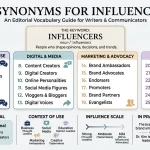
The word “influencers” appears everywhere, from social media captions and marketing campaigns to business reports, professional emails, and everyday conversations. However, using the same word repeatedly can make your writing sound predictable. Whether you are describing content creators, industry experts, public personalities, or people who shape opinions, choosing a more specific alternative can make your message clearer.
Understanding synonyms for influencers helps you communicate the exact type of influence someone has. Some alternatives sound professional, while others emphasize popularity, expertise, creativity, or the ability to shape trends. This guide explores 25 useful alternatives, explains their meanings, and provides practical examples to help you select the right word for different situations.
What Does “Influencers” Mean?
Influencers are people who affect the opinions, decisions, interests, or purchasing behavior of others. Common synonyms include opinion leaders, trendsetters, content creators, public figures, tastemakers, advocates, and brand ambassadors, depending on their role and audience.
Meaning, Tone and Context
What Does Influencers Mean?
The word influencers refers to people who have the ability to affect how others think, behave, make decisions, or view particular subjects.
An influencer may gain influence through expertise, professional experience, popularity, personal relationships, social media activity, or public recognition.
For example, a fashion influencer can introduce new clothing trends, while a financial influencer may encourage people to learn about investing.
Part of Speech
Influencers is a plural countable noun.
Its singular form is influencer.
Related word forms include:
- Influence: The ability to affect someone or something.
- Influencer: A person who influences others.
- Influential: Having the power to affect opinions or decisions.
- Influenced: Affected by someone or something.
- Influencing: The act of affecting thoughts or behavior.
Tone and Connotation
The word influencers generally has a neutral tone, but its meaning can change depending on context.
Positive tone: It can describe people who inspire others, share knowledge, or encourage positive decisions.
Neutral tone: It can refer to people who have an established audience and affect public opinions.
Negative tone: In certain situations, it can describe people who promote unrealistic lifestyles, misleading information, or excessive consumerism.
Formality Level
Influencers is commonly used in casual conversations, digital marketing, journalism, and professional communication.
For academic or corporate writing, alternatives such as opinion leaders, industry experts, and influential individuals may sound more precise.
Common Use Cases
The word influencers commonly appears in:
- Social media marketing campaigns.
- Fashion and beauty discussions.
- Business and brand partnerships.
- Digital advertising.
- Public relations.
- Consumer behavior research.
- Entertainment and lifestyle content.
When and How to Use “Influencers”
Use influencers when discussing people who have an audience or personal authority that allows them to shape opinions, trends, or decisions.
Here are seven realistic examples.
1. Professional Context
The company partnered with several influencers to introduce its new product to younger customers.
2. Social Media Context
Many influencers use Instagram to share lifestyle content and connect with their followers.
3. Business Context
Brands often collaborate with influencers to increase product awareness and customer engagement.
4. Academic Context
Researchers examined how influencers affect consumer purchasing decisions.
5. Creative Context
Fashion influencers frequently introduce fresh ideas that inspire personal style.
6. Casual Conversation
Some influencers have built successful careers by sharing their everyday experiences online.
7. Email Context
We are looking for influencers who can help promote our upcoming campaign.
Another Word for Influencers
The best alternative depends on what makes someone influential.
For example, opinion leaders works well when discussing people who shape public thinking. Content creators emphasizes producing digital material, while trendsetters describes people who introduce new styles and ideas.
Here are the best choices by context.
- Professional writing: Opinion leaders, industry experts, influential individuals.
- Academic writing: Opinion leaders, key opinion leaders, influential figures.
- Casual conversation: Social media personalities, creators, online personalities.
- Emotional writing: Inspirational figures, role models, advocates.
- Creative writing: Tastemakers, trendsetters, cultural icons.
- Resume or workplace use: Brand ambassadors, campaign advocates, industry thought leaders.
- Social media captions: Content creators, digital creators, online personalities.
- Stronger meaning: Thought leaders, prominent figures, key opinion leaders.
- Softer meaning: Content creators, bloggers, community voices.
When Not to Use “Influencers”
Although influencers is a useful word, it is not always the most accurate choice.
Sometimes, a more specific term communicates the person’s actual contribution.
1. When discussing subject expertise
If someone influences decisions through professional knowledge, industry experts may be more appropriate.
Example:
General: The influencers discussed the latest technology.
Precise: The technology experts discussed the latest developments.
2. When discussing content production
If the main activity is creating digital material, content creators is more descriptive.
Example:
General: The influencers published new videos.
Precise: The content creators published new videos.
3. When discussing public opinion
Opinion leaders is a better choice when the focus is on shaping public attitudes.
4. When discussing fashion or lifestyle trends
Trendsetters is more suitable for people who introduce popular styles and ideas.
5. When discussing paid partnerships
Brand ambassadors is more appropriate when someone officially represents or promotes a company.
Choosing a precise alternative helps readers understand exactly what a person does rather than simply knowing that they have influence.
Words Commonly Confused With “Influencers”
Several related terms describe people with audiences, authority, or public recognition. However, their meanings are not identical.
1. Influencers vs. Content Creators
Influencers affect opinions or decisions, while content creators primarily produce material such as videos, photographs, articles, and podcasts.
A content creator may also be an influencer, but not every creator has significant influence.
2. Influencers vs. Celebrities
Influencers often build their audiences through specialized content and direct engagement. Celebrities usually gain public recognition through entertainment, sports, or other prominent activities.
3. Influencers vs. Opinion Leaders
Opinion leaders are people whose knowledge, experience, or credibility helps shape the views of others.
The term is especially useful in research, business, and communication.
4. Influencers vs. Trendsetters
Influencers can affect opinions and purchasing decisions across many subjects. Trendsetters specifically introduce or popularize new styles, behaviors, and ideas.
5. Influencers vs. Brand Ambassadors
Influencers may promote multiple products or companies. Brand ambassadors usually have an official or ongoing relationship with a particular brand.
6. Influencers vs. Advocates
Influencers can affect decisions in different ways, while advocates actively support a particular cause, product, organization, or idea.
Best Synonym by Context for Influencers
The right alternative depends on the person’s role, expertise, audience, and purpose.
| Context | Best Synonym | Why It Works | Example |
|---|---|---|---|
| Formal writing | Opinion leaders | Sounds professional and precise | Opinion leaders shape public discussions. |
| Academic writing | Key opinion leaders | Suitable for research and communication studies | Key opinion leaders affect consumer attitudes. |
| Professional use | Industry experts | Highlights specialized knowledge | Industry experts shared their recommendations. |
| Resume | Brand ambassadors | Shows promotional responsibilities | Worked with brand ambassadors on campaigns. |
| Casual conversation | Social media personalities | Familiar and conversational | Social media personalities share daily updates. |
| Creative writing | Tastemakers | Suggests cultural and artistic influence | Tastemakers introduced fresh fashion ideas. |
| Emotional writing | Role models | Highlights inspiration and positive behavior | Young athletes admire these role models. |
| Strong influence | Thought leaders | Highlights authority and expertise | Thought leaders discussed industry changes. |
| Softer meaning | Content creators | Focuses on creative work | Content creators published helpful tutorials. |
| Social media captions | Digital creators | Fits online content and audiences | Digital creators shared their latest projects. |
| Fashion industry | Trendsetters | Emphasizes new styles | Trendsetters introduced seasonal fashion ideas. |
| Public relations | Public figures | Highlights public recognition | Public figures attended the event. |
| Marketing campaigns | Brand advocates | Emphasizes support and promotion | Brand advocates recommended the new service. |
Which Synonym Should You Choose?
Choosing the right synonym requires more than finding a word with a similar dictionary meaning. Consider these five factors.
1. Consider the Actual Meaning
Ask what the person does.
If they create videos, use content creators. They shape public opinions, use opinion leaders. If they introduce new styles, use trendsetters.
2. Match the Level of Formality
Formal documents benefit from terms such as influential individuals, opinion leaders, and industry experts.
For casual conversations, creators, bloggers, and social media personalities sound more natural.
3. Consider the Level of Influence
Someone with specialized authority may be described as a thought leader.
Someone who simply shares content with an audience may be better described as a digital creator.
4. Understand the Professional Value
For business communication, choose words that explain the person’s contribution.
Brand ambassadors, industry experts, and campaign advocates communicate more specific professional roles than the general word influencers.
5. Check the Sentence Context
Read the complete sentence before replacing the original word.
A synonym should preserve the intended meaning, not simply make the vocabulary sound more sophisticated.
Real Life Examples of Influencers in Sentences
Here are examples showing how different alternatives work in everyday situations.
1. School
Students often look up to role models who encourage learning, discipline, and personal development.
2. Workplace
Our marketing department invited several industry experts to discuss the future of digital advertising.
3. Writing
Opinion leaders can play an important role in shaping public conversations about social issues.
4. Conversation
I follow a few content creators who share useful cooking tips and simple recipes.
5. Social Media
Digital creators are introducing creative ways to connect with online communities.
6. Resume
Collaborated with brand ambassadors to support promotional campaigns and improve customer engagement.
7. Email
We would like to connect with selected opinion leaders for our upcoming awareness campaign.
8. Storytelling
The young designer became a tastemaker whose ideas inspired an entire generation of artists.
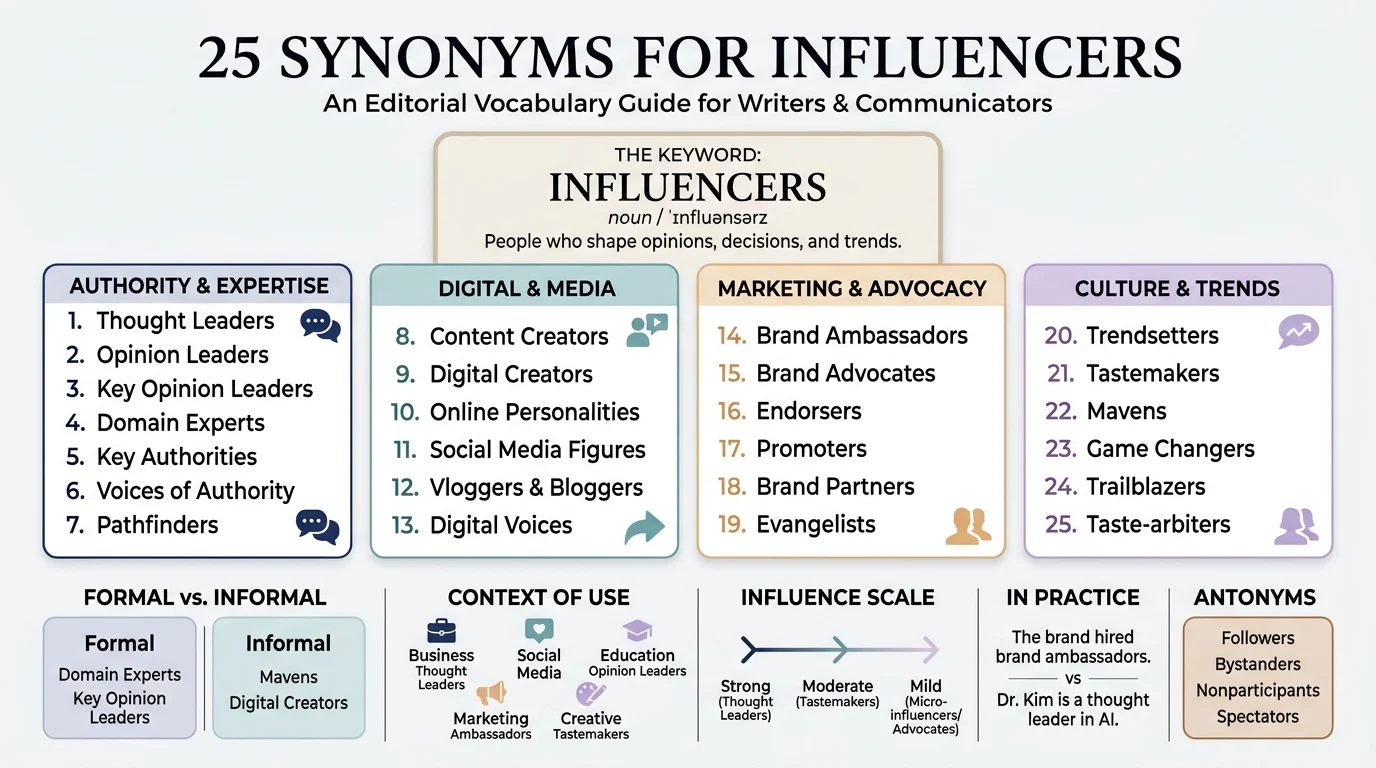
25 Synonyms for Influencers
The following alternatives cover social media, marketing, professional communication, public recognition, and personal inspiration. Some are close synonyms, while others describe specific types of influential people.
| Synonym | Simple Meaning | Best Used For | Example Sentence |
|---|---|---|---|
| 1. Opinion leaders | People who shape others’ opinions | Academic and professional writing | Opinion leaders encouraged public discussion. |
| 2. Trendsetters | People who introduce new trends | Fashion and lifestyle | Trendsetters made minimalist fashion popular. |
| 3. Thought leaders | Respected people with expertise and ideas | Business and professional settings | Thought leaders shared valuable industry insights. |
| 4. Content creators | People who produce digital content | Social media | Content creators published educational videos. |
| 5. Digital creators | People who create online material | Digital marketing | Digital creators developed engaging campaigns. |
| 6. Social media personalities | Recognized online personalities | Casual and social media writing | Social media personalities connected with millions of followers. |
| 7. Online personalities | People known for their internet presence | Digital culture | Online personalities discussed emerging trends. |
| 8. Tastemakers | People who shape cultural or artistic preferences | Fashion and creative writing | Tastemakers introduced new design concepts. |
| 9. Public figures | People widely recognized by the public | Journalism and formal writing | Public figures supported the initiative. |
| 10. Brand ambassadors | People who represent a brand | Marketing and advertising | Brand ambassadors promoted the new collection. |
| 11. Brand advocates | People who actively support a brand | Business communication | Brand advocates recommended the service. |
| 12. Advocates | People who publicly support an idea or cause | Awareness campaigns | Advocates encouraged environmental responsibility. |
| 13. Spokespeople | People who communicate on behalf of an organization | Public relations | Spokespeople explained the company’s position. |
| 14. Promoters | People who actively advertise or encourage something | Marketing and events | Promoters helped increase event attendance. |
| 15. Endorsers | People who publicly recommend products or services | Advertising | Endorsers shared their product experiences. |
| 16. Affiliates | Partners who promote products through referral arrangements | Affiliate marketing | Affiliates introduced the product to new customers. |
| 17. Bloggers | People who publish written online content | Blogging and lifestyle | Bloggers reviewed the latest travel destinations. |
| 18. Vloggers | People who create video blogs | Video platforms | Vloggers documented their weekend adventures. |
| 19. Streamers | People who broadcast live content | Gaming and entertainment | Streamers interacted with viewers during live sessions. |
| 20. Reviewers | People who evaluate products or services | Product marketing | Reviewers compared different smartphone models. |
| 21. Industry experts | People with specialized professional knowledge | Business and technical writing | Industry experts explained the market changes. |
| 22. Inspirational figures | People who motivate others | Personal and emotional writing | Inspirational figures encourage people to pursue their goals. |
| 23. Role models | People whose behavior others admire | Education and personal development | Positive role models can inspire young students. |
| 24. Celebrities | Famous and widely recognized people | Entertainment and media | Celebrities attended the charity event. |
| 25. Key opinion leaders | People with authority in a specific field | Research and professional marketing | Key opinion leaders influenced industry discussions. |
Important usage note: These 25 alternatives are not interchangeable in every sentence. For example, a reviewer evaluates something, while a brand ambassador represents a company. Choose the term that accurately describes the person’s role.
Synonym Groups and Usage Differences
Professional vs. Personal Synonyms
Professional alternatives emphasize expertise, credibility, and organizational relationships.
Useful choices include:
- Opinion leaders.
- Industry experts.
- Thought leaders.
- Brand ambassadors.
- Key opinion leaders.
Personal alternatives focus more on inspiration, popularity, and individual connections.
Useful choices include:
- Role models.
- Inspirational figures.
- Social media personalities.
- Online personalities.
- Content creators.
For example, a company may collaborate with industry experts, while a student may admire inspirational figures.
Formal vs. Conversational Synonyms
Formal alternatives work best in reports, essays, presentations, and business documents.
Examples include opinion leaders, influential individuals, public figures, and key opinion leaders.
Conversational alternatives include creators, bloggers, vloggers, and social media personalities.
Choose according to your audience. A marketing report should generally use more precise professional language than a casual Instagram caption.
Academic Synonyms
Academic writing benefits from terminology that explains how people affect opinions, attitudes, and behavior.
Consider these alternatives:
Opinion leaders: Suitable for discussing people who influence public attitudes.
Key opinion leaders: Useful when discussing recognized authority within a specific subject area.
Influential individuals: A broader expression for people who affect social or professional decisions.
Thought leaders: Appropriate when discussing people whose expertise and ideas influence a particular field.
Example:
The study examined how opinion leaders affect consumer attitudes toward sustainable products.
Professional and Business Synonyms
Business communication should explain the purpose of a person’s influence.
- Use brand ambassadors when discussing official brand representation.
- Use brand advocates when describing people who actively support a company’s products.
- Use industry experts when emphasizing professional knowledge.
- Use spokespeople when someone communicates an organization’s official position.
- Use endorsers when discussing public product recommendations.
Example:
The company partnered with industry experts and brand ambassadors to strengthen its marketing campaign.
Creative or Literary Synonyms
Creative writing benefits from alternatives that add personality, imagery, and cultural meaning.
Tastemakers: People who shape artistic and cultural preferences.
Trendsetters: People who introduce fresh styles and ideas.
Cultural icons: Highly recognized people who represent or influence a particular culture.
Inspirational figures: People whose achievements or behavior motivate others.
Example:
The young musician became a cultural icon whose creative vision influenced emerging artists.
Slang or Modern Synonyms
Modern digital communication often uses informal expressions for people who create content or build online communities.
Common examples include:
- Creators.
- Internet personalities.
- Social media stars.
- Digital creators.
- Streamers.
Some expressions, such as internet famous or social media star, are conversational rather than formal synonyms.
Use them in captions, casual discussions, and entertainment articles. Avoid them in academic papers or formal business reports unless the wording is relevant to the subject.
Strongest vs. Weaker Synonyms
Different alternatives suggest different levels or types of influence.
| Intensity | Synonym | Explanation |
|---|---|---|
| Mild | Content creators | Emphasizes producing material rather than influence. |
| Mild | Bloggers | Describes a particular content format. |
| Moderate | Social media personalities | Suggests online recognition and an audience. |
| Moderate | Brand ambassadors | Indicates an established promotional role. |
| Strong | Opinion leaders | Suggests the ability to shape opinions. |
| Strong | Trendsetters | Suggests the ability to introduce popular trends. |
| Very strong | Thought leaders | Suggests respected expertise and authority. |
| Very strong | Cultural icons | Suggests broad and lasting cultural significance. |
These terms measure different qualities, not a universal ranking of influence.
Emotional vs. Neutral Synonyms
Emotional alternatives communicate admiration, inspiration, or personal connection.
Examples include role models, inspirational figures, and cultural icons.
Neutral alternatives describe people’s activities or positions without adding strong emotional judgment.
Examples include content creators, public figures, bloggers, and industry experts.
For professional writing, neutral terminology is usually the safer choice. For motivational articles and personal storytelling, emotional alternatives can create a stronger connection.
Antonyms of Influencers
There is no single exact opposite of influencers because influence can refer to popularity, authority, expertise, or the ability to affect decisions.
However, the following words describe people with contrasting roles or limited influence in particular contexts.
| Antonym | Meaning | Example Sentence |
|---|---|---|
| 1. Followers | People who follow someone else’s ideas or activities | Followers often look to community leaders for guidance. |
| 2. Unknowns | People who are not widely recognized | The unknowns received little public attention. |
| 3. Outsiders | People who are not part of an influential group | Outsiders had limited access to the discussion. |
| 4. Ordinary people | People without special public recognition | Ordinary people shared their everyday experiences. |
| 5. Nonentities | People considered unimportant or insignificant | The organization initially overlooked these nonentities. |
| 6. Underlings | People in lower organizational positions | The executives consulted their underlings. |
| 7. Subordinates | People working under another person’s authority | Subordinates followed the manager’s instructions. |
| 8. Spectators | People who watch rather than actively participate | Spectators observed the public debate. |
| 9. Bystanders | People who are present but not involved | Bystanders watched the event from a distance. |
| 10. Laggards | People who are slow to adopt changes | Laggards were reluctant to embrace new technology. |
| 11. Imitators | People who copy others rather than introduce original ideas | Imitators followed the trendsetters. |
| 12. Nonleaders | People who do not hold leadership roles | Nonleaders participated in the group discussion. |
| 13. Inactive members | People who rarely participate or contribute | Inactive members did not engage with the campaign. |
| 14. Unrecognized individuals | People whose contributions receive little acknowledgment | Unrecognized individuals also helped shape the project. |
| 15. Nonparticipants | People who do not take part in an activity | Nonparticipants remained outside the campaign. |
Remember that these are contextual opposites, not direct dictionary antonyms. The best choice depends on whether you want to contrast popularity, authority, participation, or social influence.
Comparison: Influencers vs. Similar Words
Influencers vs. Content Creators
Influencers affect the opinions or decisions of an audience, while content creators primarily produce digital material.
Influencers emphasizes audience impact. Content creators emphasizes creative production.
Example:
Influencers introduced the new product to their followers.
Content creators produced videos explaining the product’s features.
Influencers vs. Opinion Leaders
Opinion leaders are recognized for their ability to shape attitudes through knowledge, credibility, or experience.
Influencers is broader and often associated with social media.
Opinion leaders sounds more formal and is particularly suitable for academic writing.
Example:
Influencers promoted the campaign online.
Opinion leaders shaped public attitudes toward the campaign.
Influencers vs. Trendsetters
Trendsetters introduce new styles, interests, and behaviors.
Influencers can affect decisions without necessarily creating trends.
Trendsetters is more specific when discussing fashion, culture, and lifestyle.
Example:
Influencers recommended the clothing collection.
Trendsetters introduced a completely new fashion style.
Influencers vs. Celebrities
Celebrities are famous individuals who receive widespread public attention.
Influencers can have smaller, more specialized audiences and may build their recognition through online content.
Celebrities generally emphasizes fame, while influencers emphasizes audience impact.
Example:
Influencers discussed the product in their videos.
Celebrities attended the product launch.
Influencers vs. Thought Leaders
Thought leaders are respected for their expertise, knowledge, and original ideas.
Influencers may affect behavior through popularity, entertainment, or personal recommendations.
Thought leaders sounds more authoritative in professional communication.
Example:
Influencers shared the announcement with their audiences.
Thought leaders discussed the announcement’s industry implications.
Influencers vs. Brand Ambassadors
Influencers may collaborate with different businesses, while brand ambassadors represent or promote a particular brand through an established relationship.
Brand ambassadors is more specific in advertising and corporate communication.
Example:
Influencers promoted several beauty products.
Brand ambassadors represented the company throughout its campaign.
Common Phrases and Expressions with “Influencers”
1. Social Media Influencers
Meaning: People who build online audiences and affect their interests or decisions.
Example: Social media influencers often collaborate with lifestyle brands.
2. Digital Influencers
Meaning: People who influence online audiences through digital platforms.
Example: Digital influencers helped introduce the new technology to younger customers.
3. Micro Influencers
Meaning: Influencers with relatively small, specialized audiences who often focus on particular interests or communities.
Example: The company partnered with micro influencers in the fitness industry.
4. Influencer Marketing
Meaning: A marketing strategy that involves working with influential people to promote products, services, or ideas.
Example: Influencer marketing helped the business reach a more targeted audience.
5. Influencer Partnerships
Meaning: Business collaborations between brands and influential individuals.
Example: The fashion company developed new influencer partnerships for its seasonal campaign.
6. Influencer Campaigns
Meaning: Promotional activities involving influencers and their audiences.
Example: The brand launched several influencer campaigns before the product release.
7. Influencer Outreach
Meaning: The process of contacting potential influencers for collaboration.
Example: Our marketing team started influencer outreach for the upcoming launch.
8. Influencer Engagement
Meaning: The level of interaction between influencers and their audiences.
Example: Strong influencer engagement helped improve the campaign’s visibility.
Common Mistakes to Avoid
1. Treating Every Content Creator as an Influencer
Not every person who creates online content has the ability to affect audience decisions.
Use content creator when the emphasis is on producing material rather than influencing people.
2. Confusing Influencers With Celebrities
A person does not need to be famous to influence a specific audience.
Use celebrities when widespread public recognition is the main point.
3. Using Casual Alternatives in Formal Writing
Words such as social media stars and internet personalities may sound too informal in academic or corporate documents.
Choose opinion leaders or influential individuals when appropriate.
4. Using Overly Dramatic Alternatives
Calling every popular creator a cultural icon exaggerates their importance.
Reserve stronger expressions for people with significant cultural recognition or lasting impact.
5. Repeating the Same Word Too Often
Using influencers repeatedly can make an article or report feel monotonous.
Replace it with accurate alternatives such as content creators, opinion leaders, or brand ambassadors when the context supports them.
6. Choosing the Wrong Emotional Tone
Role models suggests admiration, while promoters emphasizes advertising.
Do not use these expressions interchangeably without considering their emotional meaning.
7. Using Slang in Academic or Professional Writing
Informal expressions may reduce the credibility of a formal document.
Choose established terminology that fits the audience and purpose.
FAQs
1. What Is the Best Synonym for Influencers?
Opinion leaders is one of the best alternatives when describing people who shape public opinions. Content creators and trendsetters work better in other contexts.
2. What Is a Formal Synonym for Influencers?
Opinion leaders, influential individuals, and key opinion leaders are suitable formal alternatives, particularly in academic research and professional communication.
3. What Is an Informal Synonym for Influencers?
Creators, bloggers, vloggers, and social media personalities are common informal alternatives, especially when discussing digital content and online communities.
4. What Is Another Word for Influencers in Professional Writing?
Industry experts, thought leaders, and brand ambassadors are useful professional alternatives when describing expertise, authority, or promotional responsibilities.
5. What Is the Difference Between Influencers and Content Creators?
Influencers affect audience opinions or decisions, while content creators focus on producing digital material. One person can perform both roles.
6. What Is the Opposite of Influencers?
There is no exact opposite. Contextual alternatives include followers, unknowns, bystanders, and nonparticipants, depending on the type of influence being contrasted.
Conclusion
Influencers are people who affect the opinions, decisions, interests, or behavior of others. However, the best alternative depends on their actual role and the context in which you describe them.
Opinion leaders and thought leaders work well in professional writing, content creators and digital creators suit social media discussions, and trendsetters and tastemakers are useful for describing cultural influence.
The most important vocabulary tip is to choose accuracy over complexity. A precise synonym makes your writing more natural, informative, and meaningful. Instead of replacing influencers with the first similar word you find, consider the person’s expertise, audience, responsibilities, and level of influence.
With the right vocabulary, you can communicate more clearly in academic writing, business communication, social media, and everyday conversations.
Discover More Post:
- 50+ Synonyms for Correct | Meanings, Examples, and Best …
- 50+ Synonyms for Rare | Discover Unique Words That Make …
- 50+ Synonyms for Prove | From Evidence to Conviction, Find …