Have you ever used the word “correct” several times in an email, essay, resume, conversation, or social media post and wished you had a better word? The right alternative can make your writing more precise, professional, natural, or expressive.
The best synonym for correct depends on what you mean. You might need accurate for facts, proper for accepted behavior, appropriate for a situation, or right for a general choice.
This guide explains synonyms for correct by meaning, tone, formality, and context. You will also find practical examples for school, work, professional communication, creative writing, and everyday conversation.
What Does Correct Mean?
Correct means free from mistakes, errors, or false information, or suitable according to accepted rules, standards, or expectations. Common alternatives include accurate for facts, right for general use, proper for standards, valid for logic, and appropriate for situations.
Meaning, Tone and Context
Simple Definition
Correct means free from an error or mistake. It can also mean right, proper, suitable, or acceptable according to a particular rule, standard, fact, or situation.
For example:
“Your answer is correct.”
This means the answer is not wrong.
Correct can also describe behavior, methods, information, language, decisions, and choices.
“She used the correct format for the application.”
Here, correct means the format follows the required standard.
Part of Speech
Correct is most commonly used as an adjective and verb.
As an adjective:
“Please select the correct answer.”
As a verb:
“The editor corrected the spelling mistake.”
As a verb, correct means to identify and fix an error.
Tone
Correct usually has a neutral or positive tone.
It can sound objective when discussing facts or accuracy. In some situations, however, telling someone that they are wrong and you are correct can sound overly direct.
For example:
“Your calculation is correct.”
This sounds neutral.
“I am correct and you are wrong.”
This can sound confrontational.
Formality Level
Correct works across formal, professional, academic, and casual communication.
It is a safe general word, but a more precise synonym can improve your writing when you need to communicate a specific meaning.
Common Use Cases
Correct commonly describes:
- Facts
- Answers
- Information
- Grammar
- Spelling
- Decisions
- Procedures
- Behavior
- Calculations
- Documents
- Statements
- Rules
- Methods
- Opinions supported by evidence
Word Forms
Correct: adjective and verb
Correctly: adverb
Correction: noun
Correctness: noun
Incorrect: opposite adjective
Incorrectly: opposite adverb
Examples:
“Please enter the information correctly.”
“The teacher made a correction.”
“The correctness of the calculation was verified.”
When and How to Use Correct
Use correct when you want to say that something contains no mistake, follows a rule, matches the facts, or represents the right choice.
It is especially useful when you want a neutral and broadly understood word.
Professional
“Please make sure the client information is correct before submitting the report.”
Academic
“The student selected the correct answer after reviewing the equation.”
Personal
“You were correct about the restaurant being closed.”
“Could you confirm that the address listed below is correct?”
These examples show why correct is versatile. It can describe information, answers, predictions, and details without sounding overly emotional.
Another Word for Correct
The best single replacement for correct is often right, but it depends heavily on context.
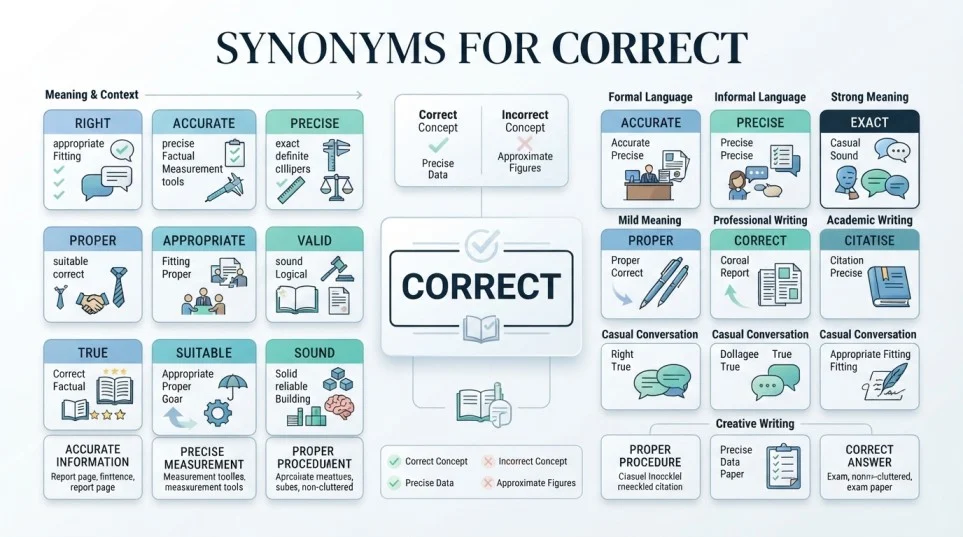
Use accurate when discussing factual information.
Use precise when exactness matters.
Use proper when something follows an accepted method or standard.
Use appropriate when something fits a particular situation.
Use valid when discussing reasoning, arguments, or conclusions.
Use suitable when something meets a particular need.
Use legitimate when something is lawful, genuine, or properly recognized.
Professional Writing
Best choices include accurate, precise, valid, and proper.
Example:
“Please provide accurate information in the application.”
Academic Writing
Use accurate, precise, valid, or sound depending on the meaning.
Example:
“The study provides accurate measurements.”
Casual Conversation
Right is usually the most natural choice.
Example:
“You were right about the weather.”
Emotional Writing
Right, true, or justified may work depending on the intended feeling.
Example:
“She knew that her decision was right.”
Creative Writing
True, rightful, sound, or fitting can add more nuance.
Example:
“He finally understood that leaving was the right choice.”
Resume or Workplace Use
Use accurate, precise, reliable, or proper when describing professional skills.
Example:
“Maintained accurate financial records.”
Social Media Captions
Right, true, and spot on can sound more conversational.
Example:
“Your prediction was spot on.”
Stronger Meaning
Use precise, exact, faultless, or unerring when you want to emphasize a very high level of accuracy.
Softer Meaning
Use reasonable, sound, or appropriate when you want to avoid sounding absolute.
When Not to Use Correct
Correct is useful, but it can sometimes be too general.
If you are discussing numbers, accurate may be more informative.
Instead of:
“The information is correct.”
Try:
“The information is accurate.”
If you are discussing a method, proper may communicate the idea more clearly.
Instead of:
“Use the correct procedure.”
Try:
“Use the proper procedure.”
If you are discussing clothing for an occasion, appropriate may be better.
Instead of:
“That is the correct outfit.”
Try:
“That is an appropriate outfit for the event.”
Precision matters because synonyms are not always interchangeable.
Words Commonly Confused With Correct
Correct vs. Accurate
Correct means free from error. Accurate emphasizes factual or numerical precision.
“Your answer is correct.”
“The measurements are accurate.”
Correct vs. Right
Right is broader and more conversational. Correct often sounds more objective or formal.
“You are right.”
“The answer is correct.”
Correct vs. Proper
Proper often refers to accepted rules, methods, behavior, or standards.
“Please use the proper procedure.”
Correct vs. Appropriate
Appropriate means suitable for a particular situation.
“Her response was appropriate for the occasion.”
Correct vs. Precise
Precise emphasizes exactness and careful detail.
“The report contains precise measurements.”
Correct vs. Valid
Valid often refers to reasoning, arguments, conclusions, documents, or claims that meet required conditions.
“That is a valid argument.”
Best Synonym by Context for Correct
Which Synonym Should You Choose?
Start by asking what kind of correctness you mean.
If you mean factually free from error, choose accurate.
If you mean generally right, choose right.
If you mean exact, choose precise or exact.
If you mean following accepted rules, choose proper.
If you mean suitable for a situation, choose appropriate.
If you mean logically acceptable, choose valid.
If you mean reasonable or well founded, choose sound.
If you want a casual expression, spot on can work in conversation.
The best synonym is therefore determined by meaning, not simply by replacing one word with another.
Real Life Examples of Correct in Sentences
School
“The teacher explained why the second answer was correct.”
Workplace
“Please check that the customer information is correct before sending the invoice.”
Writing
“Make sure the spelling is correct before publishing the article.”
Conversation
“You were correct when you said the store closes early.”
Social Media
“Your guess was spot on.”
Resume
“Maintained accurate records for more than 500 customer accounts.”
“Could you confirm that the contact information is correct?”
Storytelling
“For the first time, she realized that her decision had been right.”
18 Synonyms for Correct
These alternatives are not interchangeable in every sentence. Accurate, precise, proper, appropriate, and valid each emphasize a different aspect of being correct.
Synonym Groups and Usage Differences
Professional vs. Personal Synonyms
Professional writing often benefits from specific words such as accurate, precise, valid, and proper.
Personal conversation usually sounds more natural with right or true.
Professional:
“Please verify that the figures are accurate.”
Personal:
“You were right about the situation.”
Formal vs. Conversational Synonyms
Formal writing often favors accurate, precise, valid, proper, and appropriate.
Conversational English commonly uses right and spot on.
Formal:
“The conclusion is valid based on the available evidence.”
Conversational:
“You were right.”
Academic Synonyms
Academic writing requires precision, so accurate, precise, valid, factual, and sound are useful.
Example:
“The researchers used precise measurements to support their conclusion.”
Avoid relying too heavily on right in formal academic analysis when a more specific word communicates the intended meaning.
Professional and Business Synonyms
Business communication often requires clarity and accuracy.
Strong choices include:
- Accurate
- Precise
- Valid
- Proper
- Appropriate
- Sound
- Legitimate
Example:
“Please confirm that the figures in the proposal are accurate.”
Creative or Literary Synonyms
Creative writing gives you more freedom.
Words such as true, fitting, apt, rightful, and unerring can create more nuance.
Example:
“By sunset, she knew that leaving had been the right choice.”
Slang or Modern Synonyms
Spot on is a useful informal expression meaning completely accurate or correct.
It works well in conversation, texts, casual posts, and informal messages.
Example:
“Your description was spot on.”
It is generally less suitable for academic papers, formal reports, and highly professional documents.
Strongest vs. Weaker Synonyms
A useful intensity scale looks like this:
Reasonable: sound
Generally correct: right
Correct according to facts: accurate
Highly exact: precise
Completely matching: exact
Showing almost no possibility of error: unerring
The right choice depends on what you want to emphasize.
Emotional vs. Neutral Synonyms
Accurate, precise, and exact are generally neutral.
True can carry emotional or personal meaning.
Right can carry moral or personal meaning.
Justified can suggest that a decision or reaction deserves approval because it has a sound reason.
Antonyms of Correct
Comparison: “Correct” vs. Similar Words
Correct vs. Right
Main difference: Correct often focuses on factual or objective accuracy, while right has a broader everyday meaning.
Which one is stronger: Neither is automatically stronger.
Which one is more formal: Correct can sound slightly more formal.
Examples:
“The answer is correct.”
“You were right about the situation.”
Correct vs. Accurate
Main difference: Accurate emphasizes agreement with facts, measurements, or reality.
Which one is stronger: Accurate is more specific for factual information.
Which one is more formal: Accurate is especially useful in professional and academic writing.
Examples:
“The answer is correct.”
“The data is accurate.”
Correct vs. Precise
Main difference: Correct means without error, while precise emphasizes exactness and detail.
Which one is stronger: Precise is stronger when exactness matters.
Which one is more formal: Precise is common in academic and technical writing.
Examples:
“Your answer is correct.”
“Please provide a precise measurement.”
Correct vs. Proper
Main difference: Proper usually means following an accepted method, rule, or standard.
Which one is stronger: Neither is universally stronger.
Which one is more formal: Proper often works well in instructions and professional communication.
Examples:
“The answer is correct.”
“Please follow the proper procedure.”
Correct vs. Appropriate
Main difference: Appropriate focuses on whether something suits a particular situation.
Which one is stronger: Neither is stronger because they express different ideas.
Which one is more formal: Appropriate is common in professional and formal writing.
Examples:
“The answer is correct.”
“Her response was appropriate.”
Correct vs. Valid
Main difference: Valid often means logically acceptable or meeting established requirements.
Which one is stronger: Valid is more specialized.
Which one is more formal: Valid is particularly useful in academic, legal, and professional contexts.
Examples:
“The answer is correct.”
“That is a valid argument.”
Common Phrases and Expressions with Correct
1. Correct answer
Meaning: An answer that is free from error.
Example sentence:
“Choose the correct answer from the four options.”
2. Correct information
Meaning: Information that accurately reflects the facts.
Example sentence:
“Please make sure the customer has provided correct information.”
3. Correct procedure
Meaning: The accepted method for completing something.
Example sentence:
“Employees must follow the correct procedure when handling confidential records.”
4. Correct spelling
Meaning: Spelling that follows accepted language rules.
Example sentence:
“Check the correct spelling before submitting your essay.”
5. Correct pronunciation
Meaning: Pronunciation that follows the accepted sound or form of a word.
Example sentence:
“The instructor helped the students learn the correct pronunciation.”
6. Correct decision
Meaning: A decision considered right or appropriate.
Example sentence:
“She felt confident that she had made the correct decision.”
7. Correct way
Meaning: The appropriate or accepted method.
Example sentence:
“Let me show you the correct way to complete the form.”
8. Correct me if I am wrong
Meaning: An expression used when asking someone to identify a possible mistake.
Example sentence:
“Correct me if I am wrong, but I believe the meeting starts at nine.”
Common Mistakes to Avoid
1. Using Correct When Accurate Is Better
“Correct” is broad.
If you are discussing statistics, measurements, records, or factual information, accurate often gives readers more useful information.
2. Confusing Correct With Appropriate
Something can be correct but not appropriate for a particular situation.
For example, a casual joke may be factually correct but inappropriate during a serious business meeting.
3. Using Casual Synonyms in Formal Writing
Expressions such as spot on sound natural in conversation but may be unsuitable for academic or highly formal writing.
Choose accurate or precise instead.
4. Using an Overly Strong Synonym
Calling something faultless or unerring can sound exaggerated when you simply mean correct.
Use the strongest language only when the context supports it.
5. Repeating Correct Too Often
Repeating the same word can make writing feel flat.
Instead of writing “correct” several times, use accurate, precise, appropriate, valid, proper, or right when the meaning fits.
6. Choosing the Wrong Emotional Tone
Accurate sounds factual.
Right can sound personal.
Justified can suggest moral or logical support.
Choose the word that matches the feeling you want to communicate.
FAQs
What is the best synonym for correct?
The best synonym depends on context. Right works generally, while accurate is better for facts, precise for exactness, and appropriate for suitability.
What is a formal synonym for correct?
Accurate, precise, proper, valid, and appropriate are strong formal alternatives, depending on the intended meaning and sentence.
What is an informal synonym for correct?
Right is the most natural informal alternative. Spot on is another casual expression when something is completely accurate.
What is another word for correct in professional writing?
Accurate is often the strongest professional alternative because it clearly communicates factual reliability, especially for reports, records, data, and business information.
What is the difference between correct and accurate?
Correct means free from error, while accurate emphasizes factual agreement, precision, or closeness to the actual information.
What is the opposite of correct?
Common opposites include wrong, incorrect, inaccurate, false, mistaken, invalid, improper, and inappropriate, depending on context.
Conclusion
The word correct is useful because it works in many situations, from everyday conversations to academic writing and professional communication. However, the best synonym depends on exactly what you mean.
Choose right for general conversation, accurate for facts, precise for exact details, proper for accepted methods, appropriate for suitable behavior, and valid for logical arguments.
The most useful vocabulary habit is to avoid replacing a word simply because you want variety. Instead, choose a synonym that adds the exact meaning, tone, and level of formality your sentence needs.
For reliable publishing, verify definitions and usage with trusted dictionaries such as Cambridge, Oxford, Merriam Webster, Collins, or Britannica before final publication.
Discover More Post:
- 25+ Synonyms for Attention | Meanings, Examples, and Best …
- 25+ Synonyms for Marginalized | Meanings, Examples, and Best …
- 25+ Synonyms for Access | Meanings, Examples, and Best …