Sometimes, the word “darkness” is exactly right. Other times, a more specific word can make your sentence clearer, stronger, or more vivid. You may need a better choice for an essay, story, email, caption, or everyday conversation.
The best synonym depends on what you mean. Are you describing a room with no light, a gloomy mood, a mysterious situation, or a difficult emotional experience? This guide to synonyms for darkness explains those differences with practical examples, so you can choose the right word naturally.
What Does “Darkness” Mean?
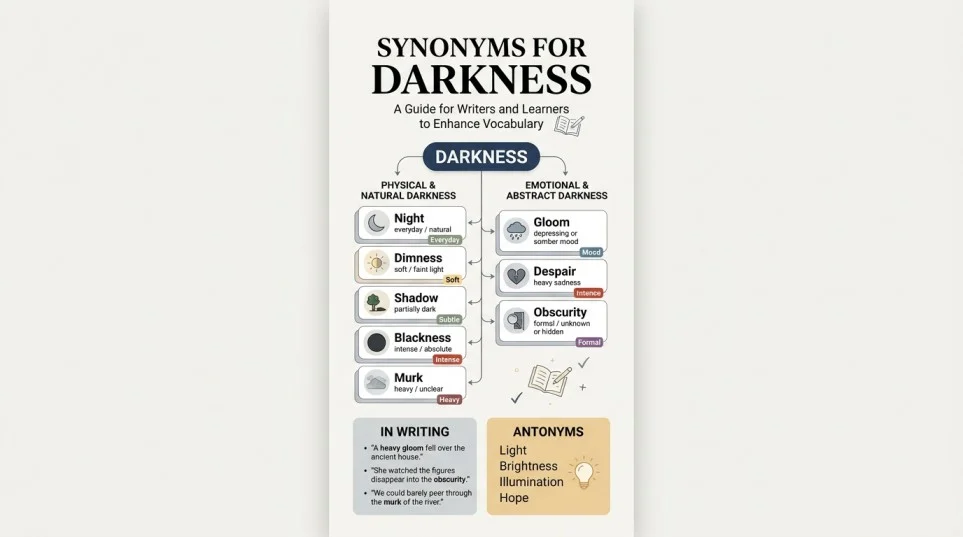
Darkness means the absence or lack of light. Depending on context, it can also describe gloom, sadness, mystery, ignorance, or something morally negative. Formal choices include obscurity and dimness, while creative choices include gloom, murk, shadow, and blackness.
Meaning, Tone and Context
Simple Definition
Darkness is the state in which there is little or no light. It can describe a physical environment, such as a dark room, or a figurative condition, such as emotional darkness.
The word can also represent sadness, fear, uncertainty, evil, or a lack of knowledge.
Part of Speech
Darkness is a noun.
Example:
“The darkness made it difficult to see the road.”
The related adjective is “dark.”
Example:
“The hallway was dark.”
The related adverb is “darkly,” although it is less common in everyday speech.
Tone
Darkness is usually neutral when it describes a physical lack of light.
Its tone can become negative when it describes sadness, fear, hopelessness, ignorance, or evil.
In creative writing, darkness can also create mystery, suspense, beauty, or atmosphere.
Formality Level
“Darkness” works in casual conversation, academic writing, professional communication, literature, journalism, and creative writing.
It is a flexible word, but a more precise synonym may be better when you want to describe a particular type of darkness.
Common Use Cases
Darkness can describe:
- A room without enough light
- Nighttime
- A shadowy environment
- A gloomy mood
- Emotional suffering
- Fear or uncertainty
- Mystery or secrecy
- Ignorance or lack of knowledge
- Evil or moral corruption
- A dramatic atmosphere in literature
When and How to Use “Darkness”
Use “darkness” when you want a broad word that can describe either a physical or figurative lack of light.
Professional Example
“The team faced uncertainty during a period of financial darkness.”
This is figurative and dramatic. In a business report, “uncertainty” would usually be more precise.
Personal Example
“She sat quietly in the darkness and thought about the difficult day.”
Here, darkness refers primarily to the physical absence of light.
Academic Example
“The author uses darkness as a symbol of fear and uncertainty.”
This is appropriate for literary analysis because darkness can function as a symbol.
Creative Example
“The darkness swallowed the narrow path ahead.”
This sentence uses personification to create suspense and atmosphere.
Another Word for “Darkness”
There is no single best replacement for darkness in every situation. The strongest choice depends on the exact meaning.
| Situation | Recommended Word |
|---|---|
| Professional writing | obscurity |
| Academic writing | dimness or obscurity |
| Casual conversation | dark |
| Emotional writing | gloom |
| Creative writing | murk or shadow |
| Resume or workplace writing | uncertainty |
| Social media captions | night or shadow |
| Strong physical darkness | blackness |
| Softer physical darkness | dimness |
| Mysterious situation | obscurity |
For professional writing, avoid replacing darkness with a dramatic word unless the subject actually calls for it.
For creative writing, words such as gloom, murk, shadow, and blackness can create stronger imagery.
When Not to Use “Darkness”
“Darkness” can be too general when your sentence needs a precise meaning.
For example:
“The office was filled with darkness.”
This is understandable, but “The office was poorly lit” gives a more practical description.
Darkness can also sound too dramatic in ordinary professional communication.
Instead of:
“The project entered a period of darkness.”
A business writer might say:
“The project entered a period of uncertainty.”
The second version is clearer and more professional.
You should also avoid using “darkness” when you really mean sadness, confusion, secrecy, or ignorance. A precise synonym can communicate the intended idea more effectively.
Words Commonly Confused With “Darkness”
Darkness vs. Shadow
Darkness refers to a general lack of light. A shadow is a darker area created when an object blocks light.
Example:
“The room was filled with darkness.”
“The tree cast a long shadow.”
Darkness vs. Gloom
Darkness can be physical or figurative. Gloom usually suggests sadness, depression, or a dark atmosphere.
Example:
“The darkness covered the street.”
“A feeling of gloom filled the room.”
Darkness vs. Dimness
Darkness suggests very little or no light. Dimness usually means reduced or weak light.
Example:
“The cave was completely dark.”
“The dimness of the lamp made reading difficult.”
Darkness vs. Obscurity
Darkness can describe a lack of light. Obscurity often describes something difficult to see, understand, or know.
Example:
“The darkness made the room impossible to see.”
“The meaning of the passage remained in obscurity.”
Darkness vs. Night
Night is the period between evening and morning. Darkness can occur at any time when light is absent.
Example:
“The darkness in the basement was complete.”
“The city becomes quiet at night.”
Darkness vs. Murk
Murk refers to thick darkness or a condition in which visibility is poor. It is especially useful in descriptive and creative writing.
Example:
“Fog and murk covered the road.”
Best Synonym by Context for “Darkness”
| Context | Best Synonym | Why It Works | Example |
|---|---|---|---|
| Formal writing | Obscurity | Sounds precise and formal | The details remained in obscurity. |
| Academic writing | Dimness | Useful for physical lack of light | The dimness affected visibility. |
| Professional or business use | Uncertainty | Better for figurative difficulty | The company faced uncertainty. |
| Resume | Uncertainty | Describes unclear conditions professionally | I worked effectively during periods of uncertainty. |
| Casual conversation | Dark | Natural and simple | It was too dark to see. |
| Creative writing | Murk | Creates a strong visual atmosphere | The boat disappeared into the murk. |
| Emotional tone | Gloom | Suggests sadness or heaviness | Gloom filled the empty house. |
| Strong intensity | Blackness | Suggests very deep darkness | Complete blackness surrounded them. |
| Soft or moderate tone | Dimness | Suggests reduced light | The dimness gave the room a calm mood. |
| Social media captions | Shadow | Short and visually expressive | Lost in the shadows. |
| Mystery | Obscurity | Suggests something hidden or unclear | The truth remained in obscurity. |
| Literary writing | Tenebrosity | Highly literary and uncommon | The poem explores spiritual tenebrosity. |
| Physical environment | Night | Refers naturally to nighttime | We walked through the forest at night. |
| Emotional suffering | Despair | Works when darkness means hopelessness | He struggled with despair. |
| Moral meaning | Evil | Works when darkness symbolizes wrongdoing | The story presents darkness as evil. |
Which Synonym Should You Choose?
- Start by asking what kind of darkness you are describing.
- If you mean a physical lack of light, choose words such as darkness, dimness, blackness, shadow, night, or murk.
- If you mean sadness or a heavy emotional state, gloom, misery, and despair may be better.
- If you mean something hidden or difficult to understand, consider obscurity.
- If you are writing creatively, murk, shadow, blackness, and tenebrosity can create a stronger atmosphere.
For professional writing, avoid dramatic substitutions when a simple word is more accurate. Words such as uncertainty, lack of clarity, and limited visibility may communicate the idea more effectively.
Real Life Examples of “Darkness” in Sentences
School
“The author uses darkness to represent fear and uncertainty.”
Workplace
“The organization faced a period of uncertainty after the leadership change.”
Writing
“The darkness surrounding the character creates a feeling of isolation.”
Conversation
“It was so dark that I could barely see the steps.”
Social Media
“Sometimes you have to walk through the darkness before you find the light.”
Resume
“I remained productive during periods of uncertainty and organizational change.”
“The lack of information created some uncertainty about the next steps.”
Storytelling
“The darkness settled over the village as the last light disappeared.”
18 Synonyms for “Darkness”
| Synonym | Simple Meaning | Best Used For | Example Sentence |
|---|---|---|---|
| Gloom | A dark or sad atmosphere | Emotional and descriptive writing | A sense of gloom filled the room. |
| Dimness | Weak or reduced light | Physical descriptions | The dimness made the signs difficult to read. |
| Shadow | A dark area caused by blocked light | Visual and creative writing | Her figure disappeared into the shadow. |
| Blackness | Very deep darkness | Strong physical imagery | The cave opened into complete blackness. |
| Obscurity | A state of being hidden or unclear | Formal and academic writing | The truth remained in obscurity for years. |
| Murk | Thick darkness or poor visibility | Creative descriptions | The boat vanished into the murk. |
| Murkiness | A condition of darkness or unclear visibility | Descriptive writing | The murkiness of the water made the bottom invisible. |
| Night | The period when it is dark outside | Everyday language | We arrived after night had fallen. |
| Dusk | The fading light after sunset | Nature and descriptive writing | The birds became quiet at dusk. |
| Shade | An area protected from direct light | Physical descriptions | We rested in the shade of a large tree. |
| Tenebrosity | Deep or intense darkness | Literary and highly formal writing | The novel creates an atmosphere of tenebrosity. |
| Somberness | A serious or gloomy quality | Emotional and formal writing | The somberness of the ceremony was noticeable. |
| Bleakness | A lack of hope or warmth | Emotional and literary writing | The bleakness of the landscape reflected her mood. |
| Despair | Complete loss of hope | Strong emotional meaning | He eventually overcame his despair. |
| Misery | Great unhappiness or suffering | Emotional writing | The character struggles through years of misery. |
| Evil | Moral wrongdoing represented as darkness | Figurative and literary writing | The story portrays evil as a spreading darkness. |
| Ignorance | Lack of knowledge or understanding | Figurative and academic contexts | Education can replace ignorance with understanding. |
| Mystery | Something unknown or difficult to explain | Creative and figurative writing | The darkness surrounding the case created a sense of mystery. |
Not every word above can replace “darkness” in every sentence. Some describe a specific physical condition, while others represent figurative darkness. Choosing the right meaning is more important than simply finding a similar word.
Synonym Groups and Usage Differences
Professional vs. Personal Synonyms
In professional writing, “darkness” is often too figurative.
If you are describing an unclear business situation, “uncertainty,” “lack of clarity,” or “limited visibility” may work better.
Personal and creative writing allows more emotional language. Gloom, despair, shadow, and blackness can communicate feelings more strongly.
Formal vs. Conversational Synonyms
Formal writing may use words such as obscurity, dimness, and tenebrosity when they accurately fit the context.
Conversation usually favors simple words.
For example:
“The room was dark.”
This sounds much more natural in conversation than:
“The room was enveloped in tenebrosity.”
Academic Synonyms
Academic writing should prioritize accuracy.
When analyzing literature, “darkness” itself may be the best choice because it can refer to a recurring symbol.
Words such as obscurity, ignorance, dimness, and gloom can be useful when their specific meanings match the argument.
Professional and Business Synonyms
Business writing usually benefits from precise language.
If “darkness” means an unclear situation, consider:
- Uncertainty
- Lack of clarity
- Limited visibility
- Unknown conditions
- Incomplete information
These choices are generally clearer than dramatic figurative language.
Creative or Literary Synonyms
Creative writing offers more freedom.
“Gloom” can create emotional heaviness. “Murk” can make a scene feel mysterious. “Blackness” can create intensity. “Shadow” can suggest danger, secrecy, or fear.
“Tenebrosity” is highly literary and should be used carefully because it may sound unnatural in ordinary prose.
Slang or Modern Synonyms
There are no widely useful slang synonyms for darkness that work across most situations.
Some informal expressions describe darkness rather than directly replacing the noun.
For example:
“It was pitch black.”
“Pitch black” is common and natural in casual speech.
However, it may be less suitable for formal academic writing.
Strongest vs. Weaker Synonyms
A useful intensity scale is:
Mild: shade, dimness
Moderate: darkness, shadow, dusk
Stronger: gloom, murk, blackness
Very strong emotional meaning: misery, despair
Very strong literary meaning: tenebrosity
Remember that intensity depends on meaning. Despair is emotionally stronger than darkness, but it does not describe physical darkness.
Emotional vs. Neutral Synonyms
Neutral words include darkness, dimness, night, and shade.
Emotionally stronger words include gloom, bleakness, misery, and despair.
Figurative words such as evil and ignorance introduce a moral or intellectual meaning.
Choose a neutral word when you are describing facts. Choose an emotional synonym when you intentionally want the reader to feel something.
Antonyms of “Darkness”
| Antonym | Meaning | Example Sentence |
|---|---|---|
| Light | Illumination or brightness | Light entered through the window. |
| Brightness | The quality of being bright | The brightness of the room increased. |
| Illumination | Light that makes something visible | The new illumination improved visibility. |
| Daylight | Natural light during the day | Daylight filled the room. |
| Radiance | Bright or glowing light | Her face seemed to have a warm radiance. |
| Glow | Soft, steady light | The lamp gave off a gentle glow. |
| Brilliance | Intense brightness | The brilliance of the sun was striking. |
| Visibility | The ability to see clearly | The improved visibility made driving easier. |
| Sunshine | Direct light from the sun | Sunshine filled the garden. |
| Clarity | A state of being clear and understandable | The explanation brought clarity to the issue. |
| Hope | A positive expectation about the future | Hope helped him continue. |
| Joy | A strong feeling of happiness | Her joy was obvious. |
| Cheerfulness | A happy and positive quality | His cheerfulness lifted the mood. |
| Enlightenment | Greater understanding or knowledge | Education can lead to enlightenment. |
| Openness | A condition of being accessible or revealed | The discussion encouraged openness. |
Some of these are direct physical opposites, while others are figurative opposites. For example, “light” directly contrasts with darkness, while “hope” contrasts with darkness only in an emotional or symbolic sense.
Comparison: “Darkness” vs. Similar Words
Darkness vs. Gloom
The main difference is that darkness primarily describes an absence of light, while gloom often suggests sadness or a depressing atmosphere.
Gloom is usually more emotional.
Example:
“The darkness covered the room.”
“The gloom in the room reflected his mood.”
Darkness vs. Dimness
Darkness suggests little or no light. Dimness suggests that some light exists but is weak.
Dimness is therefore softer.
Example:
“The room was filled with darkness.”
“The dimness of the lamp made reading difficult.”
Darkness vs. Shadow
Darkness is a general condition. A shadow is a specific darker area created when light is blocked.
Shadow is more visual and often more useful in creative descriptions.
Example:
“The darkness made it impossible to see.”
“The tree cast a long shadow.”
Darkness vs. Obscurity
Darkness concerns light. Obscurity can concern light, visibility, knowledge, meaning, or public recognition.
Obscurity is more formal.
Example:
“The darkness covered the path.”
“The meaning of the statement remained in obscurity.”
Darkness vs. Murk
Murk suggests thick, unclear darkness, often combined with poor visibility.
Murk is especially effective in atmospheric writing.
Example:
“The darkness surrounded the house.”
“The house disappeared into the murk.”
Darkness vs. Night
Night is a specific period of the day. Darkness is a condition that can occur during night or in an enclosed place.
Night is more precise when you mean the time of day.
Example:
“The darkness inside the room was complete.”
“We traveled during the night.”
Common Phrases and Expressions with “Darkness”
1. In the darkness
Meaning:
In a place or situation where there is little or no light.
Example sentence:
“We waited quietly in the darkness.”
2. Complete darkness
Meaning:
A total absence of visible light.
Example sentence:
“The power failure left the building in complete darkness.”
3. Pitch darkness
Meaning:
Extremely deep darkness.
Example sentence:
“We could not see the trail in the pitch darkness.”
4. A world of darkness
Meaning:
A figurative situation involving suffering, fear, sadness, or evil.
Example sentence:
“The novel takes its character into a world of darkness.”
5. Out of the darkness
Meaning:
Moving from a difficult or unknown condition toward a better one.
Example sentence:
“She slowly found her way out of the darkness.”
6. Darkness falls
Meaning:
Night begins or the surrounding light disappears.
Example sentence:
“We returned home before darkness fell.”
7. Into the darkness
Meaning:
Moving into a place with little or no light, often with a figurative meaning.
Example sentence:
“The traveler disappeared into the darkness.”
Common Mistakes to Avoid
1. Using “Darkness” When a More Precise Word Is Better
“The report was full of darkness” is vague.
If you mean missing information, “The report lacked clarity” is more precise.
2. Confusing Darkness With Shadow
A shadow is not simply another word for every form of darkness.
A shadow is usually created when something blocks a source of light.
3. Using a Casual Expression in Formal Writing
“Pitch black” is natural in conversation and creative writing.
For a formal report, “very low visibility” or “complete absence of light” may be more suitable.
4. Using an Overly Dramatic Synonym
Words such as despair, misery, and blackness can sound dramatic.
Do not use them when you simply mean that a room has poor lighting.
5. Repeating “Darkness” Too Often
Writers sometimes repeat the same word several times in a paragraph.
Instead, choose a contextually accurate alternative such as shadow, gloom, dimness, or murk.
6. Choosing the Wrong Emotional Tone
“Darkness” can be neutral or emotional.
If you mean sadness, gloom may be better. If you mean hopelessness, despair may be more accurate.
FAQs
What is the best synonym for darkness?
The best synonym depends on meaning. Use dimness for weak light, gloom for sadness, shadow for blocked light, and obscurity for something hidden or unclear.
What is a formal synonym for darkness?
“Obscurity” is a useful formal synonym when darkness refers to something hidden or unclear. “Dimness” works well for reduced physical light.
What is an informal synonym for darkness?
In casual speech, “dark” or “pitch black” is usually more natural than highly literary alternatives. “Night” can also work in many everyday situations.
What is another word for darkness in professional writing?
Professional writers should choose a precise word based on meaning. “Uncertainty,” “limited visibility,” “lack of clarity,” and “obscurity” can work well.
What is the difference between darkness and gloom?
Darkness usually describes a lack of light, while gloom often describes sadness, heaviness, or a depressing atmosphere.
What is the opposite of darkness?
The direct opposite of darkness is light. Depending on context, related opposites include brightness, illumination, daylight, clarity, hope, and enlightenment.
Conclusion
Darkness can describe much more than a lack of light. It can refer to night, shadows, dimness, gloom, mystery, sadness, uncertainty, ignorance, or evil, depending on the context.
The best synonym for darkness is therefore the word that communicates your exact meaning. Use dimness for weak light, shadow for blocked light, gloom for sadness, obscurity for something hidden, and murk for a dark, unclear atmosphere.
For professional and academic writing, prioritize precision over dramatic language. For creative writing, carefully chosen words such as blackness, gloom, shadow, and murk can make your descriptions more vivid.
A useful vocabulary habit is to ask yourself one question before replacing a word: “What exactly do I want the reader to understand or feel?” That answer will usually lead you to the strongest synonym.
Read More Related Articles:
- 25+ Synonyms for Access | Meanings, Examples, and Best …
- 25+ Synonyms for Definitely | Meanings, Examples, and Best …
- 25+ Synonyms for Broken | Meanings, Examples, and Best …