The word “broken” is useful, but it can become repetitive quickly. You might describe a broken phone, a broken promise, a broken heart, a broken system, or broken equipment with the same word.
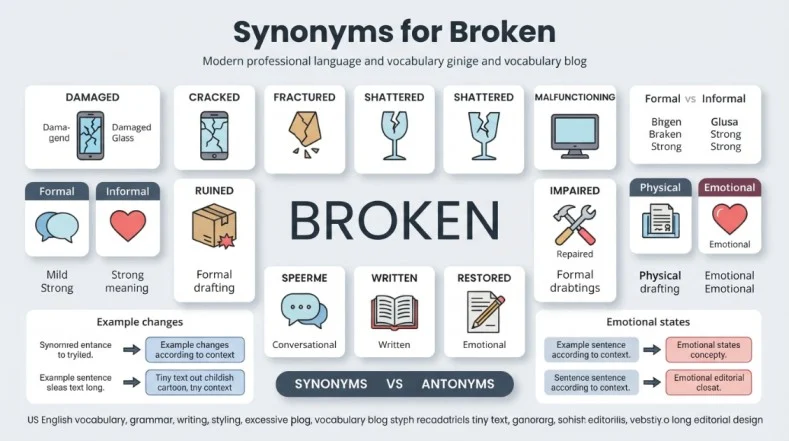
The right synonym makes your meaning more precise. A machine may be malfunctioning, glass may be shattered, a relationship may be damaged, and a person may feel devastated.
This guide to synonyms for broken explains the differences between these choices so you can select natural vocabulary for essays, emails, resumes, conversations, captions, stories, and professional communication.
What Does “Broken” Mean?
“Broken” generally means damaged, separated, no longer functioning, interrupted, or emotionally distressed. The best synonym depends on context. Use damaged for general problems, fractured for physical breaks, malfunctioning for machines, devastated for emotions, and disrupted for interrupted processes.
Meaning, Tone and Context
Simple Definition
“Broken” describes something that has been damaged, divided, interrupted, weakened, or prevented from working normally.
Its meaning changes according to the noun it describes.
- For example, a broken chair is physically damaged. A broken computer may not function correctly. A broken promise has not been kept. A broken heart describes deep emotional pain.
Part of Speech
“Broken” is commonly used as an adjective.
It is also the past participle of the verb “break.”
Examples include:
- • The window is broken.
- • Someone broke the window.
- • She has broken the agreement.
- • The machine stopped working because a component was broken.
Tone
The tone of “broken” can be neutral, negative, or emotional depending on context.
In a technical sentence, it can be neutral and factual.
“The printer is broken.”
In emotional writing, it can be much stronger.
“He felt broken after the loss.”
In descriptions of systems or institutions, it can suggest serious failure.
“The company has a broken process for handling complaints.”
Formality Level
“Broken” is common in everyday English and works in most situations.
However, more precise alternatives can sound better in professional, academic, or technical writing.
For example, “The system is malfunctioning” is usually more precise than “The system is broken.”
Common Use Cases
“Broken” can describe:
- • Physical objects
- • Machines and technology
- • Systems and processes
- • Rules and agreements
- • Promises
- • Relationships
- • Emotional states
- • Communication
- • Records or patterns
- • Languages and speech
Important Word Forms
Common forms related to “broken” include:
- • Break, the base verb
- • Breaks, present tense form
- • Broke, simple past form
- • Broken, past participle
- • Breaking, present participle
- • Breakage, the result or instance of something being broken
The correct related form depends on the grammatical role of the word in a sentence.
When and How to Use “Broken”
“Broken” is appropriate when the reader already understands the general type of problem or when you want simple, direct language.
1. Professional Context
“The customer reported that the payment terminal was broken.”
This is understandable, although “malfunctioning” may be more precise in a technical report.
2. Personal Context
“My favorite mug is broken, so I cannot use it anymore.”
Here, “broken” is natural and conversational.
3. Academic Context
“The study examines how broken communication channels affect organizational performance.”
The word can work in academic writing when the meaning is clear, although a more specific term may improve precision.
4. Emotional Context
“She felt broken after losing someone she loved.”
Here, “broken” communicates emotional distress rather than physical damage.
5. Creative Context
“The broken window allowed the cold night air to enter the abandoned house.”
The word creates a visual image and works naturally in storytelling.
6. Social Media Context
“My favorite headphones are officially broken.”
This casual use works well in a caption or post.
7. Email Context
“The attached file appears to be broken and will not open.”
For professional communication, “corrupted” may be more technically accurate if the problem concerns a damaged digital file.
Another Word for “Broken”
There is no single replacement that works in every situation. The best choice depends on what is actually wrong.
| Context | Recommended Word |
|---|---|
| Professional writing | Damaged |
| Academic writing | Impaired |
| Casual conversation | Damaged |
| Emotional writing | Devastated |
| Creative writing | Shattered |
| Resume or workplace use | Impaired |
| Social media captions | Ruined |
| Strong physical damage | Shattered |
| Softer physical problem | Damaged |
- For equipment, “malfunctioning” is often better than “broken” because it specifically indicates that something is not operating correctly.
- For glass, “shattered” can communicate much more severe physical damage.
- For emotional situations, “devastated” describes a person’s emotional state more directly.
When Not to Use “Broken”
“Broken” can be too general when you need to explain exactly what happened.
For example:
“The machine is broken.”
This sentence does not tell the reader whether the machine is damaged, malfunctioning, disconnected, defective, or completely unusable.
A more precise sentence might be:
“The machine is malfunctioning because its sensor is not responding.”
“Broken” can also sound too casual in highly technical writing.
Instead of:
“The software is broken.”
A technical document might say:
“The software contains an error that prevents the application from starting.”
Similarly, “broken” may be too dramatic for a minor issue.
“The button is broken” suggests damage.
“The button is sticking” describes a smaller and more specific problem.
Words Commonly Confused With “Broken”
Broken vs. Damaged
“Broken” often suggests that something no longer works or has been physically separated.
“Damaged” is broader and can describe something that still works despite having some physical harm.
Example:
“The screen is damaged, but the phone still works.”
Broken vs. Cracked
“Cracked” describes a surface or structure with a visible split or line.
Example:
“The glass is cracked.”
The glass may still be in one piece.
Broken vs. Fractured
“Fractured” usually describes a physical structure that has developed a break or crack. It is common in medical, technical, and formal contexts.
Example:
“The patient suffered a fractured wrist.”
Broken vs. Malfunctioning
“Malfunctioning” specifically means something is not operating correctly.
Example:
“The printer is malfunctioning.”
This does not necessarily mean that the printer is physically damaged.
Broken vs. Shattered
“Shattered” suggests severe physical damage in which something breaks into many pieces.
Example:
“The mirror shattered when it fell.”
It is much stronger than “damaged.”
Broken vs. Ruined
“Ruined” means something has been damaged or spoiled so severely that its intended value, usefulness, or condition has been seriously reduced.
Example:
“The rain ruined the outdoor event.”
Best Synonym by Context for “Broken”
| Context | Best Synonym | Why It Works | Example |
|---|---|---|---|
| Formal writing | Damaged | Clear and broadly applicable | The equipment was damaged during transport. |
| Academic writing | Impaired | Precise for reduced function | The injury impaired his ability to walk. |
| Professional or business use | Malfunctioning | Clearly describes operational problems | The payment system is malfunctioning. |
| Resume | Impaired | Suitable for describing reduced capability | The process was impaired by outdated software. |
| Casual conversation | Damaged | Natural and familiar | My laptop is damaged. |
| Creative writing | Shattered | Creates a vivid image | The shattered glass covered the floor. |
| Emotional tone | Devastated | Directly describes severe emotional distress | She was devastated by the news. |
| Strong physical damage | Shattered | Indicates extensive physical destruction | The vase was shattered on the floor. |
| Soft or moderate tone | Damaged | Does not automatically suggest total failure | The package was slightly damaged. |
| Social media caption | Ruined | Informal and expressive | My weekend plans are ruined. |
| Technical use | Malfunctioning | Identifies an operational problem | The device is malfunctioning. |
| Medical use | Fractured | Precise for certain physical injuries | He has a fractured ankle. |
| Digital files | Corrupted | Specific to damaged data | The file appears to be corrupted. |
| Agreements | Breached | Specific to violated agreements or obligations | The contract was breached. |
| Promises | Unfulfilled | Indicates that an expected promise was not kept | The promise remained unfulfilled. |
| Relationships | Damaged | Describes harm without excessive emotional intensity | Their relationship was damaged by mistrust. |
Which Synonym Should You Choose?
Start by asking what kind of “broken” situation you are describing.
- If an object has physical harm, consider “damaged,” “cracked,” “fractured,” or “shattered.”
- If a machine does not work correctly, “malfunctioning” is usually more precise.
- If a digital file cannot be used because its data has been damaged, “corrupted” may be the better term.
- If something has been completely spoiled or made unusable, “ruined” can be appropriate.
- If you are describing emotional pain, consider “devastated,” “distressed,” or “shattered,” depending on the intensity.
For a relationship, “damaged,” “strained,” or “fractured” can communicate different degrees of difficulty.
The strongest synonym is not always the best synonym. Precision matters more than intensity.
Real Life Examples of “Broken” in Sentences
School
“The student submitted a broken link, so the teacher could not access the assignment.”
A more precise alternative could be “inactive” or “invalid,” depending on the problem.
Workplace
“The technician repaired the broken equipment before the production shift began.”
“Malfunctioning equipment” may be more suitable in a formal report.
Writing
“The author uses the image of a broken mirror to represent a damaged identity.”
Here, “broken” has a symbolic meaning.
Conversation
“My old headphones are broken again.”
This is natural casual English.
Social Media
“Broken plans, rainy weather, and too much coffee.”
The informal tone works well for a caption.
Resume
“Identified and resolved malfunctioning equipment to reduce production delays.”
“Malfunctioning” is more precise and professional than “broken.”
“The attached document appears to be corrupted, so I cannot open it.”
This is clearer than simply saying that the document is broken.
Storytelling
“The broken gate swung slowly in the wind.”
The word creates a simple visual image without requiring a technical explanation.
25 Synonyms for “Broken”
| Synonym | Simple Meaning | Best Used For | Example Sentence |
|---|---|---|---|
| Damaged | Harmed but not necessarily destroyed | Objects, equipment, property | The package arrived with a damaged corner. |
| Shattered | Broken into many pieces or emotionally devastated | Glass, objects, emotions | The glass shattered when it hit the floor. |
| Fractured | Broken or cracked in a structured way | Bones, physical structures, formal descriptions | The doctor confirmed that he had a fractured wrist. |
| Cracked | Split or marked by a narrow break | Glass, screens, walls, surfaces | Her phone has a cracked screen. |
| Ruined | Damaged so badly that usefulness or quality is lost | Objects, plans, experiences | The spilled paint ruined the carpet. |
| Destroyed | Completely damaged or eliminated | Severe physical damage | The fire destroyed the building. |
| Impaired | Reduced in function or ability | Academic, medical, professional contexts | The injury impaired his mobility. |
| Malfunctioning | Not operating correctly | Machines, devices, systems | The printer is malfunctioning again. |
| Defective | Having a fault or design problem | Products, equipment, manufacturing | The company replaced the defective part. |
| Inoperable | Unable to function or be operated | Technical and professional contexts | The elevator remained inoperable for several hours. |
| Unusable | Not suitable or possible to use | Objects, files, resources | The damaged document became unusable. |
| Corrupted | Damaged so data or content cannot work properly | Digital files and data | The downloaded file was corrupted. |
| Disrupted | Interrupted or prevented from continuing normally | Services, systems, activities | The storm disrupted public transportation. |
| Impaired | Made less effective or capable | Abilities, systems, judgment | Poor visibility impaired the driver’s view. |
| Ruptured | Split or burst open | Pipes, tissues, containers | A ruptured pipe flooded the basement. |
| Torn | Pulled apart or split by force | Paper, fabric, clothing | He wore a torn jacket. |
| Battered | Repeatedly damaged or heavily worn | Objects, buildings, vehicles | The battered car still ran reliably. |
| Wrecked | Severely damaged or ruined | Vehicles, plans, informal speech | The accident wrecked the front of the car. |
| Distressed | Suffering emotional pain or showing serious difficulty | People, emotional contexts | She sounded distressed after receiving the news. |
| Devastated | Extremely upset or emotionally overwhelmed | Emotional situations | He was devastated by the loss. |
| Shaken | Emotionally disturbed or physically affected | People after difficult events | She was shaken by the sudden accident. |
| Fragmented | Divided into separate pieces or parts | Information, groups, systems | The report presents a fragmented picture of the issue. |
| Compromised | Weakened, damaged, or made less secure | Security, systems, conditions | The breach compromised customer data. |
| Breached | Violated or broken, especially an agreement or security barrier | Contracts, rules, security | The organization breached the agreement. |
| Strained | Put under pressure or made difficult | Relationships, resources, systems | Years of disagreement strained their friendship. |
Note that some of these words are context specific rather than universal replacements. For example, “breached” works naturally with an agreement or security system but would not normally replace “broken” when describing a chair.
Synonym Groups and Usage Differences
Professional vs. Personal Synonyms
Professional writing benefits from specificity.
Instead of saying:
“The system is broken.”
You might write:
“The system is malfunctioning.”
Instead of:
“The process is broken.”
You could write:
“The process is inefficient.”
Personal communication can remain simpler.
“My phone is broken.”
That sentence is perfectly natural when speaking with a friend.
Formal vs. Conversational Synonyms
Formal contexts often favor “damaged,” “impaired,” “defective,” “inoperable,” and “malfunctioning.”
Conversational English frequently uses “broken,” “wrecked,” “ruined,” and “messed up,” although the last expression is much more informal.
A professional email should usually favor precise vocabulary over slang.
Academic Synonyms
Academic writing benefits from words that identify the exact type of problem.
“Impaired” works well when something has reduced effectiveness.
“Fragmented” works well when information or systems are divided.
“Disrupted” works well when an activity or process has been interrupted.
“Compromised” works well when reliability, security, or integrity has been weakened.
Professional and Business Synonyms
Business writing often requires neutral language.
Consider:
- • Malfunctioning system
- • Defective product
- • Damaged equipment
- • Disrupted service
- • Compromised security
- • Impaired performance
These terms tell the reader more than the broad word “broken.”
Creative or Literary Synonyms
Creative writing allows stronger imagery.
“Shattered” can suggest both physical destruction and emotional devastation.
“Battered” can make an object appear worn by repeated hardship.
“Fragmented” can describe a divided memory, identity, or narrative.
“Ruined” can create a sense of irreversible loss.
Slang or Modern Synonyms
Some informal expressions can replace “broken” in casual speech.
“Messed up” is common in conversational American English, but it is too informal for most academic and professional writing.
“Wrecked” can describe a severely damaged object or an emotionally exhausted person.
Use informal expressions only when they match the audience and setting.
Strongest vs. Weaker Synonyms
A general intensity scale can help:
Damaged
↓
Cracked
↓
Fractured
↓
Heavily damaged
↓
Ruined
↓
Shattered
↓
Destroyed
These words do not form a perfect universal scale because their meanings differ by context.
For example, a cracked phone screen can still function, while a destroyed phone may be completely unusable.
Emotional vs. Neutral Synonyms
“Damaged” is generally neutral when describing an object.
“Impaired” is relatively neutral and formal.
“Distressed” describes emotional difficulty.
“Devastated” communicates very strong emotional pain.
“Shattered” can be highly emotional when describing a person.
Choose the emotional synonym only when the situation genuinely supports that level of intensity.
Antonyms of “Broken”
Because “broken” has many meanings, its opposite also changes according to context.
| Antonym | Meaning | Example Sentence |
|---|---|---|
| Intact | Complete and undamaged | The package arrived intact. |
| Whole | Not divided or damaged | The vase remained whole after the move. |
| Repaired | Fixed after damage | The technician returned the repaired computer. |
| Fixed | Restored to working condition | The broken door has been fixed. |
| Functional | Able to operate properly | The device is fully functional. |
| Working | Operating normally | The replacement printer is working. |
| Sound | In good condition | The building remains structurally sound. |
| Undamaged | Not harmed | The documents were found undamaged. |
| Unbroken | Not split, interrupted, or damaged | The glass remained unbroken. |
| Restored | Returned to an earlier condition | The historic building has been restored. |
| Operational | Ready and able to function | The system is fully operational. |
| Stable | Not failing or changing unexpectedly | The network is stable again. |
| Healthy | In good physical or emotional condition | Their relationship is healthy. |
| Coherent | Logical and connected | The final argument is coherent and easy to follow. |
| Valid | Still legally or logically acceptable | The agreement remains valid. |
Comparison: “Broken” vs. Similar Words
Broken vs. Damaged
The main difference is degree and implication.
“Damaged” means something has suffered harm. It may still work.
“Broken” can imply that something has lost its intended function or has physically separated.
“Damaged” is generally more moderate.
“Broken” can be stronger when functionality is lost.
Example:
“The phone is damaged, but it still works.”
“The phone is broken and will not turn on.”
Broken vs. Cracked
“Cracked” describes a specific physical type of damage.
“Broken” is broader.
“Cracked” is more precise for screens, glass, walls, and similar surfaces.
Example:
“The screen is cracked.”
“The screen is broken and no longer responds.”
Broken vs. Fractured
“Fractured” is more formal and technical.
It is especially common for bones and physical structures.
“Broken” is more common in everyday speech.
Example:
“She broke her arm.”
“She suffered a fractured arm.”
The second sentence sounds more clinical.
Broken vs. Malfunctioning
“Malfunctioning” specifically describes incorrect operation.
It is more precise for technology and machinery.
“Broken” can mean either physical damage or failure to work.
Example:
“The machine is broken.”
“The machine is malfunctioning because the sensor is faulty.”
Broken vs. Shattered
“Shattered” is much stronger.
It usually suggests that an object has broken into several pieces. It can also describe severe emotional pain.
Example:
“The mirror is broken.”
“The mirror is shattered.”
The second sentence suggests much greater physical damage.
Broken vs. Ruined
“Ruined” focuses on the loss of usefulness, quality, enjoyment, or value.
“Broken” often focuses on physical damage or failure.
Example:
“The chair is broken.”
“The rain ruined our picnic.”
The two words are not interchangeable in every situation.
Common Phrases and Expressions with “Broken”
1. Broken Heart
Meaning:
A state of intense emotional sadness, usually after loss, rejection, or the end of a relationship.
Example sentence:
“She had a broken heart after the relationship ended.”
2. Broken Promise
Meaning:
A promise that someone failed to keep.
Example sentence:
“One broken promise can damage trust.”
3. Broken Record
Meaning:
A person who keeps repeating the same point or a recording that repeats continuously.
Example sentence:
“I feel like a broken record because I keep reminding everyone about the deadline.”
4. Broken Rule
Meaning:
A rule that someone has violated.
Example sentence:
“The student apologized for the broken rule.”
A more natural formal expression is often “rule violation.”
5. Broken Link
Meaning:
A web link that does not lead to the expected page or resource.
Example sentence:
“The article contains a broken link.”
6. Broken System
Meaning:
A system that does not work effectively or fairly.
Example sentence:
“The report examines weaknesses in the broken system.”
In formal writing, “inefficient system,” “failed system,” or another precise description may be better.
7. Broken English
Meaning:
An informal expression traditionally used for English that contains significant grammatical or vocabulary errors.
Example sentence:
“The learner apologized for his broken English.”
However, this expression can sound negative or dismissive. “Limited English proficiency” or “developing English skills” may be more respectful in many professional or educational contexts.
8. Broken Promise
Meaning:
A commitment that was not fulfilled.
Example sentence:
“The broken promise made rebuilding trust difficult.”
Common Mistakes to Avoid
1. Using “Broken” When a More Precise Synonym Is Better
“The computer is broken” is understandable.
“The computer is malfunctioning” gives a more precise description of an operational problem.
2. Confusing “Broken” With “Cracked”
A cracked object may still be intact.
Do not automatically use “broken” when the specific issue is a crack.
3. Using Casual Vocabulary in Formal Writing
Words such as “wrecked” or “messed up” can sound too informal in academic and professional communication.
Choose “damaged,” “impaired,” “defective,” or another precise term instead.
4. Using an Overly Dramatic Synonym
Not every damaged object is “shattered” or “destroyed.”
If a laptop has a small scratch, “damaged” is more accurate.
5. Repeating “Broken” Too Often
Repeated use can make writing feel basic.
Instead of writing “broken” several times, identify the exact problem.
For example:
“The damaged screen displayed a corrupted file after the malfunctioning application closed.”
6. Choosing the Wrong Emotional Tone
“Devastated” is much stronger than “disappointed.”
Do not use an emotionally intense synonym when the situation is relatively minor.
7. Using Slang in Academic or Professional Writing
Expressions such as “messed up” may be acceptable in casual conversation but can weaken formal writing.
Choose vocabulary that matches the audience and purpose.
FAQs
What is the best synonym for “broken”?
The best synonym depends on context. “Damaged” is broadly useful, while “malfunctioning,” “shattered,” “fractured,” and “devastated” offer greater precision for specific situations.
What is a formal synonym for “broken”?
Formal alternatives include “damaged,” “impaired,” “defective,” “inoperable,” “malfunctioning,” “fragmented,” and “compromised,” depending on the intended meaning.
What is an informal synonym for “broken”?
Common informal alternatives include “wrecked,” “ruined,” and “messed up.” These work best in casual conversations, texts, and informal social media posts.
What is another word for “broken” in professional writing?
“Malfunctioning” works well for equipment and systems, while “damaged,” “impaired,” “defective,” and “compromised” provide greater precision in different professional contexts.
What is the difference between “broken” and “damaged”?
“Broken” can imply loss of function or physical separation, while “damaged” broadly means harmed. Something damaged may still work normally.
What is the opposite of “broken”?
Common opposites include “intact,” “whole,” “functional,” “working,” “repaired,” “fixed,” “undamaged,” and “operational,” depending on the meaning.
Conclusion
“Broken” is a flexible everyday word, but its best synonym depends on what has happened and how much detail you need to communicate.
Use “damaged” for general physical harm, “cracked” for visible splits, “fractured” for formal physical breaks, “malfunctioning” for machines, “corrupted” for digital data, and “shattered” for severe physical or emotional damage.
For emotional situations, “distressed,” “devastated,” and “shaken” can communicate different levels of feeling. For professional writing, choose the word that explains the specific problem rather than automatically replacing “broken” with a more complicated term.
The most useful vocabulary tip is simple: do not choose a synonym merely because it sounds advanced. Choose the word that communicates your exact meaning, tone, and level of intensity.
Definitions and specialized usage should be verified with trusted dictionaries such as Cambridge, Oxford, Merriam Webster, Collins, or Britannica before publication, especially when a word has several context dependent meanings.
Discover More Post:
- 25+ Synonyms for Values | Meanings, Examples, and Best …
- 25 Synonyms for Saw | Meanings, Examples, and Best …
- 25+ Synonyms for Dream | Meanings, Examples, and Best …