Have you ever used the word civilization repeatedly in an essay, history assignment, professional article, or everyday conversation? Although it is an important word, repeating it can make your writing sound predictable. Choosing a more precise alternative can help communicate your ideas clearly and make your vocabulary more engaging.
Understanding synonyms for civilization involves more than finding similar words. It requires knowing whether you are discussing an organized society, cultural traditions, human progress, social development, or refined behavior. This guide explores practical alternatives, explains their differences, and provides natural examples to help students, writers, and professionals choose the most appropriate word for every situation.
What Does “Civilization” Mean?
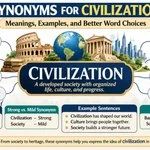
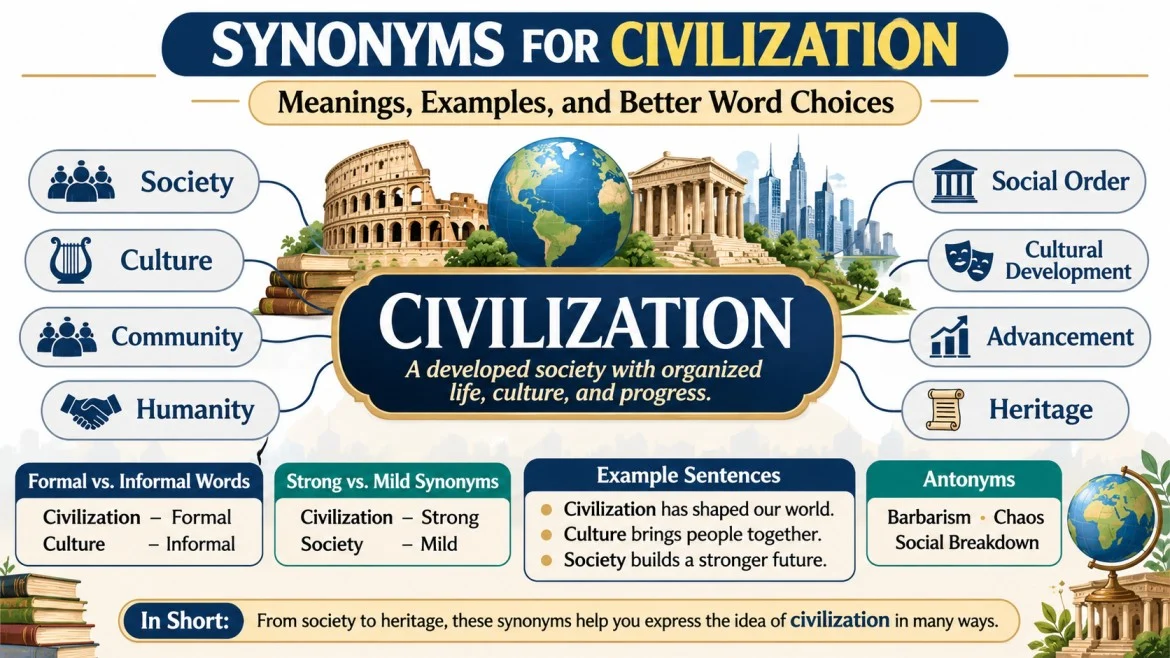
Civilization refers to an organized human society with developed institutions, culture, technology, laws, education, and social systems. Common alternatives include society, culture, community, social order, and cultural development, depending on the context.
Meaning, Tone and Context
What Does Civilization Mean?
Civilization describes an advanced or organized stage of human society characterized by established communities, government, education, technology, cultural traditions, and systems of cooperation.
It can also refer to the achievements, values, customs, and institutions developed by a particular group of people over time.
Simple Definition
Civilization means an organized human society with established cultural, political, economic, and social systems.
Part of Speech
Noun
Civilization is primarily used as a noun. It can describe an entire society, its historical achievements, or the broader development of human communities.
Tone and Formality
| Feature | Description |
|---|---|
| Tone | Generally neutral or positive |
| Formality | Formal and academic |
| Common usage | History, sociology, anthropology, education, and literature |
| Positive meaning | Human progress, knowledge, culture, and development |
| Negative association | Sometimes used when discussing the decline of societies or destructive behavior |
Common Use Cases
- History: Discussing ancient societies and historical achievements.
- Education: Explaining the development of human knowledge and institutions.
- Sociology: Examining social organization and cultural systems.
- Literature: Describing the development or decline of human communities.
- Professional writing: Discussing social progress, infrastructure, and cultural development.
Important Word Forms
| Word | Meaning | Example |
|---|---|---|
| Civilization | An organized human society | Ancient civilization influenced modern architecture. |
| Civilized | Showing socially accepted behavior or refinement | They maintained a civilized discussion. |
| Civilize | To develop or introduce social organization and cultural practices | Historical institutions helped civilize the region. |
| Civilizing | Contributing to social or cultural development | Education can have a civilizing influence. |
| Civilly | In a polite or respectful manner | The two representatives spoke civilly. |
| Civility | Politeness and respectful behavior | Civility improves public discussions. |
When and How to Use “Civilization”
Use civilization when discussing organized human societies, cultural achievements, historical development, or established systems of social organization.
It is particularly useful when the subject involves more than individual behavior or a small community.
Realistic Examples
1. Academic Context
The development of ancient civilization transformed agriculture, architecture, and political organization.
2. Professional Context
Investment in education and infrastructure can contribute to the long term development of civilization.
3. Historical Context
The Indus Valley civilization developed sophisticated urban settlements thousands of years ago.
4. Personal Context
Learning about different civilizations helped her appreciate diverse cultural traditions.
5. Creative Writing
The ruins offered a glimpse into a civilization that had disappeared centuries earlier.
6. Social Context
Respect, cooperation, and shared responsibilities are important elements of civilization.
7. Email and Communication
The presentation explores how technological innovation has influenced modern civilization.
Another Word for “Civilization”
The best single replacement for civilization is usually society when referring to an organized human population.
However, the most appropriate alternative depends on what you want to communicate. Culture emphasizes shared traditions, social order highlights organization, and advancement focuses on progress.
Here are useful alternatives by context.
| Context | Best Alternative | Why It Works |
|---|---|---|
| Professional writing | Society | Clear and suitable for formal communication |
| Academic writing | Human society | Emphasizes organized human communities |
| Casual conversation | Community | Sounds natural and approachable |
| Emotional writing | Humanity | Highlights shared human experiences |
| Creative writing | Culture | Adds emphasis on traditions and identity |
| Workplace use | Social development | Focuses on improvements in society |
| Social media captions | Heritage | Connects with historical and cultural identity |
| Stronger meaning | Cultural advancement | Emphasizes significant development |
| Softer meaning | Way of life | Focuses on everyday customs and practices |
When Not to Use “Civilization”
Although civilization is a useful word, it does not fit every situation.
Sometimes a more specific alternative communicates your meaning more accurately.
1. When discussing a small group
Civilization can sound too broad when describing a neighborhood or local group.
Better: Community.
Example: The community worked together to improve the local school.
2. When discussing traditions
Civilization may sound unnecessarily general when the subject is food, clothing, language, or customs.
Better: Culture.
Example: The region has a rich culture and distinctive traditions.
3. When discussing polite behavior
Civilization is too broad when you simply mean respectful conduct.
Better: Civility.
Example: The debate continued with civility despite strong disagreements.
4. When describing technological progress
Civilization may not clearly communicate a specific technological achievement.
Better: Advancement.
Example: Medical advancement has improved the treatment of several diseases.
5. When describing everyday routines
Civilization can sound overly formal when discussing how people live.
Better: Way of life.
Example: Modern technology has changed our way of life.
Words Commonly Confused With “Civilization”
Several related words overlap with civilization, but they have different meanings.
| Word | Main Difference | When to Use It |
|---|---|---|
| Culture | Shared traditions, beliefs, and customs | Discussing identity and traditions |
| Society | An organized group of people | Discussing social structures |
| Community | A smaller group with shared connections | Discussing local populations |
| Humanity | All human beings collectively | Discussing human experiences |
| Urbanization | The growth of towns and cities | Discussing population and city development |
| Modernization | The process of adopting modern systems | Discussing technological and institutional change |
Understanding these differences prevents inaccurate word substitutions and improves writing precision.
Best Synonym by Context for Civilization
The right synonym depends on whether your sentence discusses people, traditions, institutions, development, or behavior.
| Context | Best Synonym | Why It Works | Example |
|---|---|---|---|
| Formal writing | Society | Professional and clear | Society depends on cooperation. |
| Academic writing | Human society | Emphasizes human organization | Human society has changed over centuries. |
| Business writing | Social development | Highlights improvements | Education supports social development. |
| Resume writing | Cultural awareness | Demonstrates understanding of different cultures | Demonstrated cultural awareness in international projects. |
| Casual conversation | Community | Easy to understand | Our community values education. |
| Creative writing | Heritage | Adds historical depth | The ancient heritage remains visible. |
| Emotional writing | Humanity | Highlights human values | Humanity deserves compassion and respect. |
| Strong intensity | Cultural advancement | Emphasizes significant progress | Cultural advancement influenced regional institutions. |
| Softer meaning | Way of life | Focuses on daily experiences | Their way of life reflects generations of tradition. |
| Social media captions | Heritage | Works well with historical content | Celebrating our cultural heritage. |
| Historical discussion | Ancient society | Identifies an earlier organized population | The ancient society developed complex trade routes. |
| Sociological discussion | Social order | Highlights organization and institutions | Social order depends on shared expectations. |
Which Synonym Should You Choose?
Choosing the best synonym for civilization requires understanding the main idea of your sentence.
Use these practical guidelines.
1. Consider the Meaning
If you mean an organized population, choose society. If you mean shared customs, choose culture.
2. Consider Formality
For academic and professional writing, human society, social development, and cultural advancement can be appropriate.
For everyday conversation, community and way of life usually sound more natural.
3. Consider Emotional Intensity
Use humanity when discussing shared human experiences or moral responsibilities.
Use heritage when you want to emphasize historical identity and cultural connections.
4. Consider Professional Value
In workplace communication, choose precise terms such as cultural awareness, social development, or community engagement when they accurately describe the subject.
5. Consider Sentence Context
Never replace civilization automatically. Read the complete sentence and determine whether you are describing people, institutions, cultural practices, or progress.
Real Life Examples of Civilization in Sentences
Here are examples showing how civilization and its alternatives work in everyday situations.
| Situation | Example Sentence |
|---|---|
| School | Ancient civilizations developed writing systems that changed human history. |
| Workplace | Cultural awareness helps professionals communicate across different backgrounds. |
| Academic writing | Human society has experienced significant changes in its political organization. |
| Conversation | Every community has traditions worth understanding. |
| Social media | Celebrating the heritage that connects generations. |
| Resume | Promoted cultural awareness through international collaboration. |
| The report examines the relationship between technology and social development. | |
| Storytelling | Beneath the desert sands lay the remains of a forgotten society. |
25 Synonyms for Civilization
The following list includes close alternatives, related expressions, and context specific substitutes. Some describe civilization as an organized society, while others emphasize its cultural achievements or social development.
| Synonym | Simple Meaning | Best Used For | Example Sentence |
|---|---|---|---|
| 1. Society | An organized group of people | General and academic writing | Society changes as new ideas emerge. |
| 2. Culture | Shared beliefs, traditions, and customs | Cultural discussions | The region has a distinctive culture. |
| 3. Community | People connected by location or interests | Everyday communication | The community preserved its traditions. |
| 4. Humanity | All human beings | Philosophical and emotional writing | Humanity continues to explore new possibilities. |
| 5. Population | People living in a particular area | Research and statistics | The population expanded over several centuries. |
| 6. Nation | A people associated with a country or shared identity | Politics and history | The nation developed strong institutions. |
| 7. Social order | An organized system of social relationships | Sociology and government | Social order depends on established laws. |
| 8. Human society | Human communities and their institutions | Academic writing | Human society has evolved through cooperation. |
| 9. Cultural development | Growth of cultural practices and achievements | History and education | Cultural development shaped the region’s identity. |
| 10. Social development | Improvements in social conditions | Sociology and policy | Social development requires equal opportunities. |
| 11. Advancement | Progress toward a more developed condition | Technology and education | Scientific advancement changed human history. |
| 12. Progress | Movement toward improvement | General writing | Progress in medicine has saved countless lives. |
| 13. Refinement | Development of sophistication or polished behavior | Art and social conduct | The period brought refinement to artistic expression. |
| 14. Sophistication | Complexity, knowledge, or advanced development | Technology and culture | The ancient city demonstrated remarkable sophistication. |
| 15. Enlightenment | Increased knowledge and understanding | Philosophy and education | Education encourages intellectual enlightenment. |
| 16. Modernity | The characteristics of modern life | Social and historical analysis | Modernity transformed traditional institutions. |
| 17. Urban society | A population organized around urban living | Urban studies | Urban society depends on developed infrastructure. |
| 18. Urbanization | Growth of towns and cities | Geography and economics | Urbanization changed the region’s economy. |
| 19. Heritage | Traditions and achievements passed through generations | History and culture | Their heritage remains an important source of pride. |
| 20. Way of life | The manner in which people live | Everyday and creative writing | Their way of life reflects traditional values. |
| 21. Civility | Polite and respectful behavior | Social conduct | Civility makes disagreement more constructive. |
| 22. Decorum | Proper and socially accepted behavior | Formal settings | The guests maintained decorum throughout the ceremony. |
| 23. Social organization | The arrangement of people and institutions | Sociology and history | Social organization influenced ancient settlements. |
| 24. Cultural advancement | Development in cultural achievements | Academic and historical writing | Cultural advancement contributed to artistic innovation. |
| 25. Collective achievement | Accomplishments produced through group effort | Creative and historical writing | The monument represents a collective achievement. |
Important usage note: These 25 words are not interchangeable in every sentence. Some are close alternatives, while others describe particular dimensions of civilization. Choose according to the intended meaning.
Synonym Groups and Usage Differences
Professional vs. Personal Synonyms
Professional writing generally benefits from precise and objective alternatives.
Words such as society, social development, cultural awareness, and social organization work well in reports, presentations, and research discussions.
Personal writing can use community, heritage, humanity, and way of life to communicate human experiences and cultural connections.
Example:
Professional: Social development depends on access to quality education.
Personal: Our community has preserved its traditions for generations.
Formal vs. Conversational Synonyms
Formal vocabulary is useful when writing academic essays, historical reports, and professional documents.
Conversational alternatives make explanations easier to understand.
| Formal Synonym | Conversational Alternative |
|---|---|
| Human society | People living together |
| Social organization | How people organize themselves |
| Cultural advancement | Cultural growth |
| Social order | An organized community |
| Cultural heritage | Shared traditions |
Academic Synonyms
Academic writing should prioritize accuracy rather than complicated vocabulary.
Useful alternatives include:
- Human society, for discussions of organized human populations.
- Social organization, for examining institutions and relationships.
- Cultural development, for discussing traditions and achievements.
- Urbanization, for the expansion of cities.
- Social development, for changes in social conditions.
- Modernization, for adopting modern systems and technologies.
Example:
Instead of writing, “Civilization changed throughout history,” consider:
“Human society experienced significant changes in political, economic, and cultural organization.”
This version communicates the subject more specifically.
Professional and Business Synonyms
In business communication, civilization is rarely the most useful word unless the discussion concerns broad historical or social developments.
Consider these alternatives:
| Synonym | Professional Application |
|---|---|
| Society | Reports about social trends |
| Cultural awareness | International business communication |
| Social development | Community improvement projects |
| Community engagement | Public relations and outreach |
| Modernization | Organizational or technological change |
| Social organization | Institutional planning and research |
Example:
“Modernization has helped organizations improve communication and operational efficiency.”
Creative or Literary Synonyms
Creative writing often benefits from alternatives that introduce historical depth, emotion, and imagery.
Useful choices include:
- Heritage, for cultural memories and traditions.
- Humanity, for shared human experiences.
- Sophistication, for advanced artistic or intellectual achievements.
- Legacy, for achievements passed through generations.
- Way of life, for describing everyday customs.
Example:
“The forgotten city preserved the legacy of a remarkable society.”
Slang or Modern Synonyms
Civilization does not have many direct slang equivalents.
However, casual expressions can communicate related ideas.
| Casual Expression | Meaning | Appropriate Context |
|---|---|---|
| Modern world | Contemporary human society | Everyday discussions |
| Society today | Present social conditions | Casual explanations |
| The community | A connected group of people | Local conversations |
| Human progress | Improvements made by people | Informal educational content |
Avoid using expressions such as these in place of civilization when discussing a specific historical society or academic concept.
Strongest vs. Weaker Synonyms
The following scale compares the strength of related expressions by their emphasis on development and sophistication.
| Intensity | Word | Meaning |
|---|---|---|
| Mild | Community | A connected group of people |
| Mild | Society | An organized human population |
| Moderate | Social organization | Structured relationships and institutions |
| Moderate | Cultural development | Growth in cultural achievements |
| Strong | Advancement | Significant improvement |
| Strong | Sophistication | A high degree of complexity |
| Strong | Cultural advancement | Significant cultural progress |
These words express different ideas rather than a strict ranking of civilization.
Emotional vs. Neutral Synonyms
Neutral alternatives describe society without adding strong emotional meaning.
| Neutral Words | Emotional or Expressive Words |
|---|---|
| Society | Humanity |
| Population | Heritage |
| Social organization | Legacy |
| Community | Cultural identity |
| Social development | Collective achievement |
For factual writing, society and social organization are generally safer choices.
For inspirational or reflective writing, humanity and heritage can create a stronger emotional connection.
Antonyms of Civilization
Civilization does not have one perfect opposite in every context. Its antonyms depend on whether you mean organized society, cultural development, social order, or respectful behavior.
The following words represent contrasting conditions rather than 15 universally interchangeable opposites.
| Antonym | Meaning | Example Sentence |
|---|---|---|
| 1. Barbarism | Extreme cruelty or lack of accepted social restraint | The invasion was remembered for its barbarism. |
| 2. Savagery | Brutal or uncontrolled behavior | The conflict revealed the savagery of war. |
| 3. Primitiveness | A comparatively undeveloped state | The settlement had limited infrastructure. |
| 4. Chaos | Complete confusion or disorder | The collapse of leadership created chaos. |
| 5. Anarchy | Absence of effective government or authority | The country experienced a period of anarchy. |
| 6. Lawlessness | Lack of respect for established laws | Lawlessness weakened public confidence. |
| 7. Disorder | Lack of organization | Political disorder disrupted daily life. |
| 8. Incivility | Rude or disrespectful behavior | Incivility damaged the public discussion. |
| 9. Brutality | Extreme physical cruelty | The brutality of the conflict shocked observers. |
| 10. Rudeness | Lack of politeness | Rudeness can damage personal relationships. |
| 11. Ignorance | Lack of knowledge or understanding | Ignorance can prevent meaningful progress. |
| 12. Backwardness | A perceived lack of development | Poor infrastructure contributed to regional backwardness. |
| 13. Lawlessness | Absence of effective legal control | Lawlessness made communities feel unsafe. |
| 14. Disorganization | Lack of structure or coordination | Disorganization weakened the institution. |
| 15. Social breakdown | Collapse of established social structures | Social breakdown affected essential public services. |
Note: Lawlessness appears in two different contexts in the conceptual list above. For a final published table with 15 unique entries, replace the second occurrence with disintegration, meaning the breakdown of an established structure.
Comparison: Civilization vs. Similar Words
Understanding the differences between similar words helps prevent awkward substitutions.
Civilization vs. Society
Main difference: Civilization often describes an organized and culturally developed human society. Society simply refers to a group of people living within shared social relationships.
Stronger word: Civilization has a broader historical and developmental emphasis.
More formal: Both are formal, but civilization is especially common in historical discussions.
Examples:
Civilization: Ancient civilization developed complex systems of trade.
Society: Society depends on shared rules and responsibilities.
Civilization vs. Culture
Main difference: Civilization includes institutions, technology, infrastructure, and social organization. Culture focuses on shared beliefs, traditions, art, and customs.
Stronger word: Civilization has a broader meaning.
More formal: Both are suitable for academic writing.
Examples:
Civilization: The civilization developed advanced agricultural systems.
Culture: The culture celebrates music, storytelling, and traditional festivals.
Civilization vs. Community
Main difference: Civilization generally describes a broad organized society, while community usually refers to a smaller connected group.
Stronger word: Civilization has greater historical and social scope.
More formal: Civilization is generally more formal.
Examples:
Civilization: The ancient civilization established important trade networks.
Community: The community organized a local cultural festival.
Civilization vs. Humanity
Main difference: Civilization refers to organized human society and its achievements. Humanity refers to all human beings or the qualities associated with being human.
Stronger word: Civilization is stronger when discussing institutions and social organization.
More formal: Both work in formal writing.
Examples:
Civilization: Civilization has developed through scientific discovery.
Humanity: Humanity continues to face environmental challenges.
Civilization vs. Urbanization
Main difference: Civilization describes an organized human society. Urbanization is the process through which towns and cities grow.
Stronger word: They describe different concepts, so neither is universally stronger.
More formal: Both are suitable for academic writing.
Examples:
Civilization: The civilization established sophisticated political institutions.
Urbanization: Urbanization increased the demand for housing and transportation.
Civilization vs. Modernization
Main difference: Civilization describes an organized society or its achievements. Modernization refers to adopting modern technologies, institutions, or practices.
Stronger word: Civilization has broader scope, while modernization describes a specific process.
More formal: Both are formal terms.
Examples:
Civilization: The civilization developed a complex legal system.
Modernization: Modernization improved the region’s transportation network.
Common Phrases and Expressions with “Civilization”
1. Ancient Civilization
Meaning: A human society that existed in the distant past and developed distinctive cultural and social systems.
Example: Ancient civilization introduced important developments in mathematics and architecture.
2. Modern Civilization
Meaning: Contemporary human society and its institutions, technologies, and cultural practices.
Example: Modern civilization relies heavily on scientific innovation.
3. Western Civilization
Meaning: Historical and cultural traditions commonly associated with Western societies.
Example: The course examines the historical development of Western civilization.
4. Human Civilization
Meaning: The collective development and achievements of human societies.
Example: Agriculture played a major role in human civilization.
5. Rise of Civilization
Meaning: The emergence and development of organized human societies.
Example: The rise of civilization transformed how people lived and worked.
6. Collapse of Civilization
Meaning: The decline or breakdown of an established society and its institutions.
Example: Environmental pressures contributed to the decline of the ancient civilization.
7. Cradle of Civilization
Meaning: A region where early human societies developed important features of civilization.
Example: Mesopotamia is widely recognized as one of the cradles of civilization.
8. Advancement of Civilization
Meaning: Improvements in knowledge, technology, institutions, and human organization.
Example: Scientific discoveries have contributed to the advancement of civilization.
Common Mistakes to Avoid
1. Treating Every Similar Word as an Exact Synonym
Society, culture, and civilization have overlapping meanings, but they are not identical.
Choose the word that accurately describes your subject.
2. Confusing Civilization with Culture
Culture focuses on shared traditions and beliefs, while civilization includes broader social and institutional structures.
3. Using Casual Words in Academic Writing
Expressions such as the modern world may sound too general in research papers.
Use human society or social organization when appropriate.
4. Using Overly Dramatic Alternatives
Words such as barbarism and savagery carry strong negative meanings.
Avoid them when discussing ordinary social differences or historical development without evidence.
5. Repeating Civilization Too Often
Repeating the same noun makes paragraphs less engaging.
Alternate between society, cultural development, human society, and other accurate expressions.
6. Choosing the Wrong Emotional Tone
Humanity and heritage can create emotional connections, while social organization and population sound more factual.
Match the word to your intended message.
7. Confusing Urbanization with Civilization
Urbanization describes city growth, not the entire development of human society.
Use it only when discussing urban expansion.
FAQs
1. What Is the Best Synonym for Civilization?
Society is generally the best synonym for civilization when describing an organized human population with shared institutions and social relationships.
2. What Is a Formal Synonym for Civilization?
Human society, social organization, and cultural development are formal alternatives. The best choice depends on whether you discuss people, institutions, or progress.
3. What Is an Informal Synonym for Civilization?
Community and way of life are accessible alternatives. They work well in everyday conversations about people, traditions, and shared experiences.
4. What Is Another Word for Civilization in Professional Writing?
Society is a reliable alternative. Social development and cultural advancement are useful when discussing specific improvements in human communities.
5. What Is the Difference Between Civilization and Culture?
Civilization includes social institutions, technology, and organization, while culture focuses on shared traditions, beliefs, values, and artistic practices.
6. What Is the Opposite of Civilization?
Barbarism, savagery, and social breakdown can express contrasting ideas. The most appropriate opposite depends on the intended meaning and context.
Conclusion
Civilization describes the development of organized human societies, including their institutions, cultural achievements, technology, and social systems. Useful alternatives include society, culture, community, human society, social organization, and cultural development.
The best synonym depends on your purpose. Use society for general discussions, culture for traditions, social development for improvements, and humanity for shared human experiences.
A practical vocabulary tip is to identify exactly what you mean before replacing a word. The most effective synonym is not necessarily the most sophisticated one. It is the word that communicates your intended meaning clearly and naturally.
Discover More Post:
- 50+ Synonyms for Luxury | From Understated Elegance to …
- 50+ Synonyms for Phenomenon | From Everyday Events to …