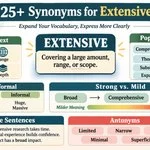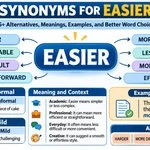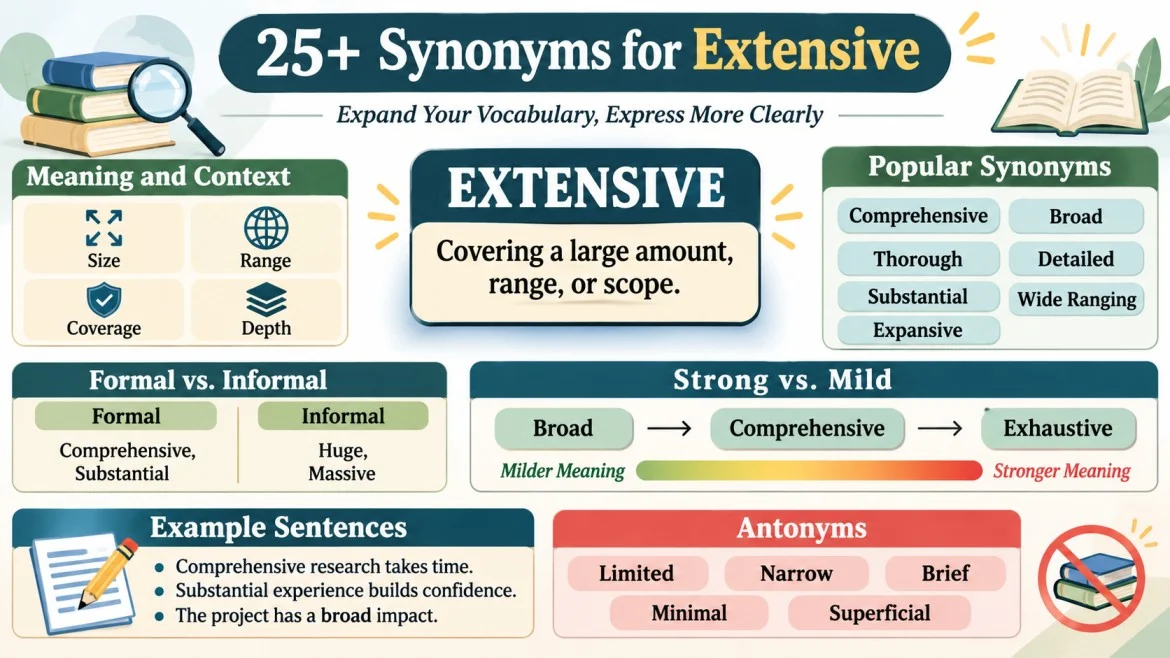
The word extensive is useful when describing something large, broad, or covering many details. However, using it repeatedly in essays, professional emails, reports, resumes, or everyday conversations can make your writing sound repetitive. Choosing a more precise alternative can help you communicate your ideas more effectively.
Whether you are describing extensive research, extensive experience, extensive knowledge, or extensive damage, the right synonym depends on what you want to emphasize. Some alternatives sound more professional, while others highlight depth, quantity, size, or coverage. This guide explores 25 useful synonyms for extensive, explains their differences, and provides natural examples to help you choose the best word for your situation.
What Does “Extensive” Mean?
Extensive means large in size, amount, range, or scope, often covering many details or areas. Common synonyms include comprehensive, broad, wide ranging, substantial, thorough, expansive, detailed, and far reaching, depending on context.
Meaning, Tone and Context
The word extensive describes something that covers a large area, includes many elements, or involves a considerable amount of information, activity, or effort.
It is commonly used in academic writing, business communication, research, professional descriptions, and everyday conversations.
1. Simple Definition
Extensive means covering a wide range, involving a large amount, or reaching across many areas.
For example:
- Extensive research means research that covers a large amount of information.
- Extensive experience means considerable experience gained over time.
- Extensive damage means damage affecting a large area or involving significant destruction.
2. Part of Speech
Extensive is an adjective. It describes the size, range, quantity, or coverage of something.
Related word forms:
| Word | Part of Speech | Meaning |
|---|---|---|
| Extensive | Adjective | Covering a large amount or range |
| Extensively | Adverb | In a wide or detailed manner |
| Extent | Noun | The degree, size, or range of something |
| Extend | Verb | To make something longer, larger, or broader |
| Extension | Noun | An increase in length, range, or duration |
3. Tone and Connotation
Extensive generally has a neutral or positive tone, although its meaning can depend on the subject.
For example, extensive knowledge sounds positive because it suggests strong understanding. Extensive damage sounds negative because it describes significant destruction.
4. Formality Level
Extensive is a moderately formal word. It works naturally in:
- Academic essays and research papers.
- Business reports and presentations.
- Professional resumes and cover letters.
- News articles and informative writing.
- Everyday conversations when describing something substantial.
5. Common Use Cases
You will frequently encounter extensive in expressions such as:
- Extensive research
- Extensive knowledge
- Extensive experience
- Extensive training
- Extensive damage
- Extensive collection
- Extensive investigation
- Extensive improvements
The best replacement depends on whether you are emphasizing size, depth, quantity, coverage, or complexity.
When and How to Use “Extensive”
Use extensive when you want to communicate that something covers a large area, includes many elements, or requires considerable effort.
Here are seven realistic examples.
1. Professional Context
The company conducted extensive research before introducing its new product.
2. Academic Context
The student completed extensive reading to prepare for the final examination.
3. Personal Context
My grandfather has extensive knowledge of traditional cooking methods.
4. Business Context
The organization made extensive improvements to its customer service system.
5. Emotional Context
The community experienced extensive damage after the severe storm.
6. Creative Writing
The explorer traveled through an extensive network of underground caves.
7. Social Media Context
Spent the weekend exploring an extensive collection of vintage books.
Another Word for “Extensive”
The best single replacement for extensive is usually comprehensive when describing something that covers all or nearly all important aspects of a subject.
However, other alternatives can be more appropriate depending on your sentence.
| Context | Best Alternative | Example |
|---|---|---|
| Professional writing | Comprehensive | We prepared a comprehensive business report. |
| Academic writing | Thorough | The researcher conducted a thorough analysis. |
| Casual conversation | Large | They have a large collection of books. |
| Emotional writing | Significant | The storm caused significant damage. |
| Creative writing | Expansive | They explored an expansive landscape. |
| Resume or workplace | Substantial | I have substantial experience in marketing. |
| Social media captions | Huge | What a huge collection of photographs! |
| Stronger meaning | Exhaustive | The team completed an exhaustive investigation. |
| Softer meaning | Broad | The course offers a broad introduction to history. |
Quick recommendation: Choose comprehensive for complete coverage, substantial for considerable quantity, thorough for careful examination, and expansive for something physically or conceptually wide.
When Not to Use “Extensive”
Although extensive is versatile, it does not fit every situation. Sometimes, a more specific word makes your writing clearer.
1. When You Mean Complete Coverage
Instead of saying:
The report provides extensive information about the project.
Write:
The report provides comprehensive information about the project.
Comprehensive emphasizes coverage of all important aspects.
2. When You Mean Careful Examination
Instead of:
The researcher conducted extensive testing.
Write:
The researcher conducted thorough testing.
Thorough emphasizes careful and detailed examination.
3. When You Mean a Large Quantity
Instead of:
The company has extensive resources.
Write:
The company has substantial resources.
Substantial emphasizes considerable quantity or importance.
4. When You Mean Physical Size
Instead of:
The property has extensive gardens.
Write:
The property has expansive gardens.
Expansive emphasizes physical space and size.
5. When You Mean a Long Explanation
Instead of:
She provided an extensive explanation.
Write:
She provided a detailed explanation.
Detailed focuses on the information and individual points included.
Words Commonly Confused With “Extensive”
Several words have meanings similar to extensive, but they are not always interchangeable.
| Word | Main Difference | Best Used For |
|---|---|---|
| Comprehensive | Covers all important aspects | Reports, guides, research |
| Thorough | Careful and complete | Investigations, reviews, testing |
| Substantial | Large in amount or importance | Resources, evidence, experience |
| Expansive | Wide or broad in physical or conceptual scope | Landscapes, collections, ideas |
| Exhaustive | Covers nearly every possible detail | Research, investigations, examinations |
| Widespread | Existing across many places or among many people | Problems, opinions, events |
For example, extensive research may describe research covering a large amount of material. Exhaustive research suggests an exceptionally complete investigation.
Understanding these differences helps prevent awkward word choices.
Best Synonym by Context for “Extensive”
The following table highlights the most useful alternatives for different writing situations.
| Context | Best Synonym | Why It Works | Example |
|---|---|---|---|
| Formal writing | Comprehensive | Suggests complete coverage | A comprehensive review was completed. |
| Academic writing | Thorough | Emphasizes careful examination | The study included a thorough analysis. |
| Professional communication | Substantial | Sounds credible and precise | We made substantial progress. |
| Resume writing | Considerable | Highlights significant experience | She has considerable industry experience. |
| Casual conversation | Large | Simple and familiar | They own a large house. |
| Creative writing | Expansive | Creates a sense of scale | An expansive valley stretched ahead. |
| Emotional writing | Significant | Emphasizes importance or impact | The event caused significant changes. |
| Strong intensity | Exhaustive | Suggests nearly complete coverage | An exhaustive investigation followed. |
| Moderate tone | Broad | Communicates a wide range | The course covers broad topics. |
| Social media captions | Huge | Sounds natural and engaging | A huge collection of memories. |
| Research papers | In depth | Highlights detailed examination | The paper offers an in depth analysis. |
| Business reports | Wide ranging | Emphasizes multiple areas | The company introduced wide ranging reforms. |
| News writing | Widespread | Highlights broad distribution | Widespread damage affected the region. |
| Technical writing | Detailed | Focuses on specific information | The manual contains detailed instructions. |
| US and UK English | Comprehensive | Commonly understood in both | A comprehensive assessment was prepared. |
Which Synonym Should You Choose?
Selecting the right synonym for extensive requires understanding what your sentence actually communicates.
Use these practical guidelines:
1. Consider the Meaning
If you are describing something that covers many topics, choose comprehensive or wide ranging. If you are describing a large quantity, consider substantial or considerable.
2. Match the Formality
For professional reports, comprehensive and substantial are useful. For everyday conversations, large, huge, and broad sound more natural.
3. Think About Emotional Intensity
Use significant when describing something important or impactful. Choose exhaustive when you want to emphasize an unusually complete effort.
4. Focus on Professional Value
On resumes, substantial, considerable, and broad can communicate experience, expertise, and responsibilities effectively.
5. Check the Sentence Context
Not every synonym fits every noun. Expansive works naturally with landscapes and collections, while thorough is more appropriate for examinations and investigations.
6. Avoid Repetition
If extensive appears several times in the same paragraph, replace it with alternatives that preserve the intended meaning.
The goal is not to use complicated vocabulary. It is to communicate the exact meaning with the clearest possible word.
Real Life Examples of “Extensive” in Sentences
Here are practical examples showing how different synonyms improve everyday and professional communication.
| Situation | Example Sentence |
|---|---|
| School | The teacher provided a comprehensive study guide for the final exam. |
| Workplace | Our team completed a thorough evaluation of the new system. |
| Writing | The article offers a detailed explanation of the subject. |
| Conversation | My uncle has a huge collection of old records. |
| Social media | Exploring an expansive garden filled with beautiful flowers. |
| Resume | Developed substantial experience in project management. |
| Please review the comprehensive report attached to this message. | |
| Storytelling | Beyond the mountains lay an expansive forest filled with ancient trees. |
| Research | The scientists conducted an exhaustive investigation. |
| Business | The organization introduced wide ranging operational improvements. |
These examples demonstrate that a carefully selected synonym can make a sentence more natural and informative.
25 Synonyms for “Extensive”
Below are 25 useful synonyms for extensive, including formal, academic, professional, descriptive, and conversational alternatives.
| Synonym | Simple Meaning | Best Used For | Example Sentence |
|---|---|---|---|
| 1. Comprehensive | Covering all important aspects | Reports and guides | The handbook provides comprehensive instructions. |
| 2. Thorough | Careful and complete | Research and investigations | The team performed a thorough inspection. |
| 3. Widespread | Distributed across many places | Problems and events | Widespread flooding affected several communities. |
| 4. Substantial | Large in amount or importance | Resources and achievements | The project requires substantial funding. |
| 5. Considerable | Quite large or significant | Experience and quantities | She has considerable knowledge of finance. |
| 6. Expansive | Covering a large physical or conceptual space | Landscapes and collections | They purchased an expansive property. |
| 7. Broad | Covering many subjects or areas | Knowledge and topics | The course provides a broad overview of economics. |
| 8. Wide ranging | Including many different areas | Discussions and policies | The committee discussed wide ranging reforms. |
| 9. Exhaustive | Covering nearly every possible detail | Investigations and research | The report includes an exhaustive review. |
| 10. Detailed | Including many specific facts | Instructions and explanations | The guide contains detailed information. |
| 11. In depth | Examining something carefully | Analysis and discussions | The article offers an in depth examination. |
| 12. Far reaching | Having effects across many areas | Decisions and consequences | The legislation introduced far reaching changes. |
| 13. Large scale | Involving a large operation or area | Projects and events | The government announced a large scale development plan. |
| 14. Sweeping | Covering a wide range, often involving major changes | Reforms and policies | The organization introduced sweeping reforms. |
| 15. Voluminous | Consisting of a very large amount | Documents and information | The lawyer reviewed voluminous records. |
| 16. Elaborate | Highly developed or containing many details | Designs and explanations | The architect presented an elaborate design. |
| 17. Extensive in scope | Covering a wide range of subjects | Formal descriptions | The program is extensive in scope. |
| 18. Pervasive | Present throughout an area or system | Influences and conditions | Pervasive problems affected the organization. |
| 19. Intensive | Involving concentrated effort or activity | Training and study | Students completed an intensive training program. |
| 20. All inclusive | Including everything important or necessary | Packages and services | The hotel offers an all inclusive vacation package. |
| 21. Profuse | Existing or appearing in great quantity | Descriptive and literary writing | The garden contained profuse greenery. |
| 22. Prolific | Producing a large amount of work or output | Writers and creators | The prolific author published several novels. |
| 23. Far flung | Extending across distant locations | Places and organizations | The charity supports far flung communities. |
| 24. Grand | Impressive in size or ambition | Projects and designs | They developed a grand architectural vision. |
| 25. Extensive in coverage | Including a large range of material | Services and educational programs | The course is extensive in coverage. |
Important usage note: These alternatives are context dependent rather than interchangeable in every sentence. For example, intensive describes concentrated effort, while prolific describes high productivity. Choose according to the intended meaning.
Synonym Groups and Usage Differences
Understanding synonym groups makes it easier to choose words that match your audience and writing purpose.
Professional vs. Personal Synonyms
Professional writing benefits from precise and credible vocabulary. Comprehensive, substantial, thorough, and considerable are particularly useful in workplace communication.
Personal writing can be more expressive. Huge, expansive, large, and significant can communicate size or importance without sounding overly technical.
For example:
- Professional: The company has substantial experience in digital marketing.
- Personal: My family has a huge collection of travel photographs.
Formal vs. Conversational Synonyms
Formal vocabulary works well in academic papers, reports, presentations, and business emails.
Conversational alternatives are more suitable for everyday communication, texts, and social media.
| Formal Synonym | Conversational Alternative |
|---|---|
| Comprehensive | Complete |
| Substantial | Large |
| Considerable | Quite a lot |
| Exhaustive | Very detailed |
| Expansive | Huge |
| Thorough | Careful |
| Wide ranging | Covering many things |
Choose formal vocabulary when precision and professionalism matter. Use familiar words when communicating with friends or casual audiences.
Academic Synonyms
Academic writing requires words that accurately explain the scope and depth of research.
The most useful choices include:
- Comprehensive: When a study covers the major aspects of a subject.
- Thorough: When describing careful examination.
- Exhaustive: When research attempts to cover nearly all relevant material.
- In depth: When discussing detailed analysis.
- Detailed: When explaining specific findings.
- Wide ranging: When a study examines multiple areas.
Example:
Instead of writing, “The researchers conducted extensive research,” you could write, “The researchers completed a comprehensive review of existing literature.”
This version provides a clearer indication of the research approach.
Professional and Business Synonyms
In business communication, the right word can make descriptions more specific and credible.
| Situation | Recommended Synonym | Example |
|---|---|---|
| Business reports | Comprehensive | We prepared a comprehensive annual report. |
| Employee experience | Substantial | He has substantial leadership experience. |
| Quality reviews | Thorough | The company completed a thorough inspection. |
| Business changes | Sweeping | Management introduced sweeping changes. |
| Company resources | Considerable | The department has considerable resources. |
| Training programs | Intensive | Employees attended an intensive training course. |
For resumes, avoid using extensive repeatedly. Instead, choose substantial or considerable when describing experience, and comprehensive when describing knowledge or expertise.
Creative or Literary Synonyms
Creative writing often benefits from words that create imagery and atmosphere.
Consider these alternatives:
- Expansive: Suggests openness and impressive size.
- Far flung: Creates a sense of distant places.
- Profuse: Describes something appearing in great abundance.
- Grand: Communicates impressive scale or ambition.
- Sweeping: Suggests a broad movement or dramatic change.
- Elaborate: Highlights intricate details.
Example:
The traveler discovered an expansive landscape filled with ancient trees and winding rivers.
Here, expansive creates a stronger visual impression than extensive.
Slang or Modern Synonyms
There is no widely accepted direct slang equivalent for extensive. However, informal words can communicate a similar idea in everyday situations.
| Informal Expression | Meaning | Example |
|---|---|---|
| Huge | Very large | That is a huge collection of books. |
| Massive | Extremely large | The event attracted a massive audience. |
| Tons of | A very large amount | We have tons of work to finish. |
| A whole lot of | A large quantity | She has a whole lot of experience. |
These expressions are appropriate for casual conversations and informal social media captions. Avoid them in academic papers and formal business reports.
Strongest vs. Weaker Synonyms
Different synonyms communicate different levels of size, coverage, and intensity.
A practical intensity guide:
- Broad: Covers several areas or subjects.
- Considerable: Quite large or important.
- Substantial: Significant in amount or size.
- Comprehensive: Covers all important aspects.
- Wide ranging: Extends across many areas.
- Exhaustive: Attempts to cover nearly every relevant detail.
This is a contextual guide, not a universal ranking. Exhaustive emphasizes completeness, while substantial emphasizes quantity.
Emotional vs. Neutral Synonyms
Some synonyms communicate facts, while others emphasize importance or emotional impact.
| Neutral Synonym | Emotional or Emphatic Alternative |
|---|---|
| Broad | Sweeping |
| Large | Massive |
| Detailed | Elaborate |
| Substantial | Significant |
| Widespread | Far reaching |
| Considerable | Tremendous |
For factual writing, choose neutral vocabulary. For storytelling or persuasive writing, stronger alternatives can create a more memorable impression.
Antonyms of “Extensive”
Antonyms of extensive describe something limited in size, scope, quantity, depth, or coverage.
The following 15 words represent different types of opposites.
| Antonym | Meaning | Example Sentence |
|---|---|---|
| 1. Limited | Restricted in amount or range | The research had limited coverage. |
| 2. Narrow | Covering a small range | The discussion focused on a narrow topic. |
| 3. Brief | Short in duration or length | She provided a brief explanation. |
| 4. Concise | Expressing information in few words | The report included a concise summary. |
| 5. Restricted | Limited by rules or conditions | Access to the documents was restricted. |
| 6. Minimal | Very small in amount | The project required minimal resources. |
| 7. Slight | Small in degree or amount | Only slight damage occurred. |
| 8. Superficial | Lacking depth or detail | The review was superficial. |
| 9. Cursory | Quick and not thorough | He conducted a cursory inspection. |
| 10. Incomplete | Missing important parts | The application was incomplete. |
| 11. Partial | Covering only part of something | We received a partial explanation. |
| 12. Selective | Including only chosen elements | The report provided selective information. |
| 13. Sparse | Thinly distributed or limited | The region has sparse vegetation. |
| 14. Scant | Very small in quantity | There was scant evidence available. |
| 15. Small scale | Involving a limited operation or area | The organization started a small scale project. |
Remember: Some antonyms describe limited quantity, while others describe limited depth or coverage. Choose the opposite that matches your intended meaning.
Comparison: Extensive vs. Similar Words
Understanding the differences between extensive and related vocabulary can improve accuracy in academic and professional writing.
Extensive vs. Comprehensive
Main difference: Extensive describes something covering a large amount or range. Comprehensive emphasizes covering all important aspects.
Stronger word: Comprehensive when complete coverage is the intended meaning.
More formal: Both are suitable for formal writing.
Examples:
- Extensive: The company completed extensive research.
- Comprehensive: The company prepared a comprehensive research report.
Extensive vs. Thorough
Main difference: Extensive emphasizes scope or quantity, while thorough emphasizes carefulness and completeness.
Stronger word: Thorough when describing detailed examination.
More formal: Both work in academic and professional contexts.
Examples:
- Extensive: The team conducted extensive testing.
- Thorough: The team conducted thorough testing.
Extensive vs. Substantial
Main difference: Extensive describes broad coverage, while substantial emphasizes considerable amount or importance.
Stronger word: Substantial when highlighting quantity or significance.
More formal: Both are professional choices.
Examples:
- Extensive: The business has extensive resources.
- Substantial: The business has substantial financial resources.
Extensive vs. Expansive
Main difference: Extensive emphasizes range or coverage, while expansive emphasizes physical or conceptual size.
Stronger word: Expansive when describing physical space or a broad landscape.
More formal: Both can work in descriptive and professional writing.
Examples:
- Extensive: The property includes extensive gardens.
- Expansive: The property features expansive gardens.
Extensive vs. Widespread
Main difference: Extensive describes a large scope or amount, while widespread emphasizes distribution across many places or people.
Stronger word: Widespread when describing something distributed across a large area.
More formal: Both are appropriate for reports and news writing.
Examples:
- Extensive: The storm caused extensive damage.
- Widespread: The storm caused widespread damage across the region.
Extensive vs. Exhaustive
Main difference: Extensive means broad or substantial in scope, while exhaustive suggests covering nearly every relevant detail or possibility.
Stronger word: Exhaustive when emphasizing maximum completeness.
More formal: Both are common in academic and professional writing.
Examples:
- Extensive: The researchers completed extensive investigations.
- Exhaustive: The researchers conducted an exhaustive investigation.
Common Phrases and Expressions with “Extensive”
Extensive frequently appears in professional, academic, and descriptive expressions.
Here are eight useful combinations and their meanings.
1. Extensive Research
Meaning: Research that covers a large amount of information or involves considerable investigation.
Example sentence: The university conducted extensive research into renewable energy technologies.
2. Extensive Experience
Meaning: A considerable amount of practical knowledge gained through work or other activities.
Example sentence: The candidate has extensive experience in project management.
3. Extensive Knowledge
Meaning: A broad understanding of a particular subject.
Example sentence: She has extensive knowledge of international business practices.
4. Extensive Damage
Meaning: Significant destruction affecting a large area or involving many things.
Example sentence: The hurricane caused extensive damage to residential buildings.
5. Extensive Training
Meaning: A large amount of instruction and practical preparation.
Example sentence: New employees receive extensive training before starting their responsibilities.
6. Extensive Investigation
Meaning: A detailed investigation covering many aspects of an issue.
Example sentence: Police conducted an extensive investigation into the incident.
7. Extensive Collection
Meaning: A collection containing many items or a wide variety of objects.
Example sentence: The museum maintains an extensive collection of historical photographs.
8. Extensive Improvements
Meaning: Significant changes or developments across several areas.
Example sentence: The school introduced extensive improvements to its learning facilities.
Common Mistakes to Avoid
Even experienced writers sometimes choose synonyms that do not accurately communicate their intended meaning.
Here are seven common mistakes to watch for.
1. Using Extensive When Comprehensive Is More Accurate
Extensive suggests broad coverage, but comprehensive communicates that all important aspects are included.
Incorrect choice: The guide provides extensive coverage of every essential topic.
Better choice: The guide provides comprehensive coverage of every essential topic.
2. Confusing Extensive With Intensive
These words have different meanings.
Extensive describes broad scope or quantity. Intensive describes concentrated effort or activity.
Example:
The company offers extensive training programs.
The company offers intensive training sessions.
3. Using Casual Words in Formal Writing
Words such as huge, tons of, and massive may sound too informal in academic reports.
Better approach: Use substantial, considerable, or comprehensive when appropriate.
4. Choosing an Overly Dramatic Synonym
Exhaustive is not suitable for every situation involving a large amount of information.
Better approach: Use detailed or thorough when the subject does not require the stronger implication of exhaustive coverage.
5. Repeating Extensive Too Often
Repeatedly using extensive can make writing feel monotonous.
Better approach: Alternate between comprehensive, broad, substantial, detailed, and considerable when their meanings fit.
6. Ignoring Emotional Tone
Significant, massive, and substantial communicate different levels of emphasis.
Better approach: Choose a neutral alternative for factual descriptions and a stronger word when the impact deserves attention.
7. Using Slang in Academic or Professional Writing
Expressions such as tons of information may sound unnatural in formal documents.
Better approach: Use a large amount of information, substantial information, or extensive information depending on the sentence.
FAQs
1. What Is the Best Synonym for Extensive?
Comprehensive is often the best synonym for extensive when describing complete coverage. Thorough, substantial, broad, and wide ranging are useful alternatives in other contexts.
2. What Is a Formal Synonym for Extensive?
Comprehensive, substantial, considerable, exhaustive, and wide ranging are formal alternatives. The best choice depends on whether you mean quantity, coverage, or depth.
3. What Is an Informal Synonym for Extensive?
Huge, large, massive, and a whole lot of are informal alternatives. They work well in conversations, texts, and casual social media captions.
4. What Is Another Word for Extensive in Professional Writing?
Substantial, comprehensive, considerable, and thorough are useful professional alternatives. They help describe experience, research, resources, improvements, and business activities.
5. What Is the Difference Between Extensive and Intensive?
Extensive refers to a broad scope or large amount, while intensive describes concentrated effort, activity, or attention within a particular period or area.
6. What Is the Opposite of Extensive?
Common opposites include limited, narrow, brief, minimal, restricted, and superficial. The appropriate antonym depends on whether you mean size, quantity, or depth.
Conclusion
Extensive describes something that covers a large area, involves a considerable amount, or includes a wide range of information. However, choosing a more specific alternative can make your communication clearer and more effective.
Comprehensive works well when emphasizing complete coverage, thorough suits careful examination, substantial highlights quantity, and expansive describes impressive size or scope.
When choosing among synonyms for extensive, always consider the sentence, audience, and intended meaning. A useful vocabulary tip is to replace a repeated word only when the alternative preserves your original meaning.
Discover More Post:
- 50+ Synonyms for Phenomenon | From Everyday Events to …
- 50+ Synonyms for Detrimental | Expert Word Choices That …