Have you ever used the word detrimental several times in an essay, work email, report, or social media post? Although it clearly describes something harmful, repeating it can make your writing feel dull. Choosing a more precise word can help you explain problems, risks, and negative effects more naturally.
This guide explores synonyms for detrimental, including their meanings, examples, and differences in tone. You will learn which alternatives work best in academic writing, business communication, everyday conversations, and creative writing. Whether you are an English learner, student, blogger, or professional, these practical suggestions will help you express negative effects clearly. You will also discover common mistakes, useful antonyms, and simple ways to choose the right word for each situation.
What Does Detrimental Mean?
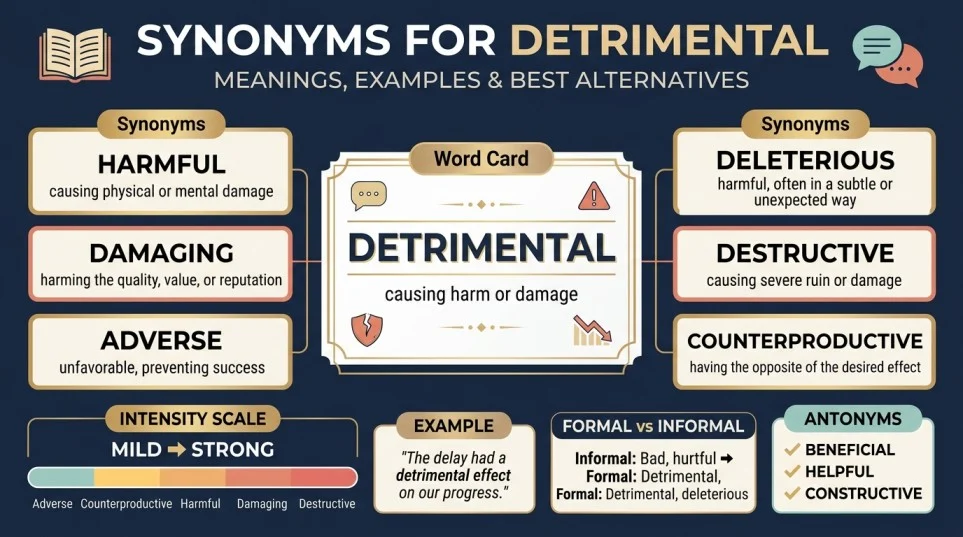
Detrimental means causing harm, damage, or negative effects. Common synonyms include harmful, damaging, adverse, injurious, unfavorable, and destructive. Use harmful for general situations, adverse for formal reports, damaging for serious negative effects, and destructive when the consequences are especially severe.
Meaning, Tone and Context
The word detrimental describes something that causes harm or has a negative effect on a person, situation, activity, or outcome.
Simple Definition
Detrimental means harmful to someone’s health, success, well being, progress, or interests.
For example, a lack of sleep can be detrimental to concentration. This means that insufficient sleep can make it harder to focus and perform well.
Part of Speech
Detrimental is an adjective. It describes a person, action, condition, habit, or decision that causes negative effects.
Example: Excessive screen time can have a detrimental effect on sleep.
Tone and Formality
Detrimental has a negative meaning and a moderately formal tone. It is common in academic essays, professional reports, workplace discussions, health articles, and analytical writing.
In casual conversation, harmful, bad for, or damaging may sound more natural.
Common Use Cases
You can use detrimental when discussing:
- Health and lifestyle habits.
- Education and academic performance.
- Business decisions and financial risks.
- Environmental damage.
- Workplace relationships and productivity.
- Personal growth and long term goals.
Related Word Forms
| Word | Part of Speech | Meaning | Example |
|---|---|---|---|
| Detrimental | Adjective | Causing harm | The policy had detrimental effects. |
| Detriment | Noun | Harm or disadvantage | The delay worked to our detriment. |
| Detrimentally | Adverb | In a harmful way | The change affected productivity detrimentally. |
The word detrimental is often used in the phrase detrimental to, as in detrimental to health or detrimental to progress.
When and How to Use Detrimental
Use detrimental when you want to explain that something has a harmful effect. It works especially well when the negative result matters more than the intention behind an action.
Here are four realistic examples.
Professional context: The outdated system was detrimental to team productivity.
Academic context: Researchers examined whether air pollution was detrimental to children’s health.
Personal context: Constant self criticism can be detrimental to your confidence.
Email context: Delaying the project approval may be detrimental to our delivery schedule.
In each sentence, detrimental explains a negative effect without automatically suggesting that the cause was intentional.
Another Word for Detrimental
The best replacement depends on what kind of harm you want to describe. Harmful is the most useful general alternative, while damaging emphasizes negative effects and adverse often suits formal analysis.
| Context | Best Alternative | Example |
|---|---|---|
| Professional writing | Adverse | The change had adverse effects on performance. |
| Academic writing | Harmful | The study examined harmful environmental conditions. |
| Casual conversation | Bad for | Skipping meals is bad for your energy levels. |
| Emotional writing | Hurtful | His hurtful comments damaged their friendship. |
| Creative writing | Corrosive | Resentment became a corrosive force in their relationship. |
| Resume or workplace use | Counterproductive | The approach was counterproductive to team goals. |
| Social media captions | Harmful | Protect your peace from harmful habits. |
| Stronger meaning | Destructive | The destructive behavior affected the entire family. |
| Softer meaning | Unfavorable | The team faced unfavorable conditions. |
Professional Writing
Choose adverse when discussing measurable outcomes, risks, policies, or business conditions.
Example: The company experienced adverse financial effects after the policy change.
Academic Writing
Use harmful, adverse, or detrimental depending on the sentence. These terms suit formal analysis, but they are not interchangeable in every context.
Example: The research explores the harmful effects of noise pollution.
Casual Conversation
Choose harmful or bad for when speaking naturally with friends, family, or colleagues.
Example: Staying up all night is bad for your health.
Emotional Writing
Use hurtful when words or actions cause emotional pain. Choose damaging when discussing their longer term effects.
Example: Repeated criticism can be damaging to a person’s self esteem.
Creative Writing
Words such as corrosive, destructive, and ruinous create stronger imagery or emphasize serious consequences.
Example: Jealousy became a corrosive influence on their friendship.
Resume and Workplace Use
Counterproductive works well when a process, habit, or decision produces the opposite of its intended result.
Example: The counterproductive approval process slowed project completion.
When Not to Use Detrimental
Detrimental is useful, but it is not always the clearest choice.
1. When the Situation Is Very Simple
Detrimental may sound overly formal in an everyday conversation.
Less natural: Skipping breakfast is detrimental to my morning routine.
More natural: Skipping breakfast makes my mornings harder.
2. When You Mean Emotional Pain
Detrimental describes a harmful effect, but hurtful more directly expresses emotional pain.
Less precise: Her detrimental comment upset me.
Better: Her hurtful comment upset me.
3. When You Mean the Opposite of Intended
Detrimental does not necessarily mean that an action defeats its own purpose. Counterproductive is more precise in that situation.
Less precise: The extra meetings were detrimental to solving the problem.
More precise: The extra meetings were counterproductive because they left less time to solve the problem.
4. When the Harm Is Extremely Serious
Detrimental can sound restrained when describing severe destruction.
Less vivid: The fire had detrimental effects on the building.
More precise: The fire caused extensive damage to the building.
5. When You Need a Specific Result
If something reduces profits, damages health, or delays progress, naming that result often makes your sentence clearer.
General: The decision was detrimental.
Specific: The decision reduced profits and delayed product development.
Words Commonly Confused With Detrimental
Several related words describe negative effects, but their meanings differ.
| Word | Main Difference | Best Use |
|---|---|---|
| Harmful | General word for causing harm | Everyday and formal writing |
| Damaging | Emphasizes injury, loss, or negative effects | Reputation, relationships, property |
| Adverse | Often describes unfavorable conditions or outcomes | Reports, research, business |
| Destructive | Suggests serious damage or destruction | Conflict, behavior, environments |
| Counterproductive | Produces an outcome opposite to the intended goal | Work methods, strategies, decisions |
| Unfavorable | Means not helpful or not advantageous | Conditions, reviews, circumstances |
For example, an adverse result may simply be unfavorable. A destructive action usually suggests more serious damage. A counterproductive action can cause problems even when the person intended to help.
Best Synonym by Context for Detrimental
The following table offers practical recommendations for different types of writing.
| Context | Best Synonym | Why It Works | Example |
|---|---|---|---|
| Formal writing | Adverse | Sounds precise and professional | The decision had adverse consequences. |
| Academic writing | Harmful | Communicates negative effects clearly | The chemical may be harmful to wildlife. |
| Business communication | Damaging | Emphasizes a negative business impact | The mistake was damaging to customer trust. |
| Resume | Counterproductive | Describes ineffective processes | We replaced counterproductive procedures. |
| Casual conversation | Bad for | Sounds natural and simple | Too much stress is bad for you. |
| Creative writing | Corrosive | Suggests gradual harm | Suspicion became a corrosive influence. |
| Emotional writing | Hurtful | Highlights emotional pain | Her hurtful remarks caused lasting tension. |
| Strong intensity | Destructive | Communicates severe damage | The destructive conflict divided the team. |
| Mild or moderate tone | Unfavorable | Describes less helpful conditions | We faced unfavorable circumstances. |
| Social media captions | Harmful | Short and easy to understand | Leave harmful habits behind. |
| Scientific reports | Adverse | Fits measured outcomes and effects | Researchers recorded adverse effects. |
| Environmental writing | Damaging | Highlights harm to nature | Plastic waste is damaging to marine ecosystems. |
| Legal or policy writing | Prejudicial | Can describe harm to rights or interests | The delay was prejudicial to the applicant’s interests. |
| Personal development | Limiting | Describes something that restricts growth | Fear can be a limiting belief. |
| Financial analysis | Costly | Emphasizes expense or financial loss | The error proved costly for the business. |
Note that prejudicial has a specific meaning in legal and formal contexts. It should not replace detrimental in every sentence.
Which Synonym Should You Choose?
Choosing the right synonym for detrimental becomes easier when you consider five factors.
1. Consider the Type of Harm
Ask what the negative effect involves.
- • Physical or general harm: harmful.
- • Financial loss or reputation damage: damaging.
- • Unfavorable research or business outcomes: adverse.
- • Severe destruction: destructive.
- • Emotional pain: hurtful.
2. Match the Level of Formality
Academic papers, professional reports, and business presentations often benefit from adverse or detrimental.
Texts and everyday conversations usually sound more natural with harmful, damaging, or bad for.
3. Check the Intensity
Do not use destructive when you simply mean inconvenient. Reserve stronger words for situations involving serious damage.
Use unfavorable for mild negative conditions, harmful for general harm, damaging for significant negative effects, and destructive for severe damage.
4. Consider the Intended Outcome
If a decision makes a goal harder to achieve, counterproductive may be more accurate than detrimental.
For example, adding unnecessary steps to a simple process can be counterproductive because it reduces efficiency.
5. Read the Whole Sentence
A synonym may fit the meaning but sound awkward with the surrounding words.
We commonly say harmful to health, damaging to a reputation, adverse effects, and detrimental to progress. Choosing a natural word combination improves clarity.
Real Life Examples of Detrimental in Sentences
These examples show how related words can make your writing more specific.
| Situation | Example Sentence |
|---|---|
| School | Poor study habits can be detrimental to academic progress. |
| Workplace | Constant interruptions are damaging to productivity. |
| Writing | Repeating the same point can weaken an otherwise strong essay. |
| Conversation | Too much screen time can be bad for your sleep. |
| Social media | Unhealthy comparisons can be harmful to your confidence. |
| Resume | Replaced counterproductive procedures with a more efficient workflow. |
| The delay may have adverse effects on the delivery schedule. | |
| Storytelling | Resentment became a destructive force within the family. |
| Finance | Rising expenses can be damaging to a small business. |
| Environment | Toxic waste can be harmful to local wildlife. |
For a resume, describe a specific improvement whenever possible. A phrase such as streamlined an inefficient process communicates your contribution more clearly than simply saying you removed detrimental practices.
18 Synonyms for Detrimental
These 18 alternatives cover general harm, formal analysis, professional writing, emotional effects, and severe consequences.
| Synonym | Simple Meaning | Best Used For | Example Sentence |
|---|---|---|---|
| 1. Harmful | Causing harm | General use | Smoking is harmful to health. |
| 2. Damaging | Causing injury or loss | Reputation and relationships | The false claim was damaging to her reputation. |
| 3. Adverse | Unfavorable or negative | Research and business | The policy produced adverse results. |
| 4. Injurious | Causing physical or other harm | Formal and legal contexts | The substance may be injurious to human health. |
| 5. Destructive | Causing serious damage | Severe consequences | Destructive habits can undermine progress. |
| 6. Hurtful | Causing emotional pain | Personal relationships | His hurtful words ended the conversation. |
| 7. Unfavorable | Not helpful or advantageous | Conditions and outcomes | The company faced unfavorable market conditions. |
| 8. Deleterious | Harmful, especially in a lasting way | Academic and scientific writing | The report examined deleterious environmental effects. |
| 9. Pernicious | Gradually or subtly harmful | Serious social or personal issues | Misinformation can have a pernicious influence. |
| 10. Toxic | Harmful or unhealthy | Chemicals and relationships | Their toxic working relationship affected morale. |
| 11. Counterproductive | Working against the intended goal | Strategies and processes | Excessive supervision became counterproductive. |
| 12. Detracting | Reducing quality, value, or appeal | Editing and presentation | Poor lighting was detracting from the display. |
| 13. Disadvantageous | Creating a disadvantage | Decisions and negotiations | The timing was disadvantageous for the seller. |
| 14. Impairing | Weakening or reducing ability | Health and performance | Lack of sleep was impairing his judgment. |
| 15. Corrosive | Gradually weakening or damaging | Trust and relationships | Constant suspicion had a corrosive effect on trust. |
| 16. Ruinous | Causing severe loss or destruction | Finances and major consequences | The ruinous investment drained their savings. |
| 17. Costly | Leading to expense or loss | Business and finance | The oversight was costly for the company. |
| 18. Limiting | Restricting growth or potential | Personal development | A limiting belief prevented her from applying. |
Some words are context specific rather than exact substitutes in every sentence. For example, costly emphasizes expense, while limiting emphasizes restricted possibilities. Choose the word that matches the actual effect.
Synonym Groups and Usage Differences
Professional vs. Personal Synonyms
Professional writing often requires clear, measured language. Adverse, damaging, disadvantageous, and counterproductive help explain risks, losses, or inefficient decisions.
Personal writing can use harmful, hurtful, toxic, or limiting to describe habits, emotions, and relationships.
Example: The policy had adverse effects on performance.
Personal version: Constant criticism was hurtful and damaging to their relationship.
Formal vs. Conversational Synonyms
Formal alternatives include adverse, injurious, deleterious, and disadvantageous. They work well in reports, essays, presentations, and research based discussions.
Conversational options include harmful, damaging, bad for, and bad. They are easier to understand in texts, everyday discussions, and informal emails.
Example for a report: The substance may have adverse effects.
Example for conversation: That product might be bad for your skin.
Academic Synonyms
Academic writing benefits from precise terms that communicate the type of harm.
- • Adverse works for negative outcomes or effects.
- • Deleterious describes harmful effects, especially in scientific or formal analysis.
- • Harmful is a clear choice when technical language is unnecessary.
- • Detrimental works when discussing effects on progress, health, or performance.
Example: The researchers investigated the deleterious effects of prolonged exposure.
Use a technical word only when it makes your meaning more accurate.
Professional and Business Synonyms
In business communication, choose words that describe the outcome rather than simply labeling something negatively.
Adverse suits risk reports. Damaging works for reputation and customer trust. Counterproductive describes processes that undermine goals. Costly emphasizes financial loss.
Example: The unnecessary approval stage was counterproductive because it delayed customer orders.
For resumes, explain the action and result rather than relying on negative adjectives.
Creative or Literary Synonyms
Creative writing can benefit from words with stronger images or emotional meaning.
Corrosive suggests gradual damage. Pernicious suggests subtle or difficult to notice harm. Ruinous communicates devastating consequences. Destructive highlights serious damage.
Example: Envy became a corrosive force that slowly destroyed their friendship.
These words create a stronger effect than detrimental, but they should match the seriousness of the scene.
Slang or Modern Synonyms
There is no single slang term that replaces detrimental in every situation. Informal expressions such as bad for you, messed up, or toxic may work in casual conversation.
Example: That habit is bad for your sleep.
Example: Their workplace culture became toxic.
Avoid casual expressions in academic papers, formal reports, and important business emails unless the tone specifically calls for them.
Strongest vs. Weaker Synonyms
The intensity of a synonym depends on the situation. This scale is a general guide rather than a strict ranking.
| Intensity | Word | Typical Meaning |
|---|---|---|
| Mild | Unfavorable | Not helpful or advantageous |
| Mild to moderate | Disadvantageous | Creates a disadvantage |
| Moderate | Harmful | Causes harm |
| Moderate to strong | Damaging | Causes noticeable negative effects |
| Strong | Deleterious | Produces harmful effects |
| Strong | Pernicious | Causes subtle or persistent harm |
| Very strong | Destructive | Causes serious damage |
| Very strong | Ruinous | Leads to severe loss or ruin |
Use the least intense word that communicates the real consequence accurately.
Emotional vs. Neutral Synonyms
Neutral words describe effects without adding much emotional judgment. Adverse, harmful, unfavorable, and disadvantageous often work this way.
Emotional words such as hurtful, toxic, corrosive, and ruinous communicate stronger feelings or consequences.
Neutral example: The decision had adverse effects on productivity.
Emotional example: Her toxic behavior made the workplace unbearable.
The second sentence communicates a more personal judgment, so it is less neutral.
Antonyms of Detrimental
Antonyms describe something beneficial, helpful, protective, or favorable rather than harmful. The best opposite depends on the context.
| Antonym | Meaning | Example Sentence |
|---|---|---|
| 1. Beneficial | Producing a good effect | Regular exercise is beneficial to health. |
| 2. Helpful | Providing assistance or value | Her advice was helpful during the transition. |
| 3. Advantageous | Creating an advantage | The location was advantageous for the business. |
| 4. Favorable | Producing a positive outcome | The company received favorable feedback. |
| 5. Constructive | Helping improve something | They offered constructive criticism. |
| 6. Positive | Having a good effect | The change had a positive impact on morale. |
| 7. Productive | Producing useful results | The team held a productive meeting. |
| 8. Supportive | Providing help or encouragement | A supportive manager builds confidence. |
| 9. Protective | Preventing harm | Protective equipment reduced the risk of injury. |
| 10. Restorative | Helping restore health or strength | The restorative treatment helped her recover. |
| 11. Improving | Making something better | Improving conditions raised employee satisfaction. |
| 12. Profitable | Producing financial gain | The profitable venture created new jobs. |
| 13. Favoring | Giving an advantage to | The new arrangement was favoring smaller suppliers. |
| 14. Enriching | Adding value or depth | The experience was enriching for the students. |
| 15. Strengthening | Making something stronger | Open communication was strengthening team trust. |
Some antonyms fit only specific situations. Profitable is an opposite in a financial context, while protective is more suitable when the concern is safety.
Comparison: Detrimental vs. Similar Words
Detrimental vs. Harmful
Detrimental is moderately formal and often emphasizes a negative effect on a particular outcome. Harmful is more direct and widely used in everyday language.
Neither word is always stronger than the other.
Detrimental: Lack of preparation was detrimental to the presentation.
Harmful: The chemical may be harmful to human health.
Detrimental vs. Damaging
Damaging emphasizes actual or potential injury, loss, or a reduction in value. Detrimental is broader and can describe any negative effect.
Damaging often sounds more direct when reputation or trust is involved.
Detrimental: Poor planning was detrimental to the project.
Damaging: The accusation was damaging to his reputation.
Detrimental vs. Adverse
Adverse commonly describes negative conditions, reactions, effects, or outcomes. Detrimental more directly suggests that something causes harm.
Both are appropriate in formal writing.
Detrimental: The delay was detrimental to progress.
Adverse: The patient experienced an adverse reaction.
Detrimental vs. Destructive
Destructive suggests serious damage or the breakdown of something. Detrimental can describe less severe negative effects.
Destructive usually communicates greater intensity.
Detrimental: The conflict was detrimental to team morale.
Destructive: The conflict was destructive to the entire organization.
Detrimental vs. Counterproductive
Detrimental means harmful or disadvantageous. Counterproductive means that an action produces results opposite to the intended goal.
Counterproductive is the more precise choice when an approach undermines its own purpose.
Detrimental: The rule was detrimental to employee morale.
Counterproductive: The extra checks were counterproductive because they slowed every task.
Detrimental vs. Unfavorable
- Unfavorable describes conditions or outcomes that are not advantageous. Detrimental suggests a harmful effect.
- Detrimental may communicate a more direct negative consequence, but the context determines the difference.
- Detrimental: The delay was detrimental to the recovery process.
Unfavorable: The company faced unfavorable market conditions.
Common Phrases and Expressions with Detrimental
1. Detrimental to Health
Meaning: Causing harm to physical or mental well being.
Example sentence: Long periods without adequate rest can be detrimental to health.
2. Detrimental to Progress
Meaning: Making it harder to move forward or achieve improvement.
Example sentence: Poor communication was detrimental to progress on the project.
3. Detrimental Effects
Meaning: Negative consequences caused by an action, condition, or event.
Example sentence: The report identified detrimental effects on local wildlife.
4. Detrimental Impact
Meaning: A harmful influence on a person, organization, or situation.
Example sentence: High staff turnover had a detrimental impact on customer service.
5. Detrimental Influence
Meaning: An influence that encourages or causes harmful outcomes.
Example sentence: Peer pressure can become a detrimental influence on decision making.
6. Detrimental Consequences
Meaning: Negative results that follow an action or event.
Example sentence: Ignoring safety rules can have detrimental consequences.
7. To the Detriment of
Meaning: In a way that harms or disadvantages someone or something.
Example sentence: He focused on speed to the detriment of accuracy.
8. Prove Detrimental
Meaning: To turn out to be harmful or disadvantageous.
Example sentence: The rushed decision proved detrimental to the company’s long term plans.
Common Mistakes to Avoid
1. Using Detrimental When a More Precise Word Is Better
Detrimental is broad. Use damaging for reputation, counterproductive for ineffective strategies, and hurtful for emotional pain.
Instead of: The comment was detrimental.
Write: The comment was hurtful and damaged their trust.
2. Confusing Detrimental With Counterproductive
These words do not mean exactly the same thing. Something detrimental causes harm, while something counterproductive works against its intended purpose.
Example: Adding unnecessary steps may be counterproductive because it slows the work.
3. Using Casual Language in Formal Writing
Expressions such as bad for you may be too informal for a research paper or business report.
Instead of: The chemical is bad for plants.
Write: The chemical may be harmful to plants.
4. Choosing an Overly Dramatic Synonym
Ruinous and destructive suggest serious consequences. Do not use them for a minor inconvenience.
Instead of: The scheduling error was ruinous.
Write: The scheduling error caused a delay.
5. Repeating the Same Word Too Often
Repeating detrimental in every paragraph makes writing less engaging. Use accurate alternatives such as harmful, adverse, or damaging when the context supports them.
Do not replace every repeated word automatically. Repetition can be useful when clarity matters more than variety.
6. Ignoring Emotional Tone
Harmful, hurtful, and toxic express different ideas. Harmful is broad, hurtful focuses on emotional pain, and toxic often describes deeply unhealthy patterns or conditions.
Choose the word that matches your intended meaning.
FAQs
1. What Is the Best Synonym for Detrimental?
Harmful is the best general synonym for detrimental. Damaging suits reputation or relationships, while adverse works well in formal reports and academic writing.
2. What Is a Formal Synonym for Detrimental?
Adverse is a strong formal alternative, especially when discussing effects, conditions, or outcomes. Deleterious is another option for scientific and academic contexts.
3. What Is an Informal Synonym for Detrimental?
Bad for is a natural informal alternative. Harmful and damaging also work in everyday conversations without sounding too technical.
4. What Is Another Word for Detrimental in Professional Writing?
Adverse, damaging, and counterproductive are useful professional alternatives. Choose adverse for negative outcomes, damaging for losses, and counterproductive for ineffective processes.
5. What Is the Difference Between Detrimental and Harmful?
Both describe negative effects. Detrimental often sounds more formal and emphasizes consequences for progress or success, while harmful is simpler and more general.
6. What Is the Opposite of Detrimental?
Beneficial is the clearest general opposite of detrimental. Helpful, advantageous, favorable, and constructive are suitable alternatives depending on the sentence.
Conclusion
Detrimental means causing harm or producing negative effects. Its best synonyms include harmful, damaging, adverse, destructive, and counterproductive, but each word has a different purpose.
Use harmful for general situations, adverse for formal reports, damaging for reputation or relationships, and counterproductive when an action works against its goal. Stronger choices such as destructive and ruinous are best reserved for serious consequences.
The most useful vocabulary tip is to choose a synonym based on the exact effect you want to describe, not simply to avoid repeating a word. Precise word choice makes your writing clearer, more natural, and easier for readers to understand.
Discover More Post:
- 50+ Synonyms for Investigate | Meanings, Examples, and Best …
- 50+ Synonyms for Other | Meanings, Examples, and Best …
- 50+ Synonyms for Truly | Meanings, Examples, and Best …