Do you keep using the word truly in emails, essays, captions, conversations, or professional writing? It is a useful word, but repeating it can make your language feel predictable.
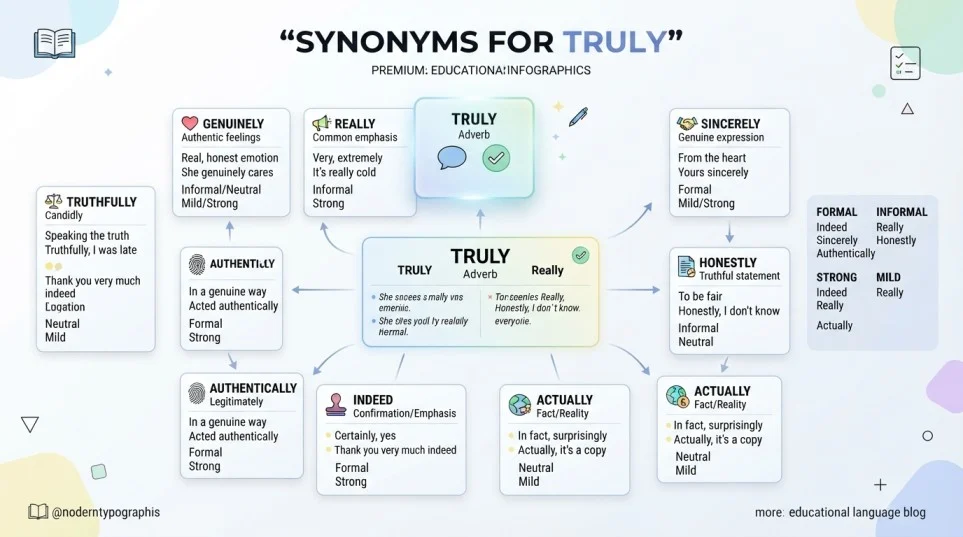
The good news is that truly has several alternatives, including genuinely, sincerely, really, honestly, authentically, and indeed. The right choice depends on what you want to emphasize.
This guide explains the meaning of truly, shows how its closest alternatives differ, and gives practical examples for school, work, social media, storytelling, and everyday conversation.
The goal is not simply to replace one word with another. Strong vocabulary comes from choosing a word that matches your exact meaning, tone, and audience.
What Does Truly Mean?
Truly means in a genuine, truthful, or real way. Depending on context, the best alternatives include genuinely for sincerity, really for casual speech, sincerely for emotion, authentically for identity, and indeed for formal emphasis.
Meaning, Tone and Context
Simple Definition
Truly means in a way that is genuine, sincere, truthful, or completely real. It can emphasize that something is actually the case rather than merely appearing to be true.
For example:
“She truly cares about her students.”
Here, truly emphasizes the speaker’s belief that the care is genuine.
Part of Speech
Truly is an adverb. It commonly modifies verbs, adjectives, and complete ideas.
Examples:
“She truly understands the problem.”
“That was truly remarkable.”
“I truly believe this approach will help.”
Tone
Truly is usually neutral to positive. It can communicate sincerity, strong belief, authenticity, or emphasis.
Its emotional effect depends on the sentence. In “I am truly grateful,” it adds warmth and sincerity. In “This is truly unacceptable,” it adds strong emphasis.
Formality Level
Truly works in both formal and informal English.
It can appear in professional emails, academic writing, personal messages, speeches, essays, stories, and social media captions.
However, alternatives such as genuinely, sincerely, authentically, or indeed may communicate a more specific meaning.
Common Use Cases
Truly is commonly used when you want to:
- Emphasize sincerity
- Confirm that something is genuine
- Strengthen an opinion
- Express deep emotion
- Emphasize an important quality
- Show strong personal belief
- Contrast reality with appearance
Related Forms
The adjective related to truly is true.
The noun form is truth.
The verb form is usually expressed through related verbs such as trust, believe, verify, or confirm, depending on the intended meaning.
The opposite concept is falsehood, although the best contrasting word depends on the sentence.
When and How to Use Truly
Use truly when you want to emphasize that something is genuine, sincere, real, or strongly felt.
Professional Example
“I truly appreciate your feedback on the proposal.”
Here, truly adds sincerity without making the sentence overly emotional.
Personal Example
“I truly enjoyed spending time with my family.”
The word emphasizes that the enjoyment was genuine.
Academic Example
“Students can truly benefit from regular practice.”
Here, truly adds emphasis to the writer’s claim.
Emotional Example
“I am truly sorry for what happened.”
Truly strengthens the sincerity of the apology.
Creative Example
“She truly believed the old house held a secret.”
In storytelling, truly can emphasize a character’s strong belief.
Another Word for Truly
The best single replacement depends on what you mean.
For professional writing, genuinely is often a useful choice when you want to communicate sincerity.
For academic writing, genuinely, actually, and indeed can work when the sentence supports their specific meanings.
For casual conversation, really is usually the most natural alternative.
For emotional writing, sincerely and genuinely can add warmth.
For creative writing, genuinely, deeply, completely, and authentically may work depending on the intended feeling.
For resumes and workplace writing, genuinely can be useful, but precise wording is usually better than adding emphasis unnecessarily.
For social media captions, really, genuinely, and honestly often sound natural.
For a stronger meaning, completely or deeply may work when the sentence concerns degree rather than truth.
For a softer meaning, honestly or really may sound more conversational.
When Not to Use Truly
Truly can become vague when you use it only to make a statement sound stronger.
For example:
“I am truly interested in this opportunity.”
This is acceptable, but a more precise sentence may communicate more.
“I am particularly interested in the opportunity to lead client research.”
The second sentence gives the reader specific information instead of relying on emphasis.
Truly can also sound overly emotional when the situation is simple.
Instead of:
“I truly need a copy of the report.”
You could simply write:
“I need a copy of the report.”
Avoiding unnecessary emphasis often makes professional writing clearer.
Words Commonly Confused With Truly
Truly vs. Really
Truly often emphasizes sincerity or genuine truth. Really is broader and more common in everyday speech.
“I truly appreciate your help.”
“I really appreciate your help.”
Both work, but truly can sound more deliberate.
Truly vs. Honestly
Honestly often signals that someone is speaking frankly or giving a personal opinion.
“I honestly do not know.”
Truly focuses more on genuineness or truth.
“I truly believe this is the right approach.”
Truly vs. Actually
Actually often corrects an assumption or emphasizes a fact.
“She actually finished the project early.”
Truly usually emphasizes sincerity or genuineness.
“She truly enjoyed the project.”
Truly vs. Sincerely
Sincerely strongly emphasizes genuine feeling or intention.
“I sincerely apologize.”
Truly is broader and can express truth, intensity, or sincerity.
Truly vs. Genuinely
Genuinely is one of the closest alternatives when truly means sincerely or authentically.
“She genuinely cares about her work.”
It is especially useful when you want to emphasize that something is not fake or artificial.
Truly vs. Indeed
Indeed is often used for formal emphasis or confirmation.
“The results are indeed encouraging.”
Truly generally sounds more personal or expressive.
Best Synonym by Context for Truly
Which Synonym Should You Choose?
Start by identifying what truly is doing in your sentence.
If you mean that something is genuine, choose genuinely or authentically.
If you mean that you are speaking frankly, honestly may be better.
If you want to emphasize a fact, actually or indeed may fit.
If you want to express sincere emotion, sincerely is often stronger.
If you want everyday conversational language, really is usually the easiest choice.
If you want emotional intensity, deeply or profoundly may be appropriate.
The best synonym is not necessarily the most sophisticated word. It is the word that communicates the intended meaning most precisely.
Real Life Examples of Truly in Sentences
School
“Students can truly improve their writing by reading regularly.”
Workplace
“I truly appreciate the effort you put into the presentation.”
Writing
“The novel truly captures the uncertainty of starting over.”
Conversation
“Do you truly think that plan will work?”
Social Media
“Truly grateful for everyone who supported this project.”
Resume
“I am genuinely interested in opportunities that involve research and communication.”
“We truly value your continued support.”
Storytelling
“He truly believed that the journey would change his life.”
18 Synonyms for Truly
Synonym Groups and Usage Differences
Professional vs. Personal Synonyms
Professional writing often benefits from precise alternatives rather than emotional emphasis.
In a business email, sincerely, genuinely, indeed, and actually can work when their specific meanings fit.
Personal communication allows more expressive choices such as really, honestly, deeply, and genuinely.
Compare:
“I truly appreciate your assistance.”
“I sincerely appreciate your assistance.”
The second version gives the sentence a slightly clearer sense of formal gratitude.
Formal vs. Conversational Synonyms
For reports, essays, and formal correspondence, indeed, sincerely, genuinely, and unquestionably can be useful.
For casual conversations and texts, really and honestly are usually more natural.
Formal:
“The findings are indeed significant.”
Conversational:
“The findings are really important.”
Neither is automatically better. The audience and purpose determine the appropriate choice.
Academic Synonyms
Academic writing requires precision.
Genuinely can describe something authentic.
Actually can clarify a fact.
Indeed can provide formal emphasis.
Factually can refer specifically to factual accuracy.
Unquestionably is appropriate only when the evidence supports a very strong claim.
Avoid replacing truly with an impressive sounding word simply to make academic writing seem sophisticated.
Professional and Business Synonyms
In workplace communication, clarity usually matters more than intensity.
For gratitude, sincerely is useful.
For authenticity, genuinely or authentically may fit.
For factual clarification, actually can work.
For formal emphasis, indeed can be effective.
For example:
“We sincerely appreciate your patience.”
This is usually more natural in a professional email than:
“We truly appreciate your patience.”
Both are correct, but sincerely communicates the intended professional tone more specifically.
Creative or Literary Synonyms
Creative writing gives you more freedom to emphasize emotion and depth.
Deeply and profoundly can create stronger emotional effects.
Earnestly can suggest seriousness.
Authentically can emphasize a character or voice that feels genuine.
For example:
“She was deeply moved by the music.”
This creates a more vivid emotional impression than the simpler:
“She was truly moved by the music.”
Slang or Modern Synonyms
Truly does not have a direct slang equivalent.
Really and honestly are common informal alternatives.
In very casual online communication, people may also use expressions such as “for real” to express genuine belief or sincerity.
For example:
“That was truly amazing.”
“That was really amazing.”
“That was amazing, for real.”
The last version is highly conversational and should generally be avoided in academic or formal professional writing.
Strongest vs. Weaker Synonyms
A useful intensity scale depends on the meaning of the original sentence.
Mild: really
Moderate: truly
Strong: genuinely
Very strong: completely
Very strong with certainty: unquestionably
Very strong with emotional depth: profoundly
These words are not interchangeable in every sentence. Intensity should match the evidence or emotion you are expressing.
Emotional vs. Neutral Synonyms
Emotional alternatives include sincerely, deeply, profoundly, and earnestly.
Neutral alternatives include actually, factually, really, and indeed.
Compare:
“I sincerely regret the mistake.”
This is emotional and personal.
“The report is factually accurate.”
This is neutral and evidence focused.
Antonyms of Truly
Truly does not have 15 strict one word dictionary antonyms in every context. The following are useful contrasting adverbs and expressions that oppose different meanings of truly, especially truth, sincerity, authenticity, and reality.
Comparison: Truly vs. Similar Words
Truly vs. Genuinely
The main difference is that genuinely strongly emphasizes authenticity or sincerity, while truly has a broader range.
Genuinely is often more precise when discussing whether feelings or qualities are real.
“Genuinely” is stronger for authenticity.
“Truly” is more flexible and slightly broader.
Example:
“I genuinely appreciate your help.”
“I truly appreciate your help.”
Truly vs. Really
Really is more common in casual American English.
Truly can sound more deliberate, sincere, or emphatic.
Neither is inherently stronger in every situation.
Example:
“I really like this book.”
“I truly value this book.”
Truly vs. Honestly
Honestly focuses on frankness or truthfulness in what someone says.
Truly focuses more broadly on genuineness, reality, or sincerity.
Honestly is often more conversational.
Example:
“I honestly do not know.”
“I truly believe you can succeed.”
Truly vs. Actually
Actually commonly introduces a fact, correction, or clarification.
Truly commonly adds emphasis to truth, sincerity, or genuineness.
Actually is more factual.
Truly is often more expressive.
Example:
“She actually arrived early.”
“She truly enjoyed the event.”
Truly vs. Sincerely
Sincerely is closely connected to genuine feeling and intention.
It is especially useful for apologies, thanks, wishes, and formal correspondence.
Truly is more versatile.
Example:
“I sincerely apologize for the delay.”
“I truly regret the decision.”
Truly vs. Indeed
Indeed is commonly used for formal emphasis or confirmation.
Truly can sound more personal and emotional.
Indeed is generally more formal.
Example:
“The result is indeed significant.”
“The result is truly impressive.”
Common Phrases and Expressions with Truly
1. Truly appreciate
Meaning:
To express sincere gratitude.
Example sentence:
“I truly appreciate your help with the project.”
2. Truly believe
Meaning:
To emphasize that a belief is genuine and strongly held.
Example sentence:
“I truly believe that consistent practice makes a difference.”
3. Truly grateful
Meaning:
Deeply or sincerely thankful.
Example sentence:
“We are truly grateful for your support.”
4. Truly remarkable
Meaning:
Extremely impressive in a genuine sense.
Example sentence:
“Her progress over the past year has been truly remarkable.”
5. Truly understand
Meaning:
To emphasize genuine understanding rather than superficial knowledge.
Example sentence:
“You will truly understand the concept after applying it several times.”
6. Truly sorry
Meaning:
To emphasize sincere regret.
Example sentence:
“I am truly sorry for the confusion.”
7. Truly unique
Meaning:
Genuinely different from others.
Example sentence:
“The artist has created a truly unique style.”
8. Truly matters
Meaning:
To emphasize genuine importance.
Example sentence:
“What truly matters is how you treat people.”
Common Mistakes to Avoid
1. Using Truly When a More Precise Word Is Better
Truly can be too broad.
Instead of saying:
“I truly understand the problem.”
Consider:
“I completely understand the problem.”
Use completely when you mean full understanding.
2. Confusing Truly With Actually
Actually usually relates to facts or corrections.
Truly usually relates to genuineness, sincerity, or emphasis.
Choose based on the intended meaning.
3. Using a Casual Alternative in Formal Writing
Really is perfectly normal in everyday speech, but formal writing may benefit from a more precise alternative.
Instead of automatically replacing truly with really, consider whether genuinely, sincerely, or indeed better communicates the intended meaning.
4. Using an Overly Dramatic Alternative
Profoundly and deeply carry stronger emotional weight.
Do not use them for ordinary situations where really or genuinely would sound more natural.
5. Repeating Truly Too Often
Repeated use can make writing sound formulaic.
If every paragraph contains truly, consider removing some instances entirely or replacing them with more precise wording.
6. Choosing the Wrong Emotional Tone
Sincerely can sound formal and heartfelt.
Honestly can sound conversational.
Profoundly can sound serious.
Really is casual.
Choose according to the audience and emotional purpose.
FAQs
What is the best synonym for truly?
Genuinely is one of the closest choices when truly means sincerely or authentically. Really works well in casual conversation.
What is a formal synonym for truly?
Indeed, sincerely, genuinely, and unquestionably can work in formal writing, depending on whether you mean emphasis, sincerity, authenticity, or certainty.
What is an informal synonym for truly?
Really is the most natural informal alternative in many everyday sentences. Honestly can also work when the sentence emphasizes frankness.
What is another word for truly in professional writing?
Genuinely, sincerely, indeed, and actually can work in professional writing when their specific meanings fit the sentence and intended tone.
What is the difference between truly and really?
Truly often emphasizes sincerity, authenticity, or genuine truth. Really is broader and more common in everyday conversation.
What is the opposite of truly?
Common contrasts include falsely, untruthfully, dishonestly, insincerely, deceptively, and inaccurately. The best choice depends on the intended meaning.
Conclusion
Truly is a flexible adverb that can express genuine truth, sincerity, authenticity, or strong emphasis. Because its meaning changes slightly with context, choosing a synonym requires more than simply finding another word.
Use genuinely when authenticity matters, sincerely for heartfelt communication, really for casual conversation, actually for factual clarification, and indeed for formal emphasis.
When writing an email, essay, resume, caption, or professional message, ask yourself what you want truly to communicate. If the word expresses sincerity, choose a sincerity focused synonym. If it expresses factual reality, choose a factual alternative.
The most useful vocabulary tip is simple: do not choose the most complicated synonym. Choose the word that communicates your exact meaning naturally and clearly.
Discover More Post:
- 25+ Synonyms for Frustrated | Meanings, Examples, and Best …
- 25+ Synonyms for Kids | Meanings, Examples, and Best …
- 25+ Synonyms for Framework | Meanings, Examples, and Best …