Using the word frustrated again and again can make emails, essays, captions, conversations, and workplace writing sound repetitive. The right alternative can make your message more precise, natural, and expressive.
The best synonym depends on what you actually mean. You might feel annoyed by a delay, discouraged by failure, irritated by someone’s behavior, or exasperated after repeated problems. Understanding these differences helps you choose stronger vocabulary without changing your intended meaning.
What Does “Frustrated” Mean?
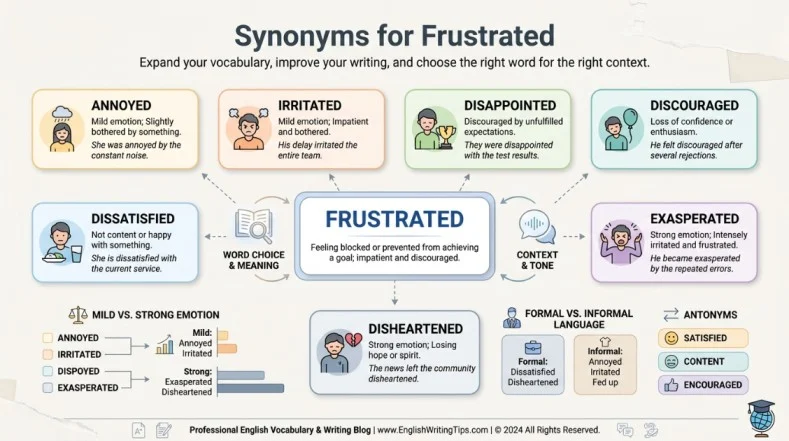
Frustrated describes feeling upset, annoyed, discouraged, or impatient because something is difficult, delayed, unsuccessful, or preventing you from reaching a goal. Depending on context, annoyed, irritated, discouraged, exasperated, disappointed, and dissatisfied can be useful alternatives.
Meaning, Tone and Context
Simple Definition
Frustrated means feeling upset or dissatisfied because you cannot achieve something you want, solve a problem, or make progress as expected.
For example:
I felt frustrated when the software stopped working during my presentation.
The feeling usually comes from an obstacle, repeated difficulty, unmet expectation, or lack of progress.
Part of Speech
Frustrated is primarily an adjective.
Example:
She felt frustrated by the constant delays.
It is also the past participle of the verb frustrate.
Related forms include:
Frustrate: to prevent someone from achieving something or to cause frustration.
Frustration: the feeling caused by difficulty, failure, delay, or obstruction.
Frustrating: causing frustration.
Tone
The word usually has a negative emotional tone because it describes dissatisfaction, irritation, discouragement, or impatience.
However, its emotional intensity can vary. Someone can be mildly frustrated by a slow website or deeply frustrated after months of unsuccessful effort.
Formality Level
Frustrated is a neutral and widely accepted word. It works well in casual conversations, emails, academic writing, workplace communication, personal writing, and social media.
Common Use Cases
You can use frustrated when discussing:
- Difficult tasks
- Delays
- Failed attempts
- Workplace problems
- Communication issues
- Personal disappointment
- Academic challenges
- Technical problems
- Relationship conflicts
- Unmet expectations
When and How to Use “Frustrated”
The word works best when an obstacle or unsuccessful result causes a negative emotional response.
Professional
I was frustrated by the repeated scheduling changes.
This sounds honest without being excessively emotional.
Personal
I felt frustrated when my plans changed at the last minute.
Academic
Students may become frustrated when a difficult concept remains unclear.
Emotional
After several unsuccessful attempts, she felt increasingly frustrated.
Creative
He stared at the unfinished painting, frustrated by every imperfect detail.
Social Media
Frustrated, tired, and ready for a fresh start.
Casual
I’m getting frustrated with this app.
These examples show why frustrated is useful as a general term. More precise synonyms can communicate exactly what kind of frustration you feel.
Another Word for “Frustrated”
There is no single perfect replacement for frustrated in every sentence.
- For professional writing, dissatisfied, concerned, disappointed, or irritated may be more precise.
- For academic writing, discouraged, hindered, or dissatisfied can work depending on the meaning.
- For casual conversation, annoyed, irritated, or fed up sounds natural.
- For emotional writing, discouraged, exasperated, or distressed can add more depth.
- For creative writing, exasperated, disheartened, agitated, or discontented may create a stronger mood.
- For resumes and workplace use, challenged can sometimes replace a negative expression when you want to focus on professional growth rather than emotion.
- For social media captions, annoyed, fed up, irritated, or disappointed can sound more conversational.
- For a stronger meaning, choose exasperated or infuriated when the context supports that intensity.
- For a softer meaning, choose concerned, disappointed, or discouraged.
When Not to Use “Frustrated”
Frustrated can become too general when you need to identify the exact emotion.
For example:
I was frustrated with the customer service.
This tells the reader you had a negative reaction, but it does not explain whether you were angry, disappointed, impatient, or dissatisfied.
A more precise version could be:
I was disappointed with the customer service.
Or:
I was irritated by the repeated delays.
Precision makes your writing more informative.
Avoid using frustrated when you actually mean physical obstruction, anger, sadness, or disappointment without an element of blocked progress.
Words Commonly Confused With “Frustrated”
| Word | Main Difference |
|---|---|
| Annoyed | Usually describes irritation caused by something bothersome |
| Angry | A stronger emotional reaction involving anger |
| Disappointed | Focuses on an outcome falling below expectations |
| Discouraged | Focuses on losing confidence or motivation |
| Irritated | Usually means mildly angry or bothered |
| Exasperated | Describes intense irritation after repeated problems |
The distinction matters because these words are related but not interchangeable in every situation.
Best Synonym by Context for “Frustrated”
| Context | Best Synonym | Why It Works | Example |
|---|---|---|---|
| Formal writing | Dissatisfied | Sounds measured and professional | The client was dissatisfied with the service. |
| Academic writing | Discouraged | Highlights reduced motivation | The student felt discouraged after repeated mistakes. |
| Professional use | Concerned | Keeps the tone diplomatic | I am concerned about the continued delays. |
| Resume | Challenged | Frames difficulty constructively | I was challenged by a rapidly changing workflow. |
| Casual conversation | Annoyed | Sounds natural and familiar | I’m annoyed by the constant notifications. |
| Creative writing | Exasperated | Adds emotional intensity | She became exasperated after hours of waiting. |
| Emotional tone | Disheartened | Emphasizes loss of hope | He felt disheartened after the rejection. |
| Strong intensity | Infuriated | Communicates intense anger | She was infuriated by the unfair decision. |
| Soft tone | Disappointed | Less aggressive than anger focused words | I was disappointed by the result. |
| Social media | Fed up | Conversational and expressive | I’m completely fed up with these delays. |
| US usage | Frustrated | Common and natural across situations | I’m frustrated with the situation. |
| UK usage | Frustrated | Also standard and widely understood | He was frustrated by the delay. |
Which Synonym Should You Choose?
Start by identifying the reason behind the emotion.
- If something simply bothers you, annoyed or irritated may be best.
- If expectations were not met, choose disappointed or dissatisfied.
- If repeated problems have tested your patience, exasperated is more accurate.
- If you are losing confidence or motivation, use discouraged or disheartened.
- If the situation has caused strong anger, infuriated may be appropriate.
For professional communication, prioritize clarity and diplomacy. Words such as concerned, dissatisfied, disappointed, and irritated can communicate a problem without sounding unnecessarily aggressive.
Real Life Examples of “Frustrated” in Sentences
School
Maya felt frustrated after struggling with the same math problem for an hour.
Workplace
The team became frustrated by repeated changes to the project requirements.
Writing
The frustrated writer deleted the paragraph and started again.
Conversation
I’m frustrated because nobody explained the new process.
Social Media
Sometimes the hardest part is staying patient when everything feels frustrating.
Resume
Instead of saying:
I was frustrated by difficult projects.
A stronger professional approach is:
I successfully managed challenging projects under changing requirements.
I am frustrated by the repeated billing errors.
For a more diplomatic workplace tone:
I am concerned about the repeated billing errors and would appreciate a resolution.
Storytelling
He felt frustrated as the locked door refused to open despite every attempt.
25 Synonyms for “Frustrated”
| Synonym | Simple Meaning | Best Used For | Example Sentence |
|---|---|---|---|
| Annoyed | Slightly angry or bothered | Everyday conversation | I was annoyed by the constant interruptions. |
| Irritated | Bothered or mildly angry | Personal and professional situations | She became irritated after waiting for an hour. |
| Aggravated | Made increasingly annoyed | Repeated problems | The delayed shipment left him aggravated. |
| Exasperated | Extremely irritated after repeated difficulty | Strong emotional situations | She was exasperated by the endless technical issues. |
| Disappointed | Upset because expectations were not met | Results and outcomes | He was disappointed by the final score. |
| Discouraged | Less confident or motivated | School and personal growth | The failed attempt left her discouraged. |
| Disheartened | Deeply discouraged or saddened | Emotional and literary writing | He felt disheartened after another rejection. |
| Dissatisfied | Unhappy with a situation or result | Business and formal writing | The customer was dissatisfied with the service. |
| Discontented | Not satisfied with existing conditions | Formal and literary writing | Employees were discontented with the new policy. |
| Displeased | Unhappy or dissatisfied | Formal communication | The manager was displeased with the outcome. |
| Fed up | Tired and annoyed by repeated problems | Casual conversation | I’m fed up with these constant delays. |
| Impatient | Unwilling to wait calmly | Delays and waiting | She became impatient during the long meeting. |
| Agitated | Emotionally unsettled or upset | Emotional descriptions | He appeared agitated during the discussion. |
| Bothered | Troubled or annoyed | Mild everyday reactions | She was bothered by the sudden noise. |
| Troubled | Worried or emotionally disturbed | Serious personal situations | He was troubled by the unexpected news. |
| Distressed | Deeply upset or worried | Serious emotional situations | The family was distressed by the sudden change. |
| Vexed | Annoyed or puzzled | Formal and literary writing | She was vexed by the complicated instructions. |
| Disconcerted | Unsettled or confused | Formal writing | He was disconcerted by the unexpected response. |
| Irked | Annoyed | Informal writing and conversation | The comment really irked her. |
| Perturbed | Worried or disturbed | Formal writing | The sudden change left the manager perturbed. |
| Angry | Strongly displeased | Strong emotional situations | He was angry about the unfair treatment. |
| Infuriated | Extremely angry | Very strong emotional situations | The decision infuriated local residents. |
| Resentful | Bitter about unfair treatment | Long lasting emotional reactions | She felt resentful after being overlooked repeatedly. |
| Strained | Under emotional or practical pressure | Relationships and situations | Their strained relationship made communication difficult. |
| Hindered | Prevented from making progress | Academic and professional contexts | The team was hindered by outdated equipment. |
Synonym Groups and Usage Differences
Professional vs. Personal Synonyms
Professional communication usually benefits from measured vocabulary.
Words such as concerned, dissatisfied, disappointed, and irritated can communicate a problem without making the message sound overly emotional.
Personal communication allows more emotional vocabulary. Annoyed, fed up, exasperated, disheartened, and infuriated may be more appropriate when expressing genuine feelings.
Formal vs. Conversational Synonyms
Formal writing favors words such as dissatisfied, displeased, perturbed, discontented, and disconcerted.
Conversational English more commonly uses annoyed, irritated, bothered, fed up, and irked.
In a formal report, dissatisfied usually sounds more appropriate than fed up.
Academic Synonyms
Academic writing should favor precision over emotional exaggeration.
Discouraged, hindered, dissatisfied, disappointed, and challenged can work well depending on the sentence.
For example:
Students may become discouraged when repeated attempts do not produce improvement.
This is more precise than simply saying:
Students may become frustrated.
Professional and Business Synonyms
Workplace communication should usually avoid unnecessarily intense emotional language.
Concerned is useful when raising an issue diplomatically.
Dissatisfied works well when discussing service quality.
Disappointed fits unmet expectations.
Irritated can describe a genuine emotional response, but it may sound more personal.
Challenged can be useful in resumes when presenting difficulty as an opportunity for growth.
Creative or Literary Synonyms
Creative writing often benefits from emotional precision.
Exasperated suggests repeated irritation.
Disheartened suggests emotional loss of hope.
Vexed creates a more traditional literary tone.
Agitated emphasizes visible emotional unrest.
Perturbed suggests disturbance or uneasiness.
Slang or Modern Synonyms
Fed up is the clearest casual expression in this group.
It works naturally in conversations, texts, and informal social posts.
However, it is usually inappropriate for academic essays, formal reports, resumes, and serious business correspondence.
Strongest vs. Weaker Synonyms
A useful intensity scale is:
Bothered → Annoyed → Irritated → Aggravated → Exasperated → Infuriated
This is not an absolute scale because context affects emotional intensity.
Bothered usually feels mild.
Annoyed suggests noticeable irritation.
Irritated can be somewhat stronger.
Aggravated often suggests growing irritation.
Exasperated suggests that repeated problems have exhausted your patience.
Infuriated indicates very strong anger.
Emotional vs. Neutral Synonyms
Emotionally expressive words include infuriated, exasperated, disheartened, resentful, and distressed.
More neutral choices include dissatisfied, disappointed, concerned, and hindered.
Choose neutral vocabulary when the goal is to explain a situation objectively.
Antonyms of “Frustrated”
| Antonym | Meaning | Example Sentence |
|---|---|---|
| Satisfied | Pleased with a result | The customer was satisfied with the service. |
| Content | Calmly pleased with a situation | She felt content with her progress. |
| Pleased | Happy about something | He was pleased with the final result. |
| Happy | Feeling positive or joyful | They were happy with the decision. |
| Delighted | Very pleased | She was delighted by the unexpected news. |
| Encouraged | Given confidence or motivation | His progress left him encouraged. |
| Hopeful | Expecting a positive outcome | She remained hopeful about the future. |
| Optimistic | Expecting good results | The team felt optimistic about the project. |
| Calm | Free from agitation or distress | He stayed calm during the difficult discussion. |
| Patient | Able to wait without becoming upset | She remained patient despite the delay. |
| Relaxed | Free from tension | He felt relaxed after finishing the assignment. |
| Confident | Certain about ability or success | She felt confident before the presentation. |
| Motivated | Ready and willing to act | The students were motivated to improve. |
| Fulfilled | Feeling that a goal or need has been achieved | He felt fulfilled after completing the project. |
| Reassured | Made less worried or uncertain | The explanation left everyone reassured. |
Comparison: “Frustrated” vs. Similar Words
“Frustrated” vs. “Annoyed”
Main difference: Frustrated often involves blocked progress or an unmet goal, while annoyed usually involves something that bothers you.
Which one is stronger: Neither is always stronger, but frustration often involves a deeper obstacle.
Which one is more formal: Both are neutral, but frustrated is more useful in professional contexts.
Examples:
I was frustrated because the system would not save my work.
I was annoyed by the constant notifications.
“Frustrated” vs. “Angry”
Main difference: Frustration can involve irritation or discouragement without intense anger.
Which one is stronger: Angry is generally stronger.
Which one is more formal: Both are acceptable, but frustrated can sound more measured.
Examples:
She was frustrated by the repeated delays.
She was angry about the unfair decision.
“Frustrated” vs. “Disappointed”
Main difference: Frustration usually involves an obstacle or blocked goal, while disappointment focuses on an outcome that failed to meet expectations.
Which one is stronger: Neither universally.
Which one is more formal: Both work well in formal communication.
Examples:
I was frustrated because I could not complete the task.
I was disappointed by the final result.
“Frustrated” vs. “Discouraged”
Main difference: Frustration emphasizes difficulty or obstruction, while discouragement emphasizes reduced confidence or motivation.
Which one is stronger: They describe different emotional effects.
Which one is more formal: Both are appropriate in academic and professional writing.
Examples:
He felt frustrated by the complicated instructions.
He felt discouraged after several unsuccessful attempts.
“Frustrated” vs. “Irritated”
Main difference: Irritated means bothered or mildly angry, while frustrated often connects the emotion to an obstacle.
Which one is stronger: Frustration can be stronger when problems continue.
Which one is more formal: Both are neutral.
Examples:
I was frustrated because the project kept losing momentum.
I was irritated by the repeated interruptions.
“Frustrated” vs. “Exasperated”
Main difference: Exasperated usually suggests a higher level of irritation caused by repeated difficulties.
Which one is stronger: Exasperated is stronger.
Which one is more formal: Both can appear in formal writing, although exasperated is more expressive.
Examples:
She was frustrated by the delay.
She was exasperated after the delay happened for the fifth time.
Common Phrases and Expressions with “Frustrated”
1. Frustrated with something
Meaning: Feeling annoyed or dissatisfied because of a situation.
Example sentence:
I am frustrated with the slow response time.
2. Frustrated by something
Meaning: Feeling upset because something creates an obstacle.
Example sentence:
The team was frustrated by repeated technical problems.
3. Feel frustrated
Meaning: Experience frustration because of difficulty or failure.
Example sentence:
Many beginners feel frustrated when progress seems slow.
4. Become frustrated
Meaning: Gradually start experiencing frustration.
Example sentence:
She began to become frustrated after several unsuccessful attempts.
5. Increasingly frustrated
Meaning: Becoming more frustrated over time.
Example sentence:
Customers became increasingly frustrated as the issue remained unresolved.
6. Deeply frustrated
Meaning: Experiencing a strong level of frustration.
Example sentence:
The community was deeply frustrated by the lack of communication.
7. Frustrated attempt
Meaning: An attempt that was prevented from succeeding.
Example sentence:
His frustrated attempt to repair the device left him searching for professional help.
Common Mistakes to Avoid
1. Using “Frustrated” When a More Precise Word Is Better
If you mean that expectations were not met, disappointed may be more accurate.
2. Confusing Frustration With Anger
Not every frustrated person is angry. Frustration can involve impatience, discouragement, or disappointment.
3. Using a Casual Synonym in Formal Writing
Expressions such as fed up can sound too informal in academic essays and professional reports.
4. Using an Overly Dramatic Synonym
Do not use infuriated for a minor inconvenience unless the emotional intensity is genuinely that strong.
5. Repeating “Frustrated” Too Often
If the same word appears repeatedly, consider whether annoyed, disappointed, discouraged, dissatisfied, or another precise alternative better communicates the intended meaning.
6. Choosing the Wrong Emotional Tone
Disheartened suggests loss of hope, while irritated suggests annoyance. They should not be treated as identical.
7. Using Slang in Academic or Professional Writing
Fed up is natural in conversation but usually too casual for formal communication.
FAQs
What is the best synonym for “frustrated”?
The best synonym depends on context. Annoyed works for mild irritation, disappointed for unmet expectations, discouraged for lost motivation, and exasperated for intense irritation.
What is a formal synonym for “frustrated”?
Dissatisfied is a strong formal alternative when someone is unhappy with a service, result, process, or situation.
What is an informal synonym for “frustrated”?
Fed up is a common informal alternative. Annoyed, bothered, and irked also work naturally in casual conversations.
What is another word for “frustrated” in professional writing?
Useful professional alternatives include concerned, dissatisfied, disappointed, irritated, and challenged, depending on the intended meaning.
What is the difference between “frustrated” and “annoyed”?
Frustrated often results from blocked progress or difficulty, while annoyed usually means something has bothered or irritated you.
What is the opposite of “frustrated”?
Common opposites include satisfied, content, encouraged, confident, hopeful, pleased, and fulfilled, depending on the context.
Conclusion
Frustrated describes the emotional response that can arise when progress is blocked, expectations are missed, or repeated problems become difficult to handle. It is a versatile word that works across casual, academic, personal, and professional communication.
The best synonym depends on the exact feeling. Choose annoyed for mild irritation, disappointed for unmet expectations, discouraged for reduced motivation, dissatisfied for formal complaints, and exasperated for repeated and intense irritation.
The most useful vocabulary habit is simple: do not replace a word merely to sound sophisticated. Replace it when the alternative expresses your meaning more precisely.
Discover More Post:
- 25+ Synonyms for Determine | Meanings, Examples, and Best …
- 25+ Synonyms for Share | Meanings, Examples and Best …
- 25+ Synonyms for Affect | Meanings, Examples, and Best …