Using the word “saw” repeatedly can make a sentence sound flat, especially when writing an essay, email, caption, resume, story, or professional message. The right alternative can make your meaning more precise and your writing more natural.
The best synonyms for saw depend on what you actually mean. You may have noticed something, observed it carefully, watched an event, witnessed an incident, spotted something quickly, or understood an idea. Choosing the right word improves clarity without making your writing sound forced.
What Does “Saw” Mean?
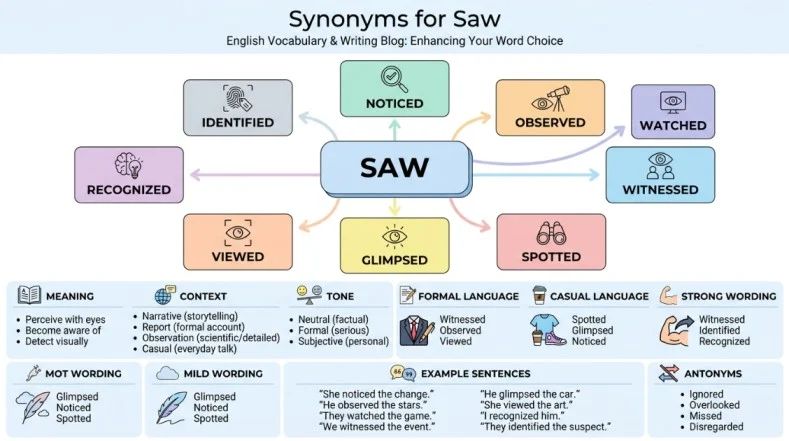
“Saw” is the past tense of “see” and usually means that someone perceived, noticed, watched, or witnessed something. Depending on context, useful alternatives include noticed, observed, viewed, witnessed, spotted, glimpsed, recognized, and realized.
Meaning, Tone and Context
Simple Definition
“Saw” is the past tense of the verb “see.” It describes experiencing something through sight or becoming aware of something through observation.
For example, “I saw a bird outside” means that I perceived the bird with my eyes.
The word can also describe understanding or recognizing something. In “She saw the problem immediately,” the meaning is closer to “understood” or “recognized.”
Part of Speech
“Saw” is primarily a verb. It is the simple past form of “see.”
Example:
“I saw the manager yesterday.”
In another meaning, “saw” is also a noun referring to a tool with a toothed blade used for cutting wood or other materials. This article focuses on “saw” as the past tense of “see.”
Tone
“Saw” usually has a neutral tone. It does not automatically express approval, criticism, excitement, or disappointment.
The tone changes according to the surrounding words.
- “I saw the presentation” is neutral.
- “I witnessed the accident” can sound more serious because “witnessed” often suggests a significant event.
- “I glimpsed the actor” suggests that the sight was brief.
Formality Level
“Saw” is common in everyday English and works in casual, academic, professional, and creative writing.
More formal alternatives include observed, witnessed, perceived, and detected.
More conversational choices include spotted and noticed.
Common Use Cases
“Saw” appears frequently in:
- Everyday conversations
- School assignments
- Professional emails
- Workplace communication
- Personal stories
- Social media captions
- News writing
- Creative writing
- Reviews
- Descriptions of events
Important Word Forms
The main forms are:
See, present tense
Saw, simple past
Seen, past participle
Seeing, present participle
Example:
- “I see the building every day.”
- “I saw the building yesterday.”
- “I have seen the building before.”
When and How to Use “Saw”
Use “saw” when you want to state that someone perceived something visually, noticed something, watched something, witnessed an event, or understood something.
The word is especially useful when the exact type of observation is not important.
Professional
“I saw your email this morning.”
This is natural in workplace communication, although “reviewed” or “noticed” may be more precise depending on the situation.
Personal
“I saw Sarah at the grocery store.”
This simply states that you noticed or encountered Sarah.
Academic
“We saw a significant change in the results.”
In academic writing, “observed” may sound more precise when describing research findings.
Emotional
“I saw the disappointment on his face.”
Here, “saw” works naturally because the writer is describing a visible emotional reaction.
Creative
“I saw the first light appear over the mountains.”
The simple verb works well because the sentence already creates a visual image.
Social Media
“Saw this beautiful sunset on my way home.”
This shortened style is common in casual captions, although complete sentences are preferable in formal writing.
“I saw your message and will review the document today.”
This sounds natural and direct in professional communication.
Another Word for “Saw”
There is no single best replacement for “saw” in every sentence. The strongest choice depends on the exact meaning.
- Professional writing: observed or reviewed
- Academic writing: observed or detected
- Casual conversation: noticed or spotted
- Emotional writing: witnessed or noticed
- Creative writing: glimpsed, beheld, or viewed
- Resume or workplace use: observed, identified, or detected
- Social media captions: spotted or caught
- Stronger meaning: witnessed or detected
- Softer meaning: noticed or glimpsed
If the person actively watched something, “watched” may be better than “saw.” If the person became aware of something unexpectedly, “noticed” is usually more accurate.
When Not to Use “Saw”
“Saw” can be too general when your sentence needs to communicate exactly how someone experienced something.
For example:
“I saw a problem in the report.”
This is understandable, but “identified a problem in the report” gives the reader more information.
“I saw an accident.”
“Witnessed an accident” can sound more appropriate when the writer was present during a serious event.
- “I saw a small detail.”
- “I noticed a small detail” better emphasizes awareness.
- “I saw the data.”
- “I reviewed the data” is usually stronger in professional or academic writing because it suggests active examination.
The goal is not to replace “saw” every time. The goal is to use a more precise word when precision matters.
Words Commonly Confused With “Saw”
Saw vs. See
“See” is the present tense, while “saw” is the simple past tense.
“I see the building every morning.”
“I saw the building yesterday.”
Saw vs. Look
“Look” usually describes directing your eyes toward something. “Saw” describes the resulting visual perception.
“I looked at the painting.”
“I saw a painting on the wall.”
Saw vs. Watch
“Watch” usually involves sustained attention over a period of time.
“I watched the movie.”
“I saw the movie.”
Both can be correct, but “watched” emphasizes the activity.
Saw vs. Notice
“Notice” emphasizes becoming aware of something.
“I saw a crack in the wall.”
“I noticed a crack in the wall.”
The second sentence suggests that the crack attracted the person’s attention.
Saw vs. Observe
“Observe” often suggests careful or deliberate attention.
“I saw the experiment.”
“I observed the experiment.”
The second version sounds more precise in an academic or scientific setting.
Saw vs. Witness
“Witness” usually means being present when an event happens, particularly an important, unusual, or serious event.
“I saw the accident.”
“I witnessed the accident.”
The second sentence carries more weight.
Best Synonym by Context for “Saw”
| Context | Best Synonym | Why It Works | Example |
|---|---|---|---|
| Formal writing | Observed | Sounds precise and professional | The researcher observed a change in behavior. |
| Academic writing | Observed | Fits careful examination | Students observed the reaction during the experiment. |
| Professional use | Reviewed | Shows active examination | I reviewed the document this morning. |
| Resume | Identified | Highlights recognition of an issue | Identified errors in customer records. |
| Casual conversation | Noticed | Natural and conversational | I noticed your new haircut. |
| Creative writing | Beheld | Creates a literary tone | She beheld the city from the hilltop. |
| Emotional writing | Witnessed | Adds seriousness and emotional weight | They witnessed a heartbreaking farewell. |
| Strong intensity | Detected | Suggests discovering something significant | The system detected an unusual pattern. |
| Soft tone | Glimpsed | Suggests a brief visual experience | I glimpsed the ocean through the trees. |
| Social media | Spotted | Sounds lively and casual | Spotted this amazing mural downtown. |
| Visual description | Viewed | Focuses on seeing something | Visitors viewed the artwork in silence. |
| Research | Detected | Suggests finding something through examination | The test detected a minor change. |
Which Synonym Should You Choose?
Start with the meaning you want to communicate.
If you simply mean visual perception, “viewed” can work. Something attracted your attention, choose “noticed.” If you watched something for a period of time, “watched” is usually better.
For careful examination, use “observed” or “reviewed.” For a serious event, “witnessed” is often stronger.
Consider emotional intensity as well. “Glimpsed” sounds brief and gentle, while “witnessed” can sound serious. “Spotted” is casual, while “perceived” is more formal and analytical.
The best synonym is the one that preserves your original meaning while adding useful precision.
Real Life Examples of “Saw” in Sentences
School
“I saw an interesting pattern in the experiment.”
A more precise academic alternative is:
“I observed an interesting pattern in the experiment.”
Workplace
“I saw an error in the report.”
A stronger professional version is:
“I identified an error in the report.”
Writing
“The author saw the issue from a different perspective.”
“Recognized” may be better when the meaning involves understanding.
Conversation
“I saw your friend at the mall.”
“Spotted” makes the sentence sound more casual.
Social Media
“Saw this amazing view during my morning walk.”
“Caught” can create a more energetic caption.
Resume
“I saw several problems in the process.”
A resume needs stronger wording:
“Identified several problems in the process.”
“I saw your message and appreciate the update.”
“Received” may be better if the emphasis is simply on getting the message.
Storytelling
“I saw a shadow moving across the doorway.”
“Glimpsed” can make the scene more atmospheric:
“I glimpsed a shadow moving across the doorway.”
25 Synonyms for “Saw”
| Synonym | Simple Meaning | Best Used For | Example Sentence |
|---|---|---|---|
| Noticed | Became aware of something | Everyday writing | I noticed a small crack near the window. |
| Observed | Watched or examined carefully | Academic and professional writing | The researcher observed a change in behavior. |
| Viewed | Looked at something | Formal descriptions and media | We viewed the final presentation together. |
| Witnessed | Was present when something happened | Serious or important events | She witnessed the accident from across the street. |
| Spotted | Saw something, often quickly | Casual conversation | I spotted your car outside the office. |
| Glimpsed | Saw briefly | Creative and descriptive writing | He glimpsed the ocean between the buildings. |
| Watched | Looked at something for a period of time | Movies, events, activities | We watched the game until the final minute. |
| Beheld | Saw something with attention or admiration | Literary writing | The travelers beheld a stunning mountain valley. |
| Perceived | Became aware through the senses or mind | Formal and academic writing | The participants perceived a difference in tone. |
| Detected | Discovered something that may be difficult to notice | Research, technology, professional use | The software detected an unusual pattern. |
| Recognized | Identified someone or something as familiar | Personal and professional contexts | I recognized her voice immediately. |
| Identified | Determined what something was | Workplace and academic writing | The analyst identified a major reporting error. |
| Examined | Looked at something carefully | Academic and professional contexts | The doctor examined the results carefully. |
| Inspected | Looked over something closely | Workplace and technical contexts | The technician inspected the equipment. |
| Surveyed | Looked over a place or situation broadly | Formal and descriptive writing | The team surveyed the area before beginning work. |
| Encountered | Came across someone or something | Formal and narrative writing | We encountered several obstacles during the project. |
| Discovered | Found or became aware of something | Research and storytelling | She discovered an important detail in the records. |
| Found | Came across or located something | Everyday communication | I found an interesting article online. |
| Caught | Managed to see or notice something | Casual and descriptive language | I caught a glimpse of the performer backstage. |
| Witnessed firsthand | Experienced an event directly | Serious or professional contexts | The reporter witnessed the situation firsthand. |
| Realized | Became aware of an idea or fact | Abstract meanings | He realized that the original plan would not work. |
| Understood | Grasped the meaning of something | Ideas and explanations | She understood the problem after reviewing the data. |
| Recognized | Became aware of a fact or quality | Formal and personal writing | The manager recognized the need for improvement. |
| Perceived | Became aware of something through observation | Formal analysis | Customers perceived the new design as more modern. |
| Took in | Looked at or absorbed visually | Conversational and descriptive writing | We stood quietly and took in the view. |
Some alternatives overlap because “saw” has several meanings. For example, “noticed” works for awareness, while “watched” works for sustained attention. “Realized” and “understood” work when “saw” expresses mental understanding rather than physical sight.
Synonym Groups and Usage Differences
Professional vs. Personal Synonyms
Personal communication usually allows simple words such as noticed, spotted, saw, and caught.
Professional communication benefits from more precise choices such as observed, identified, reviewed, examined, and detected.
For example:
Personal: “I saw an issue with the plan.”
Professional: “I identified an issue with the plan.”
The second sentence communicates stronger professional awareness.
Formal vs. Conversational Synonyms
Formal writing often favors observed, perceived, detected, examined, and identified.
Conversational English commonly uses saw, noticed, spotted, caught, and watched.
A sentence such as “I spotted the mistake” sounds natural in conversation. In a formal report, “I identified the error” may be more appropriate.
Academic Synonyms
Academic writing should favor precision over unnecessary sophistication.
“Observed,” “detected,” “identified,” “examined,” and “perceived” can work well when their meanings match the evidence.
Avoid replacing every instance of “saw” with an unusual word simply to sound intelligent. Clear language is usually more effective.
Professional and Business Synonyms
In workplace writing, “reviewed” is useful when someone examined a document or material.
“Identified” works well when someone found an issue.
“Observed” suits patterns or behavior.
“Detected” is useful when a test, system, or careful examination reveals something.
These words can make professional communication more specific without becoming unnecessarily complicated.
Creative or Literary Synonyms
Creative writing gives you more freedom.
“Glimpsed” can suggest a brief sight. “Beheld” can create an old fashioned or literary feeling. “Caught a glimpse of” can make a moment feel sudden.
Use literary alternatives when they support the atmosphere of the scene. Avoid them when they make ordinary situations sound unnatural.
Slang or Modern Synonyms
Casual expressions such as “spotted” and “caught” can sound lively in conversation and social media.
For example:
“Spotted the best coffee shop in town.”
“I caught a beautiful sunset on my way home.”
These expressions are generally too casual for academic research or formal business reports.
Strongest vs. Weaker Synonyms
A useful intensity scale is:
Mild: glimpsed
Neutral: saw
More attentive: noticed
Careful: observed
Highly focused: examined
Discovery focused: detected
Serious or significant event: witnessed
The strongest choice depends on context rather than on a universal ranking.
Emotional vs. Neutral Synonyms
“Saw” is usually neutral.
“Noticed” remains relatively neutral.
“Observed” sounds factual and controlled.
“Witnessed” often adds seriousness.
“Beheld” can add admiration or literary emotion.
“Glimpsed” can create a feeling of mystery, brevity, or delicacy.
Antonyms of “Saw”
There is no single perfect antonym for “saw” because its opposite changes according to meaning. If “saw” means noticed, the opposite may be “overlooked.” If it means witnessed, the opposite may be “missed.”
| Antonym | Meaning | Example Sentence |
|---|---|---|
| Missed | Failed to see or notice | I missed the small sign near the entrance. |
| Overlooked | Failed to notice something | We overlooked an important detail. |
| Ignored | Chose not to pay attention | He ignored the warning on the screen. |
| Disregarded | Deliberately treated something as unimportant | The team disregarded the early warning signs. |
| Neglected | Failed to give proper attention | She neglected several details in the report. |
| Avoided | Kept away from something | He avoided looking at the damaged area. |
| Lost sight of | Could no longer see something | We lost sight of the boat in the fog. |
| Remained unaware of | Did not become aware of something | They remained unaware of the change. |
| Failed to notice | Did not become aware of something | I failed to notice the small typo. |
| Failed to observe | Did not detect through observation | The inspector failed to observe the defect. |
| Did not perceive | Did not become aware through the senses or mind | The audience did not perceive the subtle difference. |
| Did not witness | Was not present for an event | She did not witness the incident herself. |
| Did not recognize | Failed to identify someone or something | I did not recognize him in the crowd. |
| Remained blind to | Failed to understand or recognize something | The company remained blind to the changing market. |
| Passed without noticing | Went by without attracting attention | The small detail passed without noticing. |
These are contextual opposites rather than perfect dictionary antonyms. The correct choice depends on what “saw” means in the original sentence.
Comparison: “Saw” vs. Similar Words
“Saw” vs. “Noticed”
The main difference is that “saw” focuses on visual perception, while “noticed” focuses on becoming aware of something.
“Noticed” is often more precise when something attracts attention.
“I saw a stain on the shirt.”
“I noticed a stain on the shirt.”
“Noticed” is stronger for awareness, not necessarily stronger in intensity.
“Saw” vs. “Observed”
“Observed” suggests more deliberate attention.
“Saw” is neutral and simple.
“I saw the behavior change.”
“I observed the behavior change.”
“Observed” is more formal and works especially well in academic and professional contexts.
“Saw” vs. “Watched”
“Watched” usually suggests sustained attention.
“I saw the game.”
“I watched the game.”
“Watched” is better when the person actively followed the event over time.
“Saw” vs. “Witnessed”
“Witnessed” usually refers to being present when an event occurred.
“I saw the accident.”
“I witnessed the accident.”
“Witnessed” sounds more serious and formal.
“Saw” vs. “Spotted”
“Spotted” often suggests seeing something quickly or unexpectedly.
“I saw my friend across the street.”
“I spotted my friend across the street.”
“Spotted” sounds more casual and energetic.
“Saw” vs. “Glimpsed”
“Glimpsed” means saw something briefly or partially.
“I saw the mountain through the trees.”
“I glimpsed the mountain through the trees.”
“Glimpsed” is more descriptive and useful when the sight was short.
Common Phrases and Expressions with “Saw”
1. Saw it coming
Meaning:
Expected or anticipated something before it happened.
Example sentence:
“I saw the company’s decision coming after the sales declined.”
2. Saw firsthand
Meaning:
Experienced or observed something directly.
Example sentence:
“We saw the impact of the new policy firsthand.”
3. Saw through something
Meaning:
Recognized the truth behind a misleading appearance or explanation.
Example sentence:
“She saw through his excuse immediately.”
4. Saw the light
Meaning:
Finally understood something or changed an opinion.
Example sentence:
“After reviewing the evidence, he finally saw the light.”
5. Saw the writing on the wall
Meaning:
Recognized signs that something negative was likely to happen.
Example sentence:
“The team saw the writing on the wall when funding was reduced.”
6. Saw red
Meaning:
Became extremely angry.
Example sentence:
“She saw red when she discovered that the contract had been changed.”
7. Saw eye to eye
Meaning:
Agreed with someone.
Example sentence:
“The two managers saw eye to eye on the main issue.”
8. Saw for yourself
Meaning:
Personally observed something instead of relying on someone else’s description.
Example sentence:
“You saw the results for yourself during the presentation.”
Common Mistakes to Avoid
1. Using “saw” when a precise synonym is better
“I saw an error in the report” is understandable.
“I identified an error in the report” sounds more professional because it shows that you found a specific problem.
2. Confusing “saw” with “seen”
“Saw” is simple past.
“I saw the movie yesterday.”
“Seen” requires a helping verb.
“I have seen the movie before.”
3. Confusing “saw” with “looked”
Looking is the action of directing your eyes toward something.
Seeing is the perception that results.
“I looked at the painting and saw a hidden figure.”
4. Using a casual synonym in formal writing
“Spotted a problem” is natural in conversation.
“Identified a problem” is generally more suitable for a formal report.
5. Using an overly dramatic synonym
“Witnessed” can sound too serious for an ordinary situation.
“I witnessed my friend buying coffee” sounds unnecessarily dramatic in most contexts.
“I saw my friend buying coffee” is more natural.
6. Repeating “saw” too often
Repeated use can make a story or description feel flat.
Instead of writing “I saw the building. I saw the people. I saw the lights,” vary the wording when the meanings are genuinely different.
7. Choosing a synonym with the wrong tone
“Beheld” sounds literary.
“Spotted” sounds casual.
“Observed” sounds formal.
“Witnessed” can sound serious.
Always match the synonym to the audience and situation.
FAQs
What is the best synonym for “saw”?
“Noticed” is often the best everyday alternative, while “observed,” “witnessed,” “spotted,” or “glimpsed” may be better for specific contexts.
What is a formal synonym for “saw”?
“Observed” is one of the best formal synonyms for “saw” when describing careful visual attention, especially in academic or professional writing.
What is an informal synonym for “saw”?
“Spotted” is a natural informal synonym when you mean that you noticed or recognized someone or something, often unexpectedly.
What is another word for “saw” in professional writing?
“Observed,” “identified,” “reviewed,” and “detected” can work well in professional writing, depending on whether you mean perception, examination, or discovery.
What is the difference between “saw” and “noticed”?
“Saw” describes visual perception, while “noticed” emphasizes becoming aware of something. “Noticed” often suggests that something attracted attention.
What is the opposite of “saw”?
Contextual opposites include “missed,” “overlooked,” “ignored,” “failed to notice,” and “did not perceive.” The correct choice depends on the intended meaning.
Conclusion
“Saw” is a simple and useful past tense of “see,” but it can express several meanings. It may describe visual perception, awareness, observation, witnessing, recognition, or understanding.
The best synonym depends on the situation. Use “noticed” for awareness, “observed” for careful attention, “watched” for sustained viewing, “witnessed” for significant events, “spotted” for casual situations, and “glimpsed” for a brief sight.
A practical vocabulary tip is to replace “saw” only when the alternative adds meaning. Strong writing is not about using the most complicated synonym. It is about choosing the clearest word for the exact idea you want to express.
Discover More Post:
- 25+ Synonyms for Determine | Meanings, Examples, and Best …
- 25+ Synonyms for Share | Meanings, Examples and Best …
- 25+ Synonyms for Affect | Meanings, Examples, and Best …