Sometimes, one familiar word appears everywhere. You might use drunk in a conversation, caption, story, essay, email, or everyday description and then realize that another word would express your meaning more precisely.
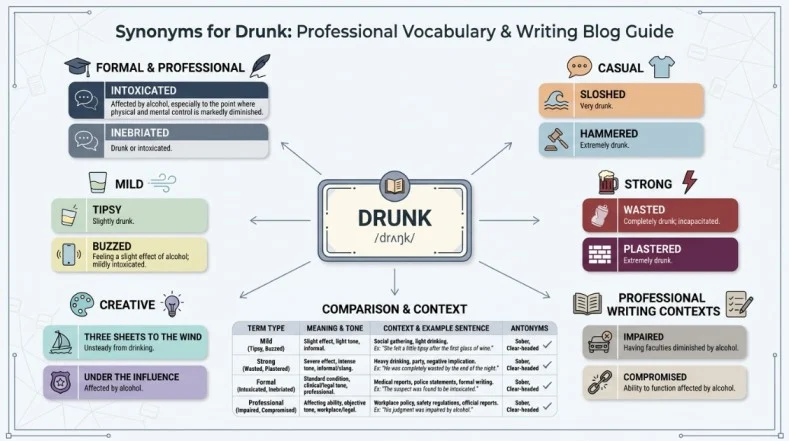
Fortunately, English offers many alternatives. For example, intoxicated suits formal communication, while tipsy describes mild effects. Similarly, buzzed works well in casual conversation, whereas wasted, hammered, and plastered create a much stronger informal impression.
The right synonym depends on meaning, intensity, audience, and tone. Therefore, learning these differences can help students, writers, professionals, and English learners communicate with greater accuracy.
What Does “Drunk” Mean?
Drunk describes a person affected by alcohol, especially when alcohol changes judgment, behavior, speech, coordination, or awareness. Formal choices include intoxicated and inebriated, while casual choices include tipsy, buzzed, wasted, and plastered.
Meaning, Tone and Context
Simple Definition
Drunk commonly describes someone whose physical or mental abilities have become affected by alcohol.
The effects can range from mild changes in mood and behavior to significant impairment of judgment, coordination, speech, and awareness.
Part of Speech
Drunk commonly functions as an adjective.
For example:
He was drunk after the party.
It also serves as the past participle of the verb drink.
For example:
She had drunk too much water.
Therefore, the surrounding sentence determines whether drunk describes a person’s condition or forms part of the verb drink.
Positive, Negative, or Neutral Tone
Drunk has a generally neutral basic meaning, although context can make it sound negative, humorous, critical, or descriptive.
For instance, a safety report may use drunk as a straightforward description. In contrast, a fictional story might use a colorful expression such as three sheets to the wind for humorous effect.
Formality Level
Drunk is extremely common in everyday American English.
However, formal settings often favor intoxicated because it sounds more objective and professional. Inebriated can also work, although it may sound more literary or old fashioned.
Common Use Cases
People commonly use drunk when discussing:
Alcohol consumption
Parties and celebrations
Personal experiences
Stories and fiction
Social situations
Public behavior
Safety concerns
Health discussions
Legal situations
Important Word Forms
Several related forms help you use the word correctly:
Drink: The base verb.
Drank: The simple past form.
Drunk: The past participle and a common adjective.
Drunken: An adjective that often appears before a noun, such as drunken behavior.
Drunkenness: A noun describing the state of being drunk.
Sober: A common opposite of drunk.
Intoxicated: A formal related adjective.
When and How to Use “Drunk”
Use drunk when you want a simple, direct, and widely understood description of alcohol related impairment.
Moreover, the word works naturally in everyday American conversations, informal writing, storytelling, and general explanations.
1. Casual Conversation
He got drunk at the birthday party and needed a ride home.
2. Personal Writing
I realized I was getting drunk, so I stopped drinking and switched to water.
3. Storytelling
The character became drunk after spending several hours at the bar.
4. Social Media
We had a great night, but nobody needed to get drunk to enjoy the celebration.
5. Workplace Context
The employee appeared drunk during the event, which concerned the organizers.
6. Academic Context
The essay examined how becoming drunk can affect judgment and decision making.
7. Safety Context
Never drive when you are drunk or when alcohol has impaired your ability to drive safely.
Another Word for “Drunk”
There is no single perfect replacement for drunk because every synonym carries a slightly different meaning or tone.
- For professional writing, choose intoxicated because it sounds neutral and precise.
- For academic writing, use intoxicated or under the influence of alcohol when the context calls for objective language.
- For casual conversation, try tipsy or buzzed when the effects are mild.
- For strong informal meaning, words such as wasted, hammered, and plastered suggest heavier intoxication.
- For creative writing, expressions such as inebriated, sloshed, and three sheets to the wind can add personality.
- For workplace communication, intoxicated generally sounds more appropriate than slang.
- For social media captions, buzzed, lit, or tipsy may fit an informal voice.
- If you need a stronger meaning, choose wasted, plastered, hammered, or smashed.
- If you need a softer meaning, choose tipsy or buzzed.
When Not to Use “Drunk”
Although drunk works in many situations, it can sound too general when you need greater precision.
For example, if someone shows only mild effects from alcohol, tipsy may communicate the situation better.
Similarly, a formal report may benefit from intoxicated instead of drunk.
On the other hand, using intoxicated in a casual text can sound unnecessarily formal.
Likewise, using wasted in an academic essay can make the writing sound too informal.
Therefore, always consider the audience, purpose, intensity, and emotional tone before selecting a synonym.
Words Commonly Confused With “Drunk”
Drunk vs. Tipsy
Drunk usually indicates noticeable alcohol related impairment. Tipsy normally describes a milder effect.
Therefore, tipsy works better when someone feels slightly affected rather than heavily impaired.
Drunk vs. Buzzed
Buzzed commonly describes a mild or moderate alcohol effect.
Meanwhile, drunk generally communicates more noticeable impairment.
Drunk vs. Intoxicated
Both words can describe alcohol related impairment. However, intoxicated sounds more formal and objective.
As a result, it often works better in professional, medical, legal, or official writing.
Drunk vs. Wasted
Wasted is highly informal and usually suggests heavy intoxication.
Therefore, use it in casual conversations, dialogue, or social content rather than formal writing.
Drunk vs. Inebriated
Inebriated can mean drunk, but it carries a formal or literary tone.
Consequently, it works better in formal descriptions and creative writing than in ordinary conversation.
Drunk vs. Sober
Sober describes someone who is not currently affected by alcohol.
Thus, sober represents the opposite state in many everyday situations.
Best Synonym by Context for “Drunk”
| Context | Best Synonym | Why It Works | Example |
|---|---|---|---|
| Formal writing | Intoxicated | Sounds objective and precise | The driver appeared intoxicated. |
| Academic writing | Intoxicated | Fits analytical language | Alcohol can affect an intoxicated person’s judgment. |
| Professional or business use | Intoxicated | Maintains a neutral tone | The employee appeared intoxicated at the event. |
| Resume | Usually none | Alcohol related wording rarely belongs on a resume | Avoid mentioning it unless directly relevant. |
| Casual conversation | Buzzed | Sounds natural and informal | I was a little buzzed after dinner. |
| Creative writing | Inebriated | Adds a literary quality | The inebriated traveler stumbled toward the inn. |
| Emotional tone | Wasted | Suggests heavy intoxication | He felt completely wasted after the celebration. |
| Strong intensity | Plastered | Communicates severe intoxication informally | He was plastered after the party. |
| Soft or moderate tone | Tipsy | Suggests mild effects | She was slightly tipsy after dinner. |
| Social media captions | Lit | Fits highly informal party language | The party was lit all night. |
| US usage | Drunk | Common everyday American English | He was drunk when he called. |
| UK usage | Smashed | Common informal British expression | He was completely smashed after the night out. |
Which Synonym Should You Choose?
First, identify the exact meaning you want.
If you simply need to describe alcohol related impairment, drunk or intoxicated will usually work.
Next, consider formality. Choose intoxicated for professional, official, academic, or safety related communication. Meanwhile, choose buzzed or tipsy for relaxed conversations.
Then, consider intensity. Tipsy suggests mild effects, whereas wasted, hammered, plastered, and smashed usually suggest heavier intoxication.
Finally, consider tone. A factual report needs neutral vocabulary, while a humorous story may benefit from a colorful expression.
In short, choose the synonym that communicates your intended meaning naturally rather than choosing an unusual word simply to avoid repetition.
Real Life Examples of “Drunk” in Sentences
School
The essay explained how becoming drunk can affect judgment and decision making.
Workplace
The manager asked the visibly drunk employee to leave the event safely.
Writing
The drunk stranger stumbled through the quiet street.
Conversation
I was drunk after the concert, so my friend drove me home.
Social Media
We stayed up talking until everyone was either tired or drunk.
The report stated that the individual appeared intoxicated during the incident.
Storytelling
By midnight, the once energetic crowd had become loud, unsteady, and heavily intoxicated.
Resume
Drunk generally does not belong on a resume unless alcohol related experience directly relates to the position.
25 Synonyms for “Drunk”
| Synonym | Simple Meaning | Best Used For | Example Sentence |
|---|---|---|---|
| Intoxicated | Affected by alcohol | Formal writing | The man appeared intoxicated when officers arrived. |
| Inebriated | Affected by alcohol | Formal or literary writing | The inebriated guest struggled to find his phone. |
| Tipsy | Slightly affected by alcohol | Casual conversation | She felt a little tipsy after dinner. |
| Buzzed | Mildly affected by alcohol | Casual American English | I felt buzzed after one drink. |
| Wasted | Very drunk | Informal speech | He was completely wasted after the celebration. |
| Plastered | Very drunk | Strong informal speech | They found him plastered on the couch. |
| Hammered | Very drunk | Casual slang | He got hammered at the party. |
| Smashed | Very drunk | Informal British usage | He was smashed by the end of the evening. |
| Sloshed | Very drunk | Humorous informal speech | The group became sloshed after hours of celebration. |
| Soused | Drunk | Informal or literary writing | The soused traveler ordered another drink. |
| Pickled | Very drunk | Humorous informal speech | By midnight, he was completely pickled. |
| Lit | Excited or highly energized, sometimes implying intoxication | Social media slang | The party was lit from the moment the music started. |
| Under the influence | Affected by alcohol | Formal and safety contexts | He appeared to be under the influence of alcohol. |
| Three sheets to the wind | Extremely drunk | Humorous storytelling | By midnight, he was three sheets to the wind. |
| Under the table | Extremely drunk | Informal speech | His friends said he was under the table before midnight. |
| Half cut | Noticeably drunk | Informal British usage | He sounded half cut when he called. |
| Flying | Strongly affected by alcohol | Informal usage | He was flying after several drinks. |
| Tight | Drunk | Informal and somewhat old fashioned usage | He was getting tight after several rounds. |
| Stupefied | Extremely impaired or mentally overwhelmed | Formal descriptive writing | The alcohol left him nearly stupefied. |
| Besotted | Deeply preoccupied or infatuated | Literary writing | The character seemed besotted with the pleasures of the night. |
| Alcohol impaired | Experiencing reduced ability because of alcohol | Formal safety writing | The report described an alcohol impaired driver. |
| Alcohol affected | Showing effects caused by alcohol | Neutral explanatory writing | The alcohol affected guest needed assistance. |
| Under alcohol’s effects | Experiencing alcohol related effects | Explanatory writing | He made the decision while under alcohol’s effects. |
| Heavily intoxicated | Strongly affected by alcohol | Formal descriptions | The patient was heavily intoxicated when admitted. |
| Mildly intoxicated | Slightly affected by alcohol | Clinical or formal writing | She appeared mildly intoxicated but remained responsive. |
Accuracy note: Not every entry above functions as a perfect one word dictionary synonym. Some are slang expressions, regional terms, descriptive phrases, or context dependent alternatives. Before publication, verify definitions and regional usage with trusted dictionaries such as Cambridge, Oxford, Merriam Webster, Collins, or Britannica.
Synonym Groups and Usage Differences
Professional vs. Personal Synonyms
Professional communication usually requires neutral and precise language.
Therefore, intoxicated generally works better than wasted, hammered, or plastered in a workplace report.
Personal conversations allow more flexibility. For example, friends may naturally use buzzed, tipsy, or wasted depending on the situation.
Formal vs. Conversational Synonyms
Formal writing generally favors intoxicated and, in some contexts, inebriated.
Conversational English commonly uses drunk, tipsy, buzzed, wasted, and similar informal terms.
As a result, always consider the audience before choosing a synonym.
Academic Synonyms
Academic writing should prioritize precision and clarity.
For that reason, intoxicated often works well when discussing alcohol related impairment.
Phrases such as alcohol impaired can also help when the writer wants to emphasize reduced ability rather than simply describe a person’s state.
Avoid slang such as hammered, wasted, and plastered in serious academic writing.
Professional and Business Synonyms
Workplace communication should remain factual and restrained.
Use intoxicated when you need to describe alcohol related impairment in an official context.
Furthermore, under the influence of alcohol can work well in safety related communication.
Avoid slang because informal expressions can weaken the professional tone.
Creative or Literary Synonyms
Creative writing gives writers greater freedom.
Words such as inebriated, soused, sloshed, and pickled can create a distinctive voice.
However, the best choice depends on the character, setting, period, and mood of the story.
Slang or Modern Synonyms
Informal English includes words such as lit, buzzed, wasted, hammered, and smashed.
These expressions can work well in dialogue, texts, captions, and casual conversations.
However, they usually do not belong in formal essays, business reports, resumes, or professional emails.
Strongest vs. Weaker Synonyms
A practical intensity scale looks like this:
Mild: Tipsy
Mild to moderate: Buzzed
Moderate: Drunk
Formal neutral: Intoxicated
Strong informal: Wasted, hammered, plastered, smashed, sloshed
Highly descriptive: Three sheets to the wind
This scale provides general guidance rather than an absolute ranking because speakers and regions may use these expressions differently.
Emotional vs. Neutral Synonyms
Neutral choices include drunk, intoxicated, and inebriated.
In contrast, wasted and hammered can suggest excess, recklessness, humor, or criticism.
Tipsy sounds softer because it generally describes mild intoxication.
Meanwhile, three sheets to the wind creates a humorous and colorful impression.
Antonyms of “Drunk”
| Antonym | Meaning | Example Sentence |
|---|---|---|
| Sober | Not affected by alcohol | She stayed sober throughout the event. |
| Clear headed | Thinking clearly | He remained clear headed during the discussion. |
| Alert | Fully aware and attentive | The driver remained alert and focused. |
| Lucid | Mentally clear | She was completely lucid during the interview. |
| Composed | Calm and controlled | He remained composed throughout the evening. |
| Temperate | Moderate and restrained | She takes a temperate approach to drinking. |
| Abstemious | Habitually moderate in consumption | He follows an abstemious lifestyle. |
| Restrained | Controlled and moderate | Her drinking remained restrained during the celebration. |
| Sober minded | Serious and rational | His sober minded approach helped resolve the issue. |
| Clear | Free from alcohol related impairment | He was clear and ready to drive. |
| Unaffected | Not influenced or impaired | She appeared unaffected by the alcohol. |
| Abstinent | Refraining from alcohol | He remains abstinent from alcohol. |
| Responsible | Acting with sound judgment | She remained responsible throughout the event. |
| Rational | Able to think logically | He stayed rational during the discussion. |
| Coordinated | Able to move with normal control | He remained coordinated throughout the activity. |
Comparison: “Drunk” vs. Similar Words
Drunk vs. Tipsy
Main difference: Drunk generally indicates noticeable impairment, while tipsy usually describes mild intoxication.
Which one is stronger: Drunk.
Which one is more formal: Both are common informal or neutral choices, although neither has a strongly formal tone.
Example sentences:
She was tipsy after dinner.
He was drunk after several drinks.
Drunk vs. Buzzed
Main difference: Buzzed often describes mild alcohol effects, while drunk usually suggests more noticeable impairment.
Which one is stronger: Drunk.
Which one is more formal: Drunk is more neutral, while buzzed is clearly informal.
Example sentences:
I felt buzzed after one drink.
He was drunk by the end of the evening.
Drunk vs. Intoxicated
Main difference: Both describe alcohol related impairment, but intoxicated sounds more formal.
Which one is stronger: Neither word is inherently stronger.
Which one is more formal: Intoxicated.
Example sentences:
He was drunk at the party.
He appeared intoxicated during the incident.
Drunk vs. Wasted
Main difference: Wasted is slang and usually suggests heavy intoxication.
Which one is stronger: Wasted generally sounds stronger.
Which one is more formal: Drunk is more neutral.
Example sentences:
He was drunk after dinner.
He was completely wasted after the party.
Drunk vs. Inebriated
Main difference: Both can describe alcohol related impairment, but inebriated has a more formal or literary quality.
Which one is stronger: Neither is necessarily stronger.
Which one is more formal: Inebriated.
Example sentences:
The man was drunk.
The inebriated guest left the restaurant.
Drunk vs. Sober
Main difference: These words describe opposite states.
Which one is stronger: Neither, because they express contrasting conditions.
Which one is more formal: Both are standard English words.
Example sentences:
He was drunk earlier.
He is sober now.
Common Phrases and Expressions with “Drunk”
1. Get drunk
Meaning: To become affected by alcohol.
Example sentence: They left early because they did not want to get drunk.
2. Too drunk
Meaning: More affected by alcohol than the situation allows.
Example sentence: He was too drunk to drive home safely.
3. Drunk driving
Meaning: Operating a vehicle while impaired by alcohol.
Example sentence: The campaign focused on preventing drunk driving.
4. Drunk in love
Meaning: A figurative expression describing intense romantic excitement or affection.
Example sentence: The poem describes someone who feels drunk in love.
5. Dead drunk
Meaning: An informal expression suggesting extreme intoxication.
Example sentence: The story described him as dead drunk after the celebration.
6. Stone drunk
Meaning: A highly informal expression suggesting severe intoxication.
Example sentence: He was stone drunk and could barely speak.
7. Drunk as a skunk
Meaning: A humorous informal expression meaning very drunk.
Example sentence: His friends joked that he was drunk as a skunk.
8. Drunk out of his mind
Meaning: Extremely drunk and significantly impaired.
Example sentence: The character arrived home drunk out of his mind.
Common Mistakes to Avoid
1. Using Drunk When a More Precise Word Works Better
If someone has only mild effects from alcohol, tipsy may communicate the situation more accurately.
Instead of saying:
She was drunk after one drink.
You could say:
She felt a little tipsy after one drink.
2. Confusing Drunk With Tipsy
Tipsy usually indicates mild intoxication.
Therefore, calling someone drunk can communicate a stronger level of impairment than you intended.
3. Using Casual Slang in Formal Writing
Words such as wasted, hammered, and plastered sound highly informal.
Instead, use intoxicated when the situation requires a neutral and professional tone.
4. Using an Overly Dramatic Expression
Three sheets to the wind may sound humorous.
However, that expression does not fit a serious report or formal description.
5. Repeating Drunk Too Often
Repeated vocabulary can make an article or story sound monotonous.
Instead, vary your wording when the meaning remains accurate. However, never replace a precise word merely to avoid repetition.
6. Choosing the Wrong Emotional Tone
Wasted may suggest excess or recklessness, while intoxicated sounds factual.
Therefore, choose the word according to the feeling you want the reader to receive.
7. Using Slang in Academic or Professional Writing
Slang can work effectively in dialogue, captions, and casual messages.
However, formal essays, reports, resumes, and business communication usually require more neutral vocabulary.
FAQs
What is the best synonym for “drunk”?
The best synonym depends on context. Intoxicated works well formally, tipsy describes mild effects, and wasted communicates strong informal intoxication.
What is a formal synonym for “drunk”?
Intoxicated is the most practical formal synonym for drunk. Inebriated also works, although it can sound more literary or old fashioned.
What is an informal synonym for “drunk”?
Common informal alternatives include buzzed, wasted, hammered, plastered, smashed, and sloshed. However, their intensity and regional usage can vary.
What is another word for “drunk” in professional writing?
Use intoxicated when you need a professional description of alcohol related impairment. Under the influence of alcohol may also fit safety contexts.
What is the difference between “drunk” and “tipsy”?
Drunk usually suggests noticeable impairment, whereas tipsy describes a milder effect. Therefore, choose tipsy when the person remains relatively functional.
What is the opposite of “drunk”?
Sober is the most direct everyday opposite of drunk. Other related choices include clear headed, alert, lucid, composed, and unaffected.
Conclusion
Drunk remains one of the most familiar words for describing alcohol related impairment. Nevertheless, English provides many alternatives that communicate differences in intensity, formality, emotion, and context.
For formal and professional communication, intoxicated usually provides the clearest choice. Meanwhile, tipsy and buzzed work well for mild effects in casual conversation. For stronger informal descriptions, wasted, hammered, plastered, and smashed create a more intense impression.
Ultimately, the best synonym depends on your audience and purpose. Instead of choosing the most unusual alternative, select the word that communicates your exact meaning naturally.
One simple vocabulary tip can make a major difference: choose synonyms by context, not simply by repetition. When you understand tone and intensity, your writing becomes clearer, more natural, and more precise.
Discover More Post:
- 25+ Synonyms for Determine | Meanings, Examples, and Best …
- 25+ Synonyms for Share | Meanings, Examples and Best …
- 25+ Synonyms for Affect | Meanings, Examples, and Best …