Using the word participate again and again can make an email, essay, resume, caption, or conversation sound repetitive. The right alternative can make your writing more precise, natural, and persuasive.
The best synonym depends on what you actually mean. You might want to emphasize joining an activity, contributing ideas, working with others, competing, or becoming actively involved. This guide explains those differences so you can choose the most natural word for every situation.
What Does “Participate” Mean?
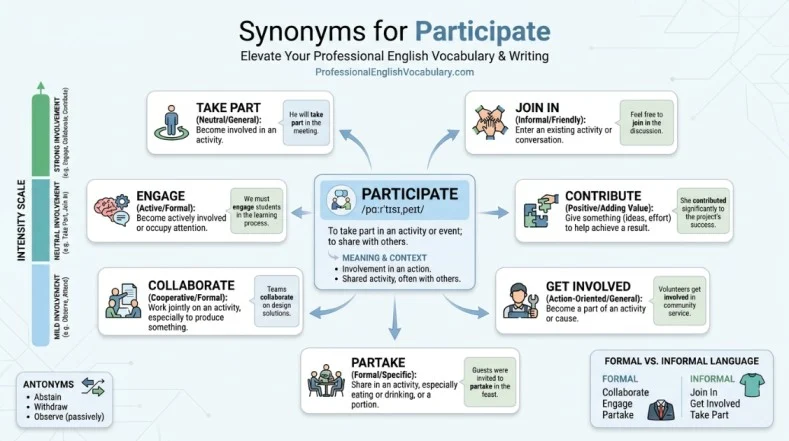
Participate means to take part in an activity, event, discussion, project, or experience. Common alternatives include engage, join in, take part, partake, contribute, collaborate, become involved, and enter, depending on the context and intended meaning.
Meaning, Tone and Context
Simple Definition
Participate means to take part in something rather than simply watch or remain uninvolved.
For example, if you participate in a class discussion, you actively contribute to the discussion instead of only listening.
Part of Speech
Participate is a verb.
Example:
“She participated in the community event.”
Its common noun form is participation.
Example:
“Student participation increased during the workshop.”
The adjective participatory describes something designed to involve people actively.
Example:
“The program uses a participatory approach.”
Tone
Participate generally has a neutral and positive tone.
It does not automatically suggest strong enthusiasm. The surrounding words determine whether the participation sounds active, enthusiastic, professional, reluctant, or routine.
Formality Level
Participate is neutral to moderately formal.
It works well in academic essays, workplace communication, resumes, applications, reports, emails, and everyday conversation.
Common Use Cases
Participate commonly appears when discussing:
- Classes and discussions
- Meetings and projects
- Sports and competitions
- Community activities
- Research studies
- Events and programs
- Workplace initiatives
- Volunteer activities
- Social activities
- Group discussions
Important Word Forms
Participate is related to several useful forms:
Participate: verb
Participation: noun
Participant: noun
Participatory: adjective
Participating: present participle
Participated: past tense and past participle
When and How to Use “Participate”
Use participate when someone actively takes part in an activity, event, discussion, project, or organized experience.
The word is especially useful when the exact type of involvement is not important or when you want a neutral description.
1. Academic Context
“Students are encouraged to participate in classroom discussions.”
2. Professional Context
“Our employees participate in monthly training sessions.”
3. Personal Context
“I decided to participate in the neighborhood cleanup.”
4. Social Context
“She participated in several activities during the reunion.”
5. Workplace Email
“Please participate in the survey before Friday.”
6. Resume Context
“Participated in a cross functional team that improved customer support processes.”
7. Social Media Context
“Grateful to participate in such a meaningful community event.”
Another Word for “Participate”
The best single replacement is usually take part because it preserves the basic meaning without changing the level of formality too much.
However, context can make another option better.
- Professional writing: engage or contribute
- Academic writing: engage or take part
- Casual conversation: join in
- Emotional writing: become involved
- Creative writing: join, engage, or take part
- Resume or workplace use: contributed, collaborated, or participated
- Social media captions: joined, took part, or got involved
- Stronger meaning: engage or contribute
- Softer meaning: be involved or take part
When Not to Use “Participate”
Participate can sound vague when you want to explain exactly what someone did.
For example:
“Maria participated in the project.”
This sentence tells readers that Maria was involved, but it does not explain her contribution.
A more precise version might be:
“Maria contributed research to the project.”
Or:
“Maria collaborated with the design team.”
Participate can also sound unnecessarily formal in casual conversation.
Instead of:
“I participated in a dinner with my friends.”
Natural American English would usually say:
“I joined my friends for dinner.”
Choose a more specific synonym when the action itself matters.
Words Commonly Confused With “Participate”
Participate vs. Attend
Attend means to be present at an event, class, meeting, or place. Participate means to actively take part.
You can attend a meeting without participating in the discussion.
Participate vs. Engage
Engage often suggests active involvement, attention, or interaction.
Participate is broader and can describe taking part without emphasizing the quality or intensity of involvement.
Participate vs. Contribute
Contribute means to provide something useful, such as ideas, money, work, information, or resources.
Participate only means taking part.
Someone can participate in a project without making a major contribution.
Participate vs. Collaborate
Collaborate means working with other people toward a shared goal.
Participate does not necessarily involve teamwork.
Participate vs. Join
Join can mean becoming a member of a group or becoming involved in an activity.
Participate focuses more directly on taking part in the activity itself.
Participate vs. Compete
Compete means taking part in a contest or competition with the goal of achieving a better result than others.
Participate is broader and does not require competition.
Best Synonym by Context for “Participate”
| Context | Best Synonym | Why It Works | Example |
|---|---|---|---|
| Formal writing | Take part | Clear and broadly appropriate | Employees can take part in the initiative. |
| Academic writing | Engage | Suggests active involvement | Students should engage in classroom discussions. |
| Professional use | Contribute | Highlights useful input | Team members contributed ideas during the meeting. |
| Resume | Contributed | Shows action and value | Contributed research to a marketing project. |
| Casual conversation | Join in | Sounds natural and friendly | Come over and join in the game. |
| Creative writing | Become involved | Adds a sense of personal involvement | She became involved in the local theater group. |
| Emotional tone | Get involved | Suggests personal commitment | He got involved in the community project. |
| Strong intensity | Engage | Implies active attention or involvement | The audience actively engaged in the discussion. |
| Soft or moderate tone | Take part | Neutral and flexible | I took part in the annual celebration. |
| Social media captions | Joined | Short and natural | Joined a great cause this weekend. |
| US usage | Participate | Standard and widely understood | Many residents participated in the event. |
| UK usage | Take part | Very natural in British English | Students took part in the competition. |
Which Synonym Should You Choose?
Start by asking what kind of involvement you want to communicate.
- Use take part when you simply mean participation.
- Use join in for friendly and informal situations.
- Use engage when active involvement or attention matters.
Use contribute when the person added something valuable.
- Use collaborate when people worked together.
- Use compete when the activity involved a contest.
- Use attend only when physical presence is the main point.
- Use become involved when you want to emphasize deeper personal involvement.
For resumes, prefer a specific action word that shows what you actually did rather than relying on participate alone.
Real Life Examples of “Participate” in Sentences
School
“Students who participate in discussions often develop stronger communication skills.”
Workplace
“Our staff members participate in regular professional development sessions.”
Writing
“The author invited readers to participate in an online discussion.”
Conversation
“Would you like to participate in the game?”
Social Media
“Excited to participate in this year’s community fundraiser.”
Resume
“Participated in a team project focused on improving customer satisfaction.”
“We encourage everyone to participate in the employee survey.”
Storytelling
“After watching from the sidelines for several weeks, Daniel finally decided to participate.”
25 Synonyms for “Participate”
| Synonym | Simple Meaning | Best Used For | Example Sentence |
|---|---|---|---|
| Take part | Join an activity or event | General use | Everyone is welcome to take part in the workshop. |
| Join in | Become involved in an activity | Casual conversation | Come and join in the celebration. |
| Engage | Become actively involved | Academic and professional contexts | Students actively engaged in the discussion. |
| Get involved | Become actively connected with something | Personal and community contexts | She decided to get involved in the local program. |
| Become involved | Start taking an active role | Formal and personal writing | He became involved in several community projects. |
| Be involved | Have an active connection or role | General and professional use | She was involved in the planning process. |
| Partake | Take part in something | Formal or traditional contexts | Guests were invited to partake in the ceremony. |
| Contribute | Add something valuable | Work, projects, discussions | Each employee contributed useful suggestions. |
| Collaborate | Work jointly with others | Professional and academic work | The researchers collaborated on the study. |
| Join | Become part of a group or activity | General and casual use | Several students joined the volunteer effort. |
| Enter | Take part in a competition or contest | Competitions | She entered the writing competition. |
| Compete | Take part in a contest | Sports and competitions | More than fifty athletes competed in the tournament. |
| Attend | Be present at an event or activity | Meetings and events | I attended the conference last week. |
| Interact | Communicate or act with others | Social and educational settings | Children interacted with other students during the activity. |
| Cooperate | Work willingly with others | Group tasks | The teams cooperated to complete the assignment. |
| Assist | Help with an activity | Work and service situations | Volunteers assisted with the community event. |
| Volunteer | Offer to take part without being required | Community and service work | Hundreds of residents volunteered for the cleanup. |
| Support | Help or back an activity or cause | Causes and organizations | Local businesses supported the fundraising campaign. |
| Respond | Take action in reaction to something | Discussions and activities | Several students responded to the instructor’s invitation. |
| Contribute to | Add effort, ideas, or resources | Projects and organizations | She contributed to the team’s research. |
| Work with | Take part alongside another person or group | Professional settings | He worked with the marketing team on the campaign. |
| Take an active role | Participate actively | Leadership and professional contexts | She took an active role in organizing the event. |
| Play a role | Have a part or function in something | Professional and general writing | Employees played a role in developing the new policy. |
| Be a part of | Belong to or participate in something | Personal and social writing | I was proud to be a part of the project. |
| Involve oneself | Deliberately become engaged | Formal writing | He chose to involve himself in the community initiative. |
Important note: Not every word above is interchangeable with participate in every sentence. Words such as attend, contribute, collaborate, compete, and assist add specific meanings. Choose them only when those meanings accurately describe the action.
Synonym Groups and Usage Differences
Professional vs. Personal Synonyms
Professional writing benefits from precise words such as contribute, collaborate, engage, and take an active role.
Personal communication can sound more natural with join in, get involved, join, and take part.
For example:
Professional: “She contributed to the product development project.”
Personal: “She joined in the family celebration.”
Formal vs. Conversational Synonyms
Participate and partake can work in more formal contexts, although partake can sound traditional in some everyday situations.
Take part is flexible and natural in both formal and conversational writing.
Join in and get involved are more conversational and often feel warmer.
Academic Synonyms
Academic writing often benefits from engage, take part, contribute, and collaborate.
For example:
“Students who actively engage in discussions can develop stronger analytical skills.”
Use contribute when the student adds ideas, research, evidence, or other useful material.
Use collaborate when two or more people work together toward a shared academic goal.
Professional and Business Synonyms
In workplace communication, precise verbs are usually stronger than generic wording.
Instead of:
“Employees participated in the project.”
Consider:
“Employees contributed research to the project.”
Or:
“Employees collaborated on the project.”
Or:
“Employees took an active role in the project.”
The best choice depends on what the employees actually did.
Creative or Literary Synonyms
Creative writing can benefit from phrases such as become involved, get involved, join, take part, and involve oneself.
These expressions can communicate a character’s growing connection with a community, event, conflict, or experience.
For emotional storytelling, “become involved” can suggest a deeper personal connection than the neutral participate.
Slang or Modern Synonyms
There is no single slang word that perfectly replaces participate in every situation.
Expressions such as “join in” and “get involved” are informal but standard American English rather than true slang.
Avoid forcing trendy expressions into professional or academic writing simply to sound modern.
Strongest vs. Weaker Synonyms
A useful intensity scale is:
Mild: attend
Neutral: participate
Neutral and active: take part
More active: engage
More personally involved: get involved
Contribution focused: contribute
Teamwork focused: collaborate
The strongest choice is not always the best choice. Precision matters more than intensity.
Emotional vs. Neutral Synonyms
Participate is generally neutral.
Take part is also neutral.
Join in can sound friendly.
Get involved can suggest personal interest or commitment.
Become involved can suggest a deeper connection.
Contribute can add a sense of value and usefulness.
Antonyms of “Participate”
| Antonym | Meaning | Example Sentence |
|---|---|---|
| Abstain | Deliberately choose not to take part | She decided to abstain from the activity. |
| Refrain | Hold yourself back from doing something | He refrained from joining the discussion. |
| Withdraw | Leave or remove yourself from involvement | The athlete withdrew from the competition. |
| Opt out | Choose not to participate | Several employees opted out of the optional program. |
| Sit out | Remain out of an activity | She decided to sit out the next game. |
| Stay away | Avoid being present or involved | He chose to stay away from the event. |
| Avoid | Keep away from an activity or situation | She avoided participating in the argument. |
| Decline | Politely refuse an opportunity or invitation | He declined the invitation to join the committee. |
| Refuse | Explicitly reject participation | The player refused to participate in the protest. |
| Disengage | Stop being actively involved | The employee gradually disengaged from the discussion. |
| Stand aside | Remain uninvolved while others act | He chose to stand aside during the debate. |
| Remain uninvolved | Stay outside an activity or situation | She preferred to remain uninvolved in the dispute. |
| Observe | Watch without actively taking part | He observed the workshop without joining the activities. |
| Exclude oneself | Deliberately leave oneself out | She excluded herself from the planning group. |
| Ignore | Give no attention or involvement | He ignored the invitation to participate. |
Comparison: Participate vs. Similar Words
Participate vs. Attend
Main difference: Participate means actively taking part, while attend mainly means being present.
Which one is stronger: Participate suggests more involvement.
Which one is more formal: Both are suitable for formal writing.
Examples:
“Students participated in the discussion.”
“Students attended the lecture.”
Participate vs. Engage
Main difference: Engage often emphasizes active attention, interaction, or involvement.
Which one is stronger: Engage can suggest more active involvement.
Which one is more formal: Both work well in professional and academic writing.
Examples:
“Students participated in the workshop.”
“Students engaged in a detailed discussion.”
Participate vs. Contribute
Main difference: Participate means taking part, while contribute means adding something useful.
Which one is stronger: Contribute is more specific when an actual contribution is involved.
Which one is more formal: Both are appropriate for professional and academic contexts.
Examples:
“She participated in the project.”
“She contributed research to the project.”
Participate vs. Collaborate
Main difference: Collaborate specifically involves working with others.
Which one is stronger: Collaborate gives more information about teamwork.
Which one is more formal: Both are professional, but collaborate is especially useful in workplace writing.
Examples:
“They participated in the initiative.”
“They collaborated on the initiative.”
Participate vs. Join
Main difference: Join can mean becoming a member or entering an activity, while participate focuses on taking part.
Which one is stronger: Neither is always stronger.
Which one is more formal: Participate is generally more formal.
Examples:
“She participated in the club’s activities.”
“She joined the club.”
Participate vs. Compete
Main difference: Compete means taking part in a contest against others.
Which one is stronger: Compete is more specific.
Which one is more formal: Both can be used in formal writing.
Examples:
“He participated in the tournament.”
“He competed in the tournament.”
Common Phrases and Expressions with “Participate”
1. Participate in an event
Meaning:
Take part in an organized event or activity.
Example sentence:
“Thousands of people participated in the annual festival.”
2. Participate in a discussion
Meaning:
Actively contribute to a conversation or discussion.
Example sentence:
“Everyone was encouraged to participate in the discussion.”
3. Participate in a program
Meaning:
Take part in an organized program.
Example sentence:
“She participated in a professional development program.”
4. Participate in a competition
Meaning:
Take part in a contest or competitive event.
Example sentence:
“More than one hundred students participated in the competition.”
5. Participate in research
Meaning:
Take part in a research study or research activity.
Example sentence:
“Volunteers participated in the research study.”
6. Actively participate
Meaning:
Take an energetic and involved role.
Example sentence:
“Employees are expected to actively participate in team meetings.”
7. Participate fully
Meaning:
Take part to the greatest practical extent.
Example sentence:
“New members are encouraged to participate fully in the training.”
8. Participate in community activities
Meaning:
Become involved in activities that benefit or connect a local community.
Example sentence:
“Many residents participate in community activities throughout the year.”
Common Mistakes to Avoid
1. Using Participate When a More Precise Word Is Better
“Sarah participated in the presentation” is understandable but vague.
If Sarah gave the presentation, say:
“Sarah presented the report.”
2. Confusing Participate With Attend
Being present does not always mean actively participating.
You can attend a meeting without speaking, contributing, or interacting.
3. Using a Casual Synonym in Formal Writing
Phrases such as “join in” may sound too conversational for some formal reports.
Use participate, engage, contribute, or take part when the context requires a more polished tone.
4. Using an Overly Dramatic Synonym
Do not replace participate with a stronger expression if the situation does not justify it.
For example, “became deeply involved” may sound excessive when someone simply attended an optional activity.
5. Repeating Participate Too Often
Repeated use can make your writing monotonous.
Replace it with a precise alternative when the meaning genuinely changes.
6. Choosing the Wrong Emotional Tone
Participate is neutral, while get involved can sound more personal.
Make sure your synonym matches the emotional message you want to create.
7. Using Slang in Academic or Professional Writing
Informal expressions may work in conversation but can weaken an academic essay, business email, or resume.
Choose standard vocabulary when your audience expects professional language.
FAQs
What is the best synonym for participate?
The best general synonym is “take part.” For more specific meanings, use engage, contribute, collaborate, join in, or become involved.
What is a formal synonym for participate?
“Engage” or “take part” can work well in formal writing. “Contribute” is better when the person adds ideas, effort, research, or resources.
What is an informal synonym for participate?
“Join in” is a natural informal alternative. “Get involved” also works when you want to emphasize personal involvement.
What is another word for participate in professional writing?
Use engage, contribute, collaborate, take an active role, or become involved when those words accurately describe the person’s specific role.
What is the difference between participate and attend?
Attend means being present at an event or activity. Participate means actively taking part, contributing, interacting, or performing an activity.
What is the opposite of participate?
Common opposites include abstain, refrain, withdraw, opt out, sit out, disengage, and remain uninvolved, depending on the context.
Conclusion
Participate means to take part in an activity, event, discussion, project, or experience. It is a flexible, neutral word that works across academic, professional, personal, and everyday communication.
The best synonym depends on your exact meaning. Choose take part for a broad replacement, join in for casual situations, engage for active involvement, contribute for added value, and collaborate when teamwork is the central idea.
The most useful vocabulary habit is to replace participate only when another word communicates something more precise. A good synonym should improve meaning, not simply make the sentence sound different.
Discover More Post:
- 25+ Synonyms for Affect | Meanings, Examples, and Best …
- 25+ Synonyms for Achieve | Meanings, Examples, and Best …
- 25+ Synonyms for Real | Meanings, Examples, and Best …