The word “real” appears everywhere. You may use it in an essay, email, resume, caption, conversation, or workplace message, then notice that the same word keeps appearing again and again.
The good news is that you do not always need to replace “real.” You need the right alternative for the meaning you intend. The best synonyms for real can make your writing more precise, natural, professional, emotional, or vivid.
This guide explains how words such as genuine, authentic, actual, true, sincere, legitimate, factual, realistic, and tangible differ. You will also find examples and practical recommendations for choosing the strongest word for each situation.
What Does “Real” Mean?
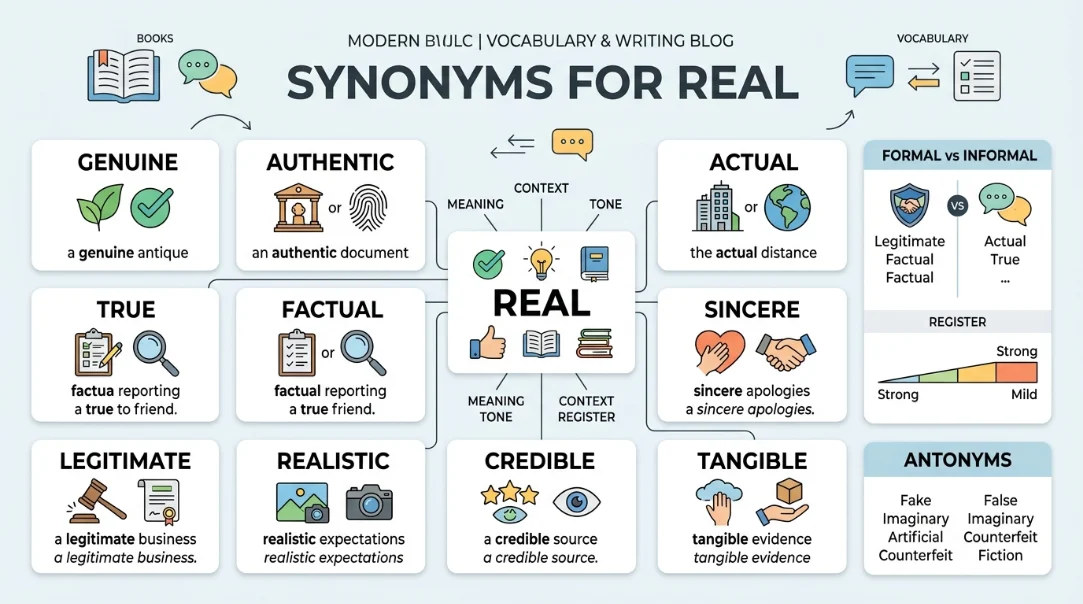
“Real” generally means genuine, true, actual, or existing rather than fake or imagined. The best synonym depends on context. Use authentic for genuine things, factual for information, sincere for feelings, legitimate for validity, and realistic for believable situations.
Meaning, Tone and Context
Simple Definition
“Real” is commonly used to describe something that genuinely exists, is true, is not fake, or accurately reflects reality.
For example:
“The painting looks real.”
Here, “real” means lifelike or realistic.
In another sentence:
“She gave me a real answer.”
Here, “real” can mean honest, sincere, or genuine depending on the intended meaning.
Part of Speech
“Real” is primarily an adjective.
It can describe a person, object, situation, feeling, experience, problem, quality, or idea.
Examples include:
“a real diamond”
“a real problem”
“real feelings”
“a real opportunity”
“real information”
“a real friend”
“real life”
“real” also appears in related forms such as “reality,” which is a noun, “really,” which is an adverb, and “realize,” which is a verb with a different meaning.
Tone
“Real” is usually neutral.
Its tone can become positive when it describes authenticity or honesty, negative when it describes a serious problem, or emotional when it describes genuine feelings.
Examples:
“She is a real friend.” This sounds positive.
“That is a real problem.” This sounds serious.
“He showed real emotion.” This sounds emotional and sincere.
Formality Level
“Real” is common in everyday English and works in many informal and professional situations.
However, it can sometimes be too general for academic, technical, or highly professional writing. A more precise word can communicate the intended meaning more clearly.
For example:
“The company faced a real issue.”
A more precise version could be:
“The company faced a significant operational issue.”
Common Use Cases
“Real” commonly describes:
People and relationships
Feelings and emotions
Objects and materials
Facts and information
Problems and opportunities
Experiences
Money and value
Identity and authenticity
Believable situations
Art and descriptions
When and How to Use “Real”
Use “real” when you want to communicate that something exists, is genuine, is true, or feels authentic.
Professional
“The company has a real opportunity to expand into new markets.”
Here, “real” emphasizes that the opportunity genuinely exists.
Personal
“She is a real friend who always supports me.”
Here, “real” suggests genuine friendship.
Academic
“The study examines the real effects of social media use.”
For academic writing, “actual” or a more specific term may sometimes be clearer.
Emotional
“He showed real concern for his team.”
“Real” emphasizes that the concern was genuine.
Creative
“The artist created a real sense of mystery.”
Here, “real” intensifies the emotional or descriptive effect.
Social Media
“Nothing beats a real conversation with a good friend.”
The word sounds natural and conversational.
“We have a real chance to improve the project before the deadline.”
The word emphasizes that the opportunity is genuine and meaningful.
Another Word for “Real”
There is no single perfect replacement for “real” because the word has several meanings.
- For professional writing, actual, genuine, legitimate, or authentic can work depending on the sentence.
- For academic writing, actual, factual, empirical, or objective may be more precise when the context supports them.
- For casual conversation, genuine, true, honest, and legit can sound natural.
- For emotional writing, sincere, heartfelt, genuine, and unfeigned are useful.
- For creative writing, lifelike, authentic, vivid, and realistic can add descriptive depth.
- For resumes and workplace writing, actual, measurable, demonstrable, and genuine may communicate more precisely than “real.”
- For social media captions, genuine, authentic, honest, and true often fit naturally.
- For a stronger meaning, consider genuine, authentic, undeniable, or veritable, depending on context.
- For a softer meaning, believable, plausible, credible, or natural may work better.
When Not to Use “Real”
“Real” is not wrong simply because it is common. The problem occurs when it fails to communicate your exact meaning.
When It Is Too Vague
“The project has real value.”
A more precise version:
“The project has measurable value for small businesses.”
The second sentence tells the reader what kind of value is meant.
When It Is Too Casual
“The report contains real facts.”
Better:
“The report contains verified facts.”
When It Is Too General
“She has real skills.”
Better:
“She has advanced data analysis skills.”
The revised sentence gives the reader useful information.
When a Stronger Word Is Needed
“He gave a real apology.”
Better:
“He gave a sincere apology.”
“Sincere” specifically communicates honesty and genuine feeling.
When a Softer Word Is Better
“That sounds real.”
If you mean that something seems believable, “plausible” or “credible” may be more precise.
Words Commonly Confused With “Real”
| Word | Difference |
|---|---|
| Real | Something exists, is genuine, or is true rather than fake or imaginary. |
| Actual | Refers to what exists or happened in fact, especially when correcting an assumption. |
| True | Usually relates to truth, correctness, or faithfulness to reality. |
| Genuine | Emphasizes authenticity and freedom from fakery. |
| Authentic | Suggests something is original, genuine, or faithful to its source or identity. |
| Realistic | Means believable or closely matching real life, rather than necessarily being factually true. |
For example, a fictional movie can be realistic without being real.
A copied designer bag can look authentic without actually being genuine.
A statement can sound believable without being true.
These distinctions are important when choosing a synonym.
Best Synonym by Context for “Real”
| Context | Best Synonym | Why It Works | Example |
|---|---|---|---|
| Formal writing | Genuine | Clearly communicates authenticity | The organization made a genuine effort to improve access. |
| Academic writing | Actual | Works well when contrasting reality with assumptions | The actual results differed from the original prediction. |
| Professional or business use | Legitimate | Emphasizes validity or credibility | The client raised a legitimate concern. |
| Resume | Demonstrable | Shows that a skill or result can be supported with evidence | She has demonstrable leadership experience. |
| Casual conversation | Genuine | Sounds natural while emphasizing honesty | He is a genuine person. |
| Creative writing | Lifelike | Creates a vivid sense of reality | The author gave the character a lifelike personality. |
| Emotional tone | Sincere | Clearly communicates honest feeling | Her sincere apology changed the conversation. |
| Strong intensity | Authentic | Strongly emphasizes originality and genuineness | The restaurant offers an authentic regional experience. |
| Soft or moderate tone | Believable | Avoids claiming complete factual certainty | The character’s explanation was believable. |
| Social media captions | Authentic | Fits modern discussions about honest self expression | Keep your content authentic and personal. |
| Facts and information | Factual | Specifically relates to facts | The article provides factual information. |
| Objects that physically exist | Tangible | Emphasizes physical or concrete existence | The team delivered tangible results. |
| Rules or claims | Valid | Emphasizes logical or official soundness | The argument presents a valid point. |
| Feelings | Heartfelt | Adds emotional warmth | She wrote a heartfelt message. |
| Art or appearance | Realistic | Describes something that resembles real life | The portrait is remarkably realistic. |
Which Synonym Should You Choose?
Start by identifying what “real” means in your sentence.
- If you mean not fake, choose genuine or authentic.
- If you mean true or factually correct, choose true or factual.
- If you mean what actually happened, choose actual.
- If you mean honest feelings, choose sincere or heartfelt.
- If you mean legally or logically acceptable, choose legitimate or valid.
- If you mean physically existing, choose tangible or existent.
- If you mean believable, choose credible, plausible, or realistic.
- If you are writing professionally, choose the most specific word instead of automatically using the most sophisticated word.
Good vocabulary is not about making every sentence sound complicated. It is about making your meaning unmistakably clear.
Real Life Examples of “Real” in Sentences
School
“The student used real examples to support her argument.”
A more academic alternative could be “actual examples” or “documented examples,” depending on the evidence.
Workplace
“The manager identified a real opportunity to reduce costs.”
“Significant” or “measurable” may be stronger if the opportunity can be quantified.
Writing
“The author created a real sense of tension.”
“Genuine” may work for emotion, while “intense” may work better when emphasizing strength.
Conversation
“I just want a real answer.”
“Honest” or “straightforward” may communicate the intention more clearly.
Social Media
“Real moments are often better than perfect ones.”
“Authentic” can create a more polished social media tone.
Resume
“I want to show real experience in customer service.”
A stronger resume phrase would be:
“I have hands on customer service experience.”
“We have a real chance to complete the project this week.”
“Strong opportunity” may sound more professional in a formal business context.
Storytelling
“The writer made the fictional city feel real.”
“Lifelike” or “realistic” could provide more descriptive precision.
25 Synonyms for “Real”
Not every synonym below works in every sentence. “Real” has several meanings, so the correct replacement depends on whether you mean genuine, factual, existing, believable, emotional, or valid.
| Synonym | Simple Meaning | Best Used For | Example Sentence |
|---|---|---|---|
| Genuine | Truly authentic or sincere | People, feelings, objects | Her genuine concern was obvious. |
| Authentic | Original and not fake | Culture, products, experiences, identity | The restaurant serves authentic regional food. |
| Actual | Existing in fact | Facts, events, results | The actual cost was higher than expected. |
| True | Correct or faithful to reality | Statements, facts, feelings | His statement proved true. |
| Factual | Based on facts | Information, writing, reports | The article provides factual information. |
| Legitimate | Valid, lawful, or justified | Claims, businesses, concerns | The customer had a legitimate complaint. |
| Valid | Sound, acceptable, or well founded | Arguments, reasons, documents | She made a valid argument. |
| Sincere | Honest and heartfelt | Apologies, emotions, communication | He offered a sincere apology. |
| Heartfelt | Deeply sincere and emotional | Messages, thanks, condolences | She wrote a heartfelt thank you note. |
| Unfeigned | Completely genuine and not pretended | Formal or literary writing | His unfeigned admiration was clear. |
| Bona fide | Genuine and authentic | Formal contexts, qualifications, claims | She is a bona fide expert in the field. |
| Veritable | Truly or genuinely so | Formal and literary emphasis | The discovery became a veritable milestone. |
| Tangible | Physically existing or clearly measurable | Results, assets, benefits | The program produced tangible benefits. |
| Concrete | Specific and clearly defined | Evidence, plans, results | The team needs concrete evidence. |
| Substantive | Meaningful and substantial | Discussion, changes, work | The meeting produced substantive improvements. |
| Existent | Actually existing | Formal or technical contexts | Evidence of an existent problem was presented. |
| Realistic | Believable or close to real life | Goals, stories, expectations | The team developed a realistic timeline. |
| Lifelike | Closely resembling real life | Art, images, characters | The sculpture has remarkably lifelike details. |
| Credible | Worth believing | Claims, sources, explanations | The journalist cited a credible source. |
| Plausible | Reasonably believable | Explanations, theories, possibilities | Her explanation sounded plausible. |
| Earnest | Serious and sincere | Requests, efforts, communication | He made an earnest attempt to help. |
| Natural | Genuine or not forced | Behavior, speech, appearance | Her natural confidence impressed the audience. |
| Undeniable | Impossible to reasonably deny | Evidence, facts, achievements | The company achieved undeniable growth. |
| Unmistakable | Clearly identifiable or genuine | Signs, qualities, characteristics | There was an unmistakable sense of excitement. |
| Truthful | Honest and accurate | People, statements, answers | Please give me a truthful answer. |
Synonym Groups and Usage Differences
Professional vs. Personal Synonyms
Professional writing often benefits from words that identify a specific quality.
Instead of “real concern,” use “legitimate concern” when discussing a valid issue.
Instead of “real results,” use “measurable results” when discussing outcomes that can be demonstrated.
Personal writing can be warmer.
“Genuine,” “sincere,” and “heartfelt” are especially useful for relationships, emotions, gratitude, and personal communication.
Formal vs. Conversational Synonyms
“Real” is naturally conversational and broadly understood.
“Genuine” and “authentic” can work in both casual and formal contexts.
“Bona fide,” “veritable,” and “unfeigned” are more formal or literary and should be used selectively.
For texts and casual conversations, simple words usually sound more natural.
For reports, essays, and formal correspondence, precision matters more than complexity.
Academic Synonyms
Academic writing often benefits from words that specify the exact relationship between a statement and reality.
- Use “actual” when contrasting what happened with what was expected.
- Use “factual” for information supported by facts.
- Use “empirical” when referring to evidence based on observation or measurement.
- Use “objective” when describing a perspective that aims to avoid personal bias.
Do not replace every occurrence of “real” with a sophisticated word. The replacement must preserve the intended meaning.
Professional and Business Synonyms
In business communication, “real” can sometimes sound vague.
Compare:
“We have real growth.”
“We achieved measurable growth.”
The second version is stronger because “measurable” tells the reader how the growth can be evaluated.
Useful professional alternatives include:
Actual
Legitimate
Genuine
Tangible
Concrete
Measurable
Demonstrable
Substantive
Choose according to the specific idea you want to express.
Creative or Literary Synonyms
Creative writing often needs more descriptive precision than ordinary conversation.
“Lifelike” works well for art and characters.
“Authentic” can describe a convincing voice or cultural detail.
“Unfeigned” can describe sincere emotion in literary prose.
“Heartfelt” adds emotional warmth.
“Veritable” can create formal literary emphasis.
Slang or Modern Synonyms
“Legit” is a common informal expression that can sometimes mean real, genuine, valid, or trustworthy.
For example:
“That restaurant is legit.”
This works in casual conversation and social media, but it is usually inappropriate for academic papers, formal reports, and professional resumes.
Strongest vs. Weaker Synonyms
A useful intensity scale depends on meaning, but this general progression can help:
Mild: believable
Moderate: credible
Clear: genuine
Strong: authentic
Very strong: undeniable
The strongest word is not automatically the best word. A synonym should match the actual evidence and tone of the sentence.
Emotional vs. Neutral Synonyms
Neutral choices include:
Actual
Factual
Valid
Concrete
Tangible
Emotional choices include:
Sincere
Heartfelt
Earnest
Genuine
Unfeigned
For example:
“The report contains factual information.”
This is neutral.
“She gave a heartfelt response.”
This is emotional.
Antonyms of “Real”
Because “real” has multiple meanings, its antonyms also depend on context.
| Antonym | Meaning | Example Sentence |
|---|---|---|
| Fake | Made to look genuine but not genuine | The watch was fake. |
| False | Not true or correct | The statement was false. |
| Artificial | Made rather than naturally occurring | The flowers were artificial. |
| Counterfeit | An unauthorized imitation | The store discovered counterfeit products. |
| Imaginary | Existing only in the mind | The child invented an imaginary friend. |
| Fictional | Created for a story rather than existing in reality | The detective is a fictional character. |
| Unreal | Not real or not resembling reality | The situation felt almost unreal. |
| Fictitious | Invented rather than factual | The report used a fictitious name. |
| Bogus | False or deliberately misleading | The website made a bogus claim. |
| Deceptive | Designed to create a false impression | The advertisement was deceptive. |
| Insincere | Not expressing genuine feelings | His apology sounded insincere. |
| Simulated | Imitated rather than genuine | The students practiced in a simulated environment. |
| Pretended | Presented as real when it is not | She gave a pretended smile. |
| Illusory | Appearing real but not actually real | The promise of instant success was illusory. |
| Untruthful | Not honest or accurate | His answer was untruthful. |
Comparison: “Real” vs. Similar Words
“Real” vs. “Actual”
The main difference is emphasis.
“Real” can mean genuine, existing, true, or believable.
“Actual” usually emphasizes what exists or happened in fact.
“Actual” is often more precise in formal writing.
Example:
“The problem is real.”
“The actual problem is a lack of funding.”
The first sentence emphasizes existence. The second identifies what the problem specifically is.
“Real” vs. “True”
“True” focuses more directly on truth or correctness.
“Real” can focus on existence or authenticity.
Example:
“The story is true.”
This means the story is factually correct.
“The painting is real.”
This means the painting genuinely exists or is not an imitation.
“Real” vs. “Genuine”
“Genuine” strongly emphasizes authenticity.
It is often more precise than “real” when discussing people, feelings, products, or intentions.
Example:
“She showed real concern.”
“She showed genuine concern.”
The second sentence makes the sincerity of her concern clearer.
“Real” vs. “Authentic”
“Authentic” emphasizes originality or faithfulness to a source, identity, tradition, or style.
“Real” is broader.
Example:
“This is a real Mexican restaurant.”
“This is an authentic Mexican restaurant.”
The second sentence specifically emphasizes authenticity and traditional character.
“Real” vs. “Realistic”
“Realistic” means believable or closely resembling reality.
It does not necessarily mean factual.
A fictional movie can be realistic even though its events never happened.
Example:
“The character feels real.”
“The character feels realistic.”
The first suggests emotional or psychological authenticity. The second emphasizes believability.
“Real” vs. “Legitimate”
“Legitimate” emphasizes validity, lawfulness, or justification.
Example:
“She has a real concern.”
“She has a legitimate concern.”
The second sentence means her concern is reasonable or justified.
Common Phrases and Expressions with “Real”
1. Real life
Meaning:
The actual world and ordinary experiences outside fiction or imagination.
Example sentence:
“Social media does not always reflect real life.”
2. Real world
Meaning:
Practical circumstances outside theory, school exercises, or imagination.
Example sentence:
“Students need opportunities to apply these skills in the real world.”
3. For real
Meaning:
Used informally to mean genuinely, seriously, or actually.
Example sentence:
“Are you for real?”
4. The real deal
Meaning:
An informal expression for someone or something that is genuinely excellent, authentic, or trustworthy.
Example sentence:
“She is the real deal when it comes to public speaking.”
5. Real talk
Meaning:
Informal language for an honest or serious discussion.
Example sentence:
“Real talk, the project needs more preparation.”
6. Real time
Meaning:
Something occurring immediately or as events happen.
Example sentence:
“The dashboard displays real time sales data.”
7. Real world experience
Meaning:
Practical experience gained outside theoretical learning.
Example sentence:
“The internship gave her valuable real world experience.”
8. Real possibility
Meaning:
A possibility that genuinely exists rather than being merely hypothetical.
Example sentence:
“There is a real possibility that the company will expand.”
Common Mistakes to Avoid
1. Using “Real” When a Precise Word Is Better
“The company had real growth.”
If you mean growth supported by measurable evidence, “measurable growth” is stronger.
2. Confusing “Real” With “True”
“Real” and “true” overlap, but they are not interchangeable in every sentence.
Use “true” when the focus is correctness or factual accuracy.
Use “real” when the focus is existence or authenticity.
3. Using Casual Synonyms in Formal Writing
“Legit” may sound natural in conversation but usually does not belong in an academic essay or formal business report.
Choose “legitimate” instead when the context calls for formal language.
4. Using an Overly Dramatic Synonym
Words such as “undeniable” make a stronger claim than “real.”
Use them only when the evidence supports that level of certainty.
5. Repeating “Real” Too Often
Repeated use can make writing feel basic or vague.
Instead of changing every occurrence randomly, identify the intended meaning and choose a precise alternative.
6. Choosing the Wrong Emotional Tone
“Factual” is useful for information but sounds inappropriate if you are describing a deeply emotional apology.
“Sincere” or “heartfelt” would work better.
7. Using Slang in Academic or Professional Writing
“Legit” is useful in casual language.
“Legitimate,” “genuine,” or “valid” is generally more suitable for formal communication.
FAQs
What is the best synonym for “real”?
The best synonym depends on meaning. “Genuine” works well for authenticity, “actual” for facts, “sincere” for emotions, and “legitimate” for valid claims.
What is a formal synonym for “real”?
“Genuine,” “actual,” “legitimate,” “factual,” “authentic,” and “tangible” can serve as formal alternatives when their specific meanings fit the sentence.
What is an informal synonym for “real”?
“Genuine,” “true,” and “legit” can work informally. “Legit” is especially casual and should generally be avoided in formal or academic writing.
What is another word for “real” in professional writing?
“Actual,” “genuine,” “legitimate,” “tangible,” “concrete,” and “measurable” are useful professional alternatives depending on the intended meaning.
What is the difference between “real” and “actual”?
“Real” can mean genuine, existing, or authentic, while “actual” usually emphasizes what exists or happened in fact, especially compared with an assumption.
What is the opposite of “real”?
Common opposites include “fake,” “false,” “artificial,” “imaginary,” “fictional,” “counterfeit,” “bogus,” and “unreal,” depending on the context.
Conclusion
“Real” is a versatile English word that can describe something genuine, true, existing, authentic, believable, or emotionally sincere. Because it carries several meanings, the best synonym depends on the exact idea behind your sentence.
Use “genuine” for authenticity, “actual” for facts and events, “sincere” for feelings, “legitimate” for valid claims, “factual” for information, “tangible” for concrete results, and “realistic” for believable situations.
The most useful vocabulary habit is simple: do not replace a common word merely to sound sophisticated. First identify the meaning, tone, and context, then choose the word that communicates that meaning most precisely.
Source verification note: Before publishing dictionary based definitions, verify word meanings and usage with trusted references such as Cambridge Dictionary, Oxford English Dictionary, Merriam Webster, Collins, or Britannica.
Read More Related Articles:
- 25+ Synonyms for Compassion | Meanings, Examples, and …
- 25+ Synonyms for Saying | Meanings, Examples, and Best …
- 25+ Synonyms for Navigate | Meanings, Examples, and Best …