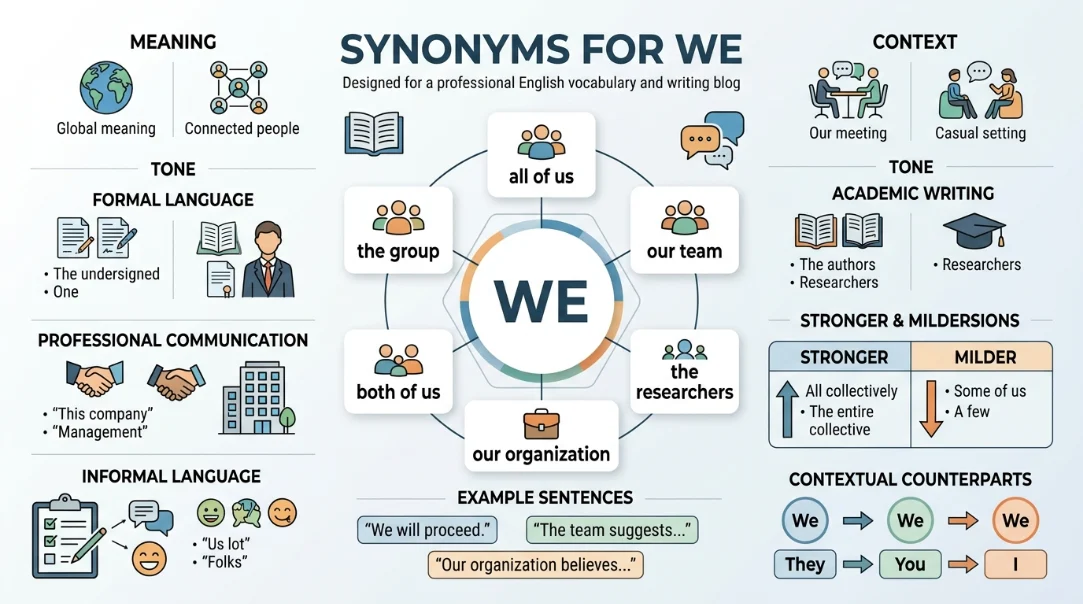
Using we repeatedly can make an essay, email, caption, presentation, or professional message sound predictable. The word is useful, but the right alternative can make your meaning more specific and your writing more natural.
The challenge is that we does not have many exact one word synonyms. Depending on the situation, you may need phrases such as all of us, our team, our organization, you and I, or the participants. Choosing the right expression depends on who you mean, the level of formality, and the purpose of the sentence.
This guide explains the meaning, tone, context, and practical alternatives to we. It also shows which choices work best in academic writing, professional communication, everyday conversation, creative writing, resumes, emails, and social media.
What Does “We” Mean?
We is a first person plural pronoun used when the speaker refers to themselves together with one or more other people. Contextual alternatives include all of us, you and I, our team, our group, and our organization. The best choice depends on meaning and tone.
Meaning, Tone and Context
Simple Definition
We refers to the speaker or writer together with at least one other person.
For example:
“We finished the project.”
Here, we means the speaker and one or more other people who worked on the project.
The exact people included in we are determined by context. In one sentence, it may mean two friends. In another, it may mean an entire company, research team, family, community, or country.
Part of Speech
We is a pronoun.
More specifically, it is a first person plural personal pronoun.
Its related possessive form is our, while ours is the corresponding possessive pronoun.
Examples:
“We completed our assignment.”
“The decision is ours.”
Tone
We is normally neutral.
It can sound friendly and inclusive when it emphasizes shared participation.
It can also sound formal in academic and professional writing, especially when used carefully in statements such as “We examined the results.”
Formality Level
We works across almost every level of communication.
It is common in:
Professional emails
Academic papers
Business presentations
Casual conversations
Personal messages
Social media captions
Speeches
Creative writing
The issue is usually not whether we is formal enough. The issue is whether a more specific expression would communicate the intended meaning more clearly.
Common Use Cases
People use we to describe:
Shared actions
Shared opinions
Group decisions
Collective experiences
Research activities
Family activities
Team achievements
Company activities
Community experiences
Shared responsibilities
Important Word Forms
| Word | Function | Example |
|---|---|---|
| We | Subject pronoun | We completed the task. |
| Us | Object pronoun | The teacher helped us. |
| Our | Possessive determiner | Our project is ready. |
| Ours | Possessive pronoun | The final decision is ours. |
| Ourselves | Reflexive pronoun | We prepared it ourselves. |
When and How to Use “We”
Use we when the speaker wants to include themselves with another person or group.
1. Professional
“We will review the proposal this afternoon.”
This is appropriate when the speaker represents a team or organization.
2. Personal
“We are going to the beach this weekend.”
Here, we refers to the speaker and other people in their personal circle.
3. Academic
“We analyzed the survey responses.”
This can be appropriate in academic writing when the researchers themselves performed the analysis.
4. Emotional
“We stood together during a difficult time.”
The word creates a sense of shared experience and solidarity.
5. Creative
“We walked through the empty streets as the city slowly woke.”
The pronoun places the reader inside a shared narrative experience.
6. Social Media
“We finally made it to the mountains.”
This sounds natural when describing an experience shared by the poster and others.
7. Email
“We appreciate your patience while we resolve this issue.”
This is common in customer service and business communication because it can represent a company or team.
Another Word for “We”
There is no single replacement that works in every sentence.
The best alternative depends on who we refers to.
| Situation | Best Alternative |
|---|---|
| Professional writing | Our team |
| Academic writing | The researchers |
| Casual conversation | All of us |
| Emotional writing | The people involved |
| Creative writing | You and I |
| Resume or workplace use | The team |
| Social media captions | All of us |
| Strong group identity | Our community |
| Softer and more specific meaning | The group |
| Company communication | Our organization |
Professional Writing
Use our team, our department, our organization, or our company when the identity of the group matters.
Instead of:
“We completed the analysis.”
You could write:
“Our research team completed the analysis.”
The second version tells the reader exactly who performed the work.
Academic Writing
Depending on the style guide, the researchers, the study team, or the authors can sometimes provide more specificity.
Instead of:
“We collected responses from 500 participants.”
You might write:
“The researchers collected responses from 500 participants.”
Always follow the style requirements of the publication, instructor, or institution.
Casual Conversation
Natural alternatives include all of us, the two of us, both of us, or you and I, depending on the sentence.
For example:
“All of us enjoyed the concert.”
This emphasizes everyone in the group.
Emotional Writing
Expressions such as all of us, our community, and the people involved can emphasize togetherness.
For example:
“Our community came together after the storm.”
Creative Writing
Writers can replace we with specific descriptions of the characters.
Instead of:
“We entered the old house.”
A story could say:
“The three of us stepped into the old house.”
This gives the reader more information and creates a stronger image.
Resume or Workplace Use
Resumes usually benefit from removing unnecessary pronouns rather than replacing we directly.
Instead of:
“We increased sales by 20 percent.”
A stronger resume statement is:
“Increased sales by 20 percent.”
This focuses attention on the achievement.
Social Media Captions
Casual phrases such as all of us, the whole crew, our group, and the family can work when they accurately describe the people involved.
For example:
“The whole crew made this trip unforgettable.”
When Not to Use “We”
We is grammatically correct in many situations, but it can sometimes be too vague.
When the Group Is Unclear
“We approved the proposal.”
The reader may not know who approved it.
A clearer version is:
“The executive committee approved the proposal.”
When Specificity Matters
“We found several errors.”
A more informative sentence could be:
“The audit team found several accounting errors.”
When Writing a Resume
Repeated use of we can make a resume sound less focused on the candidate.
Instead of:
“We developed a new marketing strategy.”
Use:
“Developed a new marketing strategy that increased qualified leads.”
When a Formal Document Requires Precision
A formal report may benefit from naming the department, research team, committee, or organization instead of repeatedly using we.
When the Meaning Is Emotional
Sometimes we creates an important sense of connection. Replacing it with a detached expression can weaken the emotional effect.
Compare:
“We stood together.”
“The participants stood together.”
The first sentence feels more personal and connected.
Words Commonly Confused With “We”
We vs. Us
We is generally used as a subject.
Us is generally used as an object.
Correct:
“We completed the work.”
Correct:
“The manager thanked us.”
Incorrect:
“Us completed the work.”
We vs. Our
We identifies the people performing an action.
Our shows possession or association.
“We submitted the report.”
“Our report was submitted yesterday.”
We vs. Ours
We identifies people.
Ours identifies something belonging to those people.
“We chose the design.”
“The final design is ours.”
We vs. Ourselves
Ourselves is a reflexive pronoun.
“We prepared the presentation ourselves.”
It emphasizes that the same people represented by we performed the action.
We vs. They
We includes the speaker.
They normally refers to other people who are not included in the speaker’s group.
“We attended the meeting.”
“They attended the meeting.”
We vs. You
We includes the speaker and another person or group.
You normally refers to the person or people being addressed.
“We need to finish the project.”
“You need to finish the project.”
Best Synonym by Context for “We”
| Context | Best Synonym | Why It Works | Example |
|---|---|---|---|
| Formal writing | The organization | Identifies the institution | The organization released its findings. |
| Academic writing | The researchers | Identifies the people conducting research | The researchers analyzed the data. |
| Professional or business use | Our team | Shows collective responsibility | Our team completed the review. |
| Resume | The team | Focuses on the group without unnecessary pronouns | The team launched a new campaign. |
| Casual conversation | All of us | Sounds natural and inclusive | All of us enjoyed the trip. |
| Creative writing | The three of us | Adds specific detail | The three of us entered the room. |
| Emotional tone | Our community | Emphasizes shared identity | Our community supported the family. |
| Strong intensity | Everyone involved | Emphasizes broad participation | Everyone involved supported the decision. |
| Soft or moderate tone | The group | Sounds neutral and restrained | The group agreed to continue. |
| Social media captions | The whole crew | Friendly and informal | The whole crew had an amazing weekend. |
| US usage | Our team | Common in American workplace communication | Our team will respond tomorrow. |
| UK usage | Our team | Also natural in British English | Our team will respond tomorrow. |
Which Synonym Should You Choose?
Start by identifying exactly who we represents.
- If you mean coworkers, choose our team or our department.
- If you mean researchers, the researchers may be clearer.
- If you mean everyone in a particular group, all of us can emphasize inclusion.
- If you mean only two people, the two of us provides useful precision.
- If the sentence appears in a resume, consider removing we completely and starting with the action or achievement.
Also consider formality.
All of us sounds conversational.
Our organization sounds professional.
The researchers sounds academic.
The whole crew sounds informal.
Finally, consider emotional intensity. Our community can create a stronger sense of belonging than the neutral expression the group.
Real Life Examples of “We” in Sentences
School
“We studied for the final exam together.”
A more specific alternative is:
“Our study group prepared for the final exam together.”
Workplace
“We completed the project ahead of schedule.”
A more precise alternative is:
“Our project team completed the project ahead of schedule.”
Writing
“We explored several possible explanations.”
In academic writing, this could become:
“The researchers explored several possible explanations.”
Conversation
“We should grab dinner after work.”
A natural alternative is:
“Why do not the two of us grab dinner after work?”
Social Media
“We had the best weekend.”
A more expressive caption could be:
“All of us had an unforgettable weekend.”
Resume
“We increased customer retention by 15 percent.”
A stronger resume version is:
“Increased customer retention by 15 percent.”
“We appreciate your patience.”
A company can make the message more specific:
“Our customer support team appreciates your patience.”
Storytelling
“We heard a strange sound upstairs.”
A more descriptive version is:
“The four of us heard a strange sound upstairs.”
25 Synonyms for “We”
Because we is a grammatical pronoun, the following alternatives are best understood as contextual replacements. They are not interchangeable in every sentence.
| Synonym | Simple Meaning | Best Used For | Example Sentence |
|---|---|---|---|
| All of us | Every person in the group | Inclusive communication | All of us enjoyed the celebration. |
| The two of us | Two people including the speaker | Specific personal situations | The two of us planned the trip together. |
| Both of us | Two people together | Personal and conversational writing | Both of us agreed with the decision. |
| The three of us | Three people including the speaker | Storytelling and personal writing | The three of us arrived early. |
| The four of us | Four people including the speaker | Specific group descriptions | The four of us shared one table. |
| You and I | The person addressed plus the speaker | Personal communication | You and I can solve this together. |
| You and me | The person addressed plus the speaker in object position | Conversation | This secret stays between you and me. |
| Our team | A team that includes the speaker | Workplace communication | Our team completed the review. |
| Our group | A defined group including the speaker | School and social settings | Our group selected the final topic. |
| Our organization | An organization represented by the speaker | Business and formal writing | Our organization supports the new initiative. |
| Our company | A business represented by the speaker | Corporate communication | Our company values customer feedback. |
| Our department | A workplace department including the speaker | Professional communication | Our department handles customer accounts. |
| Our community | A community including the speaker | Civic and emotional writing | Our community came together to help. |
| Our family | Family members including the speaker | Personal communication | Our family visits the lake each summer. |
| The family | A particular family including the speaker | Personal storytelling | The family gathered for dinner. |
| The group | A defined group including the speaker | Neutral writing | The group agreed on the proposal. |
| The participants | People taking part in an activity | Academic and formal writing | The participants completed the survey. |
| The researchers | People conducting research | Academic writing | The researchers examined the results. |
| The authors | People who wrote a work | Academic and publishing contexts | The authors discuss several limitations. |
| The committee | A committee represented by the speaker | Formal and organizational writing | The committee approved the recommendation. |
| The staff | Employees represented by the speaker | Workplace communication | The staff welcomed the new policy. |
| The crew | A working or social group | Informal communication | The crew stayed late to finish the project. |
| Everyone involved | All people participating in an activity | Formal and neutral writing | Everyone involved supported the plan. |
| People like us | People sharing a characteristic with the speaker | Persuasive and conversational writing | People like us understand the value of preparation. |
| This team | The specific team being discussed | Professional and motivational writing | This team has achieved excellent results. |
Synonym Groups and Usage Differences
Professional vs. Personal Synonyms
Professional communication often benefits from identifying the exact group.
Our team, our department, our company, and our organization can make workplace communication clearer.
For example:
“We will review the request.”
“Our customer service team will review the request.”
The second sentence gives the reader useful information.
Personal communication is usually more flexible.
All of us, both of us, the two of us, and our family can sound natural when discussing shared experiences.
Formal vs. Conversational Synonyms
Formal writing often favors specific group names.
The researchers, the committee, the organization, and the participants can provide more precision.
Conversational writing naturally uses expressions such as all of us, both of us, the two of us, and the whole crew.
The goal is not always to replace we with a more formal expression. The goal is to select the expression that accurately fits the situation.
Academic Synonyms
Academic writing values clarity and precision.
Depending on the subject and style requirements, expressions such as the researchers, the authors, the participants, and the study team can identify the relevant people.
For example:
“We collected responses from participants.”
“The researchers collected responses from participants.”
The second version can be more precise when the researchers themselves performed the action.
However, do not replace every instance of we automatically. Academic style varies by discipline, publication, and instructor.
Professional and Business Synonyms
In business communication, the best alternative depends on the role represented by we.
- Use our team when discussing a team.
- Use our department when discussing a department.
- Use our company when representing a business.
- Use our organization when representing a broader institution.
This approach can reduce ambiguity and make professional writing sound more informative.
Creative or Literary Synonyms
Creative writing often benefits from describing the group rather than using a generic pronoun.
Compare:
“We walked into the forest.”
“The five of us walked into the forest.”
The second sentence immediately gives the reader a stronger sense of the scene.
Writers can also use descriptions such as the family, the travelers, the children, the crew, or the group, provided those descriptions accurately identify the characters.
Slang or Modern Synonyms
There are some informal expressions that can replace we in particular situations, but they are not true synonyms.
The crew is casual and friendly.
The squad is highly informal and often used for a close group of friends.
The gang can also refer casually to friends or a familiar group.
These expressions can work in captions, texts, and casual conversation.
They are usually unsuitable for academic papers, formal business reports, resumes, and official documents.
Strongest vs. Weaker Synonyms
Because these alternatives identify groups rather than expressing different levels of intensity, strength is mainly created through specificity.
A useful scale is:
We
↓
The group
↓
All of us
↓
Our team
↓
Everyone involved
↓
Our entire community
These expressions are not literal intensity synonyms. They illustrate how the perceived scope of the group can become broader or more specific.
Emotional vs. Neutral Synonyms
We can be emotional or neutral depending on context.
All of us often emphasizes inclusion.
Our community emphasizes belonging.
Our family creates personal warmth.
The group is comparatively neutral.
The participants sounds factual and formal.
The researchers identifies a professional or academic role.
Choose based on the feeling you want the sentence to create.
Antonyms of “We”
Strictly speaking, we does not have one universal antonym. Its opposite depends on whether you mean the speaker, the listener, an excluded group, or another individual.
The following are useful contextual counterparts.
| Antonym | Meaning | Example Sentence |
|---|---|---|
| I | The speaker alone | I completed the assignment. |
| You | The person or people being addressed | You completed the assignment. |
| He | One male person outside the speaker group | He completed the assignment. |
| She | One female person outside the speaker group | She completed the assignment. |
| It | A nonhuman subject or thing | It caused the problem. |
| They | Other people outside the speaker group | They completed the assignment. |
| Someone else | Another person rather than the speaker group | Someone else made the decision. |
| Another group | A different group | Another group submitted the proposal. |
| The others | People excluded from the speaker group | The others arrived later. |
| Outsiders | People outside a particular group | Outsiders may see the issue differently. |
| Nobody | No person | Nobody accepted the offer. |
| No one | No individual | No one responded to the message. |
| Another person | An individual other than the speaker | Another person handled the request. |
| The opposition | A group positioned against another group | The opposition rejected the proposal. |
| The other side | A contrasting group | The other side presented a different argument. |
These are contextual counterparts rather than strict dictionary antonyms.
Comparison: “We” vs. Similar Words
We vs. Us
The main difference is grammatical position.
We normally functions as the subject.
Us normally functions as the object.
More formal:
“We completed the assignment.”
Object position:
“The instructor praised us.”
Neither is stronger or more formal. The correct choice depends on sentence structure.
We vs. Our
We refers to people.
Our indicates possession or association.
“We developed the plan.”
“Our plan was successful.”
Neither is stronger. They perform different grammatical functions.
We vs. Ours
We identifies the people.
Ours identifies something belonging to those people.
“We selected the proposal.”
“The proposal is ours.”
We vs. They
We includes the speaker.
They normally refers to people outside the speaker’s group.
“We supported the decision.”
“They supported the decision.”
The difference is perspective and group membership.
We vs. I
We refers to the speaker plus at least one other person.
I refers only to the speaker.
“We completed the project.”
“I completed the project.”
Use I when the action belongs only to you.
We vs. You
We includes the speaker.
You addresses another person or group.
“We need to leave.”
“You need to leave.”
The key distinction is who is included in the action.
Common Phrases and Expressions with “We”
1. We are
Meaning:
Used to describe the speaker and another person or group.
Example sentence:
“We are ready to begin.”
2. We have
Meaning:
Used to express possession, experience, or an action that has occurred.
Example sentence:
“We have enough time to finish.”
3. We need to
Meaning:
Used to express a shared responsibility or necessity.
Example sentence:
“We need to review the final details.”
4. We should
Meaning:
Used to express shared advice, responsibility, or a suggested action.
Example sentence:
“We should leave before traffic gets heavier.”
5. We can
Meaning:
Used to describe shared ability or possibility.
Example sentence:
“We can finish the project today.”
6. We will
Meaning:
Used to express a future action involving the speaker and others.
Example sentence:
“We will contact you tomorrow.”
7. We all
Meaning:
Used to emphasize that every member of the group is included.
Example sentence:
“We all agreed that the plan was practical.”
8. We both
Meaning:
Used when exactly two people are included.
Example sentence:
“We both enjoyed the presentation.”
Common Mistakes to Avoid
1. Using “We” When the Group Is Unclear
“We decided to change the policy.”
The reader may not know who made the decision.
Better:
“The management team decided to change the policy.”
2. Confusing “We” With “Us”
“We completed the project.”
“The manager congratulated us.”
Use we for the subject and us for the object.
3. Using a Casual Alternative in Formal Writing
“The whole crew finished the report.”
This may sound too casual in a formal report.
Better:
“The project team completed the report.”
4. Using an Overly Dramatic Alternative
“Our entire community stood united” can sound excessive when discussing a small workplace decision.
Choose language that matches the importance of the situation.
5. Repeating “We” Too Often
Several consecutive sentences beginning with we can sound repetitive.
Instead of:
“We reviewed the data. We identified errors. Corrected the records. Submitted the report.”
Vary the structure:
“Our team reviewed the data, identified errors, corrected the records, and submitted the report.”
6. Choosing the Wrong Emotional Tone
The participants sounds factual.
Our community sounds personal.
Using the wrong one can change how readers interpret the message.
7. Using Slang in Academic or Professional Writing
Expressions such as the squad, the gang, or similar casual terms may work in conversation but can weaken formal writing.
Use precise group descriptions instead.
FAQs
What is the best synonym for “we”?
The best alternative depends on context. All of us works for inclusion, while our team, the researchers, or our organization provides greater specificity.
What is a formal synonym for “we”?
There is no universal formal synonym. Depending on context, the researchers, the organization, the committee, or our organization can provide a more formal and precise alternative.
What is an informal synonym for “we”?
Common informal alternatives include all of us, both of us, the two of us, and the crew. The best choice depends on the people being described.
What is another word for “we” in professional writing?
Professional alternatives include our team, our department, our company, our organization, or a specific role such as the project team.
What is the difference between “we” and “us”?
We normally acts as the subject of a sentence, while us normally acts as the object. For example, “We called them” and “They called us.”
What is the opposite of “we”?
We has no single universal antonym. Depending on context, counterparts can include I, you, they, someone else, or another group.
Conclusion
We is a flexible first person plural pronoun that includes the speaker and at least one other person. It works naturally in conversations, emails, academic writing, workplace communication, captions, essays, and storytelling.
The best alternative depends on what you actually mean. Choose all of us when inclusion matters, our team for workplace communication, the researchers for academic precision, and our organization when representing a company or institution.
Remember that not every contextual alternative is a true synonym. Some expressions identify the group more precisely rather than simply replacing the pronoun.
The most useful vocabulary habit is simple: do not replace we just to sound sophisticated. Replace it when a more specific word or phrase makes your meaning clearer.
Read More Related Articles:
- 25+ Synonyms for Compassion | Meanings, Examples, and …
- 25+ Synonyms for Saying | Meanings, Examples, and Best …
- 25+ Synonyms for Navigate | Meanings, Examples, and Best …