Finding the right words can make your writing clearer, sharper, and more expressive. Synonyms for navigate give you flexible alternatives for describing the act of finding a route, moving through a place, handling a situation, or successfully working through a process. Whether you are writing an essay, creating professional content, improving your vocabulary, or polishing everyday communication, choosing a precise synonym can make your message more natural and engaging.
From steer and guide to explore, maneuver, and manage, the best synonyms for navigate depend on the context and intended meaning. Understanding these alternatives helps you avoid repetition while choosing words that accurately convey direction, movement, decision-making, or problem-solving. This guide explores useful options with clear meanings and practical examples.
What Does “Navigate” Mean?
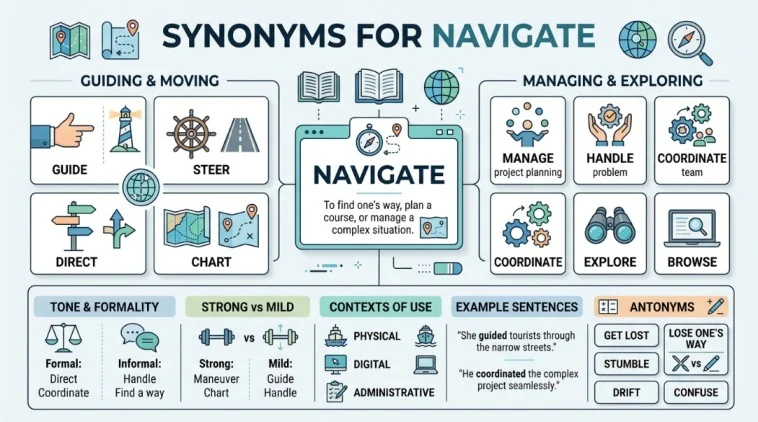
Navigate means to find or direct a route, move through a place or system, or successfully handle a situation. Depending on context, useful alternatives include guide, steer, direct, maneuver, explore, browse, manage, handle, and negotiate.
Featured Snippet Answer
The best synonym for navigate depends on the situation. Use “steer” for controlling a vehicle or course, “guide” for helping someone find a way, “browse” for websites, “maneuver” for careful movement, “manage” for handling situations, and “explore” for discovering places, ideas, or options.
Meaning, Tone and Context
1. Simple Definition
Navigate means to find a way from one place to another or to direct movement toward a destination.
It can also mean successfully dealing with a complicated situation, process, system, or set of choices.
For example, you can navigate a city, navigate a website, navigate a difficult conversation, or navigate a career change.
2. Part of Speech
“Navigate” is primarily a verb.
Common forms include:
- Navigate
- Navigated
- Navigating
- Navigation
- Navigator
- Navigational
The noun “navigation” describes the process of finding or directing a route.
3. Tone
Navigate is generally neutral.
It can sound professional when discussing systems, projects, careers, or complicated situations. It can also sound completely natural in everyday conversation.
The emotional effect depends largely on the surrounding sentence.
4. Formality Level
Navigate works in casual, academic, professional, and creative writing.
However, a more precise word can often improve the sentence. For example, “browse the website” is clearer than “navigate the website” when you simply mean looking through online content.
5. Common Use Cases
Navigate is commonly used for:
- Finding a physical route
- Driving or sailing
- Using websites and software
- Moving through complicated systems
- Handling difficult situations
- Making decisions
- Managing change
- Exploring unfamiliar places
- Guiding people
- Directing a course or process
6. Related Word Forms
Navigation: The act or process of finding or directing a route.
Navigator: A person or system that determines a route or direction.
Navigational: Relating to navigation.
Navigable: Able to be traveled through or successfully used.
When and How to Use “Navigate”
Use “navigate” when the idea involves finding a route, directing movement, working through a system, or successfully handling something complicated.
Professional
“Our team must navigate several changes in the industry.”
Here, navigate means successfully deal with changing circumstances.
Personal
“I am learning how to navigate life in a new city.”
The word suggests adapting to unfamiliar surroundings.
Academic
“Students must navigate a complex research process.”
The word describes moving successfully through a complicated process.
Emotional
“She had to navigate a difficult period after the loss.”
Here, navigate suggests managing a challenging emotional experience.
Creative
“The small boat navigated the narrow channel.”
The word creates a clear image of controlled movement through water.
Social Media
“Learning to navigate adulthood one decision at a time.”
This gives the word a metaphorical meaning related to managing life.
“I would appreciate your advice on how to navigate this process.”
This sounds polite and professional when asking for help with a complicated procedure.
Another Word for “Navigate”
There is no single replacement that works perfectly in every sentence. The best synonym depends on the intended meaning.
Professional Writing
Use manage, handle, direct, or maneuver when discussing responsibilities, systems, or challenges.
Academic Writing
Use examine, explore, address, or work through when the context involves ideas, evidence, or complex subjects.
Casual Conversation
Use find your way, get around, move through, or handle.
Emotional Writing
Use cope with, work through, handle, or manage when describing difficult experiences.
Creative Writing
Use steer, thread, chart, roam, or explore, depending on the image you want to create.
Resume or Workplace Use
Use managed, directed, coordinated, or handled when you want to emphasize an actual professional skill.
For example, “Managed complex client requests” can communicate professional responsibility more directly than “Navigated complex client requests.”
Social Media Captions
Use explore, discover, wander, or find your way when the tone is personal, relaxed, or inspirational.
Stronger Meaning
Use maneuver, negotiate, or steer when you want to emphasize deliberate control or skill.
Softer Meaning
Use explore, move through, or work through when you want a less forceful tone.
When Not to Use “Navigate”
Navigate can become vague when the reader cannot tell what action you actually performed.
For example:
“John navigated the project successfully.”
This does not explain what John actually did.
A more precise version could be:
“John coordinated the project across three departments.”
The second sentence gives the reader a clearer picture of the action.
Navigate can also sound unnecessarily sophisticated in simple situations.
Instead of:
“I navigated the grocery store.”
Say:
“I walked through the grocery store.”
However, “navigate the grocery store” could make sense if you mean finding your way through a crowded or unfamiliar store.
The key is precision. Choose a synonym that communicates the exact action rather than simply replacing one word with another.
Words Commonly Confused With “Navigate”
Navigate vs. Guide
Navigate focuses on finding or directing a route.
Guide focuses on helping another person or group reach a destination or understanding.
You navigate a trail. You guide someone along the trail.
Navigate vs. Explore
Navigate suggests purposeful movement or successful progress.
Explore emphasizes discovery and investigation.
You navigate a complicated website. You explore a new city.
Navigate vs. Manage
Navigate can mean dealing with complexity.
Manage emphasizes control, responsibility, or successful handling.
You navigate a difficult transition. You manage a project.
Navigate vs. Steer
Navigate can involve determining a route.
Steer emphasizes controlling the direction of movement.
You navigate a journey. You steer the boat.
Navigate vs. Browse
Navigate can describe moving through a website or digital system.
Browse specifically emphasizes looking through available content, pages, products, or information.
You navigate the account settings. You browse the online store.
Navigate vs. Maneuver
Navigate is broader.
Maneuver emphasizes careful movement, positioning, or strategic action, often in a difficult situation.
You navigate city traffic. You maneuver into a narrow parking space.
Best Synonym by Context for “Navigate”
| Context | Best Synonym | Why It Works | Example |
|---|---|---|---|
| Formal writing | Direct | Emphasizes purposeful control | She directed the team through the transition. |
| Academic writing | Explore | Works well for investigating ideas | The paper explores the causes of the trend. |
| Professional use | Manage | Highlights responsibility and control | She managed the new client process. |
| Resume | Coordinate | Shows organized professional action | Coordinated multiple teams during implementation. |
| Casual conversation | Find your way | Sounds natural and conversational | We found our way through downtown. |
| Creative writing | Chart | Creates a sense of deliberate direction | They charted a course across the sea. |
| Emotional tone | Work through | Suggests gradual progress through difficulty | He worked through a difficult period. |
| Strong intensity | Maneuver | Suggests skillful movement through difficulty | She maneuvered through several complex negotiations. |
| Soft tone | Explore | Feels open and nonforceful | We explored several possible solutions. |
| Social media | Wander | Creates a relaxed sense of discovery | We wandered through the old neighborhood. |
| Website use | Browse | Clearly refers to looking through online content | Browse our latest articles. |
| Driving | Steer | Emphasizes control of direction | He steered the car around the obstacle. |
Which Synonym Should You Choose?
Start by asking what “navigate” actually means in your sentence.
- If you mean finding a route, consider “find your way,” “travel,” “move through,” or “chart.”
- If you mean controlling direction, choose “steer,” “direct,” or “guide.”
- If you mean handling difficulty, consider “manage,” “handle,” “work through,” or “cope with.”
- If you mean looking through online content, “browse” is usually more precise.
- If you mean discovering something, “explore” is often the better choice.
For professional writing, prioritize words that describe a measurable action. Words such as “managed,” “directed,” and “coordinated” can communicate responsibility more clearly.
For emotional or creative writing, choose based on feeling. “Work through” feels reflective, while “maneuver” suggests effort and skill.
Real Life Examples of “Navigate” in Sentences
School
“Students often need to navigate unfamiliar academic requirements.”
A stronger alternative could be “Students often need to understand and manage unfamiliar academic requirements.”
Workplace
“Our department is learning to navigate new regulations.”
You could use “adapt to” if the focus is adjustment rather than simply dealing with the regulations.
Writing
“The author navigates several complicated themes throughout the novel.”
Here, “explores” may be better if the author is examining ideas rather than managing them.
Conversation
“Can you help me navigate this website?”
“Can you help me find my way around this website?” sounds more conversational.
Social Media
“Trying to navigate a new city without a plan.”
“Exploring a new city without a plan” gives the caption a more adventurous feeling.
Resume
“Navigated complex customer issues while maintaining high service standards.”
A more action focused resume version could be:
“Resolved complex customer issues while maintaining high service standards.”
“I would appreciate your guidance as I navigate the next stage of the process.”
This is appropriate when the process has several steps or uncertainties.
Storytelling
“The captain carefully navigated the boat through the narrow passage.”
“Steered” would be a stronger choice if the sentence specifically emphasizes control of the boat.
25 Synonyms for “Navigate”
| Synonym | Simple Meaning | Best Used For | Example Sentence |
|---|---|---|---|
| Guide | Help someone find a way | People, routes, learning | She guided the visitors through the museum. |
| Steer | Control direction | Cars, boats, movement | He steered the boat toward the harbor. |
| Direct | Control or point toward a destination | People, projects, movement | The manager directed the team toward the main goal. |
| Maneuver | Move or act carefully in a difficult situation | Vehicles, negotiations, challenges | She maneuvered the car into the tight space. |
| Manage | Successfully control or handle something | Work, challenges, situations | He managed the transition with confidence. |
| Handle | Deal with something effectively | Problems, requests, situations | She handled the customer complaint professionally. |
| Explore | Investigate or discover | Places, ideas, options, websites | We explored several solutions before deciding. |
| Browse | Look through available content | Websites, stores, catalogs | I browsed the website for more information. |
| Travel | Move from one place to another | Journeys and locations | They traveled through several small towns. |
| Roam | Move around without a fixed direction | Casual or creative writing | We roamed through the historic district. |
| Wander | Walk or move without a specific route | Travel and storytelling | They wandered through the market all afternoon. |
| Chart | Plan or determine a route | Journeys, plans, progress | The crew charted a safe course home. |
| Pilot | Control and operate a vehicle | Aircraft and some other vehicles | She piloted the aircraft through difficult conditions. |
| Directly handle | Deal with something personally | Professional situations | The supervisor directly handled the issue. |
| Coordinate | Organize several actions or groups | Workplace and projects | She coordinated the teams during the event. |
| Lead | Show the way or guide others | People, groups, organizations | He led the group through the forest. |
| Address | Deal with a problem or subject | Academic and professional writing | The report addresses several major concerns. |
| Tackle | Make a determined effort to solve something | Problems and challenges | The team tackled the technical problem together. |
| Negotiate | Work through differences to reach an outcome | Business, conflict, agreements | They negotiated the difficult contract terms. |
| Cope with | Deal with something difficult | Emotional and personal situations | She learned to cope with the sudden change. |
| Adapt to | Adjust successfully to new conditions | Change, work, environments | New employees must adapt to the company culture. |
| Work through | Make gradual progress through difficulty | Emotional, personal, academic situations | He worked through the problem one step at a time. |
| Progress through | Move forward through stages | Processes and systems | The applicants progressed through several stages. |
| Move through | Pass through a place or process | General movement | We moved through the crowded station quickly. |
| Find your way | Discover or determine how to reach somewhere | Casual conversation and travel | We eventually found our way back to the hotel. |
Note that some entries above are contextual alternatives rather than perfect replacements in every sentence. “Navigate” has several meanings, so accuracy depends on the intended sense.
Synonym Groups and Usage Differences
Professional vs. Personal Synonyms
Professional writing often benefits from specific action verbs.
Use “manage” for responsibility, “coordinate” for organizing people or activities, “direct” for leadership, and “address” for dealing with an issue.
Personal writing can be more flexible. “Find your way,” “explore,” “wander,” and “work through” can sound more natural when describing personal experiences.
Formal vs. Conversational Synonyms
Words such as “direct,” “coordinate,” “address,” and “manage” can work well in formal communication.
Conversational alternatives include “find your way,” “get around,” “handle,” and “work through.”
For an email to a manager, “manage” may sound more appropriate than “wander.” For a text to a friend, the opposite may be true.
Academic Synonyms
Academic writing should favor precision over unnecessary sophistication.
“Explore” works well when discussing research questions or ideas. “Address” works well for problems and topics. “Examine” can work when the focus is detailed investigation.
Do not replace “navigate” automatically. Sometimes “navigate” is already the clearest choice.
Professional and Business Synonyms
Business writing should show what happened rather than hide the action behind a broad word.
For example:
“Managed a complex customer transition.”
This is more specific than:
“Navigated a complex customer transition.”
Likewise, “coordinated,” “resolved,” “directed,” and “negotiated” can be valuable when they accurately describe the work performed.
Creative or Literary Synonyms
Creative writing gives you more freedom.
“Chart,” “roam,” “wander,” “thread,” “steer,” and “explore” can create different images.
For example, “The traveler wandered through the valley” creates a different mood from “The traveler charted a course through the valley.”
Slang or Modern Synonyms
There are no universally appropriate slang replacements for navigate.
Casual phrases such as “find your way around” and “get around” are common in everyday speech.
Use them in conversation, informal captions, and personal writing. Avoid them when a formal or academic audience expects precise language.
Strongest vs. Weaker Synonyms
A useful intensity scale is:
Mild: Explore, move through, find your way
Moderate: Handle, manage, guide, address
Stronger: Maneuver, negotiate, tackle, direct
The strongest choice is not automatically the best choice. Select the word that accurately matches the action.
Emotional vs. Neutral Synonyms
“Navigate” is relatively neutral.
“Manage” can emphasize competence.
“Cope with” introduces emotional difficulty.
“Work through” suggests patience and gradual progress.
“Maneuver” can suggest strategic effort.
“Explore” usually feels open and curious.
Antonyms of “Navigate”
Because navigate has several meanings, its opposites also depend on context. The following words and phrases represent different opposite ideas.
| Antonym | Meaning | Example Sentence |
|---|---|---|
| Stay | Remain in one place | We stayed at the entrance instead of moving through the building. |
| Remain | Continue in the same position or state | The boat remained in the harbor. |
| Stop | Cease movement | The driver stopped before reaching the intersection. |
| Halt | Bring movement to an end | The crew halted the journey because of the storm. |
| Retreat | Move backward or away | The hikers retreated from the dangerous path. |
| Return | Go back to a previous place | We returned to the starting point. |
| Get lost | Fail to find the correct route | We got lost after taking the wrong road. |
| Mislead | Cause someone to follow the wrong direction | The incorrect sign misled several visitors. |
| Misdirect | Send in the wrong direction | The outdated instructions misdirected the travelers. |
| Avoid | Stay away from something | She avoided the complicated process entirely. |
| Abandon | Leave something rather than continue through it | They abandoned the route after the road closed. |
| Ignore | Fail to deal with or consider something | He ignored the warning signs. |
| Resist | Refuse to move toward or accept something | She resisted the proposed change. |
| Block | Prevent movement or progress | The fallen tree blocked the road. |
| Confuse | Make a route, process, or situation harder to understand | The unclear instructions confused the new users. |
These are contextual opposites rather than universal dictionary antonyms. The appropriate opposite depends on whether navigate means movement, direction, progress, or handling complexity.
Comparison: “Navigate” vs. Similar Words
Navigate vs. Guide
Main difference: Navigate focuses on finding or directing a route. Guide focuses on helping another person or group.
Which is stronger: Neither is inherently stronger.
Which is more formal: Both can work in formal writing.
Navigate: “She navigated the trail using a detailed map.”
Guide: “She guided the students along the trail.”
Navigate vs. Explore
Main difference: Navigate suggests purposeful movement or progress. Explore suggests discovery or investigation.
Which is stronger: Navigate can imply greater direction.
Which is more formal: Both work across formal and informal contexts.
Navigate: “The team navigated the approval process.”
Explore: “The team explored several possible solutions.”
Navigate vs. Manage
Main difference: Navigate emphasizes moving through complexity. Manage emphasizes control and responsibility.
Which is stronger: Manage often sounds more action oriented in professional contexts.
Which is more formal: Both are suitable for professional writing.
Navigate: “She navigated the transition successfully.”
Manage: “She managed the transition successfully.”
Navigate vs. Steer
Main difference: Steer specifically emphasizes controlling direction.
Which is stronger: Steer is more specific when physical direction is involved.
Which is more formal: Both can be formal depending on context.
Navigate: “The captain navigated the vessel through the channel.”
Steer: “The captain steered the vessel through the channel.”
Navigate vs. Browse
Main difference: Browse means looking through content. Navigate means moving through a website or system with some directional purpose.
Which is stronger: Navigate suggests more purposeful movement.
Which is more formal: Both can be professional.
Navigate: “Navigate to the account settings.”
Browse: “Browse our collection of resources.”
Navigate vs. Maneuver
Main difference: Maneuver emphasizes careful or strategic movement.
Which is stronger: Maneuver generally conveys more difficulty or skill.
Which is more formal: Both can work in formal writing.
Navigate: “She navigated the busy streets.”
Maneuver: “She maneuvered through the narrow streets.”
Common Phrases and Expressions with “Navigate”
1. Navigate a Route
Meaning:
Find or follow a route from one location to another.
Example sentence:
“The app helped us navigate the route to the airport.”
2. Navigate a Website
Meaning:
Move between pages or sections of a website.
Example sentence:
“Users can easily navigate the website from the main menu.”
3. Navigate a System
Meaning:
Use or work through a complicated system.
Example sentence:
“New employees receive training on how to navigate the internal system.”
4. Navigate a Challenge
Meaning:
Deal successfully with a difficult situation.
Example sentence:
“The company had to navigate several challenges during the transition.”
5. Navigate Change
Meaning:
Adapt and make progress during a period of change.
Example sentence:
“Strong communication helps teams navigate change.”
6. Navigate a Difficult Conversation
Meaning:
Handle a sensitive or complicated discussion carefully.
Example sentence:
“She knew how to navigate a difficult conversation without creating more tension.”
7. Navigate Life
Meaning:
Handle the experiences, decisions, and challenges that come with life.
Example sentence:
“Everyone develops different ways to navigate life.”
8. Navigate the Process
Meaning:
Move successfully through a series of steps or requirements.
Example sentence:
“Our advisor helped us navigate the application process.”
Common Mistakes to Avoid
1. Using Navigate When a More Precise Word Is Better
“Navigated the customer complaint” is understandable, but “resolved the customer complaint” may communicate the actual action more clearly.
2. Confusing Navigate With Explore
Exploring emphasizes discovery. Navigating emphasizes direction or successful movement.
Choose “explore” when the goal is to investigate possibilities rather than reach a specific destination.
3. Using a Casual Synonym in Formal Writing
Phrases such as “get around” may sound natural in conversation but can feel too casual in an academic paper or formal report.
4. Using an Overly Dramatic Synonym
“Maneuvered through the grocery store” may sound excessive if you simply walked through a familiar store.
Use stronger language only when the situation genuinely involves difficulty or careful movement.
5. Repeating Navigate Too Often
If every paragraph says “navigate,” the writing can feel repetitive.
Replace it only when the alternative adds accuracy or improves readability.
6. Choosing the Wrong Emotional Tone
“Cope with” implies difficulty. “Explore” implies curiosity. “Manage” implies control.
Make sure the replacement word matches the emotional meaning you intend.
7. Using Slang in Academic or Professional Writing
Casual phrases can make formal writing sound less polished.
Always consider your audience before replacing a neutral word with conversational language.
FAQs
What is the best synonym for navigate?
The best synonym depends on context. Use “guide” for helping others, “steer” for direction, “browse” for websites, and “manage” for difficult situations.
What is a formal synonym for navigate?
“Direct,” “manage,” “coordinate,” “address,” and “maneuver” can serve as formal alternatives when they accurately describe the intended action.
What is an informal synonym for navigate?
Informal alternatives include “find your way,” “get around,” “move through,” and “work through,” depending on the situation.
What is another word for navigate in professional writing?
In professional writing, “manage,” “coordinate,” “direct,” “handle,” or “address” can be stronger choices because they describe specific workplace actions.
What is the difference between navigate and explore?
Navigate emphasizes finding a route or progressing through complexity. Explore emphasizes discovering, investigating, or examining places, ideas, or possibilities.
What is the opposite of navigate?
There is no single opposite for every meaning. Contextual opposites include “get lost,” “stay,” “stop,” “retreat,” “misdirect,” “block,” and “avoid.”
Conclusion
Navigate is a flexible verb that can describe finding a physical route, using a digital system, directing movement, or dealing with a complicated situation.
The best synonym depends on your exact meaning. Choose “guide” when helping someone, “steer” when controlling direction, “browse” for online content, “explore” for discovery, and “manage” or “handle” for difficult situations.
For professional and academic writing, precision matters more than simply finding a different word.
A useful vocabulary tip is to ask yourself what action you actually mean before choosing a synonym. The more specific your word choice, the clearer and more effective your writing becomes.
Source Verification Note
Before publishing, verify definitions, parts of speech, and nuanced usage with trusted dictionaries such as Cambridge Dictionary, Oxford English Dictionary, Merriam Webster, Collins Dictionary, or Britannica. Dictionary sources should be checked directly rather than relying on invented or unverified citations.
Discover More Post:
25+ Synonyms for Compassion | Meanings, Examples, and …
25+ Synonyms for Share | Meanings, Examples and Best …