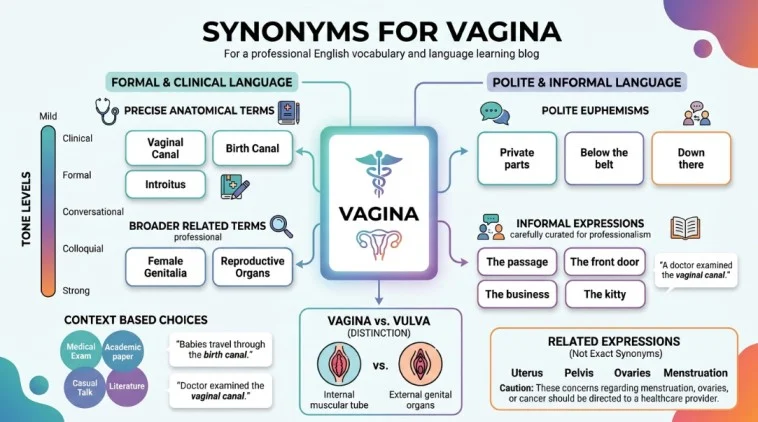
Repeating the word vagina can feel awkward when writing an essay, explaining anatomy, creating educational content, or choosing the right tone for a conversation. English offers several alternative expressions, but they are not all interchangeable.
The most accurate approach is to understand whether you need a medical term, a broader anatomical expression, a polite euphemism, or informal slang. This guide explains the differences so you can choose vocabulary that sounds natural, respectful, and appropriate for your audience.
What Does “Vagina” Mean?
Vagina is a medical noun referring to the muscular canal that connects the cervix with the outside of the body. Depending on context, alternatives include vaginal canal, birth canal, female genital tract, and broader expressions such as female genitalia.
Meaning, Tone and Context
Simple Definition
The vagina is a muscular internal reproductive structure that extends from the cervix to the vaginal opening.
It is part of the female reproductive system and is distinct from the vulva, which refers to the external female genital structures.
Part of Speech
Vagina is a noun.
Example:
“The doctor explained how the vagina functions as part of the reproductive system.”
Tone
The word vagina is neutral, anatomical, and medically appropriate.
It is not inherently positive or negative. Its tone depends mainly on the surrounding sentence and context.
Formality Level
Vagina is appropriate for:
- Medical writing
- Health education
- Biology classes
- Academic writing
- Professional healthcare communication
- General educational content
Common Use Cases
You may encounter the word in medical information, anatomy textbooks, reproductive health discussions, educational articles, healthcare appointments, and scientific writing.
Important Related Word Forms
Vaginal is the adjective related to vagina.
Example:
“The patient received information about vaginal health.”
The word vulva refers to the external genital structures and should not be treated as an exact synonym for vagina.
When and How to Use “Vagina”
Use vagina when anatomical accuracy matters. It is generally the best choice for medical, educational, academic, and health related communication.
Professional
“The healthcare provider discussed vaginal health with the patient.”
Academic
“The study examined changes affecting the vaginal microbiome.”
Personal
“She wanted reliable information about normal vaginal anatomy.”
Educational
“The diagram shows the location of the vagina within the reproductive system.”
Medical
“The medication is administered through the vagina.”
Social Media
“The post explains basic facts about the vagina using clear medical language.”
Casual
“Many people learn surprisingly little about the vagina in school.”
Another Word for “Vagina”
There is no single replacement that works in every situation because many alternatives are broader, more informal, or context specific.
Professional Writing
Use vagina or vaginal canal when anatomical precision is important.
Academic Writing
Use vagina, vaginal canal, or a scientifically appropriate anatomical expression.
Casual Conversation
Expressions such as private area or intimate area may sound softer, but they are less precise.
Emotional Writing
Intimate area can work when the goal is sensitivity rather than anatomical detail.
Creative Writing
A euphemism may fit dialogue or characterization, but the choice should reflect the speaker and setting.
Resume or Workplace Use
The word is rarely relevant to a resume. In workplace communication involving health, use precise medical terminology when necessary.
Social Media Captions
For educational posts, vagina is usually clearer than slang. For general audiences, intimate area may provide a softer tone.
Stronger Meaning
There is no need for a stronger synonym in anatomical writing. Vulgar slang can create a much stronger social or sexual tone, but it is not more medically accurate.
Softer Meaning
Private area, intimate area, and private parts can sound softer, although they are less specific.
When Not to Use “Vagina”
The word itself is not inappropriate in medical or educational writing, but it may be too specific when the sentence actually refers to the external genitalia.
For example:
Incorrect:
“The vulva is another word for the vagina.”
Better:
“The vulva refers to the external genital structures, while the vagina is an internal muscular canal.”
It can also be unnecessarily clinical in fictional dialogue where a character would naturally use a euphemism or informal expression.
Words Commonly Confused With “Vagina”
| Word | Difference |
|---|---|
| Vulva | Refers to the external female genital structures, not the vagina itself. |
| Genitals | A broader term for reproductive or sexual organs. |
| Birth canal | A context specific expression that can include the vagina during childbirth. |
| Female reproductive tract | A broader anatomical term covering multiple reproductive structures. |
| Uterus | A separate reproductive organ where pregnancy develops. |
| Cervix | The lower part of the uterus that connects to the vagina. |
Best Synonym by Context for “Vagina”
| Context | Best Synonym | Why It Works | Example |
|---|---|---|---|
| Formal writing | Vagina | Precise anatomical terminology | The vagina is part of the reproductive system. |
| Academic writing | Vagina | Scientifically clear | The research examined vaginal health. |
| Professional or business use | Vagina | Appropriate when medically relevant | The clinician explained vaginal symptoms. |
| Resume | Vaginal | Appropriate only when relevant to a medical role | The course covered vaginal health education. |
| Casual conversation | Private area | Softer and less clinical | She mentioned discomfort in her private area. |
| Creative writing | Intimate area | Provides a softer descriptive tone | The character felt uncomfortable discussing her intimate area. |
| Emotional tone | Private parts | More indirect and sensitive | She was embarrassed to discuss her private parts. |
| Strong intensity | Vulgar slang | Creates a deliberately informal or provocative tone | The character used vulgar slang in the dialogue. |
| Soft or moderate tone | Intimate area | Polite and indirect | The doctor asked about discomfort in the intimate area. |
| Social media captions | Vagina | Clear for educational content | The post explains basic vagina anatomy. |
| US usage | Vagina | Standard medical term in US English | The textbook describes the vagina clearly. |
| UK usage | Vagina | Also standard anatomical terminology | The medical guide uses the term vagina. |
Which Synonym Should You Choose?
Start with meaning, not word variety.
If anatomical accuracy matters, use vagina. You mean the external anatomy, use vulva. If you are discussing a broader area, a phrase such as female genitalia may be more suitable.
Next, consider formality. Medical and academic readers generally benefit from precise terminology, while personal or fictional contexts may call for softer language.
Finally, consider emotional intensity. Euphemisms can sound gentler, while slang can sound humorous, vulgar, provocative, or deliberately informal.
Real Life Examples of “Vagina” in Sentences
School
“The biology lesson explained the basic anatomy of the vagina and reproductive system.”
Workplace
“The healthcare presentation included information about vaginal health.”
Writing
“Accurate terminology makes the paragraph about vaginal anatomy easier to understand.”
Conversation
“She preferred using the medical term vagina rather than a slang expression.”
Social Media
“This educational post explains common facts about the vagina.”
Resume
“Completed coursework covering reproductive anatomy and vaginal health.”
“The educational brochure provides information about vaginal health and preventive care.”
Storytelling
“The character avoided medical terminology and used a softer expression instead.”
25 Synonyms and Alternative Terms for “Vagina”
Important accuracy note: The following list contains true near synonyms, broader anatomical terms, euphemisms, and informal expressions. Several are not exact anatomical equivalents. That distinction is important for good vocabulary writing.
| Synonym or Alternative | Simple Meaning | Best Used For | Example Sentence |
|---|---|---|---|
| Vaginal canal | The muscular canal known as the vagina | Medical and educational writing | The vaginal canal connects the cervix with the outside of the body. |
| Birth canal | A passage involved in childbirth | Pregnancy and childbirth contexts | The baby passes through the birth canal during delivery. |
| Female genital tract | A broader group of reproductive structures | Medical and academic writing | The study examined the female genital tract. |
| Female genitalia | The female reproductive and genital structures | Medical and general education | The article explains female genitalia using simple terminology. |
| Female genitals | A general term for female genital structures | General and educational contexts | The guide discusses female genitals respectfully. |
| Genital tract | A broader anatomical expression | Scientific writing | The infection can affect parts of the genital tract. |
| Genital area | A general area around the genitals | General communication | The patient reported irritation in the genital area. |
| Intimate area | A polite indirect expression | Sensitive conversation | She described discomfort in her intimate area. |
| Private area | A common euphemism for genital anatomy | Casual conversation | He used the phrase private area instead of a medical term. |
| Private parts | An indirect term for genital anatomy | Family and casual contexts | The child was taught that private parts deserve respectful care. |
| Intimate parts | A softer expression for genital structures | Sensitive communication | The lesson used the phrase intimate parts for younger students. |
| Internal genitalia | Internal reproductive structures | Anatomical education | The diagram identifies the internal genitalia. |
| Reproductive tract | A broader system of reproductive structures | Academic writing | The textbook describes the female reproductive tract. |
| Female anatomy | A broad term covering female body structures | General education | The course introduces basic female anatomy. |
| Female reproductive anatomy | Anatomical structures involved in reproduction | Education and healthcare | The presentation covers female reproductive anatomy. |
| Vaginal opening | The opening at the lower end of the vagina | Anatomical descriptions | The diagram labels the vaginal opening clearly. |
| Vaginal passage | A descriptive expression for the vaginal canal | Educational contexts | The text describes the vaginal passage during childbirth. |
| Yoni | A culturally specific term associated with female genital anatomy | Cultural or spiritual contexts | The author discusses the historical meaning of yoni. |
| Down there | An indirect euphemism for genital anatomy | Very casual conversation | She simply referred to discomfort down there. |
| Private region | A polite but broad expression | Sensitive general communication | The patient mentioned irritation in her private region. |
| Intimate region | A broad, indirect expression | Sensitive writing | The brochure uses intimate region as a gentle expression. |
| Lady parts | An informal euphemism for female genital anatomy | Casual conversation | The character used lady parts because she disliked medical terminology. |
| Vajayjay | A humorous euphemism for vagina | Informal or humorous speech | The television character jokingly used vajayjay. |
| Hooha | An informal euphemism for female genital anatomy | Very casual speech | The character used hooha as a humorous expression. |
| Pussy | Vulgar slang that can refer to the vagina or vulva | Informal adult dialogue only | The novel uses the vulgar term to reflect the character’s speech. |
Synonym Groups and Usage Differences
Professional vs. Personal Synonyms
Professional communication favors precise anatomical terminology.
Vagina, vaginal canal, and other medically accurate expressions work well in healthcare and educational settings.
Personal conversations may use private area, intimate area, or private parts when the speaker wants to sound less clinical.
Formal vs. Conversational Synonyms
Vagina is suitable for reports, textbooks, essays, healthcare discussions, and educational articles.
Expressions such as down there, lady parts, and hooha are conversational and should not replace anatomical terminology in formal writing.
Academic Synonyms
Academic writing benefits from precision.
Vagina, vaginal canal, female genital tract, and female reproductive anatomy can be useful when their meanings match the subject being discussed.
Avoid slang in academic writing because it can reduce clarity and professionalism.
Professional and Business Synonyms
Workplace communication should prioritize accuracy and relevance.
When discussing healthcare, education, research, or workplace policies, vagina is usually preferable to an informal euphemism.
A softer expression may be appropriate in patient centered communication when the broader context calls for accessible language.
Creative or Literary Synonyms
Creative writing allows greater flexibility.
A writer might use intimate area, private parts, or culturally specific terminology when the expression fits the character, historical setting, or narrative voice.
The key is consistency. A character’s vocabulary should sound natural for that character.
Slang or Modern Synonyms
Informal expressions such as vajayjay, hooha, and pussy can occur in contemporary English.
Their meanings, offensiveness, and social acceptability vary considerably. They are not appropriate substitutes for vagina in medical, academic, professional, or educational writing.
Strongest vs. Weaker Synonyms
A useful intensity scale is:
Vagina: neutral and medically precise.
Vaginal canal: highly anatomical and precise.
Intimate area: soft and indirect.
Private area: soft and conversational.
Lady parts: informal and euphemistic.
Vajayjay: humorous and informal.
Hooha: humorous and very casual.
Pussy: vulgar and strongly informal.
This scale describes social tone rather than anatomical accuracy.
Emotional vs. Neutral Synonyms
Vagina is generally neutral.
Vaginal canal sounds more clinical.
Intimate area sounds softer.
Private parts can sound sensitive or protective.
Slang can introduce humor, embarrassment, vulgarity, intimacy, or deliberate provocation depending on the speaker.
Antonyms of “Vagina”
Vagina has no true antonym. It names a specific anatomical structure, so creating conventional opposites would be inaccurate.
For vocabulary learners, the following terms are better understood as contrasting or anatomically related terms, not genuine antonyms.
| Contrasting Term | Meaning | Example Sentence |
|---|---|---|
| Penis | External male reproductive organ | The penis is part of male reproductive anatomy. |
| Testes | Male reproductive organs that produce sperm and hormones | The testes are located inside the scrotum. |
| Scrotum | External sac containing the testes | The scrotum helps regulate testicular temperature. |
| Prostate | Male reproductive gland below the bladder | The prostate contributes fluid to semen. |
| Uterus | Organ where pregnancy can develop | The embryo implants in the uterus. |
| Cervix | Lower portion of the uterus | The cervix connects the uterus with the vagina. |
| Vulva | External female genital structures | The vulva is different from the vagina. |
| Fallopian tube | Tube connecting the area near an ovary with the uterus | Fertilization commonly occurs in a fallopian tube. |
| Ovary | Female reproductive organ that produces eggs and hormones | An ovary releases an egg during ovulation. |
| Urethra | Tube that carries urine outside the body | The urethra is separate from the vagina. |
| Bladder | Organ that stores urine | The bladder stores urine before urination. |
| Anus | Opening at the end of the digestive tract | The anus belongs to the digestive system. |
| Rectum | Final section of the large intestine | The rectum stores stool before elimination. |
| Clitoris | Sensitive external erectile organ | The clitoris is part of the vulva. |
| Labia | Folds of skin forming part of the vulva | The labia are external genital structures. |
Comparison: Vagina vs. Similar Words
Vagina vs. Vulva
Main difference: The vagina is an internal muscular canal, while the vulva refers to external genital structures.
Which one is stronger: Neither. They describe different anatomy.
Which one is more formal: Both are standard medical terms.
Example:
“The vagina is an internal canal.”
“The vulva includes external genital structures.”
Vagina vs. Birth Canal
Main difference: Birth canal is a context based term associated with childbirth and can refer to the passage through which a baby travels.
Which one is stronger: Neither.
Which one is more formal: Both can appear in medical contexts, but vagina is more anatomically specific.
Example:
“The vagina is part of the reproductive anatomy.”
“The baby moves through the birth canal during delivery.”
Vagina vs. Genitals
Main difference: Genitals is a broad term that can refer to external reproductive or sexual organs.
Which one is stronger: Neither.
Which one is more formal: Both can be appropriate depending on context.
Example:
“The vagina is an internal reproductive structure.”
“The doctor examined the genitals.”
Vagina vs. Female Genitalia
Main difference: Female genitalia is a broader expression covering multiple structures.
Which one is stronger: Female genitalia has broader meaning.
Which one is more formal: Both are suitable for educational and medical contexts.
Example:
“The vagina is one part of female reproductive anatomy.”
“The article discusses female genitalia as a whole.”
Vagina vs. Private Area
Main difference: Private area is a vague euphemism and does not identify a specific anatomical structure.
Which one is stronger: Vagina is more precise.
Which one is more formal: Vagina is more formal and medically appropriate.
Example:
“She discussed vaginal symptoms with her doctor.”
“She mentioned discomfort in her private area.”
Vagina vs. Pussy
Main difference: Pussy is vulgar slang and can refer to female genital anatomy in informal sexual language.
Which one is stronger: Pussy has a much stronger informal and vulgar tone.
Which one is more formal: Vagina is the formal anatomical term.
Example:
“The medical article uses the term vagina.”
“The character uses vulgar slang in the dialogue.”
Common Phrases and Expressions with “Vagina”
1. Vaginal health
Meaning: Health related to the vagina and surrounding reproductive anatomy.
Example sentence: “Good vaginal health is an important part of overall reproductive health.”
2. Vaginal canal
Meaning: An anatomical expression referring to the vagina.
Example sentence: “The diagram identifies the vaginal canal.”
3. Vaginal opening
Meaning: The opening at the external end of the vagina.
Example sentence: “The educational diagram labels the vaginal opening.”
4. Vaginal discharge
Meaning: Fluid released from the vagina.
Example sentence: “The healthcare guide explains common causes of vaginal discharge.”
5. Vaginal health care
Meaning: Care and attention related to vaginal health.
Example sentence: “The clinic provides educational resources about vaginal health care.”
6. Vaginal microbiome
Meaning: The community of microorganisms associated with the vagina.
Example sentence: “The researchers studied the vaginal microbiome.”
7. Vaginal anatomy
Meaning: The structure and features of the vagina.
Example sentence: “The course introduces students to basic vaginal anatomy.”
Common Mistakes to Avoid
1. Treating Vulva as an Exact Synonym
The vagina and vulva are different anatomical structures.
Use vulva when referring to external genital anatomy and vagina when referring to the internal canal.
2. Using a Broad Term When Precision Matters
Private area may sound polite, but it does not identify a particular structure.
Medical writing should generally use the precise anatomical term.
3. Using Slang in Academic Writing
Terms such as hooha, vajayjay, and vulgar slang are inappropriate for most essays, research papers, and professional documents.
4. Assuming Every Euphemism Means Exactly the Same Thing
Expressions such as private parts and intimate area can refer to a broader area than the vagina.
Context determines their meaning.
5. Choosing an Overly Dramatic Expression
A vulgar or provocative term may distract readers from a simple factual message.
Choose neutral terminology when the subject is educational.
6. Repeating “Vagina” Unnecessarily
Repetition can make a paragraph feel awkward, but replacing every occurrence with slang is not the solution.
Use accurate related terms only when the meaning genuinely changes.
7. Confusing Tone With Accuracy
A softer expression may sound more comfortable, but it does not necessarily become a better anatomical term.
Clarity should come first in medical and educational writing.
FAQs
What is the best synonym for vagina?
The closest accurate alternative is vaginal canal. However, vagina remains the clearest standard term for most medical, academic, and educational contexts.
What is a formal synonym for vagina?
Vaginal canal is a formal anatomical alternative. Broader expressions such as female genital tract may also work when the context involves multiple structures.
What is an informal synonym for vagina?
Informal alternatives include private area, lady parts, hooha, and other euphemisms. Their meanings and levels of informality vary.
What is another word for vagina in professional writing?
For professional writing, vagina is usually the best choice. Vaginal canal can be useful when a more anatomical description is needed.
What is the difference between vagina and vulva?
The vagina is an internal muscular canal. The vulva refers to the external female genital structures, so the two terms are not interchangeable.
What is the opposite of vagina?
Vagina has no true antonym because it is the name of a specific anatomical structure. Related terms may contrast by anatomy, but they are not true opposites.
Conclusion
The word vagina is already a clear, neutral, and medically accepted term. In most educational, academic, healthcare, and professional contexts, it is better to use the precise word than to force an alternative simply to avoid repetition.
When a softer expression is appropriate, private area or intimate area may work. For anatomical writing, vaginal canal is a useful near synonym. Broader terms such as female genitalia should be used only when the sentence refers to more than the vagina.
The most useful vocabulary tip is simple: choose alternatives according to meaning, precision, audience, and tone, not just because they appear in a synonym list.
Source verification note: Before publishing definitions or medical claims, verify terminology with trusted references such as Cambridge, Oxford, Merriam Webster, Collins, or Britannica, and use authoritative medical sources for anatomical information.
Discover More Post
- 25+ Synonyms for Navigate | Meanings, Examples, and Best …
- 25+ Synonyms for Friendship | Meanings, Examples, and Best …
- 25+ Synonyms for Compassion | Meanings, Examples, and …