Have you ever used the word favorite several times in an essay, email, social media caption, or everyday conversation? Although it is a simple and familiar word, repeating it can make your writing sound predictable. Learning alternative expressions helps you communicate your preferences with greater variety, personality, and precision.
The best replacement depends on what you want to describe. You might need a professional expression for a business presentation, a warm word for someone you love, or a creative alternative for a blog post. This guide explores 25 synonyms for favorite, explains their meanings, compares their tones, and provides natural examples to help you choose the right word in different situations.
What Does “Favorite” Mean?
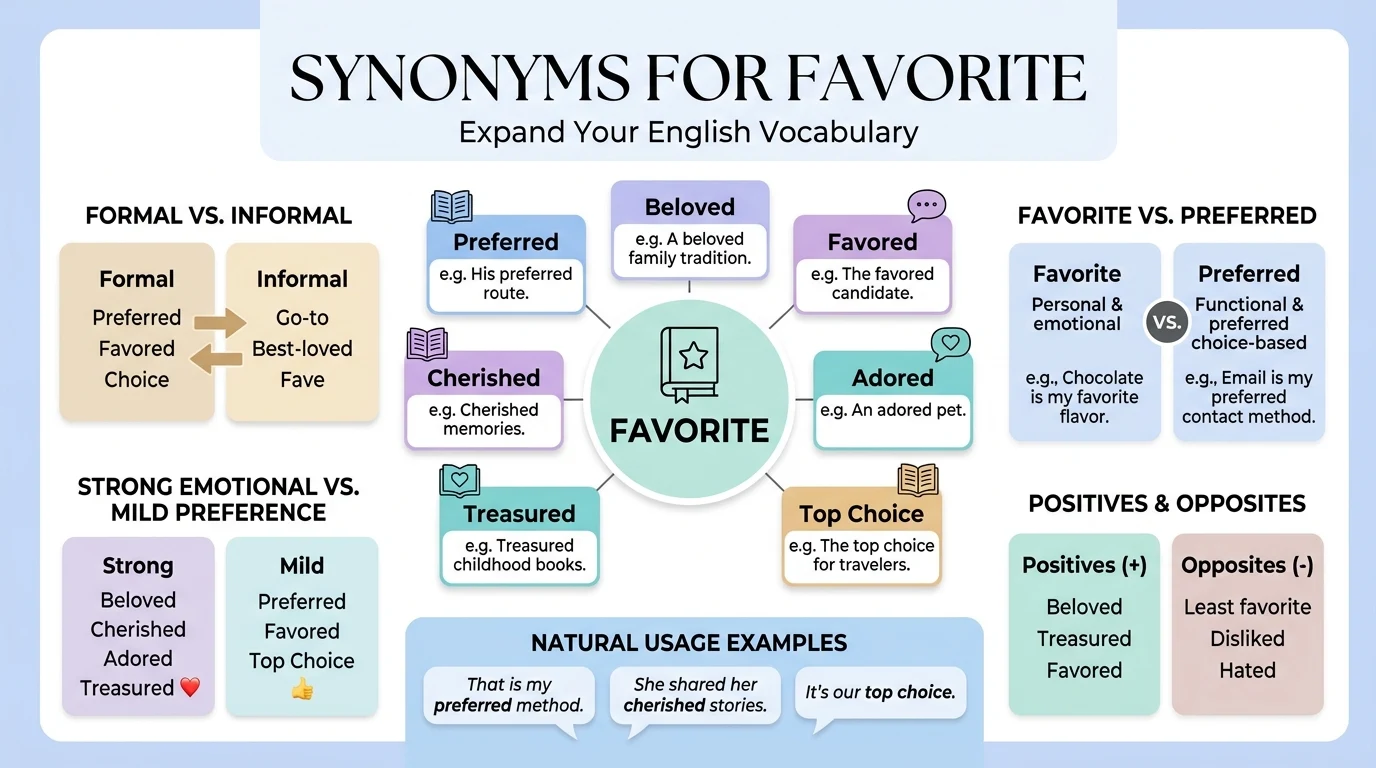
Favorite means the person, thing, activity, or choice someone likes, enjoys, or prefers more than others. Common synonyms include preferred, beloved, cherished, treasured, favored, adored, and most liked. The best alternative depends on whether you are writing formally, speaking casually, expressing affection, or describing a personal preference.
Meaning, Tone and Context
What Does Favorite Mean?
The word favorite describes someone or something that a person likes, enjoys, or chooses above other available options.
It can express personal preference, emotional attachment, popularity, or special importance.
For example, if chocolate is your favorite dessert, it means you enjoy chocolate more than other desserts.
Part of Speech
Favorite can function as both a noun and an adjective.
1. Favorite as a noun
It identifies a person or thing someone likes most.
Example: Reading mystery novels is my favorite.
2. Favorite as an adjective
It describes something that is especially liked or preferred.
Example: This is my favorite restaurant in town.
Tone and Formality
| Feature | Description |
|---|---|
| Tone | Generally positive and neutral |
| Formality | Neutral and conversational |
| Emotional meaning | Can express affection or attachment |
| Common usage | Everyday conversations, writing, reviews, captions |
| Professional suitability | Appropriate, although more precise alternatives may sometimes work better |
Common Word Forms
| Word Form | Meaning | Example |
|---|---|---|
| Favorite | Something preferred most | This is my favorite book. |
| Favorites | Multiple preferred choices | These are my favorites. |
| Favoritism | Unfair preference toward someone | The manager was accused of favoritism. |
| Favor | Support, approval, or preference | The proposal found favor with the committee. |
In American English, favorite is the standard spelling. British English generally uses favourite.
When and How to Use “Favorite”
Use favorite when identifying a preferred person, activity, product, place, or experience. It works in everyday conversations and most types of general writing.
Here are seven realistic examples.
- Personal: My favorite childhood memory is visiting my grandparents every summer.
- Professional: This presentation includes my favorite strategies for improving customer engagement.
- Academic: Shakespeare remains one of my favorite authors to study.
- Social Media: Sharing my favorite moments from this unforgettable vacation.
- Email: I have attached my favorite design concepts for your review.
- Creative: The old bookstore became her favorite escape from the noise of the city.
- Casual Conversation: Pizza is still my favorite food, no matter how many new dishes I try.
Another Word for “Favorite”
The best single replacement for favorite is usually preferred when discussing choices and beloved when expressing affection.
However, neither word works perfectly in every sentence. Choose an alternative that preserves the original meaning.
Best Alternatives by Context
| Context | Recommended Alternative | Example |
|---|---|---|
| Professional writing | Preferred | Our preferred supplier offers reliable service. |
| Academic writing | Preferred | The preferred method produced consistent results. |
| Casual conversation | Go to | This is my go to coffee shop. |
| Emotional writing | Beloved | She returned to her beloved hometown. |
| Creative writing | Cherished | He remembered that cherished afternoon. |
| Resume or workplace | Preferred | Selected as the preferred candidate. |
| Social media captions | Beloved | A few moments with my beloved people. |
| Stronger meaning | Treasured | These memories are treasured forever. |
| Softer meaning | Liked most | This is the design I liked most. |
Professional Writing
Use preferred, favored, or selected when discussing business decisions, products, strategies, or recommendations.
Example: Our preferred approach focuses on long term customer satisfaction.
Academic Writing
Preferred is usually the most appropriate replacement in academic discussions about methods, theories, or choices.
Example: The researchers selected the preferred model for further analysis.
Casual Conversation
Use go to, top choice, or liked most when speaking naturally with friends and family.
Example: That little Italian restaurant is my go to place for dinner.
Emotional Writing
Choose beloved, cherished, adored, or treasured when expressing affection or personal attachment.
Example: Her grandmother’s cherished photographs were kept in a wooden box.
Creative Writing
Use prized, dearest, cherished, or beloved to add descriptive depth.
Example: The garden remained his dearest place of comfort.
Resume and Workplace Use
Use preferred, selected, or valued when describing professional choices and recognition.
Example: Recognized as a valued contributor to the marketing team.
Social Media Captions
Use beloved, go to, top pick, or treasured depending on the message.
Example: My beloved weekend tradition never gets old.
When Not to Use “Favorite”
Although favorite is versatile, it can sound too general when a sentence requires a more precise description.
Here are situations where another word may improve your writing.
1. When discussing professional preferences
Favorite may sound too personal in formal business communication.
Instead of: This is our favorite marketing strategy.
Better: This is our preferred marketing strategy.
2. When expressing deep affection
Favorite does not always communicate strong emotional attachment.
Instead of: She is my favorite grandmother.
Better: She is my beloved grandmother.
3. When describing a special memory
Favorite may not fully express the emotional value of an experience.
Instead of: That was my favorite childhood memory.
Better: That was one of my most cherished childhood memories.
4. When discussing research methods
Favorite sounds subjective and may be unsuitable for objective academic writing.
Instead of: This is my favorite research method.
Better: This is the preferred research method for this study.
5. When describing popularity
Favorite and popular are not identical. A favorite can be someone’s personal choice, while popular describes something liked by many people.
Instead of: This is the favorite restaurant in the city.
Better: This is one of the most popular restaurants in the city, if popularity is what you mean.
Words Commonly Confused With “Favorite”
Several related words communicate preference, affection, or popularity, but their meanings are not exactly the same.
| Word | Meaning | Difference from Favorite | Example |
|---|---|---|---|
| Preferred | Chosen over alternatives | Emphasizes a deliberate choice | This is my preferred option. |
| Popular | Liked by many people | Describes public approval | This restaurant is popular locally. |
| Beloved | Deeply loved | Expresses emotional attachment | She is a beloved teacher. |
| Cherished | Valued emotionally | Highlights personal importance | It is a cherished memory. |
| Best | Better than all others | Focuses on quality or ranking | This is the best solution. |
| Admired | Respected or appreciated | Emphasizes respect | She is an admired leader. |
Best Synonym by Context for “Favorite”
Choosing the right synonym depends on your purpose, audience, and intended meaning. The following table highlights useful alternatives for different situations.
| Context | Best Synonym | Why It Works | Example |
|---|---|---|---|
| Formal writing | Preferred | Sounds professional and precise | Our preferred approach is more efficient. |
| Academic writing | Preferred | Suitable for objective discussions | The preferred model was selected. |
| Business communication | Favored | Describes a supported choice | The favored proposal received approval. |
| Resume | Valued | Highlights professional importance | A valued member of the sales team. |
| Casual conversation | Go to | Sounds natural and relaxed | This is my go to coffee shop. |
| Creative writing | Cherished | Adds emotional depth | She held onto a cherished memory. |
| Emotional expression | Beloved | Communicates deep affection | Her beloved dog waited by the door. |
| Strong emotional meaning | Treasured | Suggests great personal value | The treasured gift stayed with him. |
| Mild preference | Liked most | Communicates a simple preference | This is the design I liked most. |
| Social media captions | Top pick | Short and engaging | My top pick for weekend reading. |
| Personal relationships | Dearest | Expresses special affection | My dearest friend always understands me. |
| Product recommendations | Top choice | Highlights a leading selection | This laptop is our top choice. |
US and UK Usage
The main spelling difference is:
| American English | British English |
|---|---|
| Favorite | Favourite |
| Favorites | Favourites |
| Favoritism | Favouritism |
| Favor | Favour |
Both versions communicate the same meaning. Use favorite when writing for a US audience and maintain consistent American spelling throughout your article.
Which Synonym Should You Choose?
Choosing the right synonym is not simply about finding another word with a similar dictionary meaning. You should consider what the sentence communicates and how readers will interpret it.
Use these practical guidelines.
1. Consider the meaning
If you are discussing a personal choice, preferred or top choice may work. If you are expressing affection, beloved or cherished is more appropriate.
2. Consider formality
For professional emails, reports, and academic writing, preferred is generally safer than casual expressions such as go to.
3. Consider emotional intensity
Words such as liked most express a simple preference. Beloved, adored, and treasured communicate stronger feelings.
4. Consider professional value
In workplace communication, use valued, preferred, or favored when they accurately describe the situation.
5. Consider the sentence context
A synonym should fit naturally into the sentence. For example, beloved works when describing someone you love, but preferred is better when discussing a business option.
Practical tip: Read your sentence after replacing favorite. If the new word changes the original meaning, choose a different alternative.
Real Life Examples of “Favorite” in Sentences
Here are examples showing how different synonyms can make everyday writing more descriptive and precise.
| Situation | Example Sentence |
|---|---|
| School | My preferred subject this semester is English literature. |
| Workplace | Our preferred solution reduces unnecessary expenses. |
| Writing | This is one of her most cherished stories. |
| Conversation | That bakery is my go to place for fresh bread. |
| Social Media | A few of my top picks from this month’s adventures. |
| Resume | Recognized as a valued member of the project team. |
| Please review our preferred design before Friday. | |
| Storytelling | The old wooden house remained his beloved childhood home. |
| Shopping | This is my top choice for an everyday laptop. |
| Personal Life | Her dearest friends gathered to celebrate her birthday. |
25 Synonyms for “Favorite”
The following alternatives cover personal preferences, professional choices, emotional connections, and creative descriptions. Remember that some are context specific rather than interchangeable in every sentence.
| Synonym | Simple Meaning | Best Used For | Example Sentence |
|---|---|---|---|
| 1. Preferred | Liked or chosen more than other options | Formal and professional writing | This is our preferred solution. |
| 2. Beloved | Deeply loved | Relationships and emotional writing | She visited her beloved hometown. |
| 3. Cherished | Valued with affection | Memories and personal experiences | It is a cherished family tradition. |
| 4. Treasured | Considered extremely valuable | Emotional and personal writing | He treasured every moment with his family. |
| 5. Favored | Given preference or support | Business and general writing | The favored proposal won the vote. |
| 6. Adored | Loved very much | Personal and emotional expression | She adored her little garden. |
| 7. Prized | Highly valued or appreciated | Achievements and possessions | The collector displayed his prized painting. |
| 8. Dear | Loved or important | Personal relationships | My dear friend always supports me. |
| 9. Dearest | Most loved or especially close | Emotional and literary writing | She wrote a letter to her dearest companion. |
| 10. Admired | Respected and appreciated | Professional and personal contexts | He is an admired community leader. |
| 11. Esteemed | Highly respected | Formal and professional writing | The esteemed professor delivered a lecture. |
| 12. Valued | Considered important or worthwhile | Workplace and relationships | Every valued employee deserves recognition. |
| 13. Popular | Liked by many people | Products, places, and public preferences | This is a popular choice among students. |
| 14. Well liked | Generally liked by people | Social and professional descriptions | She is a well liked teacher. |
| 15. Top choice | The leading preferred option | Recommendations and shopping | This phone is my top choice. |
| 16. First choice | The option selected before others | Decisions and professional contexts | She was our first choice for the position. |
| 17. Go to | Regularly selected or relied upon | Casual conversation | This is my go to recipe for dinner. |
| 18. Top pick | A highly recommended selection | Reviews and social media | This book is my top pick this year. |
| 19. Choice | A selected or preferred option | General and professional writing | This is the right choice for beginners. |
| 20. Most liked | Enjoyed more than other options | Simple explanations and comparisons | Blue was the most liked color in the survey. |
| 21. Selected | Chosen from available alternatives | Formal and professional writing | The selected design received positive feedback. |
| 22. Special | Having personal importance | Emotional and descriptive writing | This place holds a special meaning for me. |
| 23. Fondest | Most warmly remembered or regarded | Memories and emotional writing | Summer vacations are among my fondest memories. |
| 24. Favorite pick | A personally preferred selection | Informal recommendations | My favorite pick from the collection is the blue one. |
| 25. Most cherished | Valued more than other things | Deep emotional expression | Her most cherished possession was an old photograph. |
Important usage note: Preferred, top choice, and first choice are strong alternatives when favorite describes a selection. Beloved, cherished, and treasured work better when it expresses emotional attachment. Popular is appropriate when discussing what many people like, not necessarily what one person prefers.
Synonym Groups and Usage Differences
Understanding synonym groups makes it easier to select an alternative that fits your audience and writing purpose.
Professional vs. Personal Synonyms
Professional and personal communication often require different vocabulary.
In professional settings, preferred, favored, selected, and valued sound appropriate when discussing decisions, recommendations, or workplace contributions.
In personal writing, beloved, cherished, adored, and dearest communicate affection and emotional importance.
Examples:
Professional: This is our preferred supplier for the upcoming project.
Personal: My beloved grandmother taught me the importance of kindness.
Formal vs. Conversational Synonyms
Formal vocabulary helps maintain a professional tone, while conversational expressions make communication sound natural.
| Formal Expressions | Conversational Expressions |
|---|---|
| Preferred | Go to |
| Favored | Top pick |
| Esteemed | Liked most |
| Selected | First choice |
| Valued | Top choice |
For reports, essays, and business emails, preferred is generally a good option.
For texts, everyday conversations, and casual recommendations, go to and top pick sound more natural.
Academic Synonyms
Academic writing often requires precise and objective language.
Consider these alternatives:
- Preferred: Best for describing a selected method or approach.
- Favored: Useful when discussing support for a particular theory or option.
- Selected: Appropriate when describing a choice made during research.
- Most liked: Useful when reporting participants’ personal preferences.
- Valued: Suitable when discussing the importance of an idea or resource.
Example:
Informal: This is my favorite method for collecting information.
Academic: This is the preferred method for collecting information in this study.
Professional and Business Synonyms
In business communication, the word you choose should communicate a clear decision or professional opinion.
| Alternative | Business Application |
|---|---|
| Preferred | Preferred vendors and strategies |
| Favored | Favored proposals and solutions |
| Selected | Selected candidates and products |
| Valued | Valued employees and customers |
| Top choice | Recommended products and services |
Example:
Our preferred marketing strategy focuses on building long term customer relationships.
Creative or Literary Synonyms
Creative writing benefits from words that communicate emotion and personality.
Beloved, cherished, dearest, treasured, and fondest are particularly useful when describing people, memories, places, and meaningful experiences.
Example:
The little garden was her cherished sanctuary, a quiet place filled with childhood memories.
These expressions help readers understand why something matters instead of simply telling them it is a favorite.
Slang or Modern Synonyms
Modern conversational English offers several expressions for describing personal preferences.
Go to: Something you regularly choose or rely on.
Example: This is my go to playlist for studying.
Top pick: A personally recommended option.
Example: This movie is my top pick for tonight.
Number one: The highest ranked or most preferred option.
Example: Pizza is still my number one choice.
These expressions work well in casual conversations, online reviews, and social media captions. Avoid excessive slang in academic papers and formal business documents.
Strongest vs. Weaker Synonyms
Not every synonym communicates the same level of preference or affection.
The following guide shows how some alternatives differ in emotional intensity.
| Intensity | Synonym | Meaning |
|---|---|---|
| Mild | Liked | Generally enjoyed |
| Mild | Preferred | Chosen over alternatives |
| Moderate | Favored | Given special preference |
| Moderate | Valued | Considered important |
| Strong | Adored | Loved deeply |
| Strong | Beloved | Held in deep affection |
| Very strong | Treasured | Considered extremely valuable |
| Very strong | Cherished | Held close with affection |
This is a contextual guide, not a universal ranking. For example, preferred can express a firm decision without communicating emotional attachment.
Emotional vs. Neutral Synonyms
Some alternatives express feelings, while others simply describe a choice.
| Emotional Synonyms | Neutral Synonyms |
|---|---|
| Beloved | Preferred |
| Cherished | Selected |
| Adored | Chosen |
| Treasured | Favored |
| Dearest | Most liked |
Use emotional alternatives when writing about relationships, memories, and meaningful experiences.
Choose neutral alternatives when discussing products, research, professional decisions, or practical preferences.
Antonyms of “Favorite”
An antonym of favorite generally describes something that is disliked, rejected, unwanted, or less preferred.
Because favorite can express both personal preference and affection, its opposite depends on the sentence.
| Antonym | Meaning | Example Sentence |
|---|---|---|
| 1. Least favorite | Liked less than all other options | Mathematics is my least favorite subject. |
| 2. Disliked | Not liked | That is a widely disliked policy. |
| 3. Disfavored | Not preferred or supported | The disfavored proposal was removed. |
| 4. Unfavored | Not given preference | The unfavored option received little support. |
| 5. Unpopular | Not liked by many people | The unpopular decision caused criticism. |
| 6. Unwanted | Not desired | The unwanted gift remained unopened. |
| 7. Rejected | Not accepted or chosen | The rejected design needed improvement. |
| 8. Avoided | Deliberately stayed away from | That restaurant is often avoided by locals. |
| 9. Detested | Hated intensely | He detested the dishonest behavior. |
| 10. Loathed | Disliked extremely | She loathed unnecessary arguments. |
| 11. Hated | Felt strong dislike toward | He hated the cold weather. |
| 12. Despised | Regarded with intense dislike | They despised the unfair treatment. |
| 13. Unappealing | Not attractive or interesting | The unappealing design failed to attract customers. |
| 14. Objectionable | Considered unacceptable or offensive | The committee rejected the objectionable proposal. |
| 15. Unwelcome | Not wanted or appreciated | The unexpected criticism was unwelcome. |
Note: These are contextual opposites, not perfect dictionary antonyms in every situation. Least favorite is the most direct opposite when discussing personal rankings.
Comparison: Favorite vs. Similar Words
Understanding the differences between favorite and related words helps prevent awkward word choices.
Favorite vs. Preferred
Main difference: Favorite expresses a personal liking, while preferred emphasizes a choice over alternatives.
Stronger: Favorite can communicate greater personal attachment.
More formal: Preferred.
Examples:
Favorite: This is my favorite restaurant.
Preferred: This is our preferred restaurant for business meetings.
Favorite vs. Beloved
Main difference: Favorite identifies something liked most, while beloved expresses deep affection.
Stronger: Beloved in emotional intensity.
More formal: Both can work in different contexts, although preferred is more suitable for formal decisions.
Examples:
Favorite: This is my favorite childhood book.
Beloved: This is a beloved childhood book that generations have enjoyed.
Favorite vs. Popular
Main difference: Favorite describes a personal preference, while popular describes something liked by many people.
Stronger: Neither is universally stronger. They communicate different ideas.
More formal: Both are suitable for general and professional writing.
Examples:
Favorite: This is my favorite clothing brand.
Popular: This is one of the most popular clothing brands in America.
Favorite vs. Cherished
Main difference: Favorite indicates preference, while cherished emphasizes emotional value.
Stronger: Cherished communicates a deeper personal attachment.
More formal: Favorite is more neutral, while cherished has a more emotional tone.
Examples:
Favorite: That is my favorite family photograph.
Cherished: That photograph is one of my most cherished possessions.
Favorite vs. Best
Main difference: Favorite is based on personal preference, while best suggests the highest quality or performance.
Stronger: Best makes a stronger claim about quality.
More formal: Both are suitable, depending on the context.
Examples:
Favorite: This is my favorite smartphone.
Best: This is the best smartphone for professional photography, according to the evaluation.
Favorite vs. Admired
Main difference: Favorite expresses preference, while admired communicates respect and appreciation.
Stronger: They describe different feelings rather than different levels of preference.
More formal: Admired often sounds more appropriate in professional descriptions.
Examples:
Favorite: She is my favorite author.
Admired: She is an admired author known for her literary contributions.
Common Phrases and Expressions with “Favorite”
These common expressions help communicate preferences naturally in everyday English.
1. All Time Favorite
Meaning: Something someone has liked more than anything else over a long period.
Example: This movie is my all time favorite.
2. Personal Favorite
Meaning: Something an individual particularly enjoys or prefers.
Example: Italian food is my personal favorite.
3. New Favorite
Meaning: Something recently discovered that has become especially enjoyable.
Example: This little coffee shop is my new favorite.
4. Old Favorite
Meaning: Something enjoyed in the past and still appreciated.
Example: We watched an old favorite movie last weekend.
5. Firm Favorite
Meaning: A clear and strong preference.
Example: The blue dress is a firm favorite among customers.
6. Fan Favorite
Meaning: Something particularly popular with fans or supporters.
Example: The final song quickly became a fan favorite.
7. Favorite Thing
Meaning: An activity, object, or experience someone particularly enjoys.
Example: Reading before bedtime is my favorite thing to do.
8. Play Favorites
Meaning: To show preference toward one person or group over others, often unfairly.
Example: Good teachers should avoid playing favorites in the classroom.
Common Mistakes to Avoid
Even though favorite is an easy word to understand, using its alternatives incorrectly can change the meaning of a sentence.
Here are seven mistakes worth avoiding.
1. Treating Every Synonym as Interchangeable
Preferred, beloved, and popular do not communicate exactly the same meaning.
Incorrect: This is my beloved marketing strategy.
Better: This is my preferred marketing strategy.
2. Confusing Favorite With Popular
Favorite can describe one person’s preference, while popular usually refers to wider public interest.
Incorrect: This is everyone’s favorite restaurant, when only one person’s opinion is known.
Better: This is my favorite restaurant.
3. Using Casual Expressions in Formal Writing
Expressions such as go to and top pick can sound too conversational in academic reports.
Better: Replace them with preferred or selected when appropriate.
4. Choosing an Overly Emotional Synonym
Words such as adored and cherished are not suitable for every professional situation.
Incorrect: This is our cherished accounting method.
Better: This is our preferred accounting method.
5. Repeating Favorite Too Often
Using the same word repeatedly can make an article or essay sound monotonous.
Better: Alternate between preferred, top choice, beloved, and cherished according to the intended meaning.
6. Confusing Personal Preference With Quality
Favorite does not automatically mean best.
Example: A person’s favorite restaurant may not be the highest rated restaurant in the city.
Use best when discussing quality and favorite when expressing personal preference.
7. Using Slang in Academic or Professional Writing
Expressions such as go to and number one may be too casual for certain documents.
Better: Choose preferred, favored, or selected for formal communication.
FAQs
1. What Is the Best Synonym for Favorite?
Preferred is the best general synonym when discussing choices. Beloved and cherished are better when expressing affection or emotional attachment.
2. What Is a Formal Synonym for Favorite?
Preferred is the most useful formal alternative. It works well in professional emails, academic papers, business reports, and discussions about decisions.
3. What Is an Informal Synonym for Favorite?
Go to, top pick, and number one are common informal alternatives. They work naturally in conversations, recommendations, and social media captions.
4. What Is Another Word for Favorite in Professional Writing?
Preferred is usually the strongest professional alternative. Favored, selected, and valued also work when describing appropriate business situations.
5. What Is the Difference Between Favorite and Preferred?
Favorite describes something liked most, often personally. Preferred emphasizes choosing one option over others, making it useful in formal and professional communication.
6. What Is the Opposite of Favorite?
Least favorite is the most direct opposite when discussing personal preference. Disliked, unwanted, and unfavored can also express opposite meanings in specific contexts.
Conclusion
The word favorite describes a person, thing, or experience that someone likes or prefers more than others. However, using the same word repeatedly can limit the variety and precision of your writing.
Some of the most useful synonyms include preferred, beloved, cherished, treasured, favored, adored, and top choice. Each has a different purpose. Preferred works well in professional writing, while beloved and cherished communicate emotional attachment.
The key is to choose words based on meaning, tone, and context rather than replacing favorite with the first alternative you find.
Discover More Post:
- 50+ Synonyms for Correct | Meanings, Examples, and Best …
- 50+ Synonyms for Rare | Discover Unique Words That Make …
- 50+ Synonyms for Prove | From Evidence to Conviction, Find …