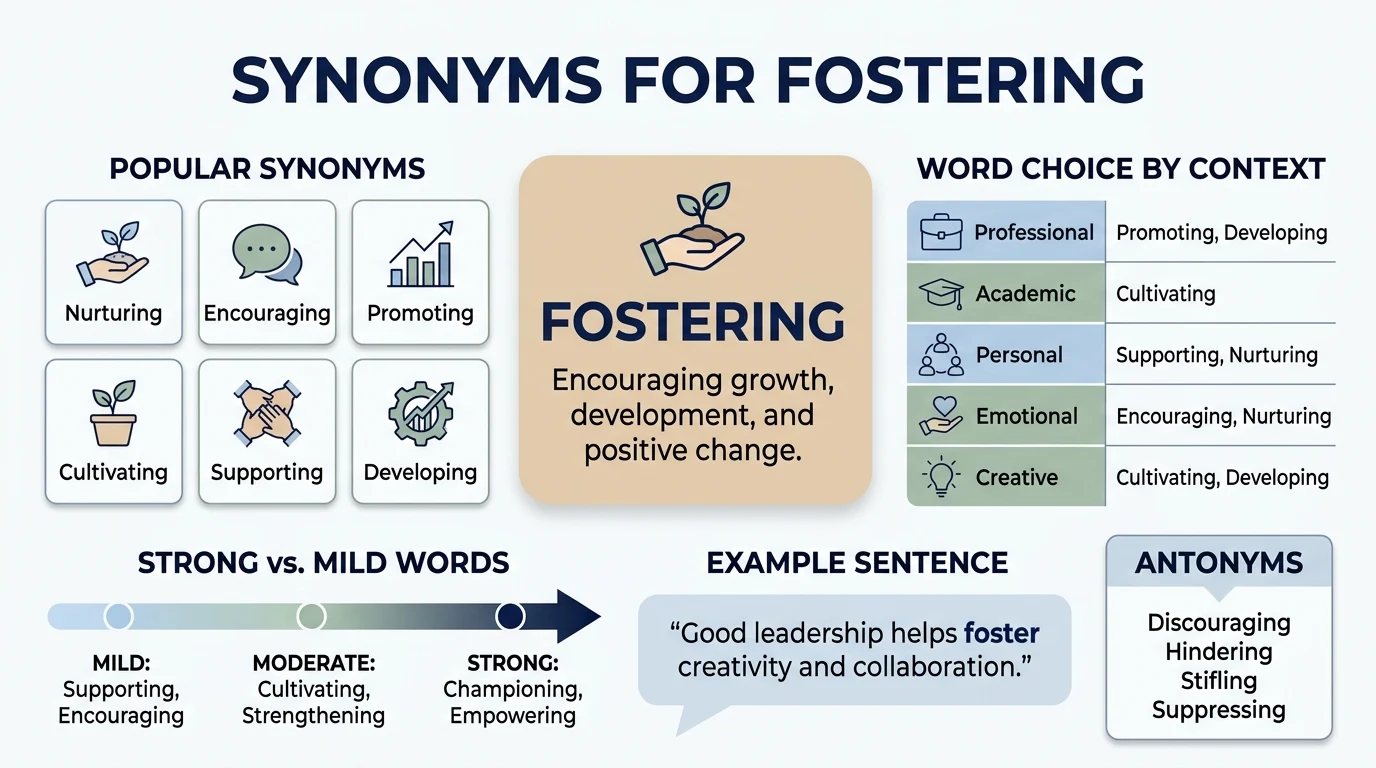
The word fostering appears frequently in academic writing, professional communication, personal development discussions, and everyday conversations. Whether you are describing a supportive workplace, encouraging creativity, developing relationships, or promoting positive change, using the same word repeatedly can make your writing sound predictable.
Learning different synonyms for fostering helps you communicate your ideas with greater precision and variety. However, not every alternative carries exactly the same meaning. Some words emphasize encouragement, while others focus on development, support, protection, or improvement. Choosing the right expression depends on your sentence, audience, and intended message.
What Does “Fostering” Mean?
Fostering means encouraging, supporting, nurturing, or helping something develop over time. Common synonyms include nurturing, promoting, encouraging, cultivating, supporting, developing, and strengthening. The best alternative depends on whether you mean personal growth, professional development, relationships, or positive change.
Meaning, Tone and Context
What Does Fostering Mean?
Fostering refers to the act of encouraging the growth, development, progress, or improvement of someone or something. It often involves providing support, creating opportunities, or establishing favorable conditions.
For example, a teacher can foster creativity by encouraging students to explore new ideas. Similarly, an organization can foster teamwork by creating a supportive workplace.
Part of Speech
Fostering is the present participle and gerund form of the verb foster.
It can function in different grammatical situations:
- Verb: The organization is fostering innovation.
- Gerund: Fostering creativity requires patience.
- Adjective: The organization provides a fostering environment.
Tone and Connotation
Fostering generally carries a positive or constructive meaning. It suggests actively helping something grow, improve, or succeed.
Its tone is usually:
• Positive: Encouraging progress, growth, and development.
• Neutral: Describing the process of supporting a particular activity or condition.
• Formal: Common in academic papers, workplace reports, business communication, and educational discussions.
Common Uses of Fostering
The word appears in several situations:
| Context | Example |
|---|---|
| Education | Fostering student creativity |
| Business | Fostering workplace innovation |
| Relationships | Fostering mutual trust |
| Personal growth | Fostering self confidence |
| Community | Fostering social connections |
| Leadership | Fostering collaboration |
| Healthcare | Fostering emotional well being |
| Technology | Fostering technological innovation |
Related Word Forms
| Word | Meaning |
|---|---|
| Foster | To encourage or support development |
| Fostering | The act of encouraging growth |
| Fostered | Supported or encouraged in the past |
| Fosterer | A person who encourages development, although uncommon |
| Foster parent | Someone who provides temporary care for a child |
When and How to Use “Fostering”
Use fostering when you want to describe an ongoing effort to encourage development, create opportunities, or provide supportive conditions.
It works especially well when the process involves patience, guidance, participation, and long term improvement.
Here are seven practical examples.
1. Professional Context
The company is fostering a culture of creativity and collaboration among its employees.
2. Academic Context
The new teaching approach focuses on fostering critical thinking and independent learning.
3. Personal Development
Reading regularly plays an important role in fostering intellectual growth.
4. Emotional Context
Open communication is essential for fostering trust and understanding in relationships.
5. Community Context
Local organizations are fostering stronger connections among neighborhood residents.
6. Social Media Context
Fostering kindness and positivity can make online communities more welcoming.
7. Email Context
Thank you for your continued efforts in fostering a productive and respectful working environment.
Another Word for Fostering
The best single replacement for fostering is often nurturing, especially when discussing personal growth, relationships, creativity, or emotional development.
However, promoting may be more appropriate when discussing policies, business initiatives, or organizational improvement.
Here are useful alternatives based on different writing situations.
| Context | Best Alternative | Example |
|---|---|---|
| Professional writing | Promoting | Promoting innovation improves organizational performance. |
| Academic writing | Cultivating | Cultivating critical thinking supports independent learning. |
| Casual conversation | Encouraging | Encouraging positive habits takes time. |
| Emotional writing | Nurturing | Nurturing trust strengthens relationships. |
| Creative writing | Inspiring | Inspiring creativity opens new possibilities. |
| Resume or workplace | Developing | Developing collaborative teams improves productivity. |
| Social media captions | Spreading | Spreading kindness makes a difference. |
| Stronger meaning | Championing | Championing equality requires consistent action. |
| Softer meaning | Supporting | Supporting personal growth creates opportunities. |
When Not to Use “Fostering”
Although fostering is useful in many situations, it is not always the most precise word.
Sometimes, another expression communicates your intended meaning more clearly.
1. When You Mean Direct Improvement
Fostering may sound indirect when describing measurable progress.
Less precise: The program is fostering employee performance.
Better: The program is improving employee performance.
2. When You Mean Active Encouragement
If someone is motivating another person to take action, encouraging may be clearer.
Less precise: The coach is fostering the players to practice.
Better: The coach is encouraging the players to practice.
3. When You Mean Financial or Practical Assistance
Supporting is more appropriate when discussing resources, funding, or direct help.
Less precise: The company is fostering local businesses financially.
Better: The company is supporting local businesses financially.
4. When You Mean Official Advancement
Promoting works better when discussing a policy, campaign, or initiative.
Less precise: The organization is fostering a new environmental policy.
Better: The organization is promoting a new environmental policy.
5. When You Mean Physical Protection
Protecting is more accurate when the main idea involves safety rather than development.
Less precise: The shelter is fostering children from danger.
Better: The shelter is protecting children from danger.
Words Commonly Confused With Fostering
Several words are closely related to fostering but communicate different ideas.
| Word | Main Difference | When to Use It |
|---|---|---|
| Nurturing | Emphasizes caring support and gradual growth | Personal development and relationships |
| Encouraging | Focuses on motivating someone or something | Education and motivation |
| Promoting | Emphasizes advancing or supporting an idea | Business and public initiatives |
| Cultivating | Suggests developing something through consistent effort | Skills, habits, and culture |
| Supporting | Focuses on providing help or assistance | Workplace and personal situations |
| Facilitating | Means making a process or activity easier | Education, teamwork, and management |
The important distinction is that fostering often combines encouragement and ongoing support, whereas these alternatives highlight particular aspects of that process.
Best Synonym by Context for Fostering
The most appropriate synonym depends on what you want to communicate. A word suitable for an academic paper may sound unnatural in a casual conversation.
Use this table to identify the strongest option for different situations.
| Context | Best Synonym | Why It Works | Example |
|---|---|---|---|
| Formal writing | Cultivating | Sounds polished and constructive | Cultivating professional relationships takes time. |
| Academic writing | Promoting | Communicates support for an idea or process | Promoting independent learning improves student engagement. |
| Business communication | Encouraging | Highlights positive workplace behavior | Encouraging innovation helps businesses grow. |
| Resume | Developing | Demonstrates an active contribution | Developed collaborative relationships across departments. |
| Casual conversation | Supporting | Simple and natural | Supporting your friends makes a difference. |
| Creative writing | Nurturing | Adds warmth and emotional depth | Nurturing a dream requires patience. |
| Emotional writing | Cherishing | Highlights care and appreciation | Cherishing meaningful relationships strengthens connections. |
| Strong intensity | Championing | Expresses active and committed advocacy | Championing equal opportunities creates lasting change. |
| Soft or moderate tone | Promoting | Suggests constructive encouragement | Promoting healthy habits can improve daily life. |
| Social media captions | Spreading | Sounds approachable and engaging | Spreading kindness wherever you go. |
| Leadership | Empowering | Highlights confidence and independence | Empowering employees encourages initiative. |
| Community development | Strengthening | Emphasizes stronger connections | Strengthening community partnerships creates opportunities. |
| Personal growth | Cultivating | Suggests gradual improvement | Cultivating self discipline takes consistency. |
| Healthcare | Supporting | Emphasizes assistance and care | Supporting patient recovery requires compassion. |
US and UK usage: Fostering is commonly understood and used in both American and British English. There is no significant difference in its basic meaning or spelling. Words such as nurturing, encouraging, and promoting also work naturally in both varieties.
Which Synonym Should You Choose?
Choosing the right synonym requires more than finding a word with a similar dictionary definition.
Consider these five factors before replacing fostering.
1. Consider the Intended Meaning
Identify what you are trying to express.
- • Use nurturing for caring and gradual development.
- • Use promoting for advancing an idea or initiative.
- • Use supporting for providing assistance.
- • Use cultivating for developing something through continued effort.
- 2. Consider Formality
Your audience determines how formal your vocabulary should be.
For academic papers and business reports, promoting, cultivating, and facilitating are useful choices.
For everyday conversations, encouraging, helping, and supporting sound more natural.
3. Consider Emotional Intensity
Some words communicate stronger commitment than others.
For example, supporting suggests assistance, while championing expresses active dedication to a cause.
4. Consider Professional Value
In resumes and workplace communication, choose words that describe measurable contributions.
Developing, strengthening, advancing, and establishing can communicate specific professional achievements.
5. Check the Complete Sentence
Always read your sentence after replacing fostering.
A synonym may have a similar meaning but require a different grammatical structure. For example, encouraging someone to participate is natural, while nurturing someone to participate may sound awkward.
Real Life Examples of Fostering in Sentences
Here are practical examples showing how alternatives to fostering work in different situations.
1. School
Original: The teacher is fostering creativity among students.
Alternative: The teacher is encouraging students to explore creative ideas.
2. Workplace
Original: The manager focuses on fostering teamwork.
Alternative: The manager prioritizes strengthening collaboration among employees.
3. Writing
Original: Reading books helps in fostering vocabulary development.
Alternative: Reading books helps cultivate a richer vocabulary.
4. Conversation
Original: We should focus on fostering better relationships.
Alternative: We should focus on building stronger relationships.
5. Social Media
Original: Fostering kindness makes the world better.
Alternative: Spreading kindness makes the world a better place.
6. Resume
Original: Responsible for fostering collaboration across departments.
Alternative: Developed collaborative relationships across multiple departments.
7. Email
Original: We appreciate your efforts in fostering innovation.
Alternative: We appreciate your commitment to promoting innovation.
8. Storytelling
Original: Her grandmother played an important role in fostering her confidence.
Alternative: Her grandmother nurtured her confidence through patience and encouragement.
25 Synonyms for Fostering: Meanings and Examples
The following alternatives cover personal growth, education, professional communication, relationships, community development, and creative writing.
Some words are direct replacements in particular contexts, while others communicate a related aspect of fostering. Always consider sentence structure before substituting them.
| Synonym | Simple Meaning | Best Used For | Example Sentence |
|---|---|---|---|
| 1. Nurturing | Providing care that encourages growth | Relationships and personal development | Nurturing creativity helps children express themselves. |
| 2. Encouraging | Giving someone confidence or motivation | Education and motivation | Encouraging students improves classroom participation. |
| 3. Promoting | Helping something gain support or progress | Business and initiatives | Promoting equality creates a fairer workplace. |
| 4. Cultivating | Developing something through continued effort | Skills and habits | Cultivating patience improves decision making. |
| 5. Supporting | Providing help or assistance | Personal and professional situations | Supporting new employees makes their transition easier. |
| 6. Developing | Helping something grow or improve | Skills and abilities | Developing leadership skills takes experience. |
| 7. Facilitating | Making an activity or process easier | Education and management | Facilitating discussions encourages teamwork. |
| 8. Stimulating | Encouraging activity or interest | Learning and creativity | Stimulating curiosity makes learning exciting. |
| 9. Strengthening | Making something stronger | Relationships and partnerships | Strengthening communication improves cooperation. |
| 10. Building | Creating or establishing something gradually | Trust and relationships | Building trust requires honesty. |
| 11. Advancing | Moving something forward | Progress and professional development | Advancing research can improve medical knowledge. |
| 12. Empowering | Giving someone confidence or authority | Leadership and education | Empowering employees encourages independent thinking. |
| 13. Inspiring | Creating enthusiasm or motivation | Creativity and personal growth | Inspiring young artists can lead to new ideas. |
| 14. Championing | Actively supporting a cause | Advocacy and leadership | Championing diversity strengthens communities. |
| 15. Establishing | Creating something that can continue | Systems and relationships | Establishing healthy habits improves daily routines. |
| 16. Advancing | Helping an idea or cause progress | Social and professional initiatives | Advancing educational opportunities benefits society. |
| 17. Promulgating | Making an idea or policy widely known | Formal and legal communication | The institution is promulgating new educational guidelines. |
| 18. Fomenting | Stimulating or provoking an activity or feeling | Political and social contexts | The campaign was accused of fomenting public unrest. |
| 19. Nurturing | Providing sustained care and encouragement | Emotional development | Nurturing young talent requires guidance. |
| 20. Fostering through assistance | Helping development by providing practical support | Community programs | The initiative supports families seeking better opportunities. |
| 21. Enabling | Making something possible | Technology and education | Enabling access to resources improves learning. |
| 22. Advancing | Promoting further development or progress | Research and innovation | Advancing scientific knowledge benefits future generations. |
| 23. Sustaining | Maintaining something over time | Relationships and progress | Sustaining a positive workplace culture requires consistency. |
| 24. Enriching | Improving quality or value | Experiences and education | Enriching classroom experiences encourages curiosity. |
| 25. Propagating | Spreading or helping something multiply | Ideas and practices | Propagating sustainable practices benefits the environment. |
Editorial note: A few alternatives above are contextual rather than exact synonyms. Fomenting can suggest provoking unrest or negative activity, while promulgating and propagating emphasize spreading ideas or practices. Use them only when their specific meanings fit.
Synonym Groups and Usage Differences
Understanding synonym groups makes it easier to select an alternative that fits your writing style.
Professional vs. Personal Synonyms
Professional communication usually emphasizes measurable progress, workplace improvement, and organizational goals.
Useful professional alternatives include:
- • Promoting innovation
- • Developing talent
- • Strengthening partnerships
- • Encouraging collaboration
- • Facilitating communication
- Personal writing often focuses on relationships, emotions, and individual development.
Useful personal alternatives include:
- • Nurturing relationships
- • Building trust
- • Supporting personal growth
- • Encouraging confidence
- • Inspiring positive change
- Example:
Professional: The manager is developing leadership capabilities across the organization.
Personal: Her parents nurtured her confidence throughout childhood.
Formal vs. Conversational Synonyms
Formal alternatives are suitable for reports, essays, professional emails, and presentations.
| Formal Word | Conversational Alternative |
|---|---|
| Cultivating | Growing |
| Facilitating | Helping |
| Promoting | Encouraging |
| Developing | Building |
| Advancing | Improving |
| Strengthening | Making stronger |
For example, an academic report might use cultivating, whereas an everyday conversation may use growing or building.
Both can communicate development, but their tone and level of precision differ.
Academic Synonyms
Academic writing requires clear and precise vocabulary.
The best alternatives depend on the subject and the specific process being discussed.
Cultivating: Suitable for describing the gradual development of skills, knowledge, or habits.
Example: Cultivating critical thinking improves students’ ability to evaluate information.
Promoting: Useful when discussing educational initiatives, research, or social improvement.
Example: Promoting inclusive education supports equal learning opportunities.
Facilitating: Appropriate when describing how a method or resource makes learning easier.
Example: Digital resources facilitate collaborative learning.
Stimulating: Useful when discussing intellectual curiosity or mental activity.
Example: Stimulating student curiosity encourages deeper exploration.
Professional and Business Synonyms
In workplace communication, synonyms for fostering should describe meaningful actions and outcomes.
Consider these options:
| Word | Professional Application |
|---|---|
| Developing | Developing employee capabilities |
| Encouraging | Encouraging workplace participation |
| Strengthening | Strengthening business partnerships |
| Empowering | Empowering team members |
| Promoting | Promoting organizational innovation |
| Establishing | Establishing productive relationships |
| Advancing | Advancing strategic initiatives |
Resume tip: Instead of writing that you were responsible for fostering collaboration, explain what you actually achieved.
For example: Developed cross functional relationships that improved communication between departments.
This wording is more specific and demonstrates professional value.
Creative or Literary Synonyms
Creative writing benefits from vocabulary that creates emotional depth and stronger imagery.
Consider these alternatives:
- • Nurturing: Suggests warmth, patience, and care.
- • Inspiring: Creates a sense of motivation and possibility.
- • Cultivating: Suggests gradual development through effort.
- • Cherishing: Expresses deep appreciation and affection.
- • Enriching: Adds depth, meaning, or value.
- Example: Her grandmother nurtured a love of storytelling that remained with her throughout adulthood.
Slang or Modern Synonyms
Fostering does not have a widely accepted direct slang equivalent.
However, casual expressions can communicate similar ideas in informal conversations.
| Expression | Meaning | Example |
|---|---|---|
| Building up | Helping someone become more confident | We are building each other up. |
| Backing | Supporting someone or something | I am backing your new project. |
| Growing | Developing over time | We are growing a positive community. |
| Spreading | Sharing something with others | Keep spreading good energy. |
| Helping out | Providing practical assistance | Everyone is helping out with the project. |
These expressions work in conversations, messages, and casual captions.
Avoid them in academic papers or formal business reports unless the context specifically calls for conversational language.
Strongest vs. Weaker Synonyms
Not every alternative expresses the same level of commitment.
Here is a practical intensity scale.
| Intensity | Synonym | Meaning |
|---|---|---|
| Mild | Supporting | Providing assistance |
| Mild | Helping | Making development easier |
| Moderate | Encouraging | Giving motivation |
| Moderate | Promoting | Actively supporting progress |
| Moderate | Cultivating | Developing through consistent effort |
| Strong | Empowering | Giving confidence and independence |
| Strong | Strengthening | Making something more effective |
| Very strong | Championing | Actively advocating for something |
Use stronger expressions when the sentence describes meaningful commitment or active involvement.
Emotional vs. Neutral Synonyms
Emotional alternatives communicate care, connection, or personal investment.
| Emotional Synonym | Neutral Synonym |
|---|---|
| Nurturing | Developing |
| Cherishing | Supporting |
| Inspiring | Promoting |
| Encouraging | Facilitating |
| Empowering | Establishing |
| Strengthening | Advancing |
For example, nurturing relationships sounds more personal than developing relationships.
Neither expression is universally better. Choose according to the emotional message you want readers to understand.
Antonyms of Fostering
Antonyms of fostering describe actions that discourage growth, prevent development, reduce support, or damage progress.
The following 15 words represent different opposites depending on context.
| Antonym | Meaning | Example Sentence |
|---|---|---|
| 1. Discouraging | Reducing motivation | Constant criticism is discouraging creativity. |
| 2. Hindering | Making progress difficult | Poor communication is hindering teamwork. |
| 3. Stifling | Preventing natural development | Strict rules are stifling innovation. |
| 4. Suppressing | Preventing something from developing or being expressed | The policy is suppressing individual expression. |
| 5. Neglecting | Failing to provide necessary care | Neglecting employee development affects productivity. |
| 6. Undermining | Weakening confidence or effectiveness | Dishonesty is undermining public trust. |
| 7. Obstructing | Blocking progress | Unnecessary restrictions are obstructing research. |
| 8. Impeding | Slowing or preventing progress | Limited resources are impeding development. |
| 9. Thwarting | Preventing an effort from succeeding | Poor planning is thwarting the initiative. |
| 10. Inhibiting | Restricting growth or activity | Fear is inhibiting creative expression. |
| 11. Deterring | Discouraging someone from taking action | High costs are deterring participation. |
| 12. Damaging | Causing harm | Negative behavior is damaging relationships. |
| 13. Weakening | Reducing strength or effectiveness | Poor leadership is weakening team morale. |
| 14. Abandoning | Leaving without continued support | Abandoning the project interrupted its development. |
| 15. Repressing | Holding back feelings, actions, or development | Repressing open discussion limits honest communication. |
These words are contextual antonyms rather than interchangeable opposites. Choose the one that accurately describes the action you want to express.
Comparison: Fostering vs. Similar Words
Several alternatives to fostering appear similar but have important differences in meaning, intensity, and usage.
Fostering vs. Nurturing
Main difference: Fostering broadly means encouraging development, while nurturing emphasizes providing care and attention during growth.
Which is stronger? Nurturing often conveys a warmer and more personal sense of care.
Which is more formal? Both are suitable for formal writing.
Examples:
Fostering: The program focuses on fostering creativity among students.
Nurturing: Parents play an important role in nurturing children’s creativity.
Fostering vs. Encouraging
Main difference: Fostering suggests ongoing support for development, while encouraging focuses on giving motivation or confidence.
Which is stronger? Fostering often implies a broader and more sustained effort.
Which is more formal? Both work in professional and academic communication.
Examples:
Fostering: The school is fostering independent learning.
Encouraging: The teacher is encouraging students to ask questions.
Fostering vs. Promoting
Main difference: Fostering focuses on helping something develop, while promoting emphasizes actively advancing or advocating for it.
Which is stronger? Promoting can suggest more direct public or organizational action.
Which is more formal? Both are appropriate in formal writing.
Examples:
Fostering: The organization is fostering stronger community relationships.
Promoting: The organization is promoting community participation.
Fostering vs. Cultivating
Main difference: Fostering means supporting development, while cultivating emphasizes gradually developing something through consistent effort.
Which is stronger? Neither is always stronger. Cultivating highlights sustained effort.
Which is more formal? Both are suitable for academic and professional writing.
Examples:
Fostering: The program is fostering leadership skills.
Cultivating: The program is cultivating leadership skills through practical training.
Fostering vs. Supporting
Main difference: Fostering encourages growth, while supporting focuses on providing assistance or resources.
Which is stronger? Fostering often suggests a more active developmental process.
Which is more formal? Both work in professional communication.
Examples:
Fostering: The company is fostering employee creativity.
Supporting: The company is supporting employees through professional training.
Fostering vs. Developing
Main difference: Fostering means encouraging growth, while developing refers to the actual process of creating or improving something.
Which is stronger? Developing can suggest more direct involvement in producing a result.
Which is more formal? Both are common in academic and business writing.
Examples:
Fostering: The organization is fostering leadership potential.
Developing: The organization is developing future leaders.
Common Phrases and Expressions with Fostering
These expressions show how fostering naturally appears in different areas of communication.
1. Fostering Creativity
Meaning: Encouraging people to explore ideas and express original thoughts.
Example sentence: The school encourages hands on activities for fostering creativity among young learners.
2. Fostering Innovation
Meaning: Creating conditions that support new ideas, methods, and solutions.
Example sentence: The company invests in employee training for fostering innovation.
3. Fostering Relationships
Meaning: Developing positive connections through communication, trust, and mutual respect.
Example sentence: Regular communication is essential for fostering meaningful relationships.
4. Fostering Growth
Meaning: Supporting personal, professional, or organizational development.
Example sentence: Constructive feedback plays an important role in fostering employee growth.
5. Fostering Collaboration
Meaning: Encouraging people to work together toward shared goals.
Example sentence: The manager introduced group activities for fostering collaboration.
6. Fostering Understanding
Meaning: Encouraging awareness, knowledge, and appreciation of different perspectives.
Example sentence: Open discussions are useful for fostering understanding among diverse communities.
7. Fostering Trust
Meaning: Building confidence through honesty, consistency, and reliability.
Example sentence: Transparent communication is essential for fostering trust within an organization.
8. Fostering Independence
Meaning: Encouraging people to become more confident and self reliant.
Example sentence: Good teaching methods focus on fostering independence among students.
Common Mistakes to Avoid
Even experienced writers sometimes use fostering incorrectly or choose alternatives that do not fit their intended meaning.
Here are seven mistakes worth avoiding.
1. Using Fostering When a More Precise Word Is Better
Fostering can sound vague when you are describing a specific result.
Weak: The training is fostering employee performance.
Better: The training is improving employee performance.
2. Confusing Fostering With Encouraging
Encouraging generally means motivating someone, while fostering suggests broader support for development.
Incorrect distinction: The two words always mean exactly the same thing.
Better approach: Use encouraging for motivation and fostering for ongoing developmental support.
3. Using Casual Synonyms in Formal Writing
Expressions such as building up or helping out may sound too conversational in academic reports.
Better: Choose developing, promoting, or cultivating when appropriate.
4. Choosing an Overly Dramatic Alternative
Words such as championing can sound excessive when describing a small, routine action.
Better: Use supporting or encouraging for ordinary situations.
5. Repeating Fostering Too Often
Repeated use makes paragraphs less engaging.
Better: Alternate between nurturing, promoting, cultivating, and supporting when their meanings fit.
6. Choosing the Wrong Emotional Tone
Nurturing communicates care, while facilitating emphasizes making a process easier.
Better: Match the word to the emotional or practical meaning of your sentence.
7. Using Unusual Vocabulary Without Checking Its Meaning
Words such as fomenting and promulgating have specific meanings that do not always match fostering.
Better: Check a trusted dictionary before using an unfamiliar alternative.
FAQs
1. What Is the Best Synonym for Fostering?
Nurturing is often the best synonym when describing personal growth and relationships. Promoting, cultivating, and encouraging work better in other contexts.
2. What Is a Formal Synonym for Fostering?
Cultivating, promoting, facilitating, and developing are useful formal alternatives, particularly in academic writing, professional reports, and organizational communication.
3. What Is an Informal Synonym for Fostering?
Supporting, helping, encouraging, and building are natural alternatives for everyday conversations, friendly messages, and casual writing.
4. What Is Another Word for Fostering in Professional Writing?
Developing, promoting, strengthening, and cultivating are effective professional alternatives that communicate workplace improvement, collaboration, and organizational progress.
5. What Is the Difference Between Fostering and Nurturing?
Fostering broadly means encouraging development, while nurturing emphasizes caring support, attention, and guidance throughout the growth process.
6. What Is the Opposite of Fostering?
Discouraging, hindering, stifling, and suppressing are common opposites. The best choice depends on whether you mean preventing growth or withholding support.
Conclusion
Fostering means encouraging, supporting, and helping someone or something develop over time. It is a useful word in education, professional communication, personal relationships, community development, and academic writing.
The best alternatives include nurturing, encouraging, promoting, cultivating, supporting, developing, and strengthening. Each communicates a slightly different idea, so the right choice depends on your sentence, audience, and intended tone.
A practical vocabulary tip is to identify whether your sentence emphasizes care, motivation, progress, or assistance before choosing a replacement. This simple habit makes your writing more natural, precise, and engaging.
Ultimately, using the right synonym for fostering helps you express ideas clearly without repeating the same vocabular.
Discover More Post:
- 50+ Synonyms for Snow | From Gentle Flurries to a Winter …
- 50+ Synonyms for Impressive | Powerful Alternatives to …
- 50+ Synonyms for Opinion | Meanings, Examples, and Best …