Do you keep using the word “opinion” in essays, emails, conversations, captions, or workplace writing? The word is useful, but repeating it can make your writing feel less precise.
The right alternative depends on what you actually mean. You might need view for a simple belief, perspective for a particular way of seeing an issue, stance for a firm position, or assessment for an informed evaluation.
This guide explains synonyms for opinion by meaning, tone, formality, and context so you can choose words that sound natural and appropriate.
What Does Opinion Mean?
An opinion is a personal belief, judgment, view, or interpretation about a person, subject, or situation. Common alternatives include view for general use, perspective for a particular viewpoint, stance for a firm position, and assessment for an informed judgment.
Meaning, Tone and Context
Simple Definition
An opinion is a belief, judgment, or view that someone holds about a subject. It can be based on personal experience, preferences, reasoning, information, or emotion.
For example:
My opinion is that the company should improve its customer service.
The speaker is expressing a personal judgment rather than presenting an established fact.
Part of Speech
Opinion is primarily a noun.
Example:
She shared her opinion during the meeting.
Related forms include:
Opinionated: Having strong opinions, often in a way that may seem overly forceful.
Opinative: Relating to opinion, although this form is uncommon in everyday American English.
Opine: To express an opinion, usually in formal or literary writing.
Is “Opinion” Positive, Negative, or Neutral?
The word opinion itself is generally neutral.
Its emotional meaning depends on the surrounding language.
Positive:
Her thoughtful opinion helped us solve the problem.
Neutral:
Everyone has an opinion about the proposal.
Negative:
He keeps forcing his opinion on everyone.
Formality Level
“Opinion” works comfortably in casual conversation, academic writing, professional communication, journalism, essays, and everyday speech.
However, a more specific word can sometimes communicate the intended meaning more effectively.
For example:
I value your opinion.
This is natural and general.
I value your perspective on the issue.
This sounds more specific because it emphasizes the person’s way of understanding the issue.
Common Use Cases
The word appears frequently in:
- Personal conversations
- Academic essays
- Workplace discussions
- Business communication
- Reviews
- Interviews
- Social media posts
- Editorial writing
- Debates
- Storytelling
- Professional feedback
- Decision making
When and How to Use Opinion
Use opinion when you want to identify someone’s personal belief, judgment, or view without necessarily implying a specific level of expertise or emotional intensity.
Professional Example
We would appreciate your opinion before making a final decision.
Here, “opinion” is polite and appropriate for workplace communication.
Personal Example
In my opinion, the restaurant has the best pasta in town.
This expresses a personal preference.
Academic Example
The author challenges the common opinion that technology always improves productivity.
In academic writing, “opinion” can work when discussing general beliefs or positions.
Social Media Example
My honest opinion is that this is one of the best books I have read this year.
The phrase sounds natural and conversational.
Emotional Example
Her opinion of me changed after we talked.
Here, “opinion” refers to someone’s personal judgment of another person.
Another Word for Opinion
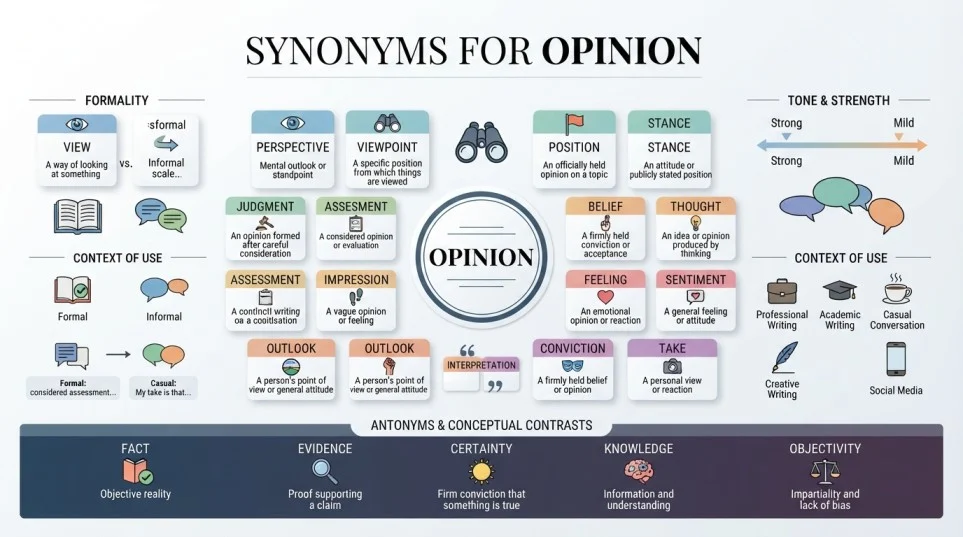
The best single replacement for opinion is usually view because it works naturally in casual, professional, and formal situations.
However, the best choice changes with context.
| Situation | Recommended Word |
|---|---|
| Professional writing | View |
| Academic writing | Perspective |
| Casual conversation | Take |
| Emotional writing | Feeling |
| Creative writing | Impression |
| Workplace use | Position |
| Resume or professional profile | Perspective |
| Social media caption | Take |
| Strong meaning | Stance |
| Softer meaning | View |
Professional Writing
Use view or position.
We would like to understand your view on the proposed changes.
Academic Writing
Use perspective, interpretation, or position when the context supports those meanings.
The study presents a different perspective on urban development.
Casual Conversation
Use view, take, or thought.
What is your take on the new policy?
Emotional Writing
Use feeling, impression, or sentiment when emotion is part of the meaning.
My first impression of the book was positive.
Creative Writing
Use impression, perspective, outlook, or interpretation.
His perspective on the world changed after the journey.
Resume or Workplace Use
Use perspective, judgment, or assessment when discussing professional thinking.
Provides informed assessments of customer needs.
Social Media Captions
Use take, view, or thought.
Here is my take on the latest trend.
Stronger Meaning
Use stance, position, conviction, or viewpoint when the person has a firm or clearly defined belief.
Softer Meaning
Use thought, impression, feeling, or view when the statement is less forceful.
When Not to Use Opinion
“Opinion” is not always the most precise word.
When You Mean a Fact
Do not call an established fact an opinion simply because people may disagree about its implications.
Less precise:
My opinion is that water freezes at a certain temperature under standard conditions.
Better:
Scientific evidence shows that water freezes at 0 degrees Celsius under standard atmospheric pressure.
When You Mean a Professional Evaluation
If someone has carefully evaluated something, assessment may be more accurate.
General:
What is your opinion of the project?
More precise:
What is your assessment of the project’s performance?
When You Mean a Firm Political or Organizational Position
Use stance or position when the belief is clearly defined.
General:
The organization shared its opinion on the proposal.
More precise:
The organization announced its position on the proposal.
When You Mean an Initial Reaction
Use impression when you are describing how something seemed to you.
General:
My opinion of the restaurant was positive.
More specific:
My first impression of the restaurant was excellent.
Words Commonly Confused With Opinion
Opinion vs. Fact
An opinion is a belief or judgment. A fact is information that can be verified.
Her opinion is that the product is excellent.
The product was released in June.
Opinion vs. Perspective
An opinion is a belief or judgment. A perspective emphasizes the way someone views or understands an issue.
His opinion is that the policy is unfair.
His perspective is shaped by years of experience in education.
Opinion vs. Belief
A belief can be a deeply held idea about something, while an opinion is often more specific to a subject or judgment.
She believes that honesty matters.
Her opinion is that the manager handled the situation poorly.
Opinion vs. Viewpoint
A viewpoint refers to a particular position or way of seeing an issue.
I respect your opinion.
I understand your viewpoint.
Opinion vs. Judgment
A judgment often suggests a conclusion reached after considering information or circumstances.
That is his opinion about the movie.
That was her judgment after reviewing the evidence.
Opinion vs. Sentiment
Sentiment often describes a prevailing feeling, attitude, or emotional position toward something.
Public sentiment toward the proposal has changed.
Best Synonym by Context for Opinion
| Context | Best Synonym | Why It Works | Example |
|---|---|---|---|
| Formal writing | View | Polished and broadly useful | The report presents the author’s view. |
| Academic writing | Perspective | Emphasizes a particular way of understanding | The article offers a new perspective. |
| Professional use | Assessment | Suggests informed evaluation | Her assessment was detailed and practical. |
| Resume | Judgment | Highlights decision making ability | Demonstrates sound professional judgment. |
| Casual conversation | Take | Natural and conversational | What is your take on the idea? |
| Creative writing | Impression | Adds personal and descriptive meaning | His first impression was unforgettable. |
| Emotional tone | Feeling | Highlights personal emotion | My feeling is that something is missing. |
| Strong intensity | Stance | Shows a firm position | The group made its stance clear. |
| Soft or moderate tone | View | Sounds measured and neutral | That is my view of the situation. |
| Social media | Take | Short and informal | Here is my take on the trend. |
| American usage | Opinion | Extremely common and natural | What is your opinion? |
| British usage | View | Frequently used as a natural alternative | What is your view? |
Which Synonym Should You Choose?
Choosing the right synonym starts with asking what kind of opinion you are expressing.
1. Ask What You Mean
- If you simply mean a personal belief, choose view or opinion.
- If you mean a way of understanding an issue, choose perspective.
- If you mean a firm position, choose stance or position.
- If you mean an informed evaluation, choose assessment.
2. Consider Formality
For formal writing, view, perspective, position, and assessment are usually stronger choices than very casual alternatives.
For conversation, take and thought can sound more natural.
3. Consider Emotional Intensity
A neutral opinion can be called a view.
A strongly held opinion may be a conviction or stance.
An emotional opinion may be described as a feeling or sentiment.
4. Consider the Sentence
Do not replace “opinion” automatically.
Sometimes “opinion” is already the clearest word.
The goal is not to use the fanciest synonym. The goal is to use the most accurate word.
Real Life Examples of Opinion in Sentences
School
My opinion changed after I read the second article.
A stronger academic alternative:
My perspective changed after I reviewed the additional evidence.
Workplace
I would like to hear your opinion before we proceed.
More professional:
I would like to hear your assessment before we proceed.
Writing
The writer gives her opinion about social media.
More precise:
The writer presents her perspective on social media.
Conversation
What is your opinion of the new restaurant?
More casual:
What is your take on the new restaurant?
Social Media
Here is my opinion about the latest update.
More conversational:
Here is my take on the latest update.
Resume
Instead of writing:
Gives opinions about business strategy.
A stronger professional expression is:
Provides informed assessments of business strategy.
I would appreciate your opinion on the proposed schedule.
This is polite, natural, and professional.
Storytelling
His opinion of the town changed after he met the people who lived there.
A more literary alternative:
His impression of the town changed after he met the people who lived there.
18 Synonyms for “Opinion”
| Synonym | Simple Meaning | Best Used For | Example Sentence |
|---|---|---|---|
| View | A belief or way of thinking | General and professional use | My view is that the plan needs more work. |
| Perspective | A particular way of seeing an issue | Academic and professional writing | Her perspective comes from years of experience. |
| Viewpoint | A particular position or way of seeing something | Discussion and analysis | From my viewpoint, the decision was reasonable. |
| Position | A stated belief or stand on an issue | Formal and professional use | The company clarified its position on the proposal. |
| Stance | A firm position on an issue | Strong arguments and public statements | The organization maintained its stance. |
| Judgment | An assessment or conclusion | Professional decision making | I trust her judgment in difficult situations. |
| Assessment | An evaluation based on consideration | Professional and academic use | His assessment identified several weaknesses. |
| Impression | An idea formed from experience or observation | Personal and creative writing | My first impression was very positive. |
| Belief | Something a person considers true | Personal and philosophical contexts | Her belief in education shaped her career. |
| Thought | An idea or personal view | Casual conversation | What are your thoughts on the proposal? |
| Feeling | A personal emotional view | Emotional and conversational writing | I have a feeling that we should wait. |
| Sentiment | A feeling or attitude toward something | Public and emotional contexts | Public sentiment has shifted recently. |
| Outlook | A general attitude or way of viewing life | Personal and professional contexts | Her optimistic outlook helped the team. |
| Conviction | A strongly held belief | Strong personal or moral views | He spoke with conviction about the issue. |
| Interpretation | An explanation of the meaning of something | Academic and analytical writing | Her interpretation differs from the author’s. |
| Take | A personal view of a topic | Casual and modern conversation | What is your take on the decision? |
| Idea | A thought or belief about something | General and casual use | I have an idea about why it happened. |
| Viewpoint | A particular perspective or position | Analysis and discussion | The book presents a different viewpoint. |
Synonym Groups and Usage Differences
Professional vs. Personal Synonyms
Professional communication often benefits from words that suggest careful reasoning.
Use assessment, judgment, perspective, position, or view when discussing workplace decisions.
Personal communication can comfortably use opinion, thought, feeling, take, or impression.
Compare:
What is your opinion?
with:
What is your assessment of the situation?
The second sentence suggests that the person is being asked to evaluate the situation carefully.
Formal vs. Conversational Synonyms
Formal writing often favors:
Perspective
Position
Assessment
Interpretation
Judgment
Conversational writing often favors:
Opinion
View
Thought
Take
Feeling
For an essay:
The author’s perspective differs from earlier research.
For a casual conversation:
What is your take on it?
Academic Synonyms
Academic writing benefits from precision.
Perspective works when discussing a way of viewing an issue.
Interpretation works when discussing the meaning assigned to evidence, text, or events.
Position works when discussing an argument or intellectual stance.
Assessment works when discussing evaluation.
Example:
The researcher offers a different interpretation of the findings.
This is more precise than simply saying:
The researcher offers a different opinion.
Professional and Business Synonyms
In business communication, choose words that clarify what kind of professional judgment is involved.
- Use assessment for evaluation.
- Use position for an organization’s stated view.
- Use perspective for professional insight.
- Use judgment for decision making.
- Use view for a neutral professional belief.
Example:
We value your perspective on customer experience.
This sounds more specific than:
We value your opinion on customer experience.
Creative or Literary Synonyms
Creative writing can benefit from words that suggest personality and emotional depth.
Impression describes how something initially appears.
Outlook describes a person’s general attitude.
Perspective describes a character’s way of seeing the world.
Feeling adds emotional color.
Interpretation can create an analytical or reflective tone.
Example:
Her impression of the city changed as the evening unfolded.
Slang or Modern Synonyms
There is no single slang replacement for “opinion” that works in every situation.
The word take is common in modern casual English.
Example:
What is your take on the new design?
It works well in conversation, online discussions, podcasts, and social media.
However, it may sound too casual in a formal academic paper.
Strongest vs. Weaker Synonyms
A useful intensity scale is:
Thought: Mild and informal.
Feeling: Personal and emotional.
View: Neutral and flexible.
Perspective: Specific and thoughtful.
Position: Clearly stated.
Stance: Firm and deliberate.
Conviction: Very strongly held.
The strongest word is not always the best word. Choose based on what you actually mean.
Emotional vs. Neutral Synonyms
Neutral choices include:
Opinion
View
Perspective
Position
Assessment
More emotional choices include:
Feeling
Sentiment
Conviction
Impression
For example:
Her view of the decision was negative.
This is relatively neutral.
Her feelings about the decision were intense.
This clearly introduces emotion.
Antonyms of “Opinion”
“Opinion” does not have a perfect set of direct antonyms because it describes a type of belief rather than a simple quality. The following words represent useful conceptual contrasts, especially when distinguishing personal opinion from established information, certainty, or observable reality.
| Antonym or Conceptual Contrast | Meaning | Example Sentence |
|---|---|---|
| Fact | Information that can be verified | The date is a fact, not an opinion. |
| Evidence | Information used to support a conclusion | The decision was based on evidence. |
| Proof | Evidence that establishes something convincingly | The document provided proof of ownership. |
| Certainty | A state of being sure | She spoke with certainty about the result. |
| Knowledge | Information or understanding acquired through learning or experience | His knowledge of the subject is extensive. |
| Truth | What is regarded as factual or accurate | The investigation aimed to establish the truth. |
| Reality | The actual state of something | We need to consider the reality of the situation. |
| Objectivity | An approach based on facts rather than personal preference | The report aims to maintain objectivity. |
| Verification | The process of confirming accuracy | The information requires verification. |
| Observation | Something noticed directly | Her observation was supported by what she saw. |
| Data | Collected information used for analysis | The researchers reviewed the data. |
| Measurement | A quantified result | The measurement was recorded carefully. |
| Demonstration | Evidence or an act that clearly shows something | The experiment provided a demonstration of the principle. |
| Consensus | General agreement among a group | The committee reached a consensus. |
| Reality based conclusion | A conclusion grounded in observable information | The team reached a reality based conclusion after reviewing the records. |
Comparison: Opinion vs. Similar Words
Opinion vs. View
Main difference: Both can mean a personal belief, but “view” often sounds slightly more polished and flexible.
Which one is stronger: Neither is inherently stronger.
Which one is more formal: “View” can sound slightly more formal in some contexts.
Examples:
What is your opinion of the proposal?
What is your view of the proposal?
Both are natural.
Opinion vs. Perspective
Main difference: “Perspective” emphasizes the way someone sees or understands an issue.
Which one is stronger: Neither is necessarily stronger.
Which one is more formal: “Perspective” often fits academic and professional writing especially well.
Examples:
Her opinion changed.
Her perspective changed after gaining more experience.
Opinion vs. Stance
Main difference: A stance is a clearly defined position, often on an important or debated issue.
Which one is stronger: “Stance” is stronger.
Which one is more formal: Both can be formal, but “stance” is especially useful in public or argumentative writing.
Examples:
He expressed his opinion about the policy.
He clearly stated his stance on the policy.
Opinion vs. Judgment
Main difference: Judgment often suggests evaluation or a conclusion reached after considering information.
Which one is stronger: Judgment can sound more authoritative.
Which one is more formal: “Judgment” is common in professional contexts.
Examples:
That is my opinion.
That is my judgment after reviewing the evidence.
Opinion vs. Belief
Main difference: A belief can be deeply held and broad, while an opinion is often a particular view about a subject.
Which one is stronger: A belief can imply greater personal commitment.
Which one is more formal: Both are widely used.
Examples:
Her opinion is that the plan will work.
Her belief is that education can transform communities.
Opinion vs. Sentiment
Main difference: Sentiment often emphasizes feelings or general attitudes, especially within a group.
Which one is stronger: Neither is universally stronger.
Which one is more formal: “Sentiment” can sound more formal in business, political, and analytical contexts.
Examples:
What is your opinion of the proposal?
Public sentiment toward the proposal has changed.
Common Phrases and Expressions with Opinion
1. In My Opinion
Meaning:
A phrase used to introduce a personal belief or judgment.
Example sentence:
In my opinion, the second option is more practical.
2. In Your Opinion
Meaning:
A polite way to ask someone what they think.
Example sentence:
In your opinion, what should we change?
3. Give an Opinion
Meaning:
To express a personal belief or judgment.
Example sentence:
Students were asked to give an opinion about the issue.
4. Express an Opinion
Meaning:
To communicate what you think about something.
Example sentence:
Everyone should be free to express an opinion respectfully.
5. Share an Opinion
Meaning:
To tell other people what you think.
Example sentence:
She shared her opinion during the meeting.
6. Strong Opinion
Meaning:
A belief that someone holds firmly.
Example sentence:
He has a strong opinion about how the company should operate.
7. Difference of Opinion
Meaning:
A situation where people disagree about something.
Example sentence:
The discussion ended with a difference of opinion.
8. Matter of Opinion
Meaning:
Something that depends largely on personal judgment or preference.
Example sentence:
Which design looks better is largely a matter of opinion.
Common Mistakes to Avoid
1. Using “Opinion” When You Mean a Fact
Do not label verifiable information as an opinion.
Instead, identify whether you mean a fact, observation, measurement, or evidence.
2. Confusing Opinion With Perspective
A perspective is a particular way of seeing an issue. An opinion is a belief or judgment.
The words overlap, but they are not identical in every sentence.
3. Using a Casual Synonym in Formal Writing
Words such as take can sound natural in conversation but may feel too casual in academic writing.
Use perspective, view, or position when appropriate.
4. Using an Overly Dramatic Synonym
Do not use conviction when you simply mean a mild preference.
For example:
My conviction is that chocolate ice cream tastes better.
This sounds unnecessarily serious.
Better:
My opinion is that chocolate ice cream tastes better.
5. Repeating “Opinion” Too Often
If a paragraph uses “opinion” several times, consider whether you actually mean view, perspective, position, assessment, or impression.
6. Choosing the Wrong Emotional Tone
- Use feeling or sentiment when emotion matters.
- Use assessment or judgment when evaluation matters.
- Use stance when firmness matters.
7. Using Slang in Academic or Professional Writing
“Take” is useful in casual English, but formal writing often benefits from more precise vocabulary.
FAQs
1. What is the best synonym for opinion?
The best synonym is usually view because it is natural, flexible, and suitable for casual, professional, and formal communication.
2. What is a formal synonym for opinion?
Perspective, position, assessment, and judgment can work as formal alternatives when their specific meanings fit the sentence.
3. What is an informal synonym for opinion?
Take and thought are natural informal alternatives. For example, “What is your take on the idea?” sounds conversational.
4. What is another word for opinion in professional writing?
View, perspective, assessment, position, and judgment can replace opinion in professional writing depending on the intended meaning.
5. What is the difference between opinion and perspective?
An opinion is a belief or judgment, while a perspective emphasizes the particular way someone sees, understands, or approaches an issue.
6. What is the opposite of opinion?
There is no single perfect antonym. Useful conceptual contrasts include fact, evidence, certainty, knowledge, objectivity, and verified information.
Conclusion
An opinion is a personal belief, judgment, or view about a subject. It is a versatile word, but choosing a more precise alternative can make your communication clearer and more effective.
Use view for a flexible general alternative, perspective for a particular way of seeing an issue, stance for a firm position, assessment for an informed evaluation, and take for casual conversation.
The best synonym for opinion is not always the most sophisticated word. The strongest vocabulary choice is the one that accurately matches your meaning, tone, audience, and situation.
When in doubt, ask yourself one simple question: Am I expressing a belief, describing a perspective, making an evaluation, or taking a firm position? Your answer will usually reveal the right word.
Discover More Post:
- 25+ Synonyms for Attention | Meanings, Examples, and Best …
- 25+ Synonyms for Marginalized | Meanings, Examples, and Best …
- 25+ Synonyms for Access | Meanings, Examples, and Best …