If you keep using the word “prejudice” in essays, conversations, workplace writing, captions, or professional communication, you may want a more precise alternative. The right synonym can make your message clearer and better match the situation.
Some words describe an unfair opinion, while others describe hostility, discrimination, assumptions, or favoritism. Understanding these differences helps you choose vocabulary that communicates exactly what you mean.
This guide explores synonyms for prejudice, their meanings, tone, intensity, examples, and best uses in academic, professional, personal, and creative writing.
What Does Prejudice Mean?
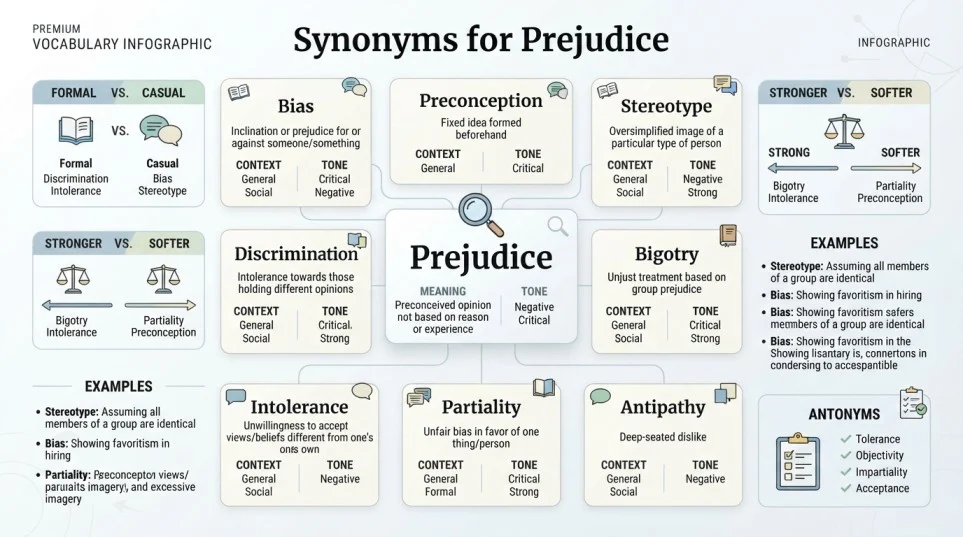
Prejudice means an unfair or unreasonable opinion formed about a person or group before knowing enough about them. Depending on context, useful alternatives include bias, preconception, partiality, bigotry, intolerance, discrimination, stereotyping, and preconceived notion.
Meaning, Tone and Context
Simple Definition
Prejudice is a preconceived opinion or judgment about a person, group, idea, or situation, usually formed without sufficient knowledge or fair consideration.
It often involves an unfair negative attitude toward people because of characteristics such as background, identity, appearance, beliefs, social status, or group membership.
For example:
His prejudice against unfamiliar cultures affected his judgment.
The sentence suggests that his opinion existed before he had enough information to make a fair assessment.
Part of Speech
“Prejudice” is primarily a noun.
Example:
The organization works to reduce prejudice in the workplace.
It can also be used as a verb, although this use is less common in everyday conversation.
Example:
The decision could prejudice the outcome of the investigation.
The adjective “prejudiced” describes someone or something influenced by an unfair prior judgment.
Example:
The reviewer was criticized for making a prejudiced assumption.
Tone
Prejudice usually has a negative tone because it describes unfair judgment or preconceived attitudes.
It is rarely neutral when describing human behavior.
However, the word can be used objectively in academic, legal, historical, social, and professional discussions.
Formality Level
“Prejudice” is a standard word suitable for casual conversation, academic writing, journalism, professional communication, and formal discussion.
It is particularly useful when discussing social attitudes, unfair judgments, cultural assumptions, and group based attitudes.
Common Use Cases
Prejudice commonly appears when discussing:
- Social attitudes
- Cultural differences
- Workplace fairness
- Education
- History
- Politics and public policy
- Personal relationships
- Stereotypes
- Discrimination
- Social inequality
- Literature and storytelling
- Human behavior
Important Word Forms
| Form | Word | Example |
|---|---|---|
| Noun | Prejudice | Prejudice can influence decision making. |
| Adjective | Prejudiced | The comment sounded prejudiced. |
| Verb | Prejudice | The evidence could prejudice the review. |
| Related noun | Preconception | She entered the discussion without strong preconceptions. |
| Related adjective | Unbiased | The panel attempted to remain unbiased. |
When and How to Use Prejudice
Use “prejudice” when you want to describe an opinion, attitude, or judgment formed without adequate knowledge or fair consideration.
It is especially appropriate when the subject involves unfair treatment or negative assumptions about a person or group.
Professional Example
The company introduced training to address prejudice and improve workplace inclusion.
This works because the sentence discusses an organizational issue in a professional setting.
Academic Example
The study examines how prejudice can influence social perceptions.
Here, “prejudice” sounds precise and appropriate for academic writing.
Personal Example
I realized that my first impression was influenced by prejudice.
The word describes an unfair assumption made before knowing the person.
Emotional Example
She felt hurt by the prejudice directed toward her family.
The word carries a serious emotional meaning in this context.
Another Word for Prejudice
The best single replacement depends on what you mean.
Bias is usually the most versatile alternative when you mean an unfair preference or tendency.
- For professional writing, “bias” often sounds more precise.
- For academic writing, “bias,” “preconception,” and “stereotype” can work depending on the exact idea.
- For casual conversation, “bias” or “unfair judgment” is easy to understand.
- For emotional writing, “bigotry,” “intolerance,” or “hostility” may communicate a stronger attitude.
- For creative writing, “antipathy,” “animus,” or “preconception” can add a more specific tone.
- For workplace writing, “bias” is often preferable because it can describe unfair judgment without automatically implying personal hatred.
- For social media captions, “bias,” “stereotyping,” or “intolerance” may be more direct.
- For a stronger meaning, choose “bigotry,” “hostility,” or “animus” when the context supports that intensity.
- For a softer meaning, “preconception,” “assumption,” or “bias” may be more appropriate.
When Not to Use Prejudice
“Prejudice” is not always the most precise word.
If you simply mean a preference, “preference” may be better.
She has a preference for local products.
Calling this prejudice would make the statement unnecessarily negative.
- If you mean a measurable tendency in a decision making system, “bias” may be more accurate.
The hiring process showed signs of bias.
- If you mean an assumption based on a generalized belief about a group, “stereotype” may be more precise.
The advertisement relies on a stereotype.
- If you mean active unfair treatment rather than an attitude, “discrimination” may be the better word.
The employee reported discrimination after being denied an opportunity because of her background.
The distinction matters because prejudice usually describes an attitude or preconceived judgment, while discrimination often refers to behavior or treatment.
Words Commonly Confused With Prejudice
Prejudice vs. Bias
Prejudice is usually an unfair preconceived judgment. Bias is a broader term describing a tendency that can influence judgment.
Prejudice vs. Discrimination
Prejudice is generally an attitude or belief. Discrimination usually refers to unfair treatment or behavior based on a characteristic or group membership.
Prejudice vs. Stereotype
A stereotype is a generalized belief about a group. Prejudice involves an unfair attitude or judgment that may develop from such beliefs.
Prejudice vs. Bigotry
Bigotry usually describes strong and unreasonable intolerance toward people with different identities, beliefs, or backgrounds. It is often stronger than prejudice.
Prejudice vs. Preconception
A preconception is an idea formed before having enough information. It is not always negative, while prejudice usually carries an unfair or negative implication.
Prejudice vs. Preference
A preference is simply a choice or liking. Prejudice implies an unfair judgment and should not be used for ordinary personal preferences.
Best Synonym by Context for Prejudice
| Context | Best Synonym | Why It Works | Example |
|---|---|---|---|
| Formal writing | Bias | Clear and broadly understood | The report examines bias in decision making. |
| Academic writing | Preconception | Emphasizes an idea formed beforehand | The experiment challenged several common preconceptions. |
| Professional use | Bias | Fits workplace discussions about judgment | The company reviewed the process for possible bias. |
| Resume | Impartiality as the opposite concept | Shows a commitment to fairness | Demonstrated impartiality when evaluating applications. |
| Casual conversation | Bias | Natural and easy to understand | I think he has a bias against new ideas. |
| Creative writing | Antipathy | Adds emotional depth | His antipathy toward the village was obvious. |
| Emotional tone | Intolerance | Highlights rejection of differences | Her intolerance made the conversation difficult. |
| Strong intensity | Bigotry | Communicates severe intolerance | The community spoke out against bigotry. |
| Soft or moderate tone | Preconception | Less accusatory | The decision may have been influenced by a preconception. |
| Social media | Stereotyping | Directly identifies generalized assumptions | Stereotyping can distort how we see others. |
| US usage | Bias | Common and widely understood | The discussion focused on unconscious bias. |
| UK usage | Prejudice | Very common in social and public discussion | The campaign aimed to challenge prejudice. |
Which Synonym Should You Choose?
Start by identifying exactly what you mean.
- If you mean an unfair tendency in judgment, choose bias.
- If you mean an opinion formed before learning enough information, choose preconception.
- If you mean a generalized belief about a group, choose stereotype.
- If you mean unfair treatment or conduct, choose discrimination.
- If you mean strong intolerance toward a group, choose bigotry or intolerance.
- If you mean strong emotional hostility, consider antipathy, animus, or hostility.
Think about formality as well. “Bias” works comfortably in workplace and academic writing, while “bigotry” carries much stronger emotional force.
The best synonym is not always the strongest word. It is the word that accurately matches your intended meaning.
Real Life Examples of Prejudice in Sentences
School
The history class examined how prejudice influenced social attitudes during different periods.
Workplace
The manager wanted to make sure personal prejudice did not influence the hiring decision.
Writing
The novel explores prejudice through the experiences of several characters.
Conversation
I do not want prejudice to affect how I judge someone I have just met.
Social Media
Challenging prejudice starts with questioning assumptions we may not realize we have.
Resume
Supported initiatives designed to promote fairness and reduce workplace bias.
We should review the process carefully to ensure that personal bias does not influence the outcome.
Storytelling
Years of prejudice had shaped the way he viewed everyone outside his community.
18 Synonyms for Prejudice
The following alternatives include direct synonyms and closely related terms that can replace “prejudice” when the intended meaning matches.
| Synonym | Simple Meaning | Best Used For | Example Sentence |
|---|---|---|---|
| Bias | An unfair tendency or preference | Professional and academic writing | The review process must minimize bias. |
| Preconception | An idea formed before knowing enough | Academic and thoughtful writing | Her preconception changed after hearing his explanation. |
| Partiality | Unfair preference for one side | Formal writing | The judge was expected to avoid partiality. |
| Predisposition | A tendency to think or act a certain way | Academic and analytical writing | His predisposition toward familiar ideas affected the discussion. |
| Prepossession | A strong prior opinion | Formal and literary writing | Her prepossession made it difficult to consider another view. |
| Preconceived notion | An opinion formed beforehand | General and explanatory writing | The conversation challenged his preconceived notion about the community. |
| Presumption | An assumption accepted before sufficient proof | Formal and analytical contexts | The argument was based on an unfair presumption. |
| Discrimination | Unfair treatment based on a characteristic | Workplace, legal, and social contexts | The policy was designed to prevent discrimination. |
| Bigotry | Strong intolerance toward a group | Serious and emotional contexts | The community rejected religious bigotry. |
| Intolerance | Lack of acceptance toward differences | Social and emotional writing | Intolerance can make productive dialogue difficult. |
| Favoritism | Unfair preference for one person or group | Workplace and personal contexts | Employees complained about favoritism. |
| One sidedness | Failure to consider different perspectives fairly | Reviews and analysis | The article was criticized for its one sidedness. |
| Unfairness | Lack of fairness | General and accessible writing | The decision created a perception of unfairness. |
| Animus | Strong hostility toward someone or something | Formal and legal style | The comments appeared to reveal personal animus. |
| Antipathy | Strong dislike or opposition | Formal and literary writing | His antipathy toward the proposal was clear. |
| Hostility | Unfriendly or aggressive attitude | Emotional and interpersonal contexts | Her hostility toward the new policy surprised everyone. |
| Stereotype | A generalized belief about a group | Social and academic discussions | The advertisement reinforced a harmful stereotype. |
| Chauvinism | Excessive belief in the superiority of one’s group | Social and critical writing | The essay examines cultural chauvinism. |
Synonym Groups and Usage Differences
Professional vs. Personal Synonyms
In professional communication, “bias” is often the strongest practical choice because it describes unfair influence without automatically suggesting hatred or hostility.
In personal writing, “preconception,” “assumption,” or “unfair judgment” can sound more reflective.
For example:
The hiring process may contain bias.
This is professional and measured.
I realized that my assumption about him was unfair.
This is more personal and reflective.
Formal vs. Conversational Synonyms
Formal writing often benefits from “partiality,” “preconception,” “predisposition,” “animus,” or “bias.”
Conversational English usually favors simpler words such as “bias,” “unfair judgment,” “assumption,” or “stereotyping.”
In an academic essay, “preconception” may sound more appropriate than a casual phrase such as “jumping to conclusions.”
Academic Synonyms
Academic writing benefits from precise terms.
“Bias” works well when discussing research, judgment, evaluation, or methodology.
“Preconception” works when discussing ideas formed before evidence is considered.
“Stereotype” is useful when discussing generalized beliefs about social groups.
“Predisposition” works when describing an existing tendency that may influence thinking or behavior.
Always choose the word that describes the exact mechanism being discussed.
Professional and Business Synonyms
“Bias” is particularly useful in workplace communication.
For example:
The organization is reviewing the process for potential bias.
“Partiality” can work in formal evaluations.
“Favoritism” is more specific when someone unfairly gives advantages to particular people.
“Discrimination” should be reserved for situations involving unfair treatment or conduct that genuinely fits that meaning.
Creative or Literary Synonyms
Creative writing gives you more freedom to choose words based on emotional effect.
“Antipathy” can communicate deep dislike.
“Animus” suggests hostility or strong ill feeling.
“Prepossession” creates a more formal literary tone.
“Hostility” is direct and emotionally vivid.
These choices can help a writer avoid repeating “prejudice” while preserving the emotional atmosphere of a scene.
Slang or Modern Synonyms
There is no single slang synonym for “prejudice” that works reliably in every situation.
Modern informal language may use phrases such as “having a bias,” “judging someone,” or “stereotyping.”
These expressions are suitable for casual conversations and social media, but formal essays and professional documents generally benefit from more precise vocabulary.
Strongest vs. Weaker Synonyms
A useful intensity scale is:
Mild: preconception, assumption, presumption
Moderate: bias, partiality, stereotyping, unfairness
Strong: intolerance, hostility, antipathy
Very strong: bigotry, severe discrimination
Intensity depends heavily on context. A strong word should not be used simply because it sounds more powerful.
Emotional vs. Neutral Synonyms
For a relatively neutral analytical tone, use “bias,” “preconception,” or “predisposition.”
For emotional writing, “hostility,” “antipathy,” “intolerance,” or “bigotry” may be appropriate.
The emotional difference can be substantial.
Compare:
The reviewer showed bias.
with:
The reviewer showed hostility.
The first focuses on unfair judgment. The second suggests an openly unfriendly attitude.
Antonyms of Prejudice
Because prejudice describes unfair judgment, its opposites often describe fairness, openness, neutrality, and acceptance.
| Antonym | Meaning | Example Sentence |
|---|---|---|
| Impartiality | Fairness without favoring one side | The panel maintained impartiality throughout the review. |
| Objectivity | Judging according to facts rather than personal feelings | The report aimed for objectivity. |
| Fairness | Treating people or situations justly | Fairness should guide every decision. |
| Neutrality | Not taking an unfair side | The moderator maintained neutrality during the debate. |
| Tolerance | Acceptance of differences | Tolerance encourages respectful discussion. |
| Acceptance | Willingness to recognize and respect differences | Acceptance can strengthen a community. |
| Openness | Willingness to consider different ideas | Openness helped the team find a better solution. |
| Broadmindedness | Willingness to consider unfamiliar views | Her broadmindedness made discussions easier. |
| Inclusivity | Making people feel welcomed and represented | The organization promotes inclusivity. |
| Egalitarianism | Belief in equal social standing | Egalitarianism rejects unfair hierarchies. |
| Equity | Fair treatment that considers different circumstances | The policy was created to improve equity. |
| Understanding | Awareness of another person’s situation or perspective | Understanding can reduce unnecessary conflict. |
| Respect | Recognition of another person’s value or rights | Respect should guide difficult conversations. |
| Nonpartisanship | Lack of favoritism toward a particular side | The organization emphasized nonpartisanship. |
| Evenhandedness | Treating different sides equally | The editor was praised for her evenhandedness. |
Comparison: Prejudice vs. Similar Words
Prejudice vs. Bias
The main difference is scope. Prejudice usually refers to an unfair preconceived attitude or judgment, while bias can describe a broader tendency that influences judgment.
Bias is often more neutral and professional in tone.
Example:
The hiring process showed bias.
Example:
The candidate faced prejudice because of his background.
Prejudice vs. Discrimination
Prejudice generally describes an attitude or belief. Discrimination usually describes unfair treatment or action.
Discrimination is therefore more appropriate when the focus is on what someone did rather than what they believed.
Example:
The manager showed prejudice toward older workers.
Example:
The manager discriminated against older workers during hiring.
Prejudice vs. Stereotype
A stereotype is a generalized belief about a group.
Prejudice involves an unfair attitude or judgment.
A stereotype can contribute to prejudice, but the two words are not identical.
Example:
The advertisement relies on a stereotype.
Example:
The customer’s prejudice affected how she treated the employee.
Prejudice vs. Bigotry
Bigotry is usually stronger than prejudice.
It suggests intense and unreasonable intolerance toward people with different characteristics, beliefs, or backgrounds.
Example:
The discussion revealed prejudice.
Example:
The comments were openly bigoted.
Prejudice vs. Preconception
A preconception is simply an idea formed before receiving enough information.
It does not always carry the strongly negative meaning associated with prejudice.
Example:
I had a preconception about the neighborhood.
Example:
He expressed prejudice against the people who lived there.
Prejudice vs. Partiality
Partiality means favoring one person, group, or side over another.
It may involve unfairness, but it does not necessarily involve a negative attitude toward the disfavored side.
Example:
The referee was accused of partiality.
Example:
The speaker’s prejudice affected his view of the entire group.
Common Phrases and Expressions with Prejudice
1. Racial Prejudice
Meaning: An unfair attitude toward people based on perceived race or racial background.
Example sentence:
The documentary examines the history and effects of racial prejudice.
2. Religious Prejudice
Meaning: An unfair judgment toward people because of their religion or beliefs.
Example sentence:
The program aims to reduce religious prejudice through education.
3. Gender Prejudice
Meaning: Unfair assumptions or judgments based on gender.
Example sentence:
The research explores how gender prejudice can influence career expectations.
4. Social Prejudice
Meaning: Unfair attitudes toward people based on social characteristics or group membership.
Example sentence:
Social prejudice can affect how communities interact.
5. Overcome Prejudice
Meaning: To move beyond unfair assumptions or attitudes.
Example sentence:
Education can help people overcome prejudice.
6. Challenge Prejudice
Meaning: To question or oppose unfair attitudes.
Example sentence:
The campaign encourages people to challenge prejudice in everyday situations.
7. Deep Seated Prejudice
Meaning: A strongly established unfair attitude that may be difficult to change.
Example sentence:
The organization is working to address deep seated prejudice within the community.
8. Unconscious Prejudice
Meaning: An unfair attitude or assumption that a person may not consciously recognize.
Example sentence:
Training can help employees recognize unconscious prejudice and examine their assumptions.
Common Mistakes to Avoid
1. Using “Prejudice” When You Mean Preference
Not every preference is prejudice.
Incorrect idea: She has prejudice for coffee over tea.
Better: She has a preference for coffee.
Prejudice implies unfair judgment, while preference simply describes what someone likes.
2. Confusing Prejudice With Discrimination
Prejudice usually concerns attitudes or judgments.
Discrimination generally concerns unfair treatment or behavior.
Choose “discrimination” when the sentence focuses on an action or decision that treats someone unfairly.
3. Using a Casual Synonym in Formal Writing
Words such as “judging people” may be understandable, but academic writing often benefits from precise terms such as “bias,” “preconception,” or “stereotyping.”
4. Using an Overly Dramatic Synonym
Do not replace every instance of prejudice with “bigotry.”
Bigotry is much stronger and suggests serious intolerance.
If the situation only involves an assumption, “preconception” may be more accurate.
5. Repeating “Prejudice” Too Often
Repeating the same word can make an essay or article feel monotonous.
Use “bias,” “preconception,” “stereotype,” or another accurate alternative when the meaning remains consistent.
6. Choosing the Wrong Emotional Tone
“Bias” is comparatively analytical.
“Hostility” is emotional.
“Bigotry” is highly serious.
Before selecting a synonym, consider how strongly you want the sentence to sound.
7. Using Slang in Academic or Professional Writing
Casual expressions may work in conversation but can weaken formal writing.
For essays, reports, applications, and workplace communication, choose established vocabulary that precisely communicates your point.
FAQs
What is the best synonym for “prejudice”?
“Bias” is usually the best general synonym, while “preconception,” “stereotype,” “discrimination,” or “bigotry” may be better depending on the specific meaning.
What is a formal synonym for “prejudice”?
Formal alternatives include “partiality,” “preconception,” “prepossession,” “predisposition,” “animus,” and “bias,” depending on the intended meaning.
What is an informal synonym for “prejudice”?
In casual conversation, people often use “bias,” “unfair judgment,” “stereotyping,” or “judging someone unfairly” instead of the more formal alternatives.
What is another word for “prejudice” in professional writing?
“Bias” is usually the most useful professional alternative because it is concise, widely understood, and appropriate for workplace discussions.
What is the difference between “prejudice” and “bias”?
Prejudice generally describes an unfair preconceived attitude, while bias is broader and can describe any tendency that influences judgment, including unconscious or systematic tendencies.
What is the opposite of “prejudice”?
Common opposites include impartiality, objectivity, fairness, neutrality, openness, tolerance, acceptance, inclusivity, equity, and evenhandedness.
Conclusion
“Prejudice” describes an unfair preconceived judgment or attitude, and the best alternative depends on exactly what you want to communicate.
Use bias for a broad professional or academic meaning. Choose preconception for an idea formed beforehand, stereotype for a generalized belief, discrimination for unfair treatment, and bigotry for strong intolerance.
When choosing synonyms for prejudice, focus on meaning first and intensity second. A precise word is more effective than a dramatic one.
A useful vocabulary habit is to ask yourself one question before replacing the word: Am I describing an assumption, an attitude, a belief, an emotion, or an action? That answer will usually lead you to the strongest synonym.
Discover More Post:
- 25+ Synonyms for Attention | Meanings, Examples, and Best …
- 25+ Synonyms for Marginalized | Meanings, Examples, and Best …
- 25+ Synonyms for Access | Meanings, Examples, and Best …