The word greedy is useful, but repeating it can make your writing sound predictable. You may need a better choice when describing someone who wants too much money, attention, power, food, or possessions.
This guide explains synonyms for greedy in natural American English. You will learn which words fit professional writing, school essays, casual conversations, social media captions, emotional writing, and creative descriptions.
What Does Greedy Mean?
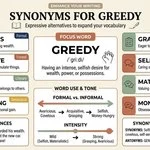
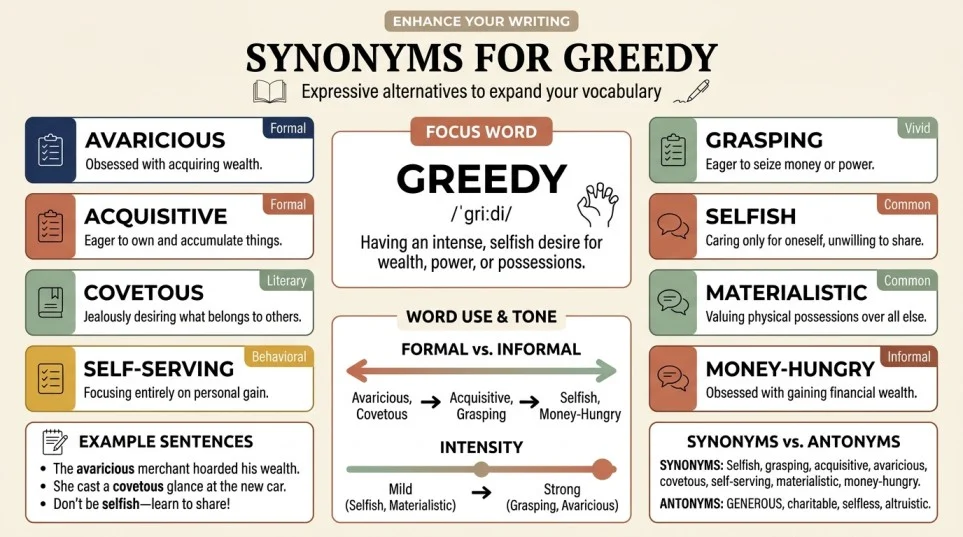
Greedy describes someone who wants more than they reasonably need or deserve, especially money, possessions, power, food, or attention. Formal choices include avaricious and acquisitive, while casual choices include grabby and money hungry.
Meaning, Tone and Context
1. Simple Definition
Greedy means wanting more of something than is reasonable, fair, or necessary.
The word often describes an excessive desire for money, possessions, food, attention, success, control, or other benefits.
For example:
She was greedy for praise and wanted every accomplishment recognized.
The company was criticized for being greedy with its profits.
2. Part of Speech
Greedy is an adjective.
Related forms include greed, a noun, and greedily, an adverb.
The noun greed refers to an excessive desire for more wealth, possessions, power, or other benefits.
The adjective greedy describes the person, behavior, or attitude connected with that desire.
3. Positive, Negative, or Neutral Tone
Greedy is strongly negative in most situations.
Calling someone greedy usually suggests that the person wants more than is fair or reasonable.
For example, saying someone is ambitious can be positive or neutral. Calling that person greedy suggests excessive self interest.
4. Formality Level
Greedy is a common everyday word. It works in casual conversation, general writing, stories, news discussions, and many workplace situations.
For formal or academic writing, a more precise word may be better. Avaricious, acquisitive, or self serving can communicate a specific type of excessive desire.
5. Common Use Cases
Greedy can describe:
- A person who wants excessive money
- Someone who takes more than their fair share
- A person who wants too much food
- Someone who constantly seeks attention
- A business focused excessively on profit
- A person who wants control or power
- Someone who refuses to share
- A character driven by excessive desire
6. Important Word Forms
| Word | Meaning | Example |
|---|---|---|
| Greedy | Wanting more than is reasonable | The greedy investor wanted even greater returns. |
| Greed | Excessive desire for more | Greed can damage trust. |
| Greedily | In a greedy manner | He looked greedily at the prize. |
| Generous | Willing to give or share | She was generous with her time. |
| Ungenerous | Not willing to give or share | His response seemed ungenerous. |
When and How to Use Greedy
Greedy is best when you want to clearly criticize excessive desire or unfair behavior.
Professional Context
The proposal could appear greedy if the company demands most of the available resources.
This sentence is direct, but a formal report might use self serving or excessively profit focused for a more measured tone.
Personal Context
My brother was being greedy when he took the last three pieces of cake.
Here, greedy sounds natural because the situation is informal and easy to understand.
Academic Context
The novel presents greed as a destructive force that influences the main character.
In academic writing, greed is often more useful than greedy when discussing the broader concept.
Social Media Context
Taking all the credit for the team effort feels pretty greedy.
The word works well in a short caption because it is familiar and emotionally clear.
Another Word for Greedy
The best single replacement depends on what kind of greed you mean.
- For professional writing, self serving can work when someone is acting mainly for personal benefit.
- For academic writing, avaricious or acquisitive can be more precise when discussing excessive desire for wealth or possessions.
- For casual conversation, grabby is natural when someone wants more than their share.
- For emotional writing, grasping can suggest an intense and unpleasant desire for money or advantage.
- For creative writing, covetous can emphasize a strong desire for something another person has.
- For resume or workplace writing, avoid directly calling a person greedy. Use precise descriptions such as overly competitive, self serving, or excessively profit focused when appropriate.
- For social media captions, grabby or money hungry can create a stronger conversational effect.
- For a stronger meaning, rapacious or insatiable may fit.
- For a softer meaning, acquisitive or self interested may sound less openly judgmental.
When Not to Use Greedy
Greedy is not always the most precise word.
- If someone simply wants success, ambitious may be better.
- If someone wants money specifically, avaricious may be more exact.
- If someone wants what belongs to another person, covetous may communicate the idea more clearly.
- If someone takes more than their fair share, grabby may sound more natural in casual speech.
Consider these examples:
She is greedy for success.
This sounds strongly critical.
She is ambitious and wants to advance her career.
This sounds more neutral and professional.
He is greedy for money.
He is avaricious and strongly focused on accumulating wealth.
The second example gives readers a clearer picture of the behavior.
Words Commonly Confused With Greedy
Greedy vs. Ambitious
Ambitious means strongly motivated to achieve something. Greedy suggests excessive desire.
An ambitious employee may work hard to earn a promotion.
A greedy employee may take credit for other people’s work to get promoted.
Greedy vs. Selfish
Selfish means putting your own needs or interests before others. Greedy specifically suggests wanting more than you need or deserve.
A selfish person may refuse to help.
A greedy person may take more resources than their fair share.
Greedy vs. Stingy
Stingy describes someone who is unwilling to spend or give money.
Greedy describes excessive desire to obtain or keep more.
A stingy person may refuse to buy a gift.
A greedy person may demand a larger share of the money.
Greedy vs. Covetous
Covetous means strongly wanting something that belongs to someone else.
Greedy has a broader meaning and does not necessarily involve another person’s possessions.
Greedy vs. Materialistic
Materialistic describes someone who places a high value on possessions, money, or material success.
A materialistic person may enjoy luxury without necessarily taking more than their fair share.
Greedy suggests excessive desire.
Greedy vs. Self Serving
Self serving describes behavior intended mainly to benefit oneself.
It can involve greed, but it does not always mean wanting more possessions or money.
Best Synonym by Context for Greedy
| Context | Best Synonym | Why It Works | Example |
|---|---|---|---|
| Formal writing | Avaricious | Precise and formal | The avaricious investor ignored ethical concerns. |
| Academic writing | Acquisitive | Useful for discussing desire to obtain more | The study examines acquisitive behavior. |
| Professional use | Self serving | Focuses on personal benefit | His recommendation appeared self serving. |
| Resume | Ambitious | More positive and professional | She is an ambitious professional. |
| Casual conversation | Grabby | Natural and informal | That kid is being grabby with the snacks. |
| Creative writing | Covetous | Adds emotional depth | He gave the treasure a covetous glance. |
| Emotional writing | Grasping | Suggests unpleasant desire | His grasping behavior damaged their friendship. |
| Strong intensity | Rapacious | Communicates extreme appetite for gain | The rapacious buyer wanted control of the entire market. |
| Moderate tone | Acquisitive | Less openly insulting | The company became increasingly acquisitive. |
| Social media | Money hungry | Familiar and expressive | People called the policy money hungry. |
| Business discussion | Profit driven | Focuses specifically on profit | The firm was criticized as excessively profit driven. |
| Food context | Insatiable | Works well for an appetite that cannot be satisfied | He had an insatiable appetite. |
Which Synonym Should You Choose?
Start by asking what the person wants.
- If the focus is money, choose avaricious, money hungry, or grasping.
- If the focus is possessions, acquisitive or materialistic may fit.
- If the person wants something belonging to someone else, covetous is more precise.
- If the problem is unfair sharing, grabby or selfish may be clearer.
Next, consider tone.
- Use greedy for a direct and familiar criticism. Use avaricious for formal writing. Use grabby for casual speech. Use rapacious when you want a very strong negative impression.
Finally, consider whether the behavior is actually negative.
If someone wants professional success, ambitious may be a better choice than greedy.
Real Life Examples of Greedy in Sentences
School
The greedy student took extra supplies even though everyone had already received a set.
Workplace
The manager seemed greedy when he claimed credit for the team’s results.
Writing
The story follows a greedy ruler whose desire for power eventually destroys his kingdom.
Conversation
You are being greedy. Leave some pizza for everyone else.
Social Media
Wanting every compliment for yourself can make you look greedy.
Resume
Avoid describing yourself as greedy on a resume. Ambitious, driven, or achievement focused usually communicates professional motivation more effectively.
Instead of accusing a colleague of being greedy, explain the specific concern: The current allocation may not give every team equal access to the available resources.
Storytelling
The merchant became increasingly grasping as his fortune grew.
18 Synonyms for Greedy
| Synonym | Simple Meaning | Best Used For | Example Sentence |
|---|---|---|---|
| Avaricious | Extremely eager for wealth | Formal writing | The avaricious businessman cared more about profit than fairness. |
| Acquisitive | Eager to obtain possessions or wealth | Academic and formal writing | Her acquisitive nature led her to collect valuable artwork. |
| Covetous | Strongly wanting what another person has | Emotional and literary writing | He cast a covetous look at his neighbor’s new car. |
| Grasping | Eager to gain money or advantage | Critical descriptions | His grasping behavior made cooperation difficult. |
| Rapacious | Extremely greedy and aggressive in seeking gain | Strong criticism | The rapacious corporation pursued every possible source of revenue. |
| Insatiable | Impossible to satisfy | Desire, appetite, ambition | She had an insatiable desire for recognition. |
| Selfish | Putting personal interests first | Personal and everyday situations | It was selfish to take all the available seats. |
| Self serving | Mainly intended to benefit oneself | Professional and business writing | His explanation sounded self serving. |
| Materialistic | Focused strongly on possessions and wealth | Lifestyle discussions | His materialistic outlook influenced many of his decisions. |
| Mercenary | Motivated mainly by money or personal gain | Formal and critical writing | Her mercenary approach damaged the spirit of the project. |
| Money hungry | Excessively focused on making money | Casual writing and speech | The advertisement made the company seem money hungry. |
| Grabby | Wanting more than your share | Casual conversation | The children became grabby when the treats arrived. |
| Possessive | Wanting to control or keep something | Relationships and possessions | His possessive attitude made the partnership uncomfortable. |
| Piggish | Greedy or unpleasantly excessive | Informal criticism | His piggish behavior at the buffet embarrassed his friends. |
| Voracious | Having an extremely large appetite or desire | Food and figurative writing | The investor had a voracious appetite for new opportunities. |
| Overreaching | Trying to gain more power or advantage than is reasonable | Business and formal criticism | The proposal seemed overreaching and unfair. |
| Profit focused | Giving strong priority to financial gain | Business contexts | The company became increasingly profit focused. |
| Self interested | Motivated mainly by personal benefit | Neutral or formal discussion | His decision was understandable but clearly self interested. |
Synonym Groups and Usage Differences
Professional vs. Personal Synonyms
In professional writing, avoid calling someone greedy unless the criticism is necessary and well supported.
Words such as self serving, self interested, profit focused, and acquisitive can describe behavior more precisely.
In personal conversations, greedy and selfish are more natural.
Grabby works especially well when discussing children, food, toys, or small everyday situations.
Formal vs. Conversational Synonyms
Avaricious, acquisitive, covetous, and rapacious are more formal or literary.
Greedy, selfish, and money hungry are easier to understand in everyday conversation.
Grabby is highly conversational and should generally be avoided in formal essays or business reports.
Academic Synonyms
Academic writing benefits from precision.
Acquisitive works well when discussing the desire to obtain possessions or wealth. Avaricious works when the focus is excessive desire for money.
Materialistic can work when discussing values centered on possessions.
Self serving is useful when discussing motives or decisions that primarily benefit the individual.
Professional and Business Synonyms
Business writing requires careful wording.
- If someone is motivated by personal advantage, self serving may be appropriate.
- If a company prioritizes financial gain, profit focused may be more precise.
- If a strategy attempts to gain too much control or advantage, overreaching may be appropriate.
Creative or Literary Synonyms
Creative writing often benefits from words that communicate character and emotion.
Covetous suggests desire for something another person possesses.
Grasping creates an unpleasant image of someone desperate for money or advantage.
Rapacious suggests aggressive and extreme pursuit of gain.
Slang or Modern Synonyms
Money hungry is informal but widely understood in American English.
Grabby is also informal and works best for simple situations involving sharing.
These choices are usually inappropriate for academic papers, formal reports, and professional documents.
Strongest vs. Weaker Synonyms
A useful intensity scale is:
Mild: acquisitive, self interested
Moderate: greedy, selfish, materialistic
Strong: grasping, avaricious, covetous
Very strong: rapacious, insatiable
The correct choice depends on what kind of desire you are describing. Stronger words can make a sentence sound judgmental or dramatic.
Emotional vs. Neutral Synonyms
Greedy is emotionally negative.
Rapacious and grasping are even more negative.
Acquisitive can sound more neutral, especially in academic or business discussions.
Self interested can be relatively measured because it focuses on motivation rather than directly attacking someone’s character.
Antonyms of Greedy
| Antonym | Meaning | Example Sentence |
|---|---|---|
| Generous | Willing to give or share | She was generous with her time. |
| Selfless | Putting others before yourself | His selfless actions helped the entire group. |
| Giving | Willing to provide help or resources | She has always been giving toward others. |
| Charitable | Willing to help people in need | The charitable donor supported several local causes. |
| Altruistic | Concerned with helping others | His altruistic decision benefited the community. |
| Benevolent | Kind and generous toward others | The benevolent leader funded the community project. |
| Magnanimous | Generous and forgiving | She was magnanimous after winning the debate. |
| Unselfish | Not focused mainly on personal gain | His unselfish choice helped his teammates. |
| Sharing | Willing to let others use or have something | The sharing child offered everyone a turn. |
| Content | Satisfied with what one has | He was content with his current income. |
| Satisfied | Feeling that enough has been received | She was satisfied with her achievements. |
| Modest | Not excessively focused on status or possessions | He lived a modest life despite his success. |
| Frugal | Careful about spending resources | She was frugal without being unwilling to help others. |
| Temperate | Moderate and controlled in behavior | He maintained a temperate approach to spending. |
| Generous hearted | Naturally willing to give and help | Her generous hearted nature made her a trusted friend. |
Comparison: Greedy vs. Similar Words
Greedy vs. Ambitious
The main difference is motivation.
Ambitious describes a strong desire to achieve success. Greedy suggests excessive desire for more.
Ambitious is usually more positive and professional.
Example: She is ambitious and hopes to lead the department someday.
Example: She is greedy and wants the entire reward for herself.
Greedy vs. Selfish
Selfish means putting your own interests ahead of others.
Greedy focuses more specifically on wanting or taking too much.
Selfish is broader. Greedy is stronger when excessive acquisition is the main issue.
Example: It was selfish to ignore their needs.
Example: It was greedy to take more than half the available supplies.
Greedy vs. Stingy
Stingy describes unwillingness to spend or give.
Greedy describes excessive desire to obtain or keep more.
Stingy is more closely connected with refusing to give.
Example: He is stingy with his money.
Example: He is greedy and wants every available reward.
Greedy vs. Covetous
Covetous means strongly wanting something that belongs to someone else.
Greedy does not require another person’s possession.
Covetous is more specific and often sounds literary.
Example: She was greedy for wealth.
Example: He was covetous of his neighbor’s property.
Greedy vs. Materialistic
Materialistic describes strong concern with money, luxury, and possessions.
Greedy implies excessive desire or unfair behavior.
Materialistic can describe a lifestyle or value system without suggesting that someone takes more than their share.
Greedy vs. Self Serving
Self serving describes actions that mainly benefit the person taking them.
Greedy describes excessive desire for more.
Self serving is often better for professional analysis because it focuses on behavior and motivation.
Common Phrases and Expressions with Greedy
1. Greedy for Money
Meaning: Wanting more money than seems reasonable.
Example sentence: His greedy pursuit of money damaged his relationships.
2. Greedy for Attention
Meaning: Wanting excessive attention or recognition.
Example sentence: The performer was criticized for being greedy for attention.
3. Greedy for Power
Meaning: Wanting excessive control or authority.
Example sentence: The story follows a ruler who becomes greedy for power.
4. Greedy for Success
Meaning: Wanting achievement to an excessive degree.
Example sentence: Being eager to succeed is healthy, but becoming greedy for success can create problems.
5. Greedy for More
Meaning: Wanting additional rewards, possessions, or benefits even after receiving enough.
Example sentence: Even after winning the prize, he was greedy for more.
6. Greedy Appetite
Meaning: An excessive desire for food or, figuratively, for something else.
Example sentence: The athlete seemed to have a greedy appetite after the long race.
7. Greedy Behavior
Meaning: Actions that show excessive desire or unwillingness to share.
Example sentence: The manager apologized for the team’s greedy behavior.
8. Greedy Person
Meaning: Someone who consistently wants more than is reasonable.
Example sentence: Nobody wants to be known as a greedy person.
Common Mistakes to Avoid
1. Using Greedy When Ambitious Is Better
Do not call someone greedy simply because they want professional success.
Use ambitious when the person is motivated and determined without exploiting others.
2. Confusing Greedy With Stingy
A stingy person does not want to give or spend.
A greedy person wants to obtain or keep more.
The two ideas can overlap, but they are not identical.
3. Using Casual Synonyms in Formal Writing
Words such as grabby and money hungry can sound too informal in academic or professional writing.
Choose avaricious, acquisitive, or self serving when the context requires more formal language.
4. Using an Overly Dramatic Synonym
Rapacious is much stronger than greedy.
Do not use it for a minor situation, such as someone taking an extra cookie.
5. Repeating Greedy Too Often
If the same word appears several times, replace it with a precise alternative.
For example, use selfish for behavior, avaricious for money, and covetous for another person’s possessions.
6. Choosing a Synonym With the Wrong Emotional Tone
Acquisitive can sound relatively neutral.
Rapacious sounds strongly negative.
Choose based on the impression you want the reader to receive.
FAQs
What is the best synonym for greedy?
The best synonym depends on context. Avaricious works for excessive desire for wealth, while selfish, acquisitive, grasping, or grabby fit other situations.
What is a formal synonym for greedy?
Avaricious is one of the strongest formal synonyms for greedy when describing excessive desire for money or wealth. Acquisitive is another useful formal choice.
What is an informal synonym for greedy?
Grabby is a natural informal synonym when someone wants more than their share. Money hungry also works when the focus is excessive desire for money.
What is another word for greedy in professional writing?
Self serving, self interested, acquisitive, or profit focused may work better in professional writing because they identify the specific behavior more carefully.
What is the difference between greedy and selfish?
Greedy suggests wanting or taking too much. Selfish means putting personal interests before others. A person can be selfish without being financially greedy.
What is the opposite of greedy?
Common opposites include generous, selfless, giving, charitable, altruistic, content, satisfied, and unselfish. The best choice depends on the specific context.
Conclusion
Greedy describes an excessive desire for money, possessions, food, attention, power, or other benefits. It is a clear and familiar word, but the best alternative depends on what kind of desire you want to describe.
Use avaricious for excessive desire for wealth, acquisitive for a strong desire to obtain possessions, covetous for wanting what belongs to someone else, and self serving for behavior that mainly benefits the individual.
For casual situations, greedy, selfish, grabby, and money hungry can sound natural. For formal writing, more precise vocabulary often makes your meaning clearer.
The best vocabulary tip is simple: do not choose a synonym only because it sounds sophisticated. Choose the word that describes the exact behavior, tone, and level of intensity you mean.
Discover More Post:
- 25+ Synonyms for Superior | Meanings, Examples, and Best …
- 25+ Synonyms for Inspiring | Meanings, Examples, and Best …
- 25+ Synonyms for Overcome | Meanings, Examples, and Best …