If you keep using the word purple in descriptions, captions, essays, stories, or everyday conversation, your writing can start to feel repetitive. The good news is that English offers many precise alternatives, especially when you want to describe a particular shade, mood, object, or visual effect.
The best synonym for purple depends on context. Violet can sound precise, lavender feels softer, plum suggests a deep rich shade, and mauve creates a muted impression. This guide explains the meaning, tone, intensity, and practical use of these alternatives so you can choose the right word for school, work, creative writing, social media, emails, or everyday speech.
What Does “Purple” Mean?
Purple is a color created by combining red and blue, and it can range from soft lavender to deep violet. Useful alternatives include violet for precision, lavender for softness, plum for depth, and mauve for a muted tone.
Meaning, Tone and Context
Simple Definition
Purple is a color that generally falls between red and blue. It includes a broad family of shades, from pale lilac and lavender to rich plum and deep violet.
The word can describe an actual color or create a symbolic impression. Purple is often associated with royalty, creativity, mystery, spirituality, luxury, and imagination.
Part of Speech
Purple can function as both an adjective and a noun.
As an adjective:
She wore a purple dress to the event.
As a noun:
Purple is one of my favorite colors.
Tone
Purple itself is generally neutral as a color description, but it can create different emotional impressions depending on its shade and context.
Light purple can feel gentle, calm, romantic, or delicate. Dark purple can feel luxurious, dramatic, mysterious, or sophisticated.
Formality Level
Purple is a standard and widely accepted English word. It works comfortably in casual conversation, academic writing, business communication, creative writing, product descriptions, and social media.
More specific color words can sometimes make writing sound more polished because they communicate the exact visual quality you want.
Common Use Cases
Purple commonly appears when describing:
- Clothing
- Flowers
- Paint and design
- Interior decoration
- Food and drinks
- Nature
- Branding
- Art
- Photography
- Beauty products
- Feelings and moods
- Fiction and storytelling
Important Word Forms and Related Terms
Purple is primarily used as a noun and adjective.
There is no commonly used verb form meaning to make something purple in ordinary modern English. The related expression purpled exists in literary usage, but it is uncommon.
Other useful related words include:
- Purple
- Purplish
- Violet
- Lavender
- Lilac
- Plum
- Mauve
- Amethyst
- Magenta
- Orchid
When and How to Use “Purple”
Use purple when you want to identify a broad color family without specifying an exact shade.
If the precise shade matters, choose a more specific alternative. For example, lavender communicates a much lighter and softer appearance than plum.
Professional Example
Context: Professional design
The company selected a deep purple for its presentation materials.
Purple works naturally in workplace communication when discussing branding, design, products, or visual materials.
Personal Example
Context: Personal description
My sister bought a purple jacket for the winter.
The simple word purple is usually better than a complicated color term when precision is not important.
Academic Example
Context: Academic writing
The researcher used purple markings to distinguish one category from another.
In academic writing, purple is appropriate when the color itself is relevant to the subject.
Creative Example
Context: Creative writing
A deep violet glow spread across the evening sky.
Here, violet creates a more vivid visual image than the general word purple.
Another Word for “Purple”
There is no single perfect replacement for purple because different alternatives describe different shades.
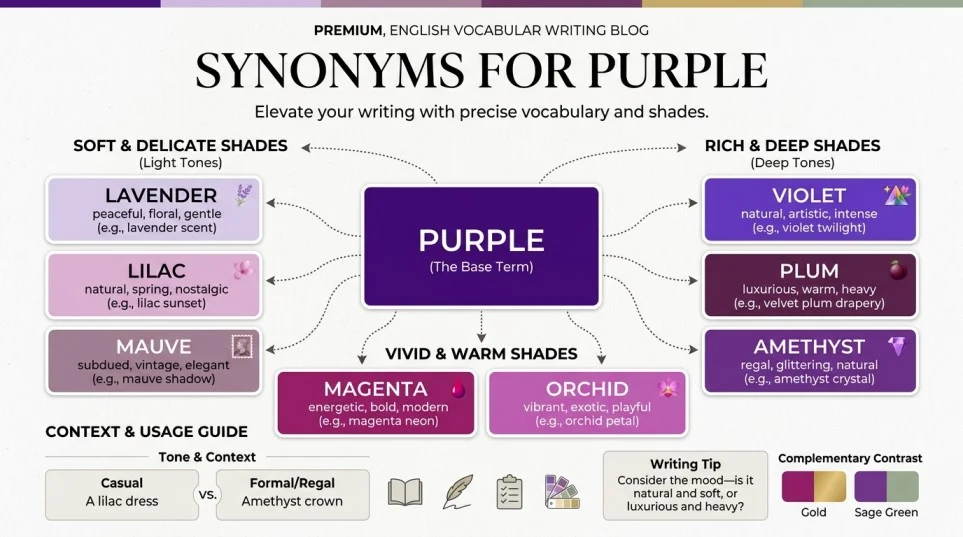
For most situations, violet is one of the closest alternatives. However, lavender, lilac, mauve, plum, amethyst, orchid, and magenta can be better choices when a particular shade is intended.
Professional Writing
Use violet, deep violet, or plum when describing a specific design color.
Academic Writing
Use violet when discussing color precisely, especially in scientific, artistic, or visual contexts.
Casual Conversation
Use purple itself, violet, or lavender, depending on the shade.
Emotional Writing
Use lavender, lilac, or violet when you want a softer or more atmospheric feeling.
Creative Writing
Use amethyst, plum, violet, or orchid to create stronger imagery.
Resume or Workplace Use
Use precise color terms only when color is relevant to your professional work. A designer might write:
Created visual materials using violet and lavender color palettes.
Social Media Captions
Lavender, lilac, violet, and plum can make captions feel more descriptive and stylish.
Stronger Meaning
Use deep violet, rich plum, or dark purple when you want a more intense visual effect.
Softer Meaning
Use lavender, lilac, or pale violet for a delicate appearance.
When Not to Use “Purple”
Purple is useful, but it can be too general when the exact shade matters.
For example:
She wore a purple dress.
This sentence is correct, but it does not tell the reader whether the dress was pale, dark, muted, reddish, or bluish.
A more precise sentence could be:
She wore a deep plum dress.
The second version gives the reader a clearer visual impression.
Purple can also sound less expressive in creative writing when a specific shade would strengthen the image.
Instead of:
The flowers were purple.
You could write:
The flowers were soft lavender.
The second sentence gives the reader more information about the appearance and mood.
Words Commonly Confused With “Purple”
Purple vs. Violet
Purple is a broad color category, while violet usually refers to a more specific blue leaning shade.
Use violet when you want greater color precision.
Purple vs. Lavender
Lavender is generally a pale, soft shade associated with purple.
Use lavender when the color is light and delicate.
Purple vs. Lilac
Lilac usually describes a light purple shade with a soft, floral impression.
Use lilac when describing flowers, clothing, decoration, or gentle color palettes.
Purple vs. Mauve
Mauve is a muted purple that often contains gray or pink undertones.
Use mauve when the color appears subdued rather than vivid.
Purple vs. Magenta
Magenta is a vivid color that sits strongly between red and purple in common color descriptions.
Use magenta when the shade appears bright, intense, and noticeably pinkish.
Purple vs. Plum
Plum usually describes a dark, rich purple associated with the color of the fruit.
Use plum for sophisticated, deep, or luxurious color descriptions.
Best Synonym by Context for “Purple”
| Context | Best Synonym | Why It Works | Example |
|---|---|---|---|
| Formal writing | Violet | Sounds precise and polished | The artwork uses violet tones. |
| Academic writing | Violet | Clearly identifies a color family | The sample appeared violet under the light. |
| Professional or business use | Plum | Gives a refined design impression | The brand uses a dark plum accent. |
| Resume | Violet | Useful for design related work | Developed violet based presentation graphics. |
| Casual conversation | Purple | Familiar and natural | I bought a purple shirt. |
| Creative writing | Amethyst | Creates rich visual imagery | An amethyst glow filled the room. |
| Emotional tone | Lavender | Suggests softness and calm | The room had a peaceful lavender glow. |
| Strong intensity | Deep violet | Communicates visual depth | The sky became deep violet at sunset. |
| Soft or moderate tone | Lilac | Suggests a gentle purple | She chose a lilac dress. |
| Social media captions | Lavender | Stylish and visually descriptive | Loving this lavender sunset. |
| Luxury design | Plum | Suggests richness and sophistication | The lounge featured plum velvet chairs. |
| Floral descriptions | Lilac | Closely associated with flowers | The garden was filled with lilac blooms. |
Which Synonym Should You Choose?
Choosing an alternative to purple is mainly about shade, intensity, tone, and context.
Use purple when you simply need a general color name.
Use violet when precision matters. It is especially useful in academic, scientific, artistic, and descriptive contexts.
- Use lavender or lilac when the color is light and soft.
- Use plum when the shade is dark, rich, or sophisticated.
- Use mauve when the purple looks muted, dusty, or subdued.
- Use magenta when the color is vivid and has a strong pink or red quality.
- Use amethyst when you want an elegant or gemstone inspired description.
A simple rule is this: choose the word that gives the reader the clearest mental picture without adding unnecessary complexity.
Real Life Examples of “Purple” in Sentences
School
The student used purple highlights to identify the key vocabulary terms.
Workplace
The marketing team selected purple for the campaign graphics.
Writing
The purple sky reflected across the quiet lake.
Conversation
Do you prefer the purple one or the blue one?
Social Media
Purple skies make every sunset feel magical.
Resume
Designed purple and violet visual assets for seasonal marketing campaigns.
I attached the updated version with the purple headings you requested.
Storytelling
As night approached, the mountains disappeared beneath a veil of deep violet.
18 Synonyms for “Purple”
Some words below are exact or near synonyms, while others identify particular purple shades. This distinction matters because color vocabulary is highly dependent on shade.
| Synonym | Simple Meaning | Best Used For | Example Sentence |
|---|---|---|---|
| Violet | A blue leaning purple color | Precise descriptions | The flowers had bright violet petals. |
| Lavender | A pale, soft purple | Calm and delicate imagery | The walls were painted lavender. |
| Lilac | A light floral purple | Flowers and soft colors | She wore a beautiful lilac blouse. |
| Mauve | A muted purple with pink or gray qualities | Fashion and interiors | The sofa came in a muted mauve shade. |
| Plum | A deep, rich purple | Luxury and fashion | He chose a dark plum suit. |
| Amethyst | A gemstone inspired purple | Creative and elegant descriptions | The necklace had an amethyst color. |
| Orchid | A vivid pinkish purple | Flowers and design | The room featured orchid colored accents. |
| Magenta | A vivid reddish purple | Graphics and modern design | The poster used bright magenta lettering. |
| Mulberry | A dark reddish purple | Fashion and decorative writing | The fabric had a rich mulberry tone. |
| Wine | A deep reddish purple | Fashion and interiors | She selected a wine colored handbag. |
| Eggplant | A very dark purple | Food, design, and interiors | The kitchen cabinets were eggplant in color. |
| Heather | A soft muted purple | Clothing and textiles | The sweater came in a subtle heather shade. |
| Periwinkle | A light blue purple | Soft visual descriptions | The wall was painted pale periwinkle. |
| Fuchsia | A bright pinkish purple | Fashion and visual design | Her shoes were a vivid fuchsia. |
| Grape | A medium or dark purple | Food, branding, and casual descriptions | The drink had a grape color. |
| Byzantium | A deep purple shade | Historical and artistic contexts | The painting used Byzantium tones. |
| Tyrian | A historically rich purple | Historical and luxury references | The fabric recalled the famous Tyrian purple of antiquity. |
| Raisin | A dark brownish purple | Fashion and product descriptions | The boots came in a dark raisin shade. |
Synonym Groups and Usage Differences
Professional vs. Personal Synonyms
Professional writing benefits from precision. If color is relevant to a project, terms such as violet, plum, mauve, and lavender can communicate more information than simply saying purple.
Personal writing does not require the same level of precision. Purple is usually the most natural choice for everyday conversation.
Formal vs. Conversational Synonyms
Purple is completely acceptable in formal writing. More specific words become useful when the exact shade contributes to the meaning.
A report might say:
The samples showed a violet coloration.
A casual speaker might simply say:
The samples looked purple.
Both sentences can be appropriate in their respective settings.
Academic Synonyms
Academic writing should favor accuracy over decorative vocabulary.
Violet is useful when a specific color needs to be identified. Lavender, mauve, and magenta can also work when the research concerns a particular shade or visual characteristic.
Professional and Business Synonyms
In business communication, color words often appear in design, branding, fashion, marketing, packaging, and product descriptions.
Use precise terms when they help a colleague, client, or customer understand exactly what you mean.
For example:
The new packaging uses a deep plum background with lavender accents.
This is more informative than:
The new packaging uses purple.
Creative or Literary Synonyms
Creative writing gives you more freedom to use expressive color vocabulary.
Words such as amethyst, violet, plum, lilac, and orchid can create stronger imagery.
For example:
The horizon faded from rose into a deep violet haze.
The specific shade helps readers visualize the scene.
Slang or Modern Synonyms
Purple does not have many genuine slang synonyms. Modern speakers may use playful descriptions such as grape when discussing a color informally, especially in fashion, food, or design.
However, grape should not replace purple in academic or professional writing unless it is the established name of a specific color.
Strongest vs. Weaker Synonyms
A simple intensity scale can help:
Soft: lavender, lilac, pale violet
Moderate: purple, violet, orchid
Rich: plum, amethyst, mulberry
Vivid: magenta, fuchsia
Very deep: dark purple, deep violet, eggplant
Intensity depends on the actual shade, so these categories are descriptive rather than absolute.
Emotional vs. Neutral Synonyms
Neutral terms include purple and violet.
Softer terms such as lavender and lilac can create peaceful or delicate associations.
Rich terms such as plum and amethyst can suggest luxury, elegance, or sophistication.
Vivid terms such as magenta and fuchsia can create energetic or dramatic impressions.
Antonyms of “Purple”
Purple does not have a true linguistic antonym because colors do not normally function as direct opposites in the same way that words such as hot and cold do.
In color vocabulary, however, writers sometimes use contrasting colors or nonpurple colors as practical opposites. Yellow is especially important because it is commonly considered complementary to purple.
The following list therefore represents contrasting color choices rather than strict dictionary antonyms.
| Antonym | Meaning | Example Sentence |
|---|---|---|
| Yellow | A bright warm color that contrasts strongly with purple | The yellow flowers stood out against the purple wall. |
| Gold | A warm metallic yellow shade | Gold lettering contrasted with the purple background. |
| Orange | A vivid warm color | Orange accents created contrast with the purple design. |
| Amber | A warm yellow orange shade | Amber lights balanced the purple decorations. |
| Green | A color commonly contrasted with purple in visual design | Green leaves surrounded the purple flowers. |
| Lime | A bright yellow green | Lime details created a strong contrast with purple. |
| Chartreuse | A vivid yellow green | Chartreuse text stood out against the purple panel. |
| Red | A warm primary color with strong visual contrast | Red flowers appeared beside the purple ones. |
| Blue | A cool primary color that differs from purple | Blue and purple were used in separate sections. |
| White | A neutral light color | White lettering was placed over the purple background. |
| Black | A neutral dark color | Black furniture contrasted with the purple walls. |
| Gray | A neutral muted color | Gray accents softened the purple interior. |
| Brown | A warm earthy color | Brown wood created contrast with the purple fabric. |
| Beige | A pale neutral color | Beige curtains balanced the purple sofa. |
| Cream | A soft warm neutral | Cream walls made the purple artwork more noticeable. |
Comparison: Purple vs. Similar Words
Purple vs. Violet
Main difference: Purple is a broad color term, while violet generally describes a more blue leaning shade.
Which is stronger: Neither is automatically stronger.
Which is more formal: Violet can sound slightly more precise.
Examples:
She bought a purple sweater.
The artist used violet pigment.
Purple vs. Lavender
Main difference: Lavender is a pale and soft type of purple.
Which is stronger: Purple can describe stronger shades.
Which is more formal: Neither is inherently more formal.
Examples:
The room was painted purple.
The room was painted pale lavender.
Purple vs. Mauve
Main difference: Mauve is a muted purple with pink or gray qualities.
Which is stronger: Purple can describe more saturated shades.
Which is more formal: Mauve can sound more specialized in fashion and design.
Examples:
She chose a purple dress.
She chose a muted mauve dress.
Purple vs. Plum
Main difference: Plum usually describes a darker and richer purple.
Which is stronger: Plum often creates a deeper visual impression.
Which is more formal: Neither is inherently more formal.
Examples:
The curtains were purple.
The curtains were deep plum.
Purple vs. Magenta
Main difference: Magenta is much more vivid and usually has a stronger red or pink quality.
Which is stronger: Magenta is often more intense.
Which is more formal: Both are standard color terms.
Examples:
The design used purple accents.
The design used vivid magenta accents.
Purple vs. Lilac
Main difference: Lilac usually describes a lighter, softer purple associated with the lilac flower.
Which is stronger: Purple can describe much stronger shades.
Which is more formal: Neither is inherently more formal.
Examples:
She painted the wall purple.
She painted the wall soft lilac.
Common Phrases and Expressions with “Purple”
1. Purple Heart
Meaning:
Purple Heart can refer to the military decoration awarded to members of the United States armed forces who are wounded or killed in qualifying circumstances.
Example sentence:
The museum displayed a Purple Heart alongside the veteran’s belongings.
2. Purple Patch
Meaning:
A purple patch describes a period when someone performs exceptionally well, especially in sports or another competitive activity.
Example sentence:
The player is enjoying a purple patch this season.
3. Born to the Purple
Meaning:
This traditional expression refers to someone born into royalty or a highly privileged family.
Example sentence:
The historical novel follows a prince born to the purple.
4. Purple Prose
Meaning:
Purple prose describes writing that is excessively elaborate, decorative, or emotional.
Example sentence:
The editor removed several passages of purple prose from the manuscript.
5. Purple Haze
Meaning:
Purple haze can describe a purple colored mist or atmospheric appearance. It is also used as a creative expression.
Example sentence:
A purple haze settled over the mountains at dusk.
6. Purple State
Meaning:
A purple state is a US state where political support is relatively competitive between major parties.
Example sentence:
The campaign focused heavily on voters in several purple states.
Common Mistakes to Avoid
1. Using Purple When a Precise Shade Is Better
Saying purple is not wrong, but it can be too general.
Instead of:
She wore a purple dress.
Try:
She wore a deep plum dress.
Use the more specific word when the shade matters.
2. Treating Every Purple Shade as an Exact Synonym
Lavender, magenta, mauve, plum, and violet are related color terms, but they do not describe exactly the same shade.
Choose based on the actual color you want to communicate.
3. Using a Casual Color Description in Formal Writing
Terms such as grape may sound too informal in professional or academic contexts.
Use standard terms such as purple, violet, lavender, or mauve when precision is important.
4. Choosing an Overly Dramatic Color Word
Not every purple object needs to be described as amethyst or Tyrian.
Overly elaborate vocabulary can make simple writing feel unnatural.
5. Repeating Purple Too Often
Repeated use can make descriptive writing feel flat.
Instead, identify the actual shade and replace repeated uses with accurate alternatives when appropriate.
6. Choosing the Wrong Emotional Tone
Lavender can feel soft and peaceful, while deep plum can feel rich and dramatic.
Make sure the selected word matches the mood of your sentence.
7. Confusing Color Names With Strict Synonyms
Color vocabulary often works through shades and categories rather than perfect synonyms.
A useful synonym guide should explain those differences instead of pretending every related word means exactly the same thing.
FAQs
What is the best synonym for purple?
Violet is one of the closest alternatives, while lavender, lilac, mauve, plum, and amethyst work better when you need to describe a particular shade.
What is a formal synonym for purple?
Violet is a strong formal alternative because it sounds precise and works well in academic, artistic, scientific, and professional descriptions.
What is an informal synonym for purple?
Purple itself is already natural and conversational. Grape can sometimes describe a purple shade informally, especially in casual design or fashion discussions.
What is another word for purple in professional writing?
Violet, plum, mauve, or lavender can work in professional writing when they accurately describe the color being discussed.
What is the difference between purple and violet?
Purple is a broad color term, while violet usually refers to a more specific shade that leans toward blue.
What is the opposite of purple?
Purple has no strict linguistic opposite. Yellow is commonly considered its complementary color, while other colors can provide practical visual contrast.
Conclusion
Purple is a broad and useful color word, but choosing a more specific alternative can make your writing clearer and more vivid. Violet works well for precision, lavender and lilac suggest softness, plum creates a rich impression, mauve feels muted, and magenta adds intensity.
The best synonym for purple depends on the actual shade, the emotional effect you want, and the context in which you are writing. Instead of replacing purple simply to avoid repetition, choose a related color term that gives the reader more useful information.
A practical vocabulary tip is simple: do not choose the fanciest color word. Choose the most accurate one.
Read More Related Articles:
- 25+ Synonyms for Access | Meanings, Examples, and Best …
- 25+ Synonyms for Definitely | Meanings, Examples, and Best …
- 25+ Synonyms for Broken | Meanings, Examples, and Best …