Have you ever written “access” several times in an email, essay, resume, or report and felt that the wording sounded repetitive? The word is useful, but it can describe several different ideas, including entering a place, using information, obtaining something, or having permission.
Learning synonyms for access helps you choose a word that communicates your exact meaning. A professional email may need “authorization,” while a casual conversation may sound more natural with “entry” or “use.”
This guide explains the meaning, tone, context, and practical differences among common alternatives. The goal is not simply to replace access, but to help you choose the most precise word for each situation.
What Does “Access” Mean?
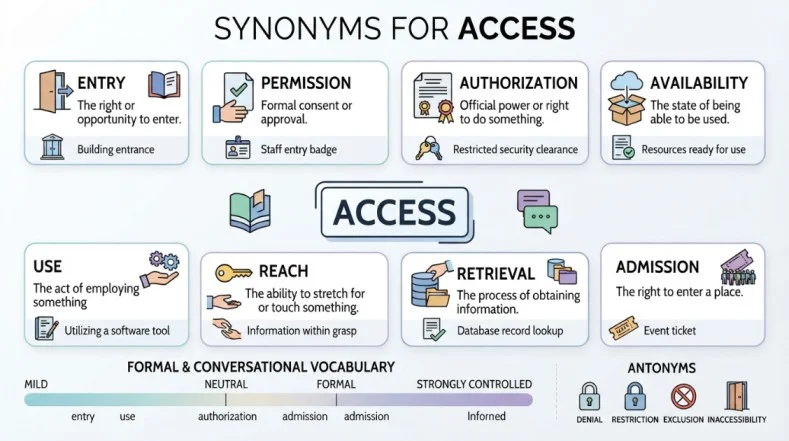
Access means the ability, right, or opportunity to enter, reach, use, obtain, or retrieve something. Depending on context, useful alternatives include entry, admission, availability, permission, authorization, reach, obtain, retrieve, and use.
Meaning, Tone and Context
Simple Definition
The word access generally refers to the ability or opportunity to reach, enter, use, or obtain something.
For example:
“Employees need access to the company database.”
Here, access means the ability or permission to use the database.
Access can also describe the act of reaching or entering a place.
“Visitors can access the building through the main entrance.”
In this sentence, access means enter or reach.
Part of Speech
Access is commonly used as both a noun and a verb.
As a noun:
“Students have access to the online library.”
As a verb:
“Students can access the online library from home.”
The noun often refers to availability, permission, entry, or opportunity. The verb often means enter, reach, use, obtain, or retrieve.
Tone
Access is generally neutral in tone. It works well in casual conversations, academic writing, business communication, technical writing, and professional documents.
Its tone becomes more specific depending on the surrounding words.
For example, “access to healthcare” sounds factual, while “restricted access” communicates limitation.
Formality Level
Access is versatile and can be used in both formal and everyday English.
It is especially common in technology, education, healthcare, business, government, transportation, security, and professional communication.
Common Use Cases
You may use access when discussing:
- Entering a building or location
- Using an account or system
- Obtaining information
- Reaching a resource
- Having permission
- Using a service
- Retrieving digital information
- Getting healthcare or education
- Reaching a physical location
- Having an opportunity to interact with someone or something
Important Word Forms
Access: noun and verb
Accessible: adjective describing something that can be reached, entered, used, or obtained
Accessibility: noun describing how easily something can be reached or used
Inaccessible: adjective describing something that cannot easily be reached, entered, or used
Accessible to: commonly used to describe who can use or reach something
Example:
“The course is accessible to students from different backgrounds.”
When and How to Use “Access”
Access is appropriate when you want to express the ability to enter, reach, use, retrieve, or obtain something.
1. Professional
“Only authorized employees can access the financial records.”
Here, access refers to permission to use or view information.
2. Personal
“I need access to my old photos before I replace my phone.”
The word refers to the ability to reach or use the photos.
3. Academic
“Students have access to thousands of research articles through the university library.”
Access describes the availability of educational resources.
4. Technology
“Users can access their accounts from any supported device.”
Here, access means enter or use a digital system.
5. Email
“Please let me know if you cannot access the shared document.”
This is a natural use in workplace communication.
6. Resume
“Managed user access to internal software and company resources.”
In a resume, access can describe a responsibility involving systems, information, or security.
7. Casual Conversation
“Can you give me access to the folder?”
This is natural when talking about shared files or resources.
Another Word for “Access”
There is no single replacement that works in every sentence because access has several meanings.
- For professional writing, consider authorization, permission, availability, or entry, depending on the sentence.
- For academic writing, availability, entry, reach, or obtain may work.
- For casual conversation, entry, use, reach, or get into may sound natural.
- For emotional writing, connection, closeness, or reach may sometimes express the intended idea more effectively.
- For creative writing, entry, reach, pathway, or approach can add more descriptive meaning.
- For resume or workplace use, authorization, entry, availability, retrieval, or use may provide greater precision.
- For social media captions, entry, reach, connection, or availability may fit depending on the subject.
- For a stronger meaning, use words such as authorization, clearance, or admission when permission or controlled entry is specifically intended.
- For a softer meaning, use availability, opportunity, or use when the situation is about having something available rather than receiving formal permission.
When Not to Use “Access”
Access can sometimes sound too broad because it covers several different meanings.
For example:
“Employees have access to the training.”
This could mean the training is available, that employees are allowed to use it, or that they can physically enter it.
A more precise sentence would be:
“Employees have permission to view the training.”
Or:
“The training is available to all employees.”
When Access Is Too General
Instead of:
“She gained access to the executive.”
Consider:
“She gained an opportunity to speak with the executive.”
The second sentence makes the intended meaning clearer.
When Access Is Too Formal
In a casual sentence, “access” can occasionally sound less natural than “use.”
Instead of:
“May I access your charger?”
You might simply say:
“Can I use your charger?”
When Access Is Too Weak
If you specifically mean official permission, “authorization” can be more precise.
Instead of:
“You need access to the system.”
Use:
“You need authorization to use the system.”
Words Commonly Confused With “Access”
Access vs. Entry
Access can mean the ability or permission to enter. Entry usually focuses more directly on entering a place.
“Visitors have access to the museum.”
“Visitors have entry to the museum.”
The first can emphasize permission or availability. The second focuses more directly on admission or entering.
Access vs. Admission
Admission usually means permission to enter or the process of being allowed into a place or event.
Access is broader because it can also mean reaching information, services, systems, or resources.
Access vs. Permission
Permission means approval to do something. Access can involve permission, but it can also simply describe the ability to reach or use something.
Access vs. Authorization
Authorization is more specific and formal. It usually means official approval or permission.
Access can exist without emphasizing who granted permission.
Access vs. Availability
Availability means that something can be obtained, used, or found.
Access can describe the ability to use something that is available, but the two words are not interchangeable in every context.
Access vs. Reach
Reach means successfully getting to, contacting, or extending to something.
Access can imply reach, but it frequently includes an additional idea of permission or usability.
Best Synonym by Context for “Access”
| Context | Best Synonym | Why It Works | Example |
|---|---|---|---|
| Formal writing | Authorization | Clearly communicates official approval | Employees require authorization to view restricted records. |
| Academic writing | Availability | Works naturally when discussing resources | Students benefit from the availability of online journals. |
| Professional or business use | Permission | Clearly explains the right to use something | You need permission to edit the document. |
| Resume | Authorization | Shows responsibility involving controlled use | Managed authorization for internal systems. |
| Casual conversation | Use | Simple and natural | Can I use your computer? |
| Creative writing | Entry | Creates a stronger sense of entering a place | The hidden doorway offered entry into the garden. |
| Emotional tone | Connection | Can express meaningful personal access to another person | Her kindness gave him a deeper connection to the community. |
| Strong intensity | Clearance | Suggests formal approval, especially for restricted areas | The technician received security clearance. |
| Soft or moderate tone | Availability | Focuses on something being obtainable or present | The program improves the availability of educational resources. |
| Social media captions | Reach | Works naturally for audiences and destinations | The campaign expanded its reach across the country. |
| Technology | Retrieval | Precise when information is being obtained from storage | The system allows rapid retrieval of customer records. |
| Physical locations | Entry | Directly describes entering a place | Entry is available through the north gate. |
US and UK Usage
Access is widely understood in both US and UK English.
The core meanings are the same, although particular expressions surrounding access can vary by region, institution, or industry.
For American English, common phrases include “access to healthcare,” “access the account,” “gain access,” and “restricted access.”
Which Synonym Should You Choose?
Start by identifying what access means in your sentence.
- If you mean permission, choose permission or authorization.
- If you mean official approval, authorization or clearance may be more precise.
- If you mean entering a place, choose entry or admission.
- If you mean using something, use or availability may be clearer.
- If you mean getting information, consider retrieval, obtaining, or reaching.
- If you mean contacting an audience, reach may be the better choice.
Consider formality as well. Authorization and clearance sound more official, while use and get into are more conversational.
Finally, consider emotional intensity. Neutral words such as availability and entry work well for factual writing, while connection can introduce a more personal meaning.
Real Life Examples of “Access” in Sentences
School
“Students have access to digital textbooks through the school library.”
A more specific alternative could be:
“Students can use digital textbooks through the school library.”
Workplace
“New employees receive access to the company portal during orientation.”
A more precise version could be:
“New employees receive authorization to use the company portal during orientation.”
Writing
“The article gives readers access to practical vocabulary strategies.”
Another option is:
“The article provides readers with useful vocabulary resources.”
Conversation
“Do you have access to the files?”
A casual alternative is:
“Can you get to the files?”
Social Media
“The new feature gives creators access to better editing tools.”
A shorter alternative is:
“The new feature gives creators more editing tools.”
Resume
“Provided customers with access to account support services.”
A more action focused version could be:
“Connected customers with account support services.”
“Please confirm that you have access to the shared folder.”
This is concise and natural for workplace communication.
Storytelling
“The narrow path provided access to a quiet garden hidden behind the house.”
A more literary alternative could be:
“The narrow path led into a quiet garden hidden behind the house.”
25 Synonyms for “Access”
The following words and phrases cover different senses of access. They should not be treated as interchangeable in every sentence.
| Synonym | Simple Meaning | Best Used For | Example Sentence |
|---|---|---|---|
| Entry | The act or right of entering | Buildings, places, events | Visitors must show identification before entry. |
| Admission | Permission to enter | Schools, events, institutions | Admission to the conference is limited. |
| Permission | Approval to do or use something | Everyday and professional situations | You need permission to edit the file. |
| Authorization | Official permission | Business, technology, security | The employee received authorization to view the records. |
| Clearance | Official approval for restricted access | Security and controlled environments | The contractor received clearance before entering the facility. |
| Availability | The state of being obtainable or usable | Services, resources, opportunities | The program increased the availability of online courses. |
| Use | The ability or act of using something | Casual and practical language | Employees can use the software from home. |
| Reach | The ability to get to or contact something | People, places, audiences | The campaign helped the organization reach new customers. |
| Admission rights | The right to enter | Controlled locations and events | Members receive admission rights to the private facility. |
| Entry rights | The right to enter a place | Formal location based contexts | Residents have entry rights through the secured gate. |
| Retrieval | Getting stored information | Computers, databases, records | The application supports quick retrieval of archived files. |
| Obtaining | Getting or acquiring something | Information, resources, materials | Researchers focused on obtaining reliable data. |
| Acquisition | The process of obtaining something | Business and formal writing | The acquisition of specialized resources improved the project. |
| Approach | A way of reaching something | Physical and figurative contexts | The northern approach provides easier access to the station. |
| Passage | A way through or into a place | Physical locations and descriptive writing | The passage leads directly into the courtyard. |
| Entrance | A point or means of entering | Buildings and physical spaces | The main entrance is closed after midnight. |
| Opportunity | A favorable chance to do or obtain something | Education, employment, services | The scholarship gives students an opportunity to study abroad. |
| Exposure | Contact with or experience of something | Ideas, information, experiences | The internship gave her exposure to modern marketing tools. |
| Connection | A link that provides contact or communication | People, networks, emotional contexts | His professional connection helped him find useful resources. |
| Contact | Communication or interaction with someone | People and organizations | The website gives customers direct contact with support staff. |
| Link | A connection between people, systems, or resources | Technology and information | The portal provides a direct link to account services. |
| Pathway | A route toward something | Education, careers, figurative writing | The program creates a pathway to higher education. |
| Ingress | The act or means of entering | Technical and formal contexts | The building has controlled ingress for visitors. |
| Open access | Availability without significant restrictions | Research, publishing, information | The journal makes its articles available through open access. |
| Availability rights | Rights concerning the use or availability of resources | Specialized administrative contexts | The agreement defines availability rights for participating organizations. |
Synonym Groups and Usage Differences
Professional vs. Personal Synonyms
Professional writing often benefits from precision.
Use authorization when you mean formal approval, permission when you mean approval in a broader sense, and clearance when access involves security or restrictions.
Personal communication usually favors simpler words.
For example, “Can I use your laptop?” sounds more natural than “Can I access your laptop?” when you simply want to use it.
Formal vs. Conversational Synonyms
Formal writing can use authorization, admission, clearance, retrieval, and acquisition when their meanings are accurate.
Conversational English often favors use, entry, get into, reach, or permission.
Compare:
“Authorization is required to view the records.”
“You need permission to see the records.”
Both are clear, but the first sounds more institutional.
Academic Synonyms
Academic writing often needs precision rather than variety for its own sake.
Use availability when discussing resources, access when discussing opportunities or resources broadly, retrieval when discussing information systems, and admission when discussing entry into an institution.
Example:
“Improved access to educational resources can support student learning.”
The word access works well because the sentence includes several related ideas, including availability and opportunity.
Professional and Business Synonyms
Business communication frequently uses access when discussing software, databases, accounts, files, information, customers, and services.
When greater precision is useful, choose authorization for official approval, permission for general approval, clearance for restricted environments, and retrieval for obtaining stored information.
Example:
“Only managers have authorization to modify financial records.”
Creative or Literary Synonyms
Creative writing can replace access with words that create a more vivid sense of movement or connection.
Entry, entrance, passage, pathway, reach, and connection can provide different shades of meaning.
Instead of:
“The door gave access to the garden.”
A story might say:
“The narrow passage opened into a forgotten garden.”
The second version creates a stronger visual image.
Slang or Modern Synonyms
There is no widely accepted slang replacement for access that works across all situations.
In casual technology conversations, people may say “get into,” “get on,” or simply “use.”
For example:
“I cannot get into my account.”
This is conversational, while:
“I cannot access my account.”
is neutral and suitable for both casual and professional communication.
Strongest vs. Weaker Synonyms
The following scale describes the general force of these words when the intended meaning involves permission or control.
Mild: availability
Moderate: access
More specific: permission
Formal: authorization
Highly controlled: clearance
These words are not a strict intensity scale in every context. Their difference mainly comes from how specifically they communicate permission, restriction, or official approval.
Emotional vs. Neutral Synonyms
Access, entry, availability, and use are generally neutral.
Connection can introduce a personal or emotional dimension.
Opportunity can suggest hope, possibility, or personal advancement.
Reach can sound more human when discussing communication, relationships, or influence.
Choose the word according to the emotion you want the sentence to communicate rather than replacing access automatically.
Antonyms of “Access”
Access has several meanings, so its opposite depends on the context. The following terms represent accurate opposites for particular senses.
| Antonym | Meaning | Example Sentence |
|---|---|---|
| Denial | Refusal to allow access | The applicant received a denial of entry. |
| Exclusion | Keeping someone or something out | The policy resulted in the exclusion of unauthorized visitors. |
| Restriction | A limit placed on access or use | The system has a restriction on external users. |
| Prohibition | An official rule preventing an action | The building has a prohibition on unauthorized entry. |
| Inaccessibility | The condition of being difficult or impossible to reach or use | The inaccessibility of the road delayed deliveries. |
| Blockage | Something that prevents passage or movement | A blockage prevented access to the entrance. |
| Obstruction | Something that blocks a route or process | The fallen tree created an obstruction on the path. |
| Closure | The act of shutting something | The closure of the bridge limited travel. |
| Disconnection | The loss of a connection | The disconnection ended access to the online service. |
| Unavailability | The condition of not being available | The unavailability of the records delayed the investigation. |
| Rejection | Refusal to accept or permit something | The request for entry received a rejection. |
| Removal | Taking away someone’s ability or opportunity to use something | The administrator announced the removal of account privileges. |
| Lockout | Prevention from entering or using a system | The security lockout prevented further login attempts. |
| Secrecy | The state of keeping information hidden | Strict secrecy prevented public access to the information. |
| Isolation | Separation from others or from resources | Geographic isolation reduced access to essential services. |
Comparison: “Access” vs. Similar Words
Access vs. Entry
Main difference: Access can mean permission, ability, or opportunity to reach something. Entry focuses more directly on entering.
Which one is stronger: Neither is universally stronger. Entry is more specific for physical entrance.
Which one is more formal: Both can be formal, depending on context.
Example with access: “Employees have access to the secure area.”
Example with entry: “Employees must use their badges for entry.”
Access vs. Admission
Main difference: Admission usually concerns being allowed into a place, institution, or event. Access has broader meanings.
Which one is stronger: Admission can sound more specific when permission to enter is the issue.
Which one is more formal: Both are appropriate in formal writing.
Example with access: “Students have access to the online library.”
Example with admission: “Admission to the program requires an application.”
Access vs. Permission
Main difference: Permission means approval to do something. Access can mean ability to reach or use something even when permission is not the focus.
Which one is stronger: Permission is more specific when approval is the main idea.
Which one is more formal: Access is broadly neutral. Permission works across both formal and casual situations.
Example with access: “She has access to the shared folder.”
Example with permission: “She has permission to edit the shared folder.”
Access vs. Authorization
Main difference: Authorization means official approval. Access can simply mean the ability to enter or use something.
Which one is stronger: Authorization is more specific about official approval.
Which one is more formal: Authorization is more formal.
Example with access: “The employee has access to the database.”
Example with authorization: “The employee has authorization to modify the database.”
Access vs. Availability
Main difference: Availability means something can be obtained or used. Access emphasizes the ability or opportunity to reach it.
Which one is stronger: Neither is universally stronger.
Which one is more formal: Both work well in formal writing.
Example with access: “Students have access to research materials.”
Example with availability: “The availability of research materials has increased.”
Access vs. Reach
Main difference: Reach emphasizes getting to, contacting, or extending toward something. Access can include permission and usability.
Which one is stronger: Reach can be more direct when physical distance or communication is involved.
Which one is more formal: Both can be neutral and professional.
Example with access: “The platform provides access to international customers.”
Example with reach: “The platform helps businesses reach international customers.”
Common Phrases and Expressions with “Access”
1. Access to
Meaning:
The ability, right, or opportunity to use, reach, or obtain something.
Example sentence:
“Students need access to reliable educational resources.”
2. Gain access
Meaning:
To obtain the ability or permission to enter, use, or reach something.
Example sentence:
“After completing verification, users can gain access to their accounts.”
3. Have access
Meaning:
To possess the ability or permission to use or reach something.
Example sentence:
“Employees have access to the training library.”
4. Restricted access
Meaning:
Access that is limited to certain people or under specific conditions.
Example sentence:
“The research facility has restricted access.”
5. Public access
Meaning:
Availability for members of the general public.
Example sentence:
“The park provides public access to the lake.”
6. Direct access
Meaning:
A straightforward or immediate way to reach or use something.
Example sentence:
“The apartment has direct access to the courtyard.”
7. Remote access
Meaning:
The ability to reach or use a system from another location.
Example sentence:
“Remote access allows employees to work with company files from home.”
8. Equal access
Meaning:
A situation in which people have comparable opportunities to use or reach something.
Example sentence:
“The organization is working to provide equal access to educational programs.”
Common Mistakes to Avoid
1. Using Access When a More Precise Word Is Better
“Access” can be broad.
If you specifically mean official approval, use authorization or permission.
Instead of:
“You need access to enter the restricted room.”
Use:
“You need authorization to enter the restricted room.”
2. Confusing Access With Admission
Admission generally concerns being allowed into a place, institution, or event.
Access can also refer to information, services, systems, opportunities, and resources.
3. Using a Casual Synonym in Formal Writing
Words such as “get into” can sound too conversational in a formal report.
Use access, entry, permission, or authorization when the context requires a professional tone.
4. Using an Overly Dramatic Synonym
Creative words such as pathway or connection may sound inappropriate when the sentence simply concerns logging into a website.
“The employee accessed the database” is clearer than replacing it with an elaborate expression.
5. Repeating Access Too Often
Repeated wording can make an article, report, or email feel monotonous.
Instead of changing every occurrence randomly, replace repeated instances only when another word expresses the intended meaning more precisely.
6. Choosing the Wrong Emotional Tone
Connection can sound personal, while access is usually neutral.
If you are writing a factual report, “access” may be better than “connection.”
If you are describing a meaningful relationship, “connection” may communicate more.
7. Using Slang in Academic or Professional Writing
Expressions such as “get into” are acceptable in casual speech but may be less suitable for academic papers or formal business documents.
Choose vocabulary that matches the audience and purpose.
FAQs
What is the best synonym for “access”?
The best synonym depends on meaning. Use entry for entering, permission for approval, authorization for official approval, availability for resources, and use for simple everyday situations.
What is a formal synonym for “access”?
Authorization is a strong formal synonym when access means official permission. Clearance is appropriate when entry or use is controlled for security or organizational reasons.
What is an informal synonym for “access”?
Use is often the most natural informal alternative when you mean using something. “Get into” can also work when talking casually about entering an account or place.
What is another word for “access” in professional writing?
Professional alternatives include authorization, permission, availability, entry, retrieval, and clearance. The correct choice depends on whether you mean approval, use, entry, or obtaining information.
What is the difference between “access” and “entry”?
Access is broader and can mean ability, permission, or opportunity to reach something. Entry specifically focuses on entering a place, event, or institution.
What is the opposite of “access”?
There is no single opposite in every context. Denial, exclusion, restriction, prohibition, inaccessibility, and unavailability can express different forms of being prevented from accessing something.
Conclusion
The word access can describe entering a place, using a system, reaching information, obtaining resources, or having permission. Because it has several meanings, the best replacement depends on the exact idea you want to communicate.
For formal situations, consider authorization or clearance when official approval matters. For entering a place, entry or admission may be clearer. Everyday use, permission or use can sound more natural. For resources, availability may be the most precise choice.
The most useful vocabulary tip is simple: do not replace a word merely to avoid repetition. Replace it when the alternative communicates your intended meaning more accurately.
Before publishing educational or professional content, verify definitions and nuanced usage with trusted dictionaries such as Cambridge, Oxford, Merriam Webster, Collins, or Britannica.
Discover More Post:
- 25+ Synonyms for Secret | Meanings, Examples, and Best …
- 25+ Synonyms for Proficient | Meanings, Examples, and Best …
- 25+ Synonyms for Walked | Meanings, Examples, and Best …