Using the word proficient again and again can make a resume, essay, email, or professional profile sound repetitive. The right alternative can make your writing more precise while showing exactly how strong your ability really is.
Whether you are describing software skills, language ability, academic knowledge, workplace experience, or a creative talent, context matters. This guide to synonyms for proficient explains which words sound natural, professional, formal, casual, strong, or more specific.
What Does “Proficient” Mean?
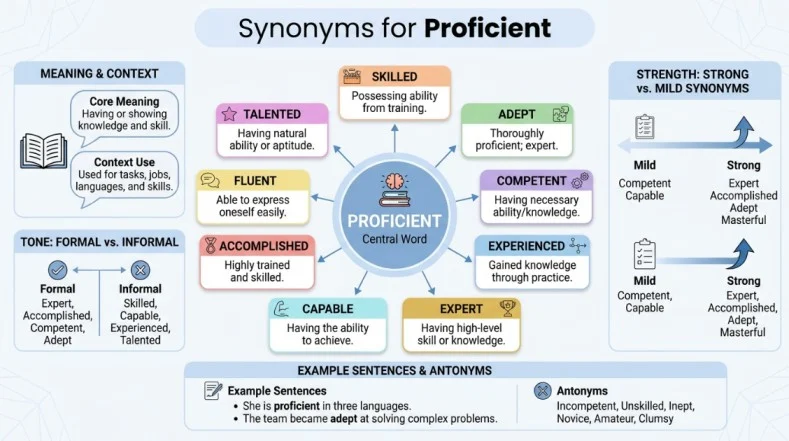
Proficient means having a good level of skill, knowledge, or ability in something. The best alternatives include skilled for general use, adept for formal writing, competent for professional contexts, fluent for languages, and expert for very advanced ability.
Meaning, Tone and Context
Simple Definition
Proficient describes someone who can do something well because they have developed sufficient skill, knowledge, practice, or experience.
For example:
“She is proficient in Excel.”
This means she has a solid working ability with Excel and can use it effectively.
Part of Speech
Proficient is an adjective.
Common related forms include:
Proficiency, the level of skill or ability.
Proficiently, in a skilled or capable manner.
Tone
Proficient usually has a positive and professional tone. It suggests reliable ability without necessarily claiming exceptional mastery.
The word is generally neutral in emotional tone. It focuses on competence rather than talent, enthusiasm, or personal qualities.
Formality Level
Proficient is moderately formal and works especially well in professional, academic, educational, and workplace settings.
It is common in resumes, job applications, performance reviews, training documents, and descriptions of technical skills.
Common Use Cases
Proficient is frequently used for:
Software skills
Foreign languages
Technical abilities
Professional tasks
Academic subjects
Writing skills
Communication abilities
Creative skills
Workplace competencies
When and How to Use “Proficient”
Use proficient when you want to communicate that someone has developed a dependable level of ability.
It is particularly useful when the skill can be learned, practiced, evaluated, or demonstrated.
Professional
“Maria is proficient in data analysis and regularly prepares detailed reports.”
Personal
“After several months of practice, I became proficient at playing the guitar.”
Academic
“The student is proficient in algebra and applies mathematical concepts accurately.”
Resume
“Proficient in Microsoft Excel, Google Sheets, and data visualization.”
“Our team is proficient in the software required for the new project.”
Creative
“She is proficient in digital illustration and character design.”
Social Media
“Finally feeling proficient with my new camera and editing software.”
Another Word for “Proficient”
The best single replacement depends on the exact meaning you want.
- For professional writing, skilled and competent are dependable choices.
- For academic writing, adept, capable, and knowledgeable can work well depending on the sentence.
- For casual conversation, good at sounds more natural than proficient.
- For emotional writing, accomplished or talented can add a stronger sense of achievement.
- For creative writing, masterful, skilled, or adept can provide more descriptive depth.
- For resumes and workplace communication, skilled, experienced, qualified, and competent are especially useful.
- For social media captions, skilled, good at, talented, or experienced often sound more conversational.
- For a stronger meaning, choose expert, masterful, or highly skilled.
- For a softer meaning, choose capable, competent, or familiar with, depending on what you actually mean.
When Not to Use “Proficient”
Proficient may sound too formal in everyday conversation.
Instead of saying:
“I am proficient at cooking.”
A natural conversational version is:
“I am pretty good at cooking.”
Proficient can also be too broad when you need to show a specific level of expertise.
Instead of:
“She is proficient in programming.”
You might write:
“She has advanced programming skills and five years of development experience.”
Avoid using proficient when the person only has basic familiarity with a subject.
If someone has only used a program a few times, “familiar with” may be more accurate.
Words Commonly Confused With “Proficient”
Proficient vs. Expert
Proficient indicates a strong working ability. Expert usually suggests a much higher level of knowledge, experience, or authority.
Use proficient when someone can perform a skill well. Use expert when the person has exceptional depth and advanced experience.
Proficient vs. Competent
Competent means capable of performing something successfully. Proficient generally suggests a stronger or more developed level of skill.
Proficient vs. Skilled
Skilled is broader and more natural in many situations. Proficient often emphasizes demonstrated ability in a particular subject or task.
Proficient vs. Experienced
Experienced focuses on time and exposure. Proficient focuses more directly on ability.
Someone can be experienced without being highly skilled, while proficiency indicates an established level of competence.
Proficient vs. Fluent
Fluent is especially appropriate for languages and communication. Proficient can describe language ability but is broader and can apply to many different skills.
Proficient vs. Talented
Talented suggests natural ability or exceptional aptitude. Proficient describes developed ability and does not necessarily imply natural talent.
Best Synonym by Context for “Proficient”
| Context | Best Synonym | Why It Works | Example |
|---|---|---|---|
| Formal writing | Adept | Polished and formal | She is adept at managing complex projects. |
| Academic writing | Capable | Clear and objective | The researcher is capable of analyzing large data sets. |
| Professional use | Skilled | Direct and widely understood | He is skilled in customer relationship management. |
| Resume | Experienced | Highlights practical background | Experienced in financial reporting and analysis. |
| Business communication | Competent | Emphasizes reliable ability | She is a competent project coordinator. |
| Casual conversation | Good at | Natural and conversational | I am pretty good at photography. |
| Creative writing | Masterful | Adds a stronger artistic meaning | Her masterful use of language impressed the audience. |
| Emotional tone | Accomplished | Suggests achievement | She is an accomplished writer. |
| Strong intensity | Expert | Indicates advanced ability | He is an expert in cybersecurity. |
| Mild or moderate tone | Capable | Avoids overstating ability | She is capable of handling the assignment. |
| Social media | Talented | Friendly and expressive | Such a talented photographer. |
| Language skills | Fluent | Best for strong communication ability | He is fluent in Spanish. |
| Technical skills | Skilled | Clear for practical abilities | She is skilled in software development. |
| Experience based context | Experienced | Focuses on practical exposure | He is an experienced editor. |
| Knowledge based context | Knowledgeable | Highlights understanding | She is knowledgeable about digital marketing. |
| Formal professional profile | Accomplished | Highlights achievement | An accomplished financial analyst. |
Which Synonym Should You Choose?
Start by identifying what you actually want to communicate.
- If you simply mean someone can perform a task well, skilled is usually the safest choice.
- If you want to emphasize reliable ability, choose competent or capable.
- If practical experience matters more than skill level, choose experienced.
- If someone has exceptional knowledge or advanced ability, expert is stronger than proficient.
- If the subject is a language, fluent may be more precise.
- If the person has achieved notable success, accomplished can communicate more than basic competence.
Always match the synonym to the evidence. Strong vocabulary should improve accuracy, not exaggerate ability.
Real Life Examples of “Proficient” in Sentences
School
“Students should become proficient in basic research and citation techniques.”
Workplace
“Our new analyst is proficient in Excel and financial modeling.”
Writing
“She is proficient in technical writing and creates clear instructional content.”
Conversation
“I am not an expert, but I am proficient enough to handle the task myself.”
Social Media
“After months of practice, I am finally proficient with video editing.”
Resume
“Proficient in Microsoft Office, Google Workspace, and project management software.”
“Our staff is proficient in the platform and can assist with the transition.”
Storytelling
“Years of practice had made her proficient with the violin, allowing her to perform confidently before an audience.”
25 Synonyms for “Proficient”
| Synonym | Simple Meaning | Best Used For | Example Sentence |
|---|---|---|---|
| Skilled | Having developed ability | General and professional use | She is skilled at solving technical problems. |
| Adept | Very capable and skillful | Formal and professional writing | He is adept at negotiating complex contracts. |
| Competent | Able to perform successfully | Workplace and practical situations | She is a competent project manager. |
| Capable | Having the ability to do something | Neutral and moderate claims | He is capable of managing the entire process. |
| Experienced | Having substantial practical exposure | Resumes and workplaces | We hired an experienced software developer. |
| Expert | Having exceptional knowledge or skill | Advanced ability | She is an expert in digital analytics. |
| Accomplished | Highly successful or skilled | Professional and creative contexts | He is an accomplished architect. |
| Talented | Showing strong natural ability | Creative and personal contexts | She is a talented musician. |
| Knowledgeable | Having substantial understanding | Academic and professional use | He is knowledgeable about tax regulations. |
| Practiced | Developed through repeated practice | Skills and performance | She is a practiced public speaker. |
| Masterful | Demonstrating exceptional skill | Creative and literary contexts | His masterful storytelling kept readers engaged. |
| Qualified | Having appropriate training or credentials | Jobs and professional contexts | She is qualified to lead the training session. |
| Versed | Familiar with a subject through knowledge or experience | Formal writing | He is well versed in corporate finance. |
| Fluent | Able to communicate smoothly | Languages and communication | She is fluent in French and English. |
| Proficiently | In a skilled manner | Describing an action | He completed the assignment proficiently. |
| Talented | Naturally or notably skilled | Creative work | The talented designer created an elegant interface. |
| Effective | Able to produce the intended result | Work and practical performance | She is effective at communicating complex ideas. |
| Efficient | Able to work productively with little waste | Workplace performance | He is efficient at organizing large projects. |
| Versatile | Able to perform well in different areas | Multiple skills | She is a versatile designer who works across several formats. |
| Accomplished | Highly developed and successful | Professional profiles | The accomplished researcher has published widely. |
| Capable | Able to handle a task successfully | Neutral professional writing | The team is capable of meeting the deadline. |
| Well trained | Having received suitable training | Workplace and technical contexts | The technicians are well trained in equipment maintenance. |
| Competent | Adequately strong and reliable | Professional situations | The consultant provided competent guidance. |
| Good at | Able to do something well | Casual conversation | I am pretty good at explaining difficult concepts. |
| Highly skilled | Having a very advanced level of ability | Professional and technical contexts | The company employs highly skilled engineers. |
Note: Some entries above are context based alternatives rather than perfect replacements in every sentence. For example, efficient describes productivity, while fluent is especially precise for language ability.
Synonym Groups and Usage Differences
Professional vs. Personal Synonyms
Professional writing usually benefits from words such as skilled, competent, experienced, qualified, adept, and knowledgeable.
Personal communication can sound more natural with good at, talented, capable, or experienced.
The best choice depends on whether you are describing measurable workplace ability or everyday ability.
Formal vs. Conversational Synonyms
A formal report might say:
“She is adept at interpreting financial data.”
A casual conversation might say:
“She is really good at reading financial reports.”
Both sentences communicate ability, but their tone is different.
Academic Synonyms
Academic writing benefits from precise terms such as capable, knowledgeable, adept, skilled, and experienced.
Choose the word that reflects the evidence available. If the subject has demonstrated ability, skilled may be appropriate. If the emphasis is knowledge, knowledgeable may be better.
Professional and Business Synonyms
For resumes, presentations, workplace emails, and professional profiles, skilled, experienced, qualified, competent, and accomplished are useful choices.
For example:
“Experienced in developing content strategies.”
This is often more informative on a resume than repeatedly writing proficient.
Creative or Literary Synonyms
Creative writing can use masterful, accomplished, talented, adept, and practiced.
These choices can create more personality than the neutral word proficient.
For example:
“Her masterful command of dialogue gave the story a natural rhythm.”
Slang or Modern Synonyms
There is no single slang equivalent that works universally for proficient.
In casual American English, expressions such as “good at,” “really good with,” or “great with” are often more natural.
These expressions should generally be avoided in formal resumes, academic papers, and professional reports.
Strongest vs. Weaker Synonyms
A useful general scale is:
Familiar with
↓
Capable
↓
Competent
↓
Proficient
↓
Skilled
↓
Adept
↓
Highly skilled
↓
Expert
↓
Masterful
This is only a practical guide, not a universal ranking. Context can change the strength of each word.
Emotional vs. Neutral Synonyms
Proficient, competent, and capable are relatively neutral.
Accomplished and talented can sound more positive and personal.
Masterful can express admiration, especially in creative or artistic contexts.
Expert sounds authoritative and should be used when the person’s knowledge or experience supports that claim.
Antonyms of “Proficient”
| Antonym | Meaning | Example Sentence |
|---|---|---|
| Unskilled | Lacking developed skill | He is unskilled at operating the equipment. |
| Incompetent | Unable to perform effectively | The manager was considered incompetent at handling the project. |
| Inexperienced | Lacking practical experience | She is inexperienced with large scale events. |
| Incapable | Unable to perform a particular task | He was incapable of completing the procedure alone. |
| Inept | Lacking ability or effectiveness | His inept handling of the situation caused delays. |
| Novice | A beginner with limited experience | As a novice, she needed additional training. |
| Amateur | Someone with limited professional experience | He is still an amateur photographer. |
| Untrained | Not properly trained | The untrained employee required supervision. |
| Unqualified | Lacking required skills or credentials | He was unqualified for the technical position. |
| Inexperienced | Having little experience | The inexperienced writer needed editorial guidance. |
| Unfamiliar | Not knowledgeable about something | I am unfamiliar with this software. |
| Clumsy | Lacking skill or coordination | He was clumsy when using the new equipment. |
| Awkward | Lacking ease or skill | She was awkward with the unfamiliar tool. |
| Ineffectual | Failing to produce the desired result | His ineffectual approach did not solve the problem. |
| Ignorant | Lacking knowledge about a subject | The statement showed that he was ignorant of the basic rules. |
Comparison: “Proficient” vs. Similar Words
Proficient vs. Skilled
The main difference is subtle. Skilled is broad and natural, while proficient often emphasizes a demonstrated level of ability.
Neither is automatically stronger in every context. Skilled is often more natural in professional writing.
Example:
“She is proficient in Excel.”
“She is skilled in Excel.”
Both are correct, but skilled often sounds more direct.
Proficient vs. Adept
Adept generally suggests a particularly strong ability to handle something.
Adept can sound slightly more polished or formal than proficient.
Example:
“He is proficient in negotiation.”
“She is adept at negotiating difficult agreements.”
Proficient vs. Competent
Competent means capable of performing something successfully.
Proficient generally communicates a more developed level of skill.
Example:
“She is competent in project management.”
“She is proficient in project management.”
The second sentence usually suggests stronger practical ability.
Proficient vs. Experienced
Experienced focuses on accumulated exposure and practice.
Proficient focuses on the ability itself.
Example:
“He is experienced in managing teams.”
“He is proficient in team management.”
Someone can be experienced without being especially proficient, so these words are not interchangeable in every situation.
Proficient vs. Expert
Expert is considerably stronger when it is supported by advanced knowledge and experience.
Use proficient for strong working ability and expert for exceptional authority.
Example:
“She is proficient in cybersecurity.”
“He is an expert in cybersecurity.”
Proficient vs. Fluent
Fluent is especially useful for languages and communication.
Proficient can describe language ability but also applies to software, technical skills, academic subjects, and many other areas.
Example:
“She is proficient in Spanish.”
“She is fluent in Spanish.”
Fluent usually suggests smoother and more advanced communication.
Common Phrases and Expressions with “Proficient”
1. Proficient in
Meaning:
Having a good level of ability in a particular subject or skill.
Example sentence:
“She is proficient in Adobe Photoshop.”
2. Proficient at
Meaning:
Being skilled at performing a particular activity.
Example sentence:
“He became proficient at repairing electronic equipment.”
3. Proficient with
Meaning:
Being skilled in using a particular tool, system, or technology.
Example sentence:
“She is proficient with several project management platforms.”
4. Proficient user
Meaning:
Someone who can use a system, tool, or program effectively.
Example sentence:
“The position requires a proficient user of spreadsheet software.”
5. Proficient level
Meaning:
A developed level of skill that allows effective performance.
Example sentence:
“The course is designed for learners who have reached a proficient level.”
6. Proficient English
Meaning:
A strong functional ability to use English.
Example sentence:
“The position requires proficient English communication skills.”
7. Become proficient
Meaning:
To develop a reliable level of skill through learning and practice.
Example sentence:
“She practiced every evening to become proficient in coding.”
Common Mistakes to Avoid
1. Using Proficient When a More Precise Word Is Better
Proficient is useful, but it does not explain the exact nature of someone’s ability.
If practical experience is the key point, experienced may be better.
2. Confusing Proficient With Expert
Proficient does not automatically mean expert.
Calling yourself an expert can sound exaggerated if you only have an intermediate or strong working ability.
3. Using a Casual Synonym in Formal Writing
Words such as good at and great with work well in conversation but may sound too informal on a resume or academic paper.
4. Using an Overly Dramatic Synonym
Masterful and exceptional can exaggerate a simple skill.
If you can perform something reliably, proficient or skilled may be more accurate.
5. Repeating Proficient Too Often
A resume containing “proficient in” several times can sound repetitive.
Replace some instances with skilled, experienced, knowledgeable, qualified, or adept when the meaning remains accurate.
6. Choosing the Wrong Emotional Tone
Talented suggests natural ability. Accomplished suggests achievement. Expert suggests authority.
Do not use them interchangeably with proficient when the additional meaning is not supported.
7. Using Slang in Academic or Professional Writing
Expressions such as really good at may sound natural in conversation but can weaken the formal tone of a research paper or professional profile.
FAQs
What is the best synonym for proficient?
The best synonym is usually skilled because it clearly communicates developed ability. Other strong choices include adept, competent, experienced, and capable.
What is a formal synonym for proficient?
Adept is a strong formal synonym for proficient. Competent, capable, knowledgeable, and accomplished can also work depending on the intended meaning.
What is an informal synonym for proficient?
Good at is the most natural informal alternative in everyday American English. Great with can also work when discussing tools, people, or activities.
What is another word for proficient in professional writing?
Skilled, experienced, competent, qualified, and adept are useful professional alternatives. Choose the word that best describes the actual skill or experience.
What is the difference between proficient and skilled?
Both describe developed ability. Skilled is broader and often more natural, while proficient commonly emphasizes a solid working level in a particular skill.
What is the opposite of proficient?
Common opposites include unskilled, inexperienced, incompetent, incapable, inept, novice, untrained, and unqualified, depending on the specific context.
Conclusion
For general situations, skilled is usually the strongest all purpose alternative. Choose adept for polished formal writing, experienced for practical background, fluent for languages, accomplished for achievement, and expert when the ability is truly advanced.
The most useful vocabulary tip is simple: do not choose a synonym just because it sounds stronger. Choose the word that accurately communicates the person’s ability, experience, tone, and situation.
Read More Related Articles:
- 25+ Synonyms for Secret | Meanings, Examples, and Best …
- 25+ Synonyms for God | Meanings, Examples, and Best …
- 25+ Synonyms for Action | Meanings, Examples, and Best …