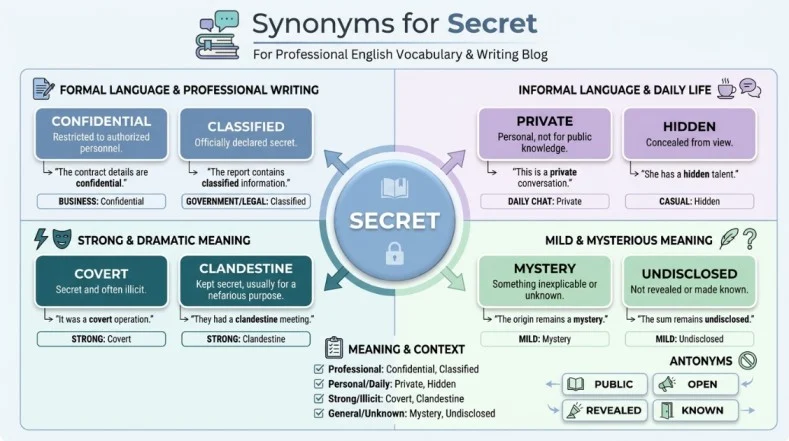
The word secret appears everywhere, from personal conversations and social media captions to emails, essays, resumes, and workplace communication. Yet using the same word repeatedly can make otherwise strong writing feel flat or imprecise.
The best alternative depends on what you actually mean. A private piece of information may be a confidence, a hidden plan may be covert, and an undisclosed business document may be confidential. Understanding these distinctions helps you sound more natural, precise, and confident.
This guide explores synonyms for secret by meaning, tone, intensity, and context, so you can choose a word that fits the situation instead of simply replacing one word with another.
What Does “Secret” Mean?
A secret is information, knowledge, an action, or a situation kept hidden from others or known only to a limited group. Depending on context, useful alternatives include confidential for professional settings, private for personal matters, covert for hidden operations, and mystery for something unexplained.
Meaning, Tone and Context
Simple Definition
As a noun, secret commonly means information known only to a few people and not intended for general knowledge. It can also describe knowledge that explains how to achieve something successfully.
As an adjective, secret describes something kept hidden, unknown, undisclosed, or done without other people knowing.
Part of Speech
Secret can function as both a noun and an adjective.
Noun: She shared a secret with her sister.
Adjective: They held a secret meeting.
Tone
The word is generally neutral, but its emotional effect depends on context.
A secret can sound:
- Positive: a secret to success
- Negative: a dark secret
- Neutral: confidential information
- Mysterious: an ancient secret
- Suspicious: a covert operation
- Personal: a private matter
Formality Level
Secret works naturally in casual, academic, creative, personal, and professional English.
More specialized alternatives can make writing more precise. For example, confidential is often better for workplace information, while clandestine suggests deliberate concealment.
Common Use Cases
The word frequently appears in:
- Personal conversations
- Emails
- School assignments
- Business communication
- News writing
- Storytelling
- Social media captions
- Relationships
- Government and security contexts
- Descriptions of unknown information
Related Word Forms
Secret: noun and adjective
Secrecy: the state or practice of keeping information hidden
Secretive: tending to hide information or activities
Secretly: in a hidden or undisclosed manner
The related form secrecy refers to the practice or condition of keeping things hidden.
When and How to Use “Secret”
Use secret when information, behavior, plans, or knowledge are intentionally hidden or known only to a limited number of people.
Personal Context
“She trusted her best friend with a family secret.”
Professional Context
“The company kept the details of the acquisition secret.”
Academic Context
“Researchers are still investigating the secrets of the ancient structure.”
Emotional Context
“He carried a painful secret for many years.”
Creative Context
“The old house seemed to hold a secret.”
Social Media Context
“Some of the best travel spots are still a secret.”
Email Context
“Please keep the project details secret until the announcement.”
Another Word for “Secret”
There is no single perfect replacement for secret in every sentence. The best choice depends on the exact meaning.
- Professional writing: confidential
- Academic writing: undisclosed or unknown
- Casual conversation: private matter
- Emotional writing: confidence
- Creative writing: mystery
- Resume or workplace use: confidential
- Social media captions: hidden gem or mystery
- Stronger meaning: clandestine
- Softer meaning: private
For example, “secret company information” becomes more professional as confidential company information.
For a mysterious unexplained event, mystery is more natural than confidential.
When Not to Use “Secret”
Although secret is flexible, it can sometimes be too broad.
If you mean information that must be protected professionally, confidential is more precise.
Less precise: “The document contains secret information.”
More precise: “The document contains confidential information.”
If you mean a hidden operation, covert may communicate the intended meaning more clearly.
Less precise: “They conducted a secret operation.”
More precise: “They conducted a covert operation.”
If you mean something unknown rather than deliberately hidden, mystery may be better.
Less precise: “The origin remains a secret.”
More precise: “The origin remains a mystery.”
Words Commonly Confused With “Secret”
Secret vs. Confidential
Secret is broad and can describe personal, emotional, creative, or official information.
Confidential usually describes information that should be restricted to authorized people.
Secret vs. Private
Private means not intended for public access or attention.
Secret usually carries a stronger idea of concealment or limited knowledge.
Secret vs. Hidden
Hidden focuses on something being physically or conceptually out of sight.
Secret often involves information that people intentionally keep from others.
Secret vs. Covert
Covert describes actions or operations designed to remain unnoticed or undisclosed.
Secret is broader and can describe information, objects, actions, or situations.
Secret vs. Clandestine
Clandestine usually suggests something deliberately concealed, especially an activity or meeting.
It can sound more formal and more suspicious than secret.
Secret vs. Mystery
A secret is something intentionally kept from others.
A mystery is something unexplained, unknown, or difficult to understand.
Best Synonym by Context for “Secret”
| Context | Best Synonym | Why It Works | Example |
|---|---|---|---|
| Formal writing | confidential | Sounds precise and professional | The report contains confidential information. |
| Academic writing | undisclosed | Clearly indicates information has not been revealed | The researchers kept the source undisclosed. |
| Professional use | confidential | Fits restricted workplace information | The files are confidential. |
| Resume use | discreet | Suggests careful handling of sensitive matters | Maintained discreet communication with clients. |
| Casual conversation | private | Sounds natural and less dramatic | That is a private matter. |
| Creative writing | mystery | Adds curiosity and intrigue | The house was surrounded by mystery. |
| Emotional tone | confidence | Suggests personally shared information | She shared the information in confidence. |
| Strong intensity | clandestine | Suggests deliberate concealment | They arranged a clandestine meeting. |
| Soft or moderate tone | private | Sounds less dramatic than secret | We discussed a private family matter. |
| Social media captions | hidden gem | Works well for discoveries and places | This café is a hidden gem. |
| Security context | classified | Indicates officially restricted information | The document was classified. |
| Hidden action | covert | Highlights concealed activity | The agency conducted a covert operation. |
Which Synonym Should You Choose?
Start with the meaning, not the word itself.
If you are talking about restricted workplace information, choose confidential. If the information is officially restricted by an authority, classified may be more accurate.
- For personal matters, private usually sounds natural and respectful.
- For a mysterious situation, choose mystery. For an intentionally hidden operation, choose covert or clandestine.
- For emotional storytelling, confidence, mystery, or hidden truth can add more nuance.
The strongest vocabulary choice is the one that preserves the original meaning while improving precision and tone.
Real Life Examples of “Secret” in Sentences
School
“The student discovered a secret about the historical building.”
Workplace
“The manager asked employees to keep the merger secret.”
Writing
“The author gradually reveals the character’s secret.”
Conversation
“I promised not to tell anyone your secret.”
Social Media
“Found a secret spot with the best sunset view.”
Resume
“Handled confidential client information with discretion.”
“Please treat the attached information as confidential.”
Storytelling
“Behind the locked door was a secret the family had protected for generations.”
25 Synonyms for “Secret”
| Synonym | Simple Meaning | Best Used For | Example Sentence |
|---|---|---|---|
| Confidential | Intended for limited access | Business and professional writing | The client records are confidential. |
| Private | Not meant for public knowledge | Personal matters | She considers the issue private. |
| Hidden | Kept out of sight or knowledge | General descriptions | A hidden room was discovered upstairs. |
| Concealed | Deliberately kept from view | Formal descriptions | The documents were concealed in a drawer. |
| Undisclosed | Not revealed publicly | Professional and formal writing | The company paid an undisclosed amount. |
| Covert | Carefully hidden from public awareness | Operations and activities | The agency launched a covert investigation. |
| Clandestine | Deliberately secret and concealed | Meetings and activities | They arranged a clandestine meeting. |
| Classified | Officially restricted | Government and security contexts | The report contains classified information. |
| Private information | Personal information not meant for others | Personal and professional settings | Please do not share my private information. |
| Confidence | Information shared privately with trust | Relationships and communication | She told him the story in confidence. |
| Mystery | Something unexplained or unknown | Creative and intellectual contexts | The disappearance remains a mystery. |
| Enigma | A person or thing difficult to understand | Literary and intellectual writing | His sudden decision remains an enigma. |
| Riddle | Something difficult to understand or solve | Puzzles and figurative writing | The ancient inscription was a riddle. |
| Unknown | Something not known | Academic and factual contexts | The cause of the event remains unknown. |
| Unrevealed | Not yet made known | Formal and literary writing | Several details remain unrevealed. |
| Unspoken | Not expressed openly | Emotional and interpersonal writing | An unspoken tension filled the room. |
| Unacknowledged | Not openly admitted or recognized | Formal and analytical writing | The problem remained unacknowledged. |
| Furtive | Done while avoiding notice | Suspicious or discreet behavior | He gave her a furtive glance. |
| Surreptitious | Done secretly to avoid attention | Formal descriptions of hidden actions | She took a surreptitious photograph. |
| Undercover | Operating secretly to conceal identity or purpose | Investigations and security | An undercover officer joined the group. |
| Stealthy | Quiet and difficult to detect | Movement and actions | The animal made a stealthy approach. |
| Secretive | Inclined to hide information | People and behavior | His secretive behavior worried his coworkers. |
| Unpublicized | Not publicly announced | Events and professional information | The company held an unpublicized meeting. |
| Restricted | Limited to authorized people | Information and access | Access to the records is restricted. |
| Sequestered | Kept apart or isolated | Formal and literary contexts | The witnesses were kept sequestered. |
Some of these words are not interchangeable in every sentence. Confidential, classified, covert, clandestine, and mystery, for example, represent different kinds of secrecy rather than identical meanings. Dictionary references distinguish these nuances clearly.
Synonym Groups and Usage Differences
Professional vs. Personal Synonyms
Professional communication usually benefits from precise terms such as confidential, restricted, classified, and undisclosed.
Personal communication often sounds more natural with private, confidence, or simply secret.
Compare:
“Please keep this secret.”
“Please treat this information as confidential.”
The second sentence sounds more appropriate in a workplace setting.
Formal vs. Conversational Synonyms
Secret, private, and hidden are common in everyday English.
Confidential, undisclosed, clandestine, and surreptitious sound more formal.
Use simpler vocabulary in texts and casual conversations. Use more precise terminology when writing reports, essays, policies, or professional emails.
Academic Synonyms
Academic writing benefits from terms that identify exactly what is unknown or undisclosed.
Useful choices include:
- Undisclosed
- Unknown
- Unrevealed
- Unacknowledged
- Mystery
- Enigma
Avoid choosing a complicated synonym simply because it sounds intelligent. Precision is more valuable than unnecessary complexity.
Professional and Business Synonyms
Business writing commonly favors:
- Confidential
- Restricted
- Undisclosed
- Classified
- Private
For example, confidential client information is more precise than secret client information.
The Cambridge Business English Dictionary specifically uses secret for restricted business information such as secret deals, meetings, proposals, and documents.
Creative or Literary Synonyms
Creative writing can benefit from more expressive choices such as:
- Mystery
- Enigma
- Hidden
- Concealed
- Unspoken
- Dark secret
These choices can create suspense, emotional depth, or curiosity without repeatedly using the word secret.
Slang or Modern Synonyms
There is no universal slang replacement for secret that works in every situation.
Casual expressions such as behind the scenes, under wraps, or hush hush can work in informal speech and social content.
They should generally be avoided in academic papers, formal reports, resumes, and serious business correspondence.
Strongest vs. Weaker Synonyms
A useful intensity scale is:
Private → hidden → confidential → concealed → covert → clandestine → surreptitious
This is not a strict universal ranking because context changes the strength of each word.
Private can sound neutral.
Covert suggests deliberate concealment.
Clandestine can imply secrecy surrounding an activity.
Surreptitious often suggests an attempt to avoid being noticed.
Emotional vs. Neutral Synonyms
Neutral choices include private, confidential, undisclosed, and restricted.
More emotional choices include dark secret, hidden truth, painful secret, and unspoken truth.
Choose neutral vocabulary when accuracy matters more than emotional effect.
Antonyms of “Secret”
The best opposite depends on whether secret refers to hidden information, restricted knowledge, or concealed behavior.
| Antonym | Meaning | Example Sentence |
|---|---|---|
| Disclosure | The act of making information known | The disclosure clarified the situation. |
| Revelation | Information that becomes known | The revelation surprised everyone. |
| Openness | Willingness to share information | Her openness built trust. |
| Transparency | Clear and accessible information | The company values transparency. |
| Publicity | Public attention or exposure | The event received widespread publicity. |
| Exposure | The act of bringing something hidden into view | The investigation led to exposure of the problem. |
| Announcement | A public statement of information | The company made an official announcement. |
| Declaration | A clear public statement | The leader issued a declaration. |
| Knowledge | Awareness or understanding of information | The facts are now common knowledge. |
| Awareness | Knowing that something exists or happens | Public awareness increased quickly. |
| Admission | An acknowledgment of something previously undisclosed | His admission ended the speculation. |
| Confession | An admission of something personal or wrong | Her confession changed the story. |
| Revelation | The discovery or disclosure of previously unknown information | The revelation changed public opinion. |
| Public record | Information openly available for people to access | The decision is now part of the public record. |
| Disclosure statement | A formal statement providing relevant information | The company issued a disclosure statement. |
Some antonyms overlap in meaning because the opposite of secret changes according to context. For personal information, disclosure may be the direct opposite. For business communication, transparency or public disclosure may be more appropriate.
Comparison: Secret vs. Similar Words
Secret vs. Private
Main difference: Secret emphasizes concealment, while private emphasizes limited access or personal boundaries.
Which is stronger: Secret usually suggests more deliberate concealment.
Which is more formal: Both work in formal writing, but private is often softer.
Examples:
“The location was secret.”
“The conversation was private.”
Secret vs. Confidential
Main difference: Confidential usually refers to information restricted to authorized people.
Which is stronger: Confidential can sound more serious in professional settings.
Which is more formal: Confidential.
Examples:
“She kept the secret.”
“The document is confidential.”
Secret vs. Hidden
Main difference: Hidden focuses on something not being visible or known.
Which is stronger: Secret can imply deliberate withholding.
Which is more formal: Hidden is simple and broadly useful.
Examples:
“They discovered a hidden room.”
“He revealed a secret.”
Secret vs. Covert
Main difference: Covert usually describes activities designed to remain unnoticed.
Which is stronger: Covert often suggests deliberate operational concealment.
Which is more formal: Covert.
Examples:
“They held a secret meeting.”
“They conducted a covert operation.”
Secret vs. Clandestine
Main difference: Clandestine strongly suggests deliberate concealment, especially involving an activity.
Which is stronger: Clandestine often sounds more secretive and suspicious.
Which is more formal: Clandestine.
Examples:
“They planned a secret meeting.”
“They arranged a clandestine meeting.”
Secret vs. Mystery
Main difference: A secret is hidden information. A mystery is something unknown or unexplained.
Which is stronger: Neither is inherently stronger.
Which is more formal: Mystery can work naturally in both formal and creative contexts.
Examples:
“She revealed the secret.”
“The cause remains a mystery.”
Common Phrases and Expressions with “Secret”
1. Keep a secret
Meaning: Avoid telling other people private information.
Example sentence:
“She promised to keep the secret until the celebration.”
2. Keep something secret
Meaning: Prevent information from becoming known.
Example sentence:
“They tried to keep the new product secret.”
3. Let someone in on the secret
Meaning: Tell someone information that was previously hidden from them.
Example sentence:
“Once the plans were finalized, they let Maya in on the secret.”
4. Make no secret of something
Meaning: Make your feelings, intentions, or opinions obvious.
Example sentence:
“The company made no secret of its plans to expand.”
5. In secret
Meaning: Without other people knowing.
Example sentence:
“They met in secret to discuss the proposal.”
6. Closely guarded secret
Meaning: Information carefully protected from disclosure.
Example sentence:
“The recipe remains a closely guarded secret.”
7. Secret weapon
Meaning: A person, method, skill, or resource that provides an unexpected advantage.
Example sentence:
“Her attention to detail is her secret weapon.”
8. Secret to success
Meaning: A method or factor believed to help someone achieve a desired result.
Example sentence:
“Consistent practice is often the secret to success.”
Common Mistakes to Avoid
1. Using “secret” when “confidential” is more precise
In business writing, confidential often communicates restricted information more professionally.
2. Confusing “secret” with “mystery”
A mystery is unexplained. A secret is usually hidden or deliberately withheld.
3. Using casual language in formal writing
Expressions such as under wraps can sound too informal in academic or professional documents.
4. Choosing an overly dramatic synonym
Calling a routine private matter clandestine may make the situation sound suspicious when it is not.
5. Repeating “secret” too often
Repetition can make writing dull. Replace it selectively with words such as private, confidential, hidden, or undisclosed when the meaning remains accurate.
6. Ignoring emotional tone
Confidential sounds factual. Dark secret sounds emotional. Mystery sounds intriguing. These words are not interchangeable.
7. Using slang in academic or professional writing
Informal expressions can be useful in conversation but may weaken the credibility of formal writing.
FAQs
What is the best synonym for secret?
The best synonym depends on context. Confidential works well professionally, private personally, covert for hidden activities, and mystery for unexplained information.
What is a formal synonym for secret?
Confidential, undisclosed, classified, clandestine, and surreptitious can work as formal alternatives, depending on the intended meaning.
What is an informal synonym for secret?
Private, hidden, and under wraps can work informally. Under wraps is especially conversational and should not replace formal vocabulary.
What is another word for secret in professional writing?
Confidential is often the strongest professional choice when information is restricted. Undisclosed also works when information has not been publicly revealed.
What is the difference between secret and private?
Secret emphasizes information being hidden or withheld. Private emphasizes something belonging to an individual or limited group rather than the public.
What is the opposite of secret?
Common opposites include disclosure, openness, transparency, publicity, and revelation. The best choice depends on the sentence and meaning.
Conclusion
The word secret can describe hidden information, private knowledge, undisclosed actions, or something difficult to understand. Its best alternative depends on what the sentence actually communicates.
Use confidential for professional information, private for personal matters, covert for hidden operations, clandestine for deliberately concealed activities, and mystery for unexplained situations.
The most useful vocabulary habit is to choose synonyms by meaning, tone, and context, rather than simply searching for a different word. A precise synonym makes writing clearer, more natural, and more effective.
Definitions and usage should be verified against trusted dictionaries such as Cambridge, Oxford, Merriam Webster, Collins, or Britannica before publication. The core meanings used here align with established dictionary distinctions for secret, including its noun and adjective uses.
Discover More Post:
- 25+ Synonyms for Navigate | Meanings, Examples, and Best …
- 25+ Synonyms for We | Meanings, Examples, and Best …
- 25+ Synonyms for Achieve | Meanings, Examples, and Best …