When the word “achieve” appears again and again in an essay, resume, email, caption, or presentation, your writing can quickly start to sound repetitive. The good news is that English offers many alternatives, but each one carries a slightly different meaning, tone, or level of formality.
Understanding synonyms for achieve is about more than replacing one word with another. A strong writer chooses words based on the result being described, the audience, the level of effort involved, and the overall tone. This guide explains those differences so you can choose natural, precise vocabulary in academic, professional, personal, and creative writing.
What Does “Achieve” Mean?
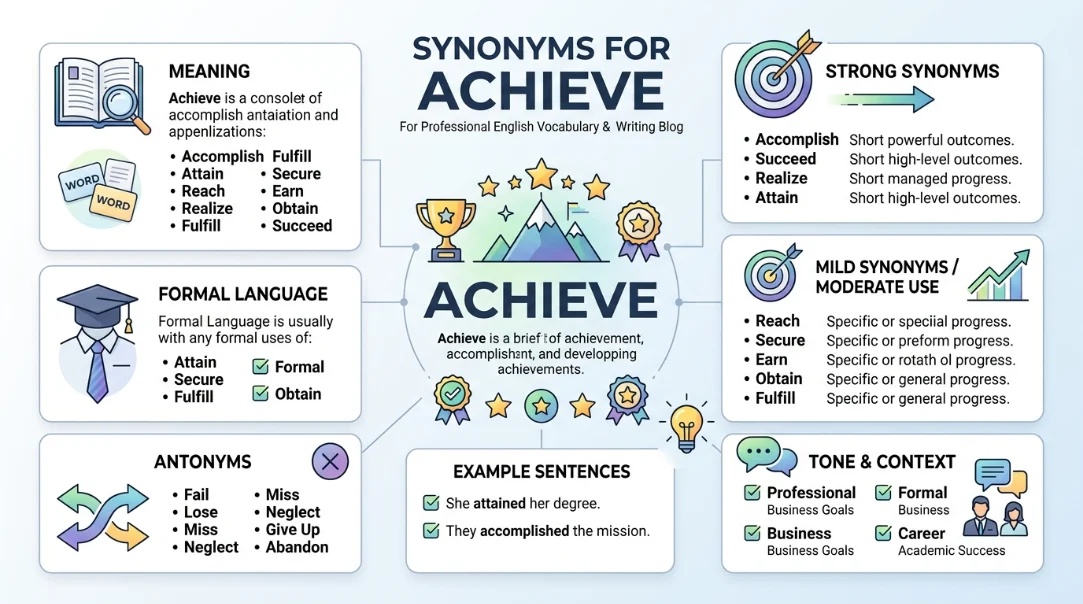
To achieve means to successfully reach a goal, complete something desired, or produce a successful result through effort. Depending on context, useful alternatives include accomplish, attain, reach, realize, fulfill, secure, obtain, earn, and succeed.
Meaning, Tone and Context
Simple Definition
Achieve means to successfully reach a goal, desired result, standard, or level of performance.
For example, if someone works hard and reaches an important goal, they can be said to have achieved it.
Part of Speech
Achieve is primarily a verb.
Example:
“She achieved her career goal.”
The noun form is achievement.
Example:
“Graduating from college was a major achievement.”
The adjective achievable describes something that can realistically be accomplished.
Example:
“The team set an achievable target.”
The adverb achievably is uncommon in everyday English and is usually better avoided.
Tone
Achieve generally has a positive and neutral tone. It often suggests effort, progress, success, or completion.
However, the surrounding sentence determines the emotional effect. “Achieve financial independence” sounds positive and ambitious, while “achieve compliance” sounds more formal and business focused.
Formality Level
Achieve works well across most forms of English. It is suitable for:
- Academic essays
- Professional emails
- Resumes
- Business reports
- Everyday conversation
- Social media
- Personal writing
- Motivational content
Because it is versatile, writers sometimes overuse it. A more specific synonym can make a sentence stronger.
Common Use Cases
Achieve commonly appears with goals, results, standards, success, progress, objectives, milestones, performance levels, and personal ambitions.
Common combinations include:
- Achieve a goal
- Achieve success
- Achieve a target
- Achieve a result
- Achieve progress
- Achieve excellence
- Achieve independence
- Achieve recognition
- Achieve a milestone
- Achieve a standard
When and How to Use “Achieve”
Use achieve when you want to emphasize successfully reaching something that usually requires effort, planning, persistence, or ability.
Professional
“Our department achieved its quarterly sales target.”
This works well in workplace communication because it clearly connects performance with a measurable result.
Personal
“She finally achieved her dream of becoming a published author.”
Here, achieve highlights a meaningful personal accomplishment.
Academic
“Students can achieve better results through consistent study habits.”
The word fits naturally in educational and academic contexts.
Emotional
“After years of uncertainty, he achieved financial independence.”
Achieve emphasizes the importance of reaching a meaningful life goal.
Creative
“After years of searching, the character achieved a sense of peace.”
The word can describe an emotional or philosophical result, not only a measurable goal.
Social Media
“Small steps every day can help you achieve your biggest goals.”
This motivational use is common in captions and personal development content.
Resume
“Achieved a 20 percent increase in customer retention within one year.”
On a resume, achieve is especially useful when paired with a specific measurable result.
Another Word for “Achieve”
The best single replacement depends on what you mean.
- Professional writing: accomplish or attain
- Academic writing: attain or accomplish
- Casual conversation: get or reach
- Emotional writing: realize or fulfill
- Creative writing: realize, attain, or fulfill
- Resume use: delivered, secured, earned, or accomplished
- Social media captions: reach, accomplish, or conquer
- Stronger meaning: accomplish or conquer
- Softer meaning: reach or make progress toward
For example, “achieve a goal” and “accomplish a goal” are close in meaning. However, “earn recognition” focuses on receiving recognition as a result of merit, while “reach a goal” emphasizes arriving at a desired outcome.
When Not to Use “Achieve”
Achieve is not always the most precise choice.
If you are describing receiving something, obtain or secure may be better.
Weak:
“She achieved a scholarship.”
Better:
“She secured a scholarship.”
If you are describing earning something through effort, earn is more specific.
Weak:
“He achieved respect from his colleagues.”
Better:
“He earned the respect of his colleagues.”
If you are describing finishing a task, complete may be clearer.
Weak:
“She achieved the report.”
Better:
“She completed the report.”
If you are describing winning, win may be more direct.
Weak:
“The team achieved the championship.”
Better:
“The team won the championship.”
The key is to choose a synonym that preserves the exact meaning of the sentence.
Words Commonly Confused With “Achieve”
Achieve vs. Accomplish
Both describe successful completion or attainment. Accomplish often focuses more strongly on completing a task, while achieve frequently focuses on reaching a goal or result.
Achieve vs. Attain
Attain often refers to reaching a particular level, status, condition, or standard after effort.
Example:
“She attained a senior leadership position.”
Achieve vs. Reach
Reach is broader and often describes arriving at a goal, destination, level, or decision.
Example:
“The company reached its sales target.”
Achieve vs. Obtain
Obtain means to get or receive something, often through effort or a process. It does not necessarily imply that the thing itself was a goal.
Example:
“He obtained the required certification.”
Achieve vs. Earn
Earn emphasizes receiving something because of effort, performance, behavior, or merit.
Example:
“She earned the trust of her clients.”
Achieve vs. Complete
Complete means to finish something. Achieve focuses more on successfully reaching a desired outcome.
Example:
“She completed the training and achieved professional certification.”
Best Synonym by Context for “Achieve”
| Context | Best Synonym | Why It Works | Example |
|---|---|---|---|
| Formal writing | Attain | Sounds polished and precise | The organization attained its long term objective. |
| Academic writing | Accomplish | Clearly expresses successful completion | Students can accomplish difficult tasks with consistent practice. |
| Professional or business use | Accomplish | Direct and credible | The team accomplished its annual objective. |
| Resume | Delivered | Emphasizes measurable results | Delivered a 15 percent increase in customer retention. |
| Casual conversation | Get | Natural and conversational | I finally got the result I wanted. |
| Creative writing | Realize | Can express a dream or vision | She realized her lifelong dream. |
| Emotional tone | Fulfill | Adds personal meaning | He fulfilled a promise he made years ago. |
| Strong intensity | Conquer | Suggests overcoming a major challenge | She conquered her fear of public speaking. |
| Soft or moderate tone | Reach | Neutral and natural | We reached a reasonable agreement. |
| Social media captions | Accomplish | Positive and motivational | Another goal accomplished. |
| US usage | Achieve | Common and natural in American English | She achieved her professional goal. |
| UK usage | Achieve | Also standard and widely understood | He achieved an impressive result. |
Which Synonym Should You Choose?
Start by identifying exactly what was successfully reached or completed.
- If the sentence describes a goal, use achieve, reach, accomplish, or attain.
- If it describes a task, accomplish or complete is often better.
- If it describes something received through effort, consider earn or obtain.
- If it describes winning, use win, score, or clinch.
- If it describes a dream, realize or fulfill can add emotional depth.
- If it describes a measurable business result, deliver, secure, accomplish, or attain may sound more precise.
Also consider formality. Words such as attain and accomplish work well in formal writing, while get and hit can sound more conversational.
Real Life Examples of “Achieve” in Sentences
School
“Students who study consistently are more likely to achieve their academic goals.”
Workplace
“Our team achieved its quarterly performance target ahead of schedule.”
Writing
“The author achieved a clear balance between explanation and storytelling.”
Conversation
“I worked hard to achieve that goal.”
Social Media
“Believe in the process, stay consistent, and achieve what you once thought was impossible.”
Resume
“Achieved a 25 percent improvement in customer satisfaction over twelve months.”
“We are pleased to share that the project achieved all major objectives.”
Storytelling
“After years of setbacks, she finally achieved the confidence she had always wanted.”
25 Synonyms for “Achieve”
| Synonym | Simple Meaning | Best Used For | Example Sentence |
|---|---|---|---|
| Accomplish | Successfully complete something | Goals and tasks | She accomplished everything on her project list. |
| Attain | Successfully reach a level or goal | Formal and academic writing | He attained a high level of professional expertise. |
| Reach | Arrive at a goal, level, or result | Everyday and professional use | The company reached its annual target. |
| Realize | Make a dream or idea become real | Dreams and ambitions | She realized her dream of opening a bookstore. |
| Fulfill | Successfully satisfy a goal, promise, or desire | Personal and emotional writing | He fulfilled his promise to help the community. |
| Complete | Finish something | Tasks and assignments | She completed the training program on time. |
| Secure | Successfully obtain something valuable | Business and professional use | The company secured a major contract. |
| Obtain | Get something through effort or a process | Formal writing | He obtained the certification after months of study. |
| Earn | Receive through effort or merit | Recognition and rewards | She earned the respect of her colleagues. |
| Gain | Obtain or develop something valuable | Skills and benefits | He gained valuable experience during the internship. |
| Succeed | Successfully accomplish an aim | General success | The team succeeded in improving customer service. |
| Meet | Reach a required standard or target | Business and academic use | The product meets all safety requirements. |
| Get | Obtain or reach something | Casual conversation | I finally got the result I wanted. |
| Win | Be successful in a competition or contest | Sports and competitions | The team won the championship. |
| Score | Obtain a result, point, or success | Sports and informal use | She scored the highest grade in the class. |
| Clinch | Secure something decisively | Competitions and major outcomes | The team clinched the division title. |
| Master | Develop complete skill in something | Skills and learning | He mastered the software within a few months. |
| Conquer | Overcome something difficult | Challenges and motivational writing | She conquered her fear of public speaking. |
| Overcome | Successfully deal with an obstacle | Challenges and personal growth | He overcame several obstacles to finish the project. |
| Produce | Create a desired result | Business and technical contexts | The new strategy produced excellent results. |
| Deliver | Produce an expected or promised result | Workplace and business use | The campaign delivered strong results. |
| Establish | Successfully create or develop something | Organizations and systems | The company established a strong presence in the market. |
| Effect | Cause a desired change | Formal writing | The policy effected significant improvements in safety. |
| Actualize | Make an idea or potential real | Formal and philosophical writing | The program helped participants actualize their potential. |
| Consummate | Bring something to completion | Very formal writing | The agreement consummated years of negotiations. |
Synonym Groups and Usage Differences
Professional vs. Personal Synonyms
Professional writing often benefits from precise words such as accomplish, attain, deliver, secure, establish, and obtain.
Personal writing can sound more natural with achieve, reach, realize, fulfill, earn, and overcome.
Compare:
“Sarah achieved her career goal.”
“Sarah realized her dream of becoming a designer.”
The first is neutral. The second carries more emotional meaning.
Formal vs. Conversational Synonyms
Formal writing favors words such as attain, obtain, accomplish, establish, and actualize.
Conversational English usually prefers achieve, reach, get, win, and meet.
For example:
Formal: “The researchers attained the required level of accuracy.”
Conversational: “The team reached its goal.”
Academic Synonyms
Academic writing should favor precise vocabulary rather than unnecessarily complicated vocabulary.
Useful choices include accomplish, attain, achieve, obtain, establish, and realize.
For example:
“The study achieved statistically significant results.”
In another context:
“The researchers obtained reliable data from the experiment.”
Obtained is better because the sentence describes collecting or receiving data rather than reaching a goal.
Professional and Business Synonyms
In workplace communication, the best word depends on the result.
- Use deliver for promised results.
- Use secure for contracts, funding, partnerships, or opportunities.
- Use earn for trust, recognition, or awards.
- Use attain for standards or levels.
- Use accomplish for goals and objectives.
- Use establish for systems, relationships, or business positions.
Creative or Literary Synonyms
Creative writing often benefits from words that add emotional or visual meaning.
Realize works well with dreams and ambitions.
Fulfill works well with promises and desires.
Conquer works well with obstacles and fears.
Overcome works well with adversity.
Attain can suggest a difficult or meaningful state.
Slang or Modern Synonyms
There are informal expressions that can sometimes replace achieve, such as hit when talking about targets.
Example:
“The campaign hit its sales target.”
This is natural in casual business conversation, but achieve or reach may be better for formal reports.
Another informal choice is nail, especially when someone performs exceptionally well.
Example:
“She nailed the presentation.”
Nail does not work as a general replacement for achieve. It is better for casual situations involving successful performance.
Strongest vs. Weaker Synonyms
A useful intensity scale is:
Mild: reach
Neutral: achieve
Clear accomplishment: accomplish
Formal or elevated: attain
Emotionally meaningful: realize or fulfill
Strong challenge based: overcome
Very forceful: conquer
The strongest word is not always the best word. Precision matters more than intensity.
Emotional vs. Neutral Synonyms
Neutral choices include achieve, reach, accomplish, attain, and meet.
More emotional choices include realize, fulfill, conquer, and overcome.
For example:
“He achieved his goal.”
“He finally realized his dream.”
Both sentences describe success, but the second carries greater emotional weight.
Antonyms of “Achieve”
| Antonym | Meaning | Example Sentence |
|---|---|---|
| Fail | Not succeed | The team failed to meet its target. |
| Miss | Fail to reach something | We missed our sales goal this quarter. |
| Lose | Fail in a competition or struggle | The team lost the final match. |
| Abandon | Give up an objective | She abandoned the original plan. |
| Forfeit | Give up or lose something | The player forfeited the opportunity. |
| Surrender | Stop resisting or pursuing victory | He surrendered after repeated setbacks. |
| Neglect | Fail to give something proper attention | They neglected their long term goals. |
| Ignore | Refuse to give attention to something | He ignored the required instructions. |
| Avoid | Stay away from something | She avoided taking responsibility for the task. |
| Prevent | Stop something from happening | Poor planning prevented the team from succeeding. |
| Hinder | Make success more difficult | Limited resources hindered progress. |
| Block | Stop progress toward an objective | Technical problems blocked the project. |
| Abolish | Completely remove something | The new policy abolished the outdated requirement. |
| Regress | Move backward instead of improving | The program began to regress after funding was reduced. |
| Fail to reach | Not arrive at a desired result | The company failed to reach its annual objective. |
Comparison: Achieve vs. Similar Words
Achieve vs. Accomplish
Main difference: Achieve often emphasizes reaching a goal or result, while accomplish often emphasizes successfully completing a task or objective.
Which one is stronger: Neither is consistently stronger.
Which one is more formal: Both are suitable for formal writing.
Achieve: “She achieved her career goal.”
Accomplish: “She accomplished the difficult assignment.”
Achieve vs. Attain
Main difference: Attain often suggests reaching a level, status, condition, or standard through effort.
Which one is stronger: Attain can sound slightly more elevated.
Which one is more formal: Attain is generally more formal.
Achieve: “He achieved excellent results.”
Attain: “He attained a senior leadership position.”
Achieve vs. Reach
Main difference: Reach is broader and can describe goals, levels, decisions, agreements, and destinations.
Which one is stronger: Achieve can imply greater effort or accomplishment.
Which one is more formal: Both are widely accepted.
Achieve: “She achieved her professional goal.”
Reach: “The two companies reached an agreement.”
Achieve vs. Obtain
Main difference: Obtain means get or receive something, while achieve usually involves successfully reaching a goal or result.
Which one is stronger: Neither is inherently stronger.
Which one is more formal: Obtain is often more formal.
Achieve: “The team achieved excellent results.”
Obtain: “The researchers obtained reliable data.”
Achieve vs. Earn
Main difference: Earn emphasizes merit, effort, or performance as the reason someone receives something.
Which one is stronger: Earn is more specific when merit matters.
Which one is more formal: Both work in professional writing.
Achieve: “She achieved recognition in her field.”
Earn: “She earned recognition through years of research.”
Achieve vs. Complete
Main difference: Complete means finish something, while achieve means successfully reach a desired outcome.
Which one is stronger: Achieve can imply a more meaningful result.
Which one is more formal: Both are suitable for formal contexts.
Achieve: “He achieved his academic goal.”
Complete: “He completed his final assignment.”
Common Phrases and Expressions with “Achieve”
1. Achieve a Goal
Meaning:
Successfully reach something you have planned or wanted to accomplish.
Example sentence:
“With consistent effort, she achieved her goal of becoming a teacher.”
2. Achieve Success
Meaning:
Become successful or produce a successful result.
Example sentence:
“The company achieved success by focusing on customer needs.”
3. Achieve a Target
Meaning:
Reach a specific measurable objective.
Example sentence:
“The sales team achieved its monthly target.”
4. Achieve Excellence
Meaning:
Reach a very high standard of quality or performance.
Example sentence:
“The program encourages students to achieve excellence.”
5. Achieve a Milestone
Meaning:
Successfully reach an important stage of progress.
Example sentence:
“The startup achieved an important milestone after launching its first product.”
6. Achieve Results
Meaning:
Produce the desired outcomes.
Example sentence:
“The new strategy helped the organization achieve better results.”
7. Achieve Independence
Meaning:
Reach a state in which someone or something can operate independently.
Example sentence:
“The program helped young adults achieve financial independence.”
Common Mistakes to Avoid
1. Using Achieve When a More Precise Word Is Better
“Achieve a scholarship” sounds unnatural because scholarships are usually secured or earned.
Better:
“She earned a scholarship.”
2. Confusing Achieve With Obtain
Obtain means get something. Achieve usually describes successfully reaching a goal or result.
Correct:
“He obtained a professional license.”
Correct:
“He achieved his professional goal.”
3. Using a Casual Synonym in Formal Writing
Words such as get, hit, nail, or score may sound too casual in academic or formal professional writing.
Choose attain, accomplish, achieve, or obtain when appropriate.
4. Using an Overly Dramatic Synonym
Not every goal needs a powerful word such as conquer.
“The team conquered its routine weekly target” sounds exaggerated.
“The team achieved its weekly target” is more natural.
5. Repeating Achieve Too Often
Repeated use can make writing monotonous.
Instead of:
“She achieved her goal, achieved success, and achieved recognition.”
Try:
“She accomplished her goal, earned recognition, and built a successful career.”
6. Choosing the Wrong Emotional Tone
Realize and fulfill can sound more emotional than achieve.
Use them when the sentence genuinely involves dreams, promises, hopes, or personal meaning.
7. Using Slang in Academic or Professional Writing
Expressions such as nail a task or crush a goal may work in social media, but they are usually unsuitable for formal essays and business reports.
FAQs
What is the best synonym for achieve?
The best synonym depends on context. Accomplish works well for tasks, attain for formal goals, reach for general goals, and realize for dreams.
What is a formal synonym for achieve?
Attain is one of the strongest formal alternatives to achieve. Accomplish, obtain, establish, and actualize can also work depending on the sentence.
What is an informal synonym for achieve?
Get can work informally when the meaning is clear. Hit is also common when discussing targets, especially in casual workplace conversation.
What is another word for achieve in professional writing?
Accomplish, attain, deliver, secure, earn, and establish can replace achieve in professional writing when their specific meanings fit the intended result.
What is the difference between achieve and accomplish?
Achieve commonly emphasizes reaching a goal or result, while accomplish often emphasizes successfully completing a task, objective, or piece of work.
What is the opposite of achieve?
Common opposites include fail, miss, lose, abandon, forfeit, surrender, hinder, block, and fail to reach, depending on the context.
Conclusion
Achieve means successfully reaching a goal, desired result, standard, or level through effort or ability. It is a versatile word that works naturally in everyday conversation, academic writing, professional communication, resumes, and creative content.
The best synonyms for achieve depend on context. Use accomplish for completed tasks, attain for formal goals or levels, reach for general outcomes, obtain for getting something, earn for merit based rewards, and realize or fulfill when emotional meaning matters.
The most useful vocabulary habit is simple: do not replace a word merely to sound sophisticated. Choose the synonym that expresses your exact meaning, fits your audience, and matches the tone of the sentence.
Discover More Post:
- 25+ Synonyms for Compassion | Meanings, Examples, and …
- 25+ Synonyms for Friendship | Meanings, Examples, and Best …