You may use the word “friendship” several times when writing an essay, caption, email, story, or personal message. Repeating the same word can make otherwise strong writing feel predictable.
The good news is that English offers many alternatives for friendship, but they do not all mean exactly the same thing. Words such as camaraderie, companionship, fellowship, amity, and rapport can emphasize different kinds of connection.
Choosing the right alternative depends on your meaning, audience, tone, and situation. A professional email may need a different word from a heartfelt caption or a literary story.
This guide explains the most useful synonyms for friendship, including their meanings, tone, examples, common mistakes, antonyms, and best uses in everyday and professional English.
What Does “Friendship” Mean?
Friendship is a close and voluntary relationship based on mutual affection, trust, companionship, or shared interests. Depending on context, useful alternatives include camaraderie, companionship, fellowship, amity, rapport, closeness, and bond.
Meaning, Tone and Context
Simple definition
Friendship means a relationship between people who care about, trust, enjoy, or support one another.
It normally suggests a positive personal connection, although the depth and nature of that connection can vary.
Part of speech
Friendship is a noun.
Example: “Their friendship lasted for many years.”
The related adjective is friendly.
Example: “She gave us a friendly welcome.”
The related noun friend refers to a person with whom someone has a friendship.
Tone
Friendship has a positive and generally warm tone.
It can describe anything from a casual social connection to a deep emotional relationship.
Formality level
Friendship is a neutral word. It works naturally in casual conversation, academic writing, professional communication, personal writing, and creative work.
Common use cases
Friendship commonly appears when discussing:
- Personal relationships
- School and college experiences
- Childhood memories
- Workplace relationships
- Social connections
- Literature and storytelling
- Psychology and communication
- Social media captions
- Personal essays
- Emotional experiences
Important word forms
Friend: a person with whom you have a personal relationship.
Friendly: kind, pleasant, and approachable.
Friendliness: a warm or pleasant manner toward others.
Befriend: to become a friend to someone.
Friendship: the relationship itself.
When and How to Use “Friendship”
Use “friendship” when you want to describe the relationship itself rather than simply the people involved.
The word is especially useful when discussing trust, affection, shared experiences, loyalty, or long term personal connection.
Personal
“Her friendship with Maya grew stronger after they moved to the same neighborhood.”
Professional
“Strong workplace friendships can contribute to better communication and collaboration.”
Academic
“The novel explores how friendship influences the main character’s decisions.”
Emotional
“His friendship gave her confidence during a difficult period.”
Creative
“Their friendship began with a chance meeting at a quiet bookstore.”
Social media
“Grateful for a friendship that has survived every chapter of life.”
“Thank you for your friendship and continued support over the years.”
Another Word for “Friendship”
There is no single replacement that works perfectly in every sentence.
- For professional writing, camaraderie, rapport, fellowship, or collegiality may be more precise.
- For academic writing, companionship, social bond, interpersonal connection, or affiliation may fit better.
- For casual conversation, companionship, closeness, bond, or camaraderie can sound natural.
- For emotional writing, bond, closeness, affection, or kinship can communicate greater warmth.
- For creative writing, fellowship, amity, kinship, connection, or companionship can add depth.
- For resumes and workplace writing, collaboration, rapport, collegiality, and teamwork are often more useful than friendship because they emphasize professional relationships.
- For social media captions, bond, connection, companionship, and camaraderie can sound warm without being overly formal.
- For a stronger meaning, consider bond, closeness, or deep companionship.
- For a softer meaning, consider acquaintance, rapport, or friendly connection.
When Not to Use “Friendship”
Friendship can sometimes be too general.
- If you are describing a professional relationship, “rapport” or “collegiality” may be more accurate.
- If you mean people working well together, “camaraderie” may communicate the idea more clearly.
- If you mean a deep emotional connection, “bond” or “closeness” may be stronger.
- If you are discussing people who simply know each other, “acquaintance” is usually more accurate than friendship.
Compare these examples:
“Good friendship among employees can improve morale.”
“Strong camaraderie among employees can improve morale.”
The second sentence emphasizes shared team spirit rather than personal friendship.
Words Commonly Confused With “Friendship”
Friendship vs. companionship
Friendship usually emphasizes a personal relationship involving affection and trust. Companionship focuses more on being together and providing company.
Friendship vs. acquaintance
An acquaintance is someone you know but are not necessarily close to. Friendship normally suggests a deeper connection.
Friendship vs. relationship
Relationship is a much broader term. It can describe family, romantic, professional, social, or personal connections.
Friendship vs. camaraderie
Camaraderie emphasizes trust, cooperation, and shared spirit, especially among teammates, coworkers, soldiers, or members of a group.
Friendship vs. rapport
Rapport describes mutual understanding and ease between people. It does not necessarily mean they are friends.
Friendship vs. fellowship
Fellowship emphasizes companionship, shared interests, shared activities, or a sense of community.
Best Synonym by Context for “Friendship”
| Context | Best Synonym | Why It Works | Example |
|---|---|---|---|
| Formal writing | Amity | Sounds polished and emphasizes peaceful relations | The two communities developed a lasting amity. |
| Academic writing | Companionship | Clearly describes supportive social connection | The study examines companionship among adolescents. |
| Professional or business use | Rapport | Highlights mutual understanding and ease | She quickly established rapport with her clients. |
| Resume | Collegiality | Emphasizes positive workplace relationships | Known for strong collegiality and communication skills. |
| Casual conversation | Camaraderie | Sounds natural and friendly | There was great camaraderie among the group. |
| Creative writing | Fellowship | Adds a literary sense of shared connection | They discovered fellowship during their journey. |
| Emotional tone | Bond | Suggests a meaningful and lasting connection | Their bond remained strong despite the distance. |
| Strong intensity | Closeness | Emphasizes emotional or personal intimacy | Their closeness grew over many years. |
| Soft or moderate tone | Rapport | Suggests positive connection without claiming friendship | The teacher developed good rapport with her students. |
| Social media captions | Connection | Feels modern, warm, and flexible | Some connections become lifelong friendships. |
| Group relationships | Camaraderie | Highlights shared spirit and mutual support | The team built strong camaraderie during the season. |
| Shared interests | Fellowship | Emphasizes community and common interests | The club created a sense of fellowship. |
Which Synonym Should You Choose?
Start by asking what you actually mean.
- If you mean a close personal relationship, choose bond, closeness, or companionship.
- If you mean friendly cooperation within a group, choose camaraderie.
- If you mean easy communication and mutual understanding, choose rapport.
- If you mean peaceful relations, choose amity.
- If you mean a workplace relationship, choose collegiality.
- If you mean shared interests or community, choose fellowship.
- If you want emotional depth, choose bond or kinship.
The best synonym is not necessarily the most sophisticated word. It is the word that communicates your intended meaning most precisely.
Real Life Examples of “Friendship” in Sentences
School
“Our friendship began when we were assigned to the same science project.”
Workplace
“Their professional rapport helped the team solve problems quickly.”
Writing
“The story shows how friendship can survive years of separation.”
Conversation
“Our friendship has changed, but we still make time for each other.”
Social media
“Celebrating the friendship that has brought so many wonderful memories.”
Resume
“Built strong rapport with clients and colleagues across multiple departments.”
“I truly appreciate your friendship and encouragement throughout the years.”
Storytelling
“From that rainy afternoon onward, their companionship became a constant part of their lives.”
25 Synonyms for “Friendship”
Some of these words are close synonyms, while others are context based alternatives. Their exact meaning changes slightly depending on the sentence.
| Synonym | Simple Meaning | Best Used For | Example Sentence |
|---|---|---|---|
| Camaraderie | Friendly spirit within a group | Teams and coworkers | The players developed strong camaraderie during the season. |
| Companionship | The comfort of having someone with you | Personal relationships | Her companionship made the long journey easier. |
| Fellowship | A sense of community or shared connection | Groups and shared interests | The volunteers found fellowship through their work. |
| Amity | Peaceful and friendly relations | Formal writing | The two communities maintained a relationship of amity. |
| Rapport | Mutual understanding and ease | Professional communication | The consultant established excellent rapport with the client. |
| Bond | A strong connection between people | Emotional writing | Years of shared experiences strengthened their bond. |
| Closeness | A strong personal or emotional connection | Personal relationships | Their closeness was obvious to everyone around them. |
| Affinity | A natural attraction or similarity | Shared interests | They discovered an immediate affinity for one another. |
| Kinship | A feeling of being closely connected | Emotional and literary writing | She felt a deep kinship with her new friend. |
| Connection | A relationship or link between people | General and modern usage | Their connection grew stronger with every conversation. |
| Association | A connection or relationship | Formal contexts | Their association began through a local community project. |
| Affiliation | A connection with a person or group | Professional and organizational use | Her affiliation with the group introduced her to many people. |
| Collegiality | Friendly cooperation among colleagues | Workplace communication | The department is known for its strong collegiality. |
| Solidarity | Unity and mutual support | Groups facing shared challenges | Their solidarity helped the community recover. |
| Teamwork | Cooperative effort toward a shared goal | Professional settings | Their teamwork created a productive working environment. |
| Cooperation | Working together willingly | Business and practical contexts | Their cooperation made the project much easier. |
| Goodwill | Friendly or helpful feelings | Formal and professional writing | The gesture created goodwill between the organizations. |
| Understanding | Mutual awareness of another person’s feelings or views | Emotional communication | Their understanding helped them resolve disagreements. |
| Affection | Feelings of fondness or warmth | Emotional writing | Years of affection kept their relationship strong. |
| Acquaintance | Someone known but not necessarily close | Weaker social connection | He was more of an acquaintance than a close friend. |
| Relationship | A connection between people | General writing | Their relationship developed gradually over time. |
| Companionship | Shared presence and support | Personal writing | The elderly couple valued each other’s companionship. |
| Social bond | A connection formed through social interaction | Academic writing | Shared activities can create a strong social bond. |
| Interpersonal connection | A connection between individuals | Academic and professional writing | Trust is important for a healthy interpersonal connection. |
| Personal connection | A meaningful relationship between individuals | General and professional writing | The teacher formed a personal connection with her students. |
Synonym Groups and Usage Differences
Professional vs. Personal Synonyms
Personal relationships are often best described with words such as bond, closeness, companionship, affection, and kinship.
Professional relationships usually require more precise language. Rapport, collegiality, cooperation, teamwork, and goodwill are often better choices.
Calling a client a “friend” can suggest a personal relationship. Calling the relationship “rapport” keeps the language professional and focuses on effective interaction.
Formal vs. Conversational Synonyms
Words such as amity, affiliation, collegiality, and interpersonal connection tend to sound more formal.
Words such as bond, connection, companionship, and camaraderie are more natural in everyday conversation.
A formal report might use “interpersonal connection,” while a personal message might simply say “bond.”
Academic Synonyms
Academic writing benefits from precision.
Depending on the subject, useful choices include companionship, social bond, interpersonal connection, affiliation, association, and solidarity.
Avoid replacing friendship with a more complicated word simply to sound academic. Precision matters more than complexity.
Professional and Business Synonyms
Rapport is especially useful when describing communication between professionals and clients.
Collegiality works well when discussing relationships between coworkers.
Teamwork and cooperation are better when the central idea is working toward a shared goal.
Goodwill can be useful when describing positive relations between organizations, businesses, or groups.
Creative or Literary Synonyms
Creative writing often benefits from words that communicate emotional depth or atmosphere.
Bond, kinship, fellowship, affection, companionship, and amity can each create a slightly different emotional effect.
For example, “their bond was unbreakable” feels more emotionally intense than “their association was lasting.”
Slang or Modern Synonyms
There are informal expressions for friendship, but many are not true synonyms.
Words such as “bestie” are highly casual and are common in texts, social media, and conversations among friends.
Use very informal expressions carefully. They may sound inappropriate in an essay, resume, business email, or formal presentation.
Strongest vs. Weaker Synonyms
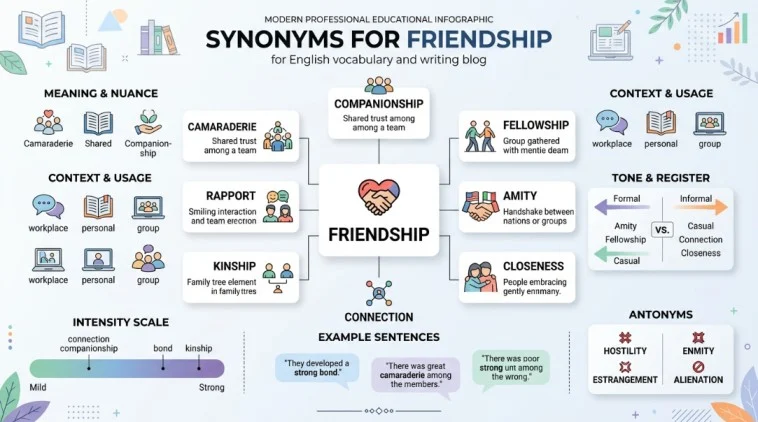
A useful intensity scale is:
Mild: acquaintance, association
Moderate: rapport, connection, companionship
Warm: affection, camaraderie, fellowship
Strong: bond, closeness, kinship
Very strong: deep bond, lifelong companionship, profound connection
These levels are contextual rather than absolute. A word’s strength can change depending on the sentence.
Emotional vs. Neutral Synonyms
Words such as association, affiliation, and relationship can remain relatively neutral.
Words such as bond, affection, closeness, and kinship usually carry more emotional weight.
Camaraderie is positive but tends to emphasize shared experience rather than deep personal affection.
Antonyms of “Friendship”
Not every opposite of friendship is a strict dictionary antonym. The following words represent different forms of social distance, hostility, separation, or lack of friendly connection.
| Antonym | Meaning | Example Sentence |
|---|---|---|
| Enmity | Strong hostility | Years of enmity divided the two families. |
| Hostility | Unfriendly or aggressive behavior | The conversation was marked by hostility. |
| Animosity | Strong dislike or resentment | There was obvious animosity between the rivals. |
| Estrangement | A state of being emotionally or socially distant | Their disagreement eventually led to estrangement. |
| Alienation | A feeling of separation from others | Moving frequently caused a sense of alienation. |
| Isolation | Separation from social contact | Prolonged isolation can make social connection difficult. |
| Loneliness | Sadness caused by lack of companionship | He struggled with loneliness after moving to a new city. |
| Antagonism | Active opposition or hostility | Their political differences created antagonism. |
| Discord | Lack of harmony | Personal disagreements created discord within the group. |
| Conflict | Serious disagreement or opposition | The conflict damaged their relationship. |
| Distrust | Lack of confidence or trust | Distrust made cooperation difficult. |
| Indifference | Lack of interest or concern | Her indifference made the relationship feel distant. |
| Coldness | Lack of warmth or friendliness | His sudden coldness surprised everyone. |
| Rivalry | Competition between people or groups | Their rivalry prevented a close relationship. |
| Opposition | Active resistance or disagreement | Their continued opposition made cooperation impossible. |
Comparison: “Friendship” vs. Similar Words
Friendship vs. Companionship
Main difference: Friendship emphasizes a personal relationship, while companionship emphasizes being together and providing company.
Which one is stronger: Friendship usually suggests a deeper social relationship.
Which one is more formal: Both are neutral, but companionship can sound slightly more literary.
Friendship example: “Their friendship lasted for decades.”
Companionship example: “She valued his companionship during the trip.”
Friendship vs. Camaraderie
Main difference: Friendship focuses on personal connection. Camaraderie focuses on shared spirit and mutual support.
Which one is stronger: Neither is automatically stronger. Their meanings are different.
Which one is more formal: Camaraderie can work well in professional and group contexts.
Friendship example: “Their friendship began in college.”
Camaraderie example: “The team developed strong camaraderie.”
Friendship vs. Rapport
Main difference: Rapport means mutual understanding and ease. Friendship usually involves a broader personal relationship.
Which one is stronger: Friendship generally suggests greater personal closeness.
Which one is more formal: Rapport is more suitable for professional writing.
Friendship example: “Their friendship grew over the years.”
Rapport example: “The manager quickly built rapport with the new employee.”
Friendship vs. Fellowship
Main difference: Fellowship emphasizes shared interests, activities, values, or community.
Which one is stronger: Friendship generally suggests greater personal familiarity.
Which one is more formal: Fellowship can sound more formal or literary.
Friendship example: “Their friendship survived the move.”
Fellowship example: “The group developed a strong sense of fellowship.”
Friendship vs. Acquaintance
Main difference: Friendship implies a meaningful personal connection. An acquaintance is someone you know but may not know well.
Which one is stronger: Friendship is much stronger.
Which one is more formal: Both are neutral.
Friendship example: “She is one of my closest friends.”
Acquaintance example: “He is an acquaintance from work.”
Friendship vs. Relationship
Main difference: Relationship is a broad term covering many types of human connections.
Which one is stronger: Friendship is more specific.
Which one is more formal: Relationship is neutral and widely used.
Friendship example: “Their friendship began in high school.”
Relationship example: “They have a strong professional relationship.”
Common Phrases and Expressions with “Friendship”
1. Lifelong friendship
Meaning: A friendship that continues for many years or throughout a person’s life.
Example sentence: “Their lifelong friendship began when they were children.”
2. Close friendship
Meaning: A friendship involving strong personal connection and familiarity.
Example sentence: “The two writers developed a close friendship.”
3. Lasting friendship
Meaning: A friendship that remains strong over time.
Example sentence: “The trip resulted in a lasting friendship.”
4. Strong friendship
Meaning: A friendship based on trust, support, or emotional connection.
Example sentence: “Their strong friendship helped them through difficult times.”
5. True friendship
Meaning: A friendship viewed as sincere, loyal, and supportive.
Example sentence: “True friendship requires trust and mutual respect.”
6. Childhood friendship
Meaning: A friendship that began during childhood.
Example sentence: “They still value their childhood friendship.”
7. Build a friendship
Meaning: To gradually develop a friendship with someone.
Example sentence: “Shared experiences helped them build a friendship.”
8. Maintain a friendship
Meaning: To continue supporting and communicating with a friend.
Example sentence: “They make an effort to maintain their friendship despite living in different states.”
Common Mistakes to Avoid
1. Treating every synonym as identical
Words such as rapport, camaraderie, and companionship overlap with friendship, but each has a slightly different focus.
Choose the word that expresses your exact meaning.
2. Using friendship when you mean acquaintance
Calling someone a friend can imply a closer relationship than you actually have.
If you barely know someone, acquaintance may be more accurate.
3. Using casual language in formal writing
Words such as “bestie” may work in a social media caption but usually do not belong in an academic essay or business report.
4. Choosing an overly dramatic word
Words such as kinship or profound bond can sound too emotional for a simple social connection.
Match the emotional intensity to the situation.
5. Repeating friendship too often
Repeated use can make writing feel monotonous.
Replace some instances with precise alternatives such as companionship, camaraderie, connection, or bond when the meaning allows it.
6. Choosing the wrong emotional tone
“Association” sounds neutral, while “affection” sounds emotional.
Always consider the feeling you want your reader to receive.
7. Using slang in academic or professional writing
Highly informal expressions may make otherwise polished writing seem less appropriate.
Use neutral vocabulary unless the context specifically calls for informal language.
FAQs
What is the best synonym for friendship?
The best synonym depends on context. Camaraderie works for groups, companionship for personal connection, rapport for professional settings, and bond for emotional depth.
What is a formal synonym for friendship?
Amity, fellowship, collegiality, affiliation, and interpersonal connection can work in formal contexts, depending on the exact meaning of the sentence.
What is an informal synonym for friendship?
Companionship, bond, connection, and camaraderie can sound natural in casual conversation. “Bestie” is much more informal and should be used selectively.
What is another word for friendship in professional writing?
Rapport is often the best choice when describing positive professional interaction. Collegiality, cooperation, teamwork, and goodwill can also fit.
What is the difference between friendship and companionship?
Friendship describes a personal relationship based on connection and trust. Companionship emphasizes the experience of being together and providing company.
What is the opposite of friendship?
There is no single opposite that fits every context. Enmity, hostility, estrangement, alienation, isolation, and distrust can describe different forms of separation or opposition.
Conclusion
Friendship describes a positive personal relationship built through connection, trust, affection, shared experiences, or companionship.
The best alternative depends on what you want to emphasize. Use rapport for professional understanding, camaraderie for group spirit, companionship for shared presence, bond for emotional strength, and amity for formal descriptions of peaceful relations.
The most useful vocabulary tip is simple: do not choose a synonym just because it sounds more advanced. Choose the word that expresses your exact meaning and matches your audience.
Before publishing a vocabulary article, dictionary definitions and word usage should be verified with trusted sources such as Cambridge Dictionary, Oxford English Dictionary, Merriam Webster, Collins Dictionary, or Britannica.
Discover More Post:
25+ Synonyms for Compassion | Meanings, Examples, and …
25+ Synonyms for Share | Meanings, Examples and Best …