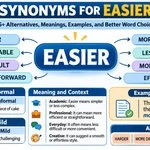
Have you ever used the word easier several times in an essay, email, conversation, or professional document? Although it communicates your meaning clearly, repeating the same word can make your writing sound predictable. Choosing a more precise alternative can help you express whether something requires less effort, involves fewer complications, or feels more manageable.
Understanding synonyms for easier is useful for students, writers, professionals, and English learners who want to communicate naturally. Some alternatives, such as simpler and more straightforward, work well in formal writing, while less challenging and more manageable suit professional and academic situations. This guide explores their meanings, differences, examples, and appropriate contexts so you can select the right expression with confidence.
What Does “Easier” Mean?
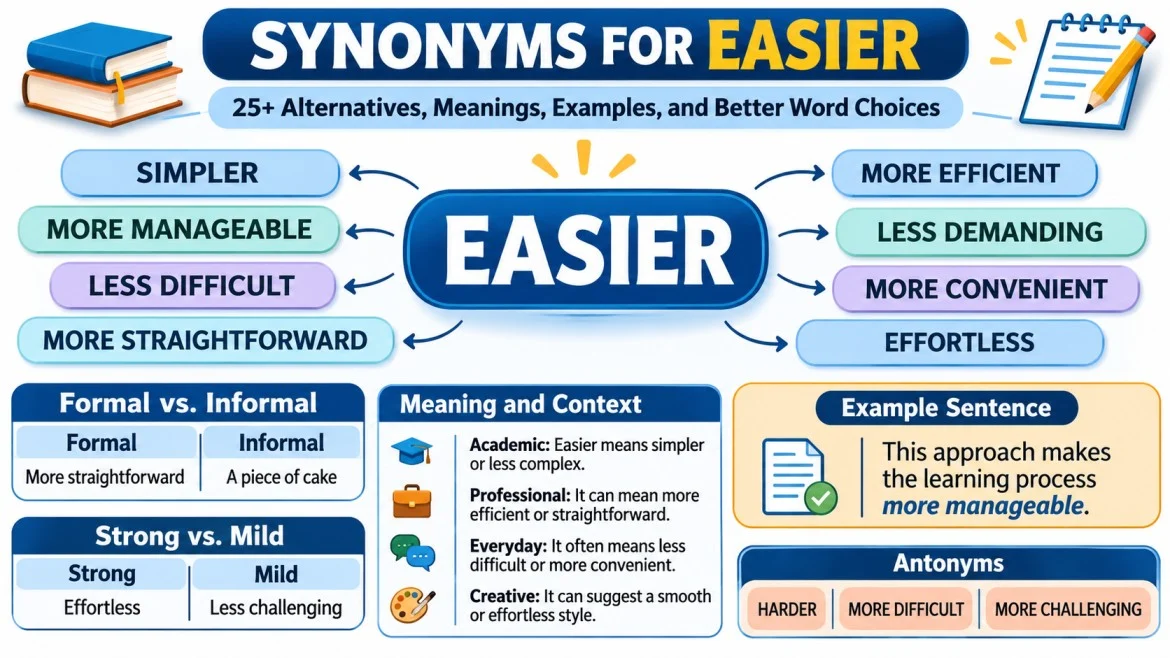
Easier means less difficult, complicated, demanding, or challenging than something else. Common synonyms include simpler, more manageable, less demanding, more straightforward, and more convenient. The best choice depends on whether you are describing effort, complexity, accessibility, or convenience.
Meaning, Tone and Context
The word easier describes something that requires less effort, difficulty, skill, or time compared with another option or an earlier situation.
For example, learning a new language may become easier when you practice regularly and use effective learning resources.
Simple definition: Less difficult to accomplish, understand, complete, or manage.
Part of speech: Comparative adjective, and comparative adverb in certain sentence structures.
Tone: Generally neutral or positive.
Formality level: Suitable for casual conversations, academic writing, workplace communication, and everyday professional documents.
Common use cases:
- Explaining a simpler process.
- Describing a less demanding task.
- Comparing two learning methods.
- Discussing convenient solutions.
- Describing improvements in daily routines.
- Explaining how technology reduces effort.
Important word forms:
| Word Form | Meaning | Example |
|---|---|---|
| Easy | Not difficult | The instructions are easy to follow. |
| Easier | Less difficult than another option | This method is easier. |
| Easiest | Least difficult among several options | This is the easiest solution. |
| Easily | Without much difficulty | She completed the task easily. |
| Ease | Freedom from difficulty or discomfort | The new tool provides greater ease. |
| Uneasy | Worried or uncomfortable | He felt uneasy about the decision. |
One important distinction: easier is comparative, so it normally compares two situations, methods, tasks, or experiences.
When and How to Use “Easier”
Use easier when you want to explain that something requires less effort or presents fewer difficulties than another option.
It works particularly well when discussing improvements, solutions, instructions, learning experiences, and everyday activities.
Here are seven realistic examples.
- Professional: The updated software makes managing customer records easier.
- Academic: Visual examples make complicated scientific concepts easier to understand.
- Personal: Following a morning routine makes getting ready easier.
- Email: I have attached a detailed guide to make the process easier for everyone.
- Resume: Developed a streamlined reporting system that made monthly reviews easier.
- Social media: Small changes can make everyday life easier.
- Casual conversation: This route is much easier than the one we took yesterday.
Notice that the word can describe different types of improvement. Sometimes it means less physical effort, while in other situations it means greater understanding or fewer complications.
Another Word for “Easier”
The best single replacement for easier is usually simpler. However, the most accurate alternative depends on what you are describing.
Here are useful choices for different situations.
| Context | Best Alternative | Example |
|---|---|---|
| Professional writing | More manageable | The new schedule is more manageable. |
| Academic writing | Less complex | The revised explanation is less complex. |
| Casual conversation | Simpler | This option is much simpler. |
| Emotional writing | Less stressful | Talking about the problem made things less stressful. |
| Creative writing | More effortless | Her movements became more effortless. |
| Resume or workplace | More efficient | Created a more efficient reporting process. |
| Social media captions | Smoother | Little habits make life smoother. |
| Stronger meaning | Effortless | The experienced team made the transition look effortless. |
| Softer meaning | Less demanding | The revised schedule feels less demanding. |
Quick recommendation: Choose simpler when referring to complexity, more manageable when referring to workload, more efficient when referring to productivity, and less demanding when referring to effort.
When Not to Use “Easier”
Although easier is versatile, it is not always the most precise word.
Sometimes it can make a sentence sound vague because readers cannot identify exactly what has improved.
Consider these situations:
1. When you mean greater efficiency
Instead of: The new system makes work easier.
Better: The new system makes work more efficient.
Efficiency specifically emphasizes better use of time, resources, or effort.
2. When you mean fewer complications
Instead of: The instructions make everything easier.
Better: The instructions make the process more straightforward.
3. When you mean less emotional pressure
Instead of: Talking about the problem made things easier.
Better: Talking about the problem made me feel less stressed.
4. When you mean greater accessibility
Instead of: The website makes information easier for everyone.
Better: The website makes information more accessible to everyone.
5. When you mean a very low level of difficulty
Instead of: The test was easier than expected.
Better: The test was relatively simple.
The better expression communicates the intended meaning more accurately.
Words Commonly Confused With “Easier”
Several words have meanings close to easier, but they are not interchangeable in every situation.
| Word | Main Difference | Best Used When |
|---|---|---|
| Simpler | Involves less complexity | Explaining instructions or ideas |
| Convenient | Saves time or reduces inconvenience | Discussing services or arrangements |
| Effortless | Requires almost no noticeable effort | Describing smooth performance |
| Manageable | Can be handled successfully | Discussing workloads or responsibilities |
| Accessible | Can be reached, understood, or used | Discussing information or resources |
| Efficient | Achieves results with less wasted effort | Discussing processes and productivity |
For example, a task can be convenient without being simple. Similarly, something can be manageable without being effortless.
Understanding these distinctions helps you choose better vocabulary.
Best Synonym by Context for “Easier”
The following table highlights the most appropriate alternatives for different writing and communication situations.
| Context | Best Synonym | Why It Works | Example |
|---|---|---|---|
| Formal writing | More straightforward | Sounds clear and professional | The revised procedure is more straightforward. |
| Academic writing | Less complex | Emphasizes reduced complexity | The second explanation is less complex. |
| Business communication | More manageable | Highlights practical handling | The revised workload is more manageable. |
| Resume writing | More efficient | Emphasizes improved productivity | Introduced a more efficient workflow. |
| Casual conversation | Simpler | Natural and familiar | This recipe is simpler. |
| Creative writing | More effortless | Creates a descriptive impression | The conversation became more effortless. |
| Emotional writing | Less stressful | Communicates emotional relief | The change made daily life less stressful. |
| Strong intensity | Effortless | Suggests almost no difficulty | She made the difficult performance look effortless. |
| Soft or moderate tone | Less demanding | Suggests reduced effort | The new schedule is less demanding. |
| Social media captions | Smoother | Sounds natural and expressive | A few changes can make life smoother. |
| Technical instructions | More user friendly | Highlights ease of use | The redesigned interface is more user friendly. |
| Everyday planning | More convenient | Emphasizes practical benefits | The new location is more convenient. |
Which Synonym Should You Choose?
Choosing the right synonym for easier requires understanding what kind of difficulty you want to describe.
Use these five practical guidelines:
- Consider the meaning: Choose simpler when something involves fewer steps or less complexity. Use more manageable when a task becomes easier to handle.
- Consider formality: Use more straightforward or less complex in formal reports and academic writing. Choose simpler in everyday communication.
- Consider emotional intensity: Use less stressful when discussing emotional pressure and less demanding when describing reduced effort.
- Consider professional value: Choose more efficient when describing improvements in workplace performance, productivity, or business processes.
- Consider sentence context: Use more convenient for practical arrangements and effortless when an activity requires almost no noticeable effort.
The best synonym is not necessarily the most sophisticated word. It is the expression that communicates your intended meaning most accurately.
Real Life Examples of “Easier” in Sentences
Different situations require different alternatives. Here are practical examples showing how to replace easier naturally.
| Situation | Example Sentence |
|---|---|
| School | The teacher provided simpler explanations to help students understand algebra. |
| Workplace | The updated dashboard makes project management more efficient. |
| Writing | Breaking the topic into smaller sections makes it more manageable. |
| Conversation | This restaurant is more convenient to reach by bus. |
| Social media | A little organization can make your daily routine smoother. |
| Resume | Introduced an efficient tracking system that reduced administrative work. |
| I have included a straightforward guide for completing the application. | |
| Storytelling | As the journey continued, each step seemed less challenging. |
| Technology | The redesigned application offers a more intuitive experience. |
| Personal development | Regular practice makes difficult skills more attainable. |
These examples demonstrate how a precise alternative can improve clarity without changing the original message.
25 Synonyms for “Easier”
Here are 25 useful synonyms and alternative expressions for easier, with their meanings and natural examples.
| Synonym | Simple Meaning | Best Used For | Example Sentence |
|---|---|---|---|
| 1. Simpler | Less complicated | Everyday and academic writing | The simplified instructions made the assignment simpler. |
| 2. More manageable | Easier to handle | Workloads and responsibilities | Dividing the project made it more manageable. |
| 3. Less difficult | Involving fewer challenges | General comparisons | The second exercise was less difficult than the first. |
| 4. More straightforward | Clearer and less complicated | Professional communication | The new procedure is more straightforward. |
| 5. Less challenging | Requiring less skill or effort | Education and work | The revised examination was less challenging. |
| 6. More convenient | Better suited to practical needs | Everyday arrangements | Online payments are more convenient for customers. |
| 7. More effortless | Requiring less noticeable effort | Creative and descriptive writing | The experienced speaker made the presentation seem more effortless. |
| 8. Less demanding | Requiring less energy or attention | Work and personal life | The alternative schedule is less demanding. |
| 9. Less complex | Having fewer complicated elements | Technical and academic writing | The updated model is less complex. |
| 10. More accessible | Easier to reach, understand, or use | Education and technology | The website makes educational resources more accessible. |
| 11. Smoother | Involving fewer difficulties or interruptions | Processes and experiences | The improved system ensures a smoother experience. |
| 12. More efficient | Achieving results with less wasted effort | Business and productivity | Automation makes the reporting process more efficient. |
| 13. Uncomplicated | Simple and without complications | General descriptions | We need an uncomplicated solution. |
| 14. Less strenuous | Requiring less physical effort | Exercise and physical activities | Walking is less strenuous than running uphill. |
| 15. Less stressful | Creating less worry or pressure | Emotional and personal situations | Planning ahead makes traveling less stressful. |
| 16. More intuitive | Easier to understand or operate naturally | Technology and design | The new interface is more intuitive. |
| 17. More practical | Easier to apply in real situations | Solutions and planning | This approach is more practical for small businesses. |
| 18. Less laborious | Requiring less prolonged effort | Repetitive work and tasks | The automated process is less laborious. |
| 19. Less cumbersome | Less awkward or complicated to handle | Procedures and equipment | The compact design is less cumbersome. |
| 20. More digestible | Easier to understand or absorb | Information and education | Short lessons make difficult subjects more digestible. |
| 21. Less taxing | Requiring less mental or physical energy | Demanding activities | The revised workload is less taxing. |
| 22. More attainable | Easier to achieve or reach | Goals and personal development | Smaller milestones make the target more attainable. |
| 23. More feasible | More realistic to accomplish | Business and planning | The revised proposal is more feasible. |
| 24. Less troublesome | Causing fewer problems | Everyday situations | The new arrangement is less troublesome. |
| 25. More painless | Involving less discomfort or difficulty | Informal communication | The updated registration process is more painless. |
Important usage note: These alternatives express different aspects of reduced difficulty. For example, more feasible describes something more realistic to accomplish, while more convenient describes something better suited to practical needs. Always check the sentence meaning before replacing easier.
Synonym Groups and Usage Differences
Understanding synonym groups makes it easier to select words that match your audience, purpose, and writing style.
Professional vs. Personal Synonyms
Professional communication usually benefits from words that emphasize efficiency, clarity, and practical results.
Consider these alternatives:
- More manageable: Suitable for workloads and responsibilities.
- More efficient: Appropriate for processes and business operations.
- More straightforward: Useful for instructions and explanations.
- Less demanding: Suitable for discussing workloads and schedules.
In personal communication, words such as simpler, less stressful, more convenient, and smoother sound natural.
For example:
Professional: The revised workflow makes daily operations more efficient.
Personal: Planning meals in advance makes everyday life simpler.
Formal vs. Conversational Synonyms
- Formal writing benefits from precise alternatives that communicate specific improvements.
Formal alternatives:
- Less complex
- More straightforward
- More manageable
- More feasible
- More efficient
Conversational alternatives:
- Simpler
- Less difficult
- More convenient
- Smoother
- Less stressful
For example, in a professional report, write:
“The revised procedure is more straightforward.”
In casual conversation, you could say:
“This way is much simpler.”
Both sentences communicate reduced difficulty, but their tones suit different audiences.
Academic Synonyms
Academic writing requires accurate language that explains complexity, comprehension, and the level of difficulty involved.
Useful alternatives include:
- Less complex: Appropriate when discussing theories, systems, or research methods.
- More accessible: Useful when information becomes easier for readers to understand.
- More straightforward: Suitable for explaining clearer procedures or arguments.
- More manageable: Appropriate when describing assignments, research projects, or study workloads.
- More digestible: Useful when explaining how difficult information can be understood in smaller portions.
Example:
“The revised explanation presents the theoretical framework in a less complex format.”
This sounds more precise than repeatedly using easier in an academic essay.
Professional and Business Synonyms
In business writing, the best replacement depends on the result being described.
| Situation | Recommended Synonym | Example |
|---|---|---|
| Improving productivity | More efficient | The new workflow is more efficient. |
| Reducing workload | More manageable | The revised schedule is more manageable. |
| Simplifying instructions | More straightforward | The onboarding process is more straightforward. |
| Improving customer experience | More convenient | The payment system is more convenient. |
| Improving software usability | More intuitive | The updated platform is more intuitive. |
| Reducing administrative work | Less laborious | Automation makes reporting less laborious. |
For resumes, emphasize measurable improvements rather than simply saying that a task became easier.
For example:
“Implemented an automated reporting system that reduced manual administrative work.”
This demonstrates a practical achievement instead of making a general claim.
Creative or Literary Synonyms
Creative writing often requires words that communicate mood, movement, emotion, or the overall experience.
Useful choices include:
- Effortless: Suggests natural performance without noticeable struggle.
- Smoother: Describes a process or experience with fewer interruptions.
- Less demanding: Communicates reduced pressure.
- Uncomplicated: Creates an impression of simplicity.
- Less stressful: Highlights emotional relief.
Example:
“After months of uncertainty, the journey finally became smoother.”
This creates a more descriptive impression than simply saying the journey became easier.
Slang or Modern Synonyms
Some informal expressions communicate ease in a relaxed and conversational way.
| Expression | Meaning | Example |
|---|---|---|
| A breeze | Extremely easy | The final assignment was a breeze. |
| A piece of cake | Very easy to accomplish | The interview turned out to be a piece of cake. |
| No sweat | Not difficult or troublesome | Don’t worry, fixing this is no sweat. |
| Painless | Involving little difficulty or discomfort | The online process was surprisingly painless. |
| A walk in the park | Very easy | Compared with the previous test, this one was a walk in the park. |
These expressions work well in conversations, informal blogs, and friendly messages.
Avoid them in academic essays, formal reports, and professional documents unless the writing style specifically allows conversational language.
Strongest vs. Weaker Synonyms
Synonyms for easier can communicate different levels of difficulty.
The following scale provides a practical guide, moving from a modest reduction in difficulty toward almost complete absence of effort.
| Intensity | Alternative | Meaning |
|---|---|---|
| Mild | Less challenging | Some difficulty remains, but it is reduced. |
| Mild | Less demanding | Requires less effort or energy. |
| Moderate | More manageable | Can be handled with greater control. |
| Moderate | More straightforward | Involves fewer complications. |
| Strong | Simpler | Has fewer complicated elements. |
| Very strong | Nearly effortless | Requires very little effort. |
| Strongest | Effortless | Appears to require virtually no effort. |
This is a contextual scale, not a universal ranking. For example, simpler describes complexity rather than necessarily measuring physical effort.
Emotional vs. Neutral Synonyms
Some alternatives simply describe reduced difficulty, while others communicate feelings.
Neutral alternatives:
- Simpler
- Less complex
- More manageable
- More straightforward
- More feasible
Emotionally expressive alternatives:
- Less stressful
- More comfortable
- Less overwhelming
- More reassuring
- Less intimidating
Example:
Neutral: The revised instructions make the application process more straightforward.
Emotional: Having someone explain the process made the experience less intimidating.
Choose emotional alternatives when the sentence involves confidence, anxiety, comfort, or personal experience.
Antonyms of “Easier”
Antonyms describe situations involving greater difficulty, complexity, effort, or discomfort.
Here are 15 useful opposites of easier.
| Antonym | Meaning | Example Sentence |
|---|---|---|
| 1. Harder | More difficult | The advanced course is harder than the introductory one. |
| 2. More difficult | Requiring greater effort or skill | The second assignment was more difficult. |
| 3. More challenging | Involving greater challenges | The final examination was more challenging. |
| 4. More complicated | Having more difficult details | The new procedure is more complicated. |
| 5. More complex | Containing more interconnected elements | The updated system is more complex. |
| 6. More demanding | Requiring greater effort | The new position is more demanding. |
| 7. More strenuous | Requiring greater physical effort | The mountain trail is more strenuous. |
| 8. More laborious | Requiring prolonged work | Manual calculations are more laborious. |
| 9. More cumbersome | Difficult or awkward to handle | The older system is more cumbersome. |
| 10. More troublesome | Causing additional problems | The alternative method proved more troublesome. |
| 11. Trickier | More difficult to manage or understand | The second question is trickier. |
| 12. Tougher | More difficult or demanding | This training program is tougher. |
| 13. More taxing | Requiring greater mental or physical energy | The extended shift was more taxing. |
| 14. More arduous | Involving considerable effort | Completing the expedition was more arduous. |
| 15. Less accessible | More difficult to reach, understand, or use | The technical guide is less accessible to beginners. |
Note: Some antonyms describe specific types of difficulty rather than direct opposites in every sentence. Choose according to the intended meaning.
Comparison: Easier vs. Similar Words
Understanding the differences between easier and related expressions helps you avoid awkward substitutions.
Easier vs. Simpler
Main difference: Easier describes something requiring less effort or difficulty. Simpler describes something with fewer complicated elements.
Which is stronger? Neither is universally stronger. Simpler specifically emphasizes reduced complexity.
Which is more formal? Both are suitable for formal and informal writing.
Examples:
- Easier: This exercise is easier than yesterday’s assignment.
- Simpler: This explanation uses simpler language.
Easier vs. Effortless
Main difference: Easier means less difficult compared with something else. Effortless describes something that appears to require almost no effort.
Which is stronger? Effortless is stronger.
Which is more formal? Both work in formal writing, although effortless is more descriptive.
Examples:
- Easier: The revised process is easier to follow.
- Effortless: Her presentation appeared effortless.
Easier vs. Convenient
Main difference: Easier focuses on reduced difficulty, while convenient emphasizes practical suitability and reduced inconvenience.
Which is stronger? Neither is inherently stronger.
Which is more formal? Both are appropriate for professional communication.
Examples:
- Easier: The online application is easier to complete.
- Convenient: Online applications are more convenient for busy professionals.
Easier vs. Manageable
Main difference: Easier indicates reduced difficulty. Manageable means something can be handled successfully without becoming overwhelming.
Which is stronger? Manageable emphasizes the ability to handle a task rather than its overall simplicity.
Which is more formal? Manageable is particularly useful in professional and academic writing.
Examples:
- Easier: The revised assignment is easier.
- Manageable: Breaking the assignment into sections makes it more manageable.
Easier vs. Efficient
Main difference: Easier describes reduced difficulty, while efficient describes achieving a result with less wasted time, effort, or resources.
Which is stronger? Neither. They communicate different qualities.
Which is more formal? Efficient is especially useful in business and professional writing.
Examples:
- Easier: The new software makes data entry easier.
- Efficient: The new software makes data entry more efficient.
Easier vs. Straightforward
Main difference: Easier emphasizes reduced difficulty. Straightforward describes something clear, uncomplicated, and easy to understand or follow.
Which is stronger? Straightforward emphasizes clarity.
Which is more formal? Straightforward is especially suitable for professional communication.
Examples:
- Easier: The revised instructions are easier to follow.
- Straightforward: The revised instructions are more straightforward.
Common Phrases and Expressions with “Easier”
Certain expressions involving easier are common in American English. Learning them can improve everyday communication and make your writing sound more natural.
1. Make Things Easier
Meaning: To reduce difficulty or effort in a situation.
Example sentence: Creating a weekly schedule can make things easier for everyone.
2. Easier Said Than Done
Meaning: Something sounds simple but is difficult to accomplish in reality.
Example sentence: Saving money every month is easier said than done.
3. Make Life Easier
Meaning: To reduce everyday difficulties or improve convenience.
Example sentence: Using a budgeting application can make life easier.
4. Take the Easier Route
Meaning: To choose an option that requires less effort or involves fewer complications.
Example sentence: We decided to take the easier route and complete the application online.
5. Get Easier Over Time
Meaning: To become less difficult through practice or experience.
Example sentence: Public speaking gets easier over time when you practice regularly.
6. Easier to Understand
Meaning: More accessible or clearer to comprehend.
Example sentence: The teacher used diagrams to make the lesson easier to understand.
7. Easier to Manage
Meaning: Less difficult to organize, control, or handle.
Example sentence: Dividing the workload makes the project easier to manage.
8. Find an Easier Way
Meaning: To discover a method that requires less effort or creates fewer complications.
Example sentence: The development team is trying to find an easier way to organize customer information.
Common Mistakes to Avoid
Using synonyms incorrectly can change the meaning of a sentence. Avoid these common vocabulary mistakes.
1. Using easier when a more precise word is needed
Incorrect: The new system is easier for productivity.
Better: The new system is more efficient.
Use efficient when describing improved productivity or reduced wasted resources.
2. Confusing easier with effortless
Incorrect: The assignment was effortless, although it required several hours of work.
Better: The assignment was easier than the previous one.
Effortless suggests virtually no noticeable effort, while easier allows some difficulty to remain.
3. Using casual expressions in formal writing
Incorrect: The research process was a piece of cake.
Better: The research process was relatively straightforward.
Informal expressions can weaken the professional tone of academic work.
4. Using convenient when you mean simple
Incorrect: The mathematical formula is more convenient to understand.
Better: The mathematical formula is simpler to understand.
Convenient describes practical suitability, not necessarily reduced complexity.
5. Repeating easier too frequently
Incorrect: This method is easier, and the next step is easier because everything becomes easier.
Better: This method is simpler, the next step is more manageable, and the overall process becomes more straightforward.
Varying vocabulary makes writing more engaging.
6. Choosing a synonym with the wrong emotional tone
Incorrect: The conversation became effortless when discussing a painful experience.
Better: The conversation became less stressful.
Choose words that accurately represent the emotional situation.
7. Using slang in academic or professional writing
Incorrect: The technical examination was a piece of cake.
Better: The technical examination was less challenging than expected.
Keep informal expressions for conversations and relaxed writing.
FAQs
1. What is the best synonym for easier?
The best synonym for easier is simpler. Other useful alternatives include more manageable, less difficult, more straightforward, and less demanding.
2. What is a formal synonym for easier?
More straightforward, less complex, and more manageable are suitable formal alternatives. They work particularly well in academic papers, reports, and professional documents.
3. What is an informal synonym for easier?
Simpler, less difficult, and a breeze are natural informal alternatives. Expressions such as a piece of cake work in casual conversations.
4. What is another word for easier in professional writing?
More efficient, more manageable, and more straightforward are useful professional alternatives, depending on whether you describe productivity, workload, or clarity.
5. What is the difference between easier and simpler?
Easier describes reduced difficulty or effort, while simpler specifically describes reduced complexity. Something can be simpler without requiring less physical effort.
6. What is the opposite of easier?
Common opposites include harder, more difficult, more challenging, more complicated, and more demanding. The best choice depends on the type of difficulty.
Conclusion
Understanding synonyms for easier helps you communicate more clearly and avoid repeating the same vocabulary in everyday conversations, academic assignments, emails, and professional documents.
Words such as simpler, more manageable, more straightforward, less demanding, and more efficient offer useful alternatives, but each has a slightly different meaning. The right choice depends on whether you are describing complexity, effort, convenience, productivity, or emotional pressure.
A practical vocabulary tip is to identify exactly what has become less difficult before selecting a synonym. This small habit will make your writing more precise, natural, and engaging.
Discover More Post:
- 50+ Synonyms for Luxury | From Understated Elegance to …
- 50+ Synonyms for Phenomenon | From Everyday Events to …