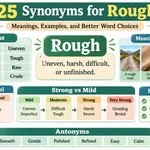
Have you ever used the word “rough” repeatedly when describing a difficult day, an uneven surface, a challenging experience, or an unfinished piece of work? Although it is a common English word, repeating it can make your writing sound less descriptive. Choosing a more precise alternative helps communicate exactly what you mean.
Understanding synonyms for rough can improve your vocabulary and make your conversations, essays, emails, captions, and professional writing more effective. Words such as harsh, uneven, coarse, difficult, rugged, and unpolished can replace rough in different situations. However, each alternative carries a slightly different meaning. This guide explores their definitions, tones, practical examples, and the best ways to use them naturally.
What Does “Rough” Mean?
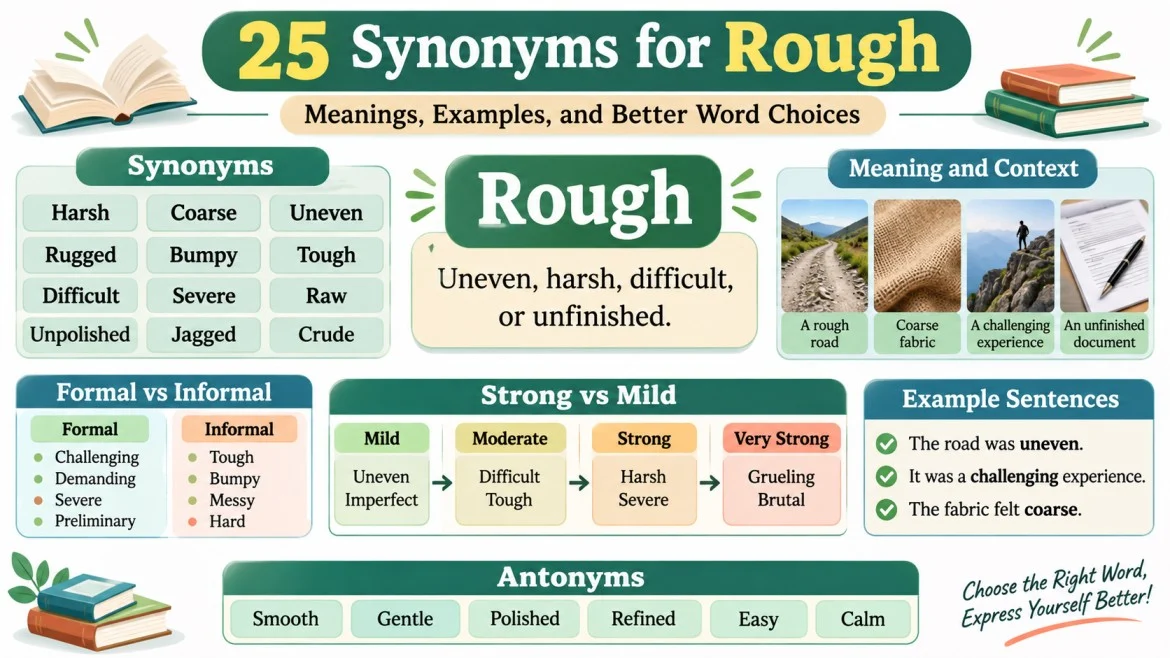
Rough means uneven, coarse, harsh, difficult, or unfinished, depending on the context. Common synonyms include rugged, bumpy, harsh, coarse, challenging, difficult, raw, and unpolished. The best replacement depends on whether you describe a surface, experience, personality, or piece of work.
Meaning, Tone and Context
The word “rough” has several meanings in English. It generally describes something that lacks smoothness, feels unpleasant, involves difficulty, or has not been completed carefully.
1. Simple Definition
Rough can describe:
- A surface that feels uneven or coarse.
- A situation that is difficult or unpleasant.
- Weather or conditions that are severe or stormy.
- A person who behaves harshly or aggressively.
- Work that is unfinished or not polished.
- An approximate measurement or estimate.
For example:
- The road was rough and full of potholes.
- She had a rough day at work.
- He gave me a rough estimate of the expenses.
- The writer submitted a rough draft of the article.
2. Part of Speech
Rough is primarily an adjective. It can also function as a verb and an adverb in certain expressions.
| Word Form | Meaning | Example |
|---|---|---|
| Rough | Uneven, difficult, or coarse | The surface feels rough. |
| Roughly | Approximately or without gentleness | The project costs roughly $500. |
| Roughen | To make something less smooth | Wind and cold can roughen the skin. |
| Roughness | The quality of being uneven or harsh | The roughness of the fabric bothered me. |
3. Tone and Formality
Rough is a neutral, versatile word. Its emotional tone changes according to the sentence.
- Positive: A rough but rewarding journey can suggest resilience.
- Negative: A rough experience usually suggests difficulty or discomfort.
- Neutral: A rough estimate simply means an approximate calculation.
4. Common Use Cases
Rough is commonly used when discussing:
- Physical surfaces and materials.
- Difficult experiences and challenging situations.
- Severe weather and road conditions.
- Unfinished writing and creative projects.
- Harsh behavior or treatment.
- Approximate figures, plans, and measurements.
When and How to Use “Rough”
Use rough when you want to describe something uneven, difficult, unpleasant, harsh, or incomplete without giving an overly detailed explanation.
Here are seven realistic examples.
- Professional: The construction team encountered rough conditions during the initial phase of the project.
- Personal: My friend has been going through a rough period recently.
- Academic: The researcher prepared a rough outline before developing the final paper.
- Emotional: Losing someone you love can be a rough experience.
- Creative: The artist created a rough sketch before painting the final version.
- Social Media: Some days are rough, but every challenge teaches us something valuable.
- Email: I have attached a rough version of the proposal for your review.
Another Word for “Rough”
The best single replacement for rough depends on what you are describing. There is no universal synonym that works in every sentence.
Here are useful alternatives for different situations.
- Professional writing: Challenging, demanding, or difficult. These words describe complicated situations more precisely.
- Academic writing: Uneven, coarse, preliminary, or approximate. Choose according to the subject being discussed.
- Casual conversation: Tough, bumpy, or hard. These alternatives sound natural in everyday speech.
- Emotional writing: Difficult, painful, or distressing. These words communicate emotional experiences more clearly.
- Creative writing: Rugged, jagged, raw, or weathered. These alternatives create stronger visual descriptions.
- Resume or workplace use: Challenging, demanding, or complex. These words describe professional responsibilities more positively.
- Social media captions: Tough, wild, or messy. These words create a conversational tone.
- Stronger meaning: Harsh, severe, brutal, or grueling. These words communicate greater intensity.
- Softer meaning: Uneven, unfinished, preliminary, or imperfect. These alternatives describe less serious situations.
When Not to Use “Rough”
Although rough is useful, it can sometimes sound too general. Replacing it with a more precise word helps readers understand your intended meaning.
Consider these situations:
1. When describing a difficult experience
Instead of: I had a rough experience.
Better: I had a challenging experience.
Challenging gives readers a clearer understanding of the difficulty.
2. When describing a physical surface
Instead of: The table feels rough.
Better: The table feels coarse.
Coarse works particularly well when discussing texture.
3. When describing unfinished work
Instead of: Here is my rough version.
Better: Here is my preliminary version.
Preliminary sounds more appropriate in formal and professional communication.
4. When describing severe behavior
Instead of: His behavior was rough.
Better: His behavior was harsh.
Harsh communicates an unpleasant or unkind attitude.
5. When describing difficult weather
Instead of: The weather was rough.
Better: The weather was stormy.
Stormy gives a more specific description of weather conditions.
Words Commonly Confused With “Rough”
Several English words have meanings similar to rough, but they are not interchangeable in every situation.
| Word | Difference from Rough | Example |
|---|---|---|
| Tough | Describes something difficult, strong, or resilient | It was a tough decision. |
| Coarse | Mainly describes texture, quality, or material | The fabric feels coarse. |
| Harsh | Suggests unpleasant severity or unkindness | His criticism was harsh. |
| Rugged | Describes something naturally uneven, strong, or irregular | They explored rugged mountains. |
| Raw | Describes something unprocessed, untreated, or emotionally exposed | The artist presented a raw design. |
| Uneven | Specifically describes a surface or distribution that is not level | The floor is uneven. |
Best Synonym by Context for “Rough”
The best synonym changes according to the subject, audience, and intended tone.
| Context | Best Synonym | Why It Works | Example |
|---|---|---|---|
| Formal writing | Harsh | Communicates unpleasant severity | The employees faced harsh conditions. |
| Academic writing | Uneven | Provides a precise physical description | The sample had an uneven surface. |
| Professional or business | Challenging | Sounds constructive and professional | The company faced a challenging quarter. |
| Resume | Demanding | Highlights responsibility and effort | Managed demanding project deadlines. |
| Casual conversation | Tough | Sounds natural and familiar | It has been a tough week. |
| Creative writing | Rugged | Creates vivid imagery | A rugged mountain landscape stretched ahead. |
| Emotional writing | Painful | Expresses emotional difficulty | It was a painful experience. |
| Strong intensity | Brutal | Communicates extreme difficulty | The team endured a brutal schedule. |
| Soft or moderate tone | Uneven | Describes irregularity without exaggeration | The path was slightly uneven. |
| Social media captions | Messy | Adds a casual, expressive tone | Life gets messy sometimes. |
| Weather descriptions | Stormy | Specifically describes unsettled weather | A stormy afternoon interrupted the trip. |
| Material descriptions | Coarse | Clearly communicates texture | The coarse fabric irritated her skin. |
| Unfinished writing | Preliminary | Sounds appropriate for early work | Please review the preliminary report. |
Which Synonym Should You Choose?
Choosing the right alternative for rough requires understanding what you want to communicate.
Follow these practical guidelines.
1. Identify the meaning
First, determine whether rough describes a surface, experience, person, weather condition, or unfinished project.
2. Consider formality
Use challenging, demanding, and preliminary in professional writing. Choose tough, messy, and bumpy for casual communication.
3. Think about emotional intensity
Difficult is relatively neutral, harsh sounds more severe, and brutal communicates extreme intensity.
4. Choose precision over variety
Do not replace rough with a complicated word simply to make your writing sound sophisticated. The replacement should preserve the original meaning.
5. Read the complete sentence
A synonym might look correct individually but sound unnatural in context. Always check the entire sentence before making a substitution.
Real Life Examples of “Rough” in Sentences
The following examples demonstrate how different alternatives can improve everyday communication.
School: The students faced a challenging assignment that required additional research.
Workplace: Our team experienced a demanding week while preparing for the presentation.
Writing: The author submitted a preliminary draft for editorial feedback.
Conversation: I had a tough morning, but things are getting better.
Social Media: Even through messy moments, keep moving forward.
Resume: Successfully managed complex assignments under tight deadlines.
Email: Please review the preliminary version of the report and share your suggestions.
Storytelling: The travelers crossed a rugged landscape filled with steep hills and rocky paths.
Home Improvement: The contractor repaired the uneven floor before installing the new tiles.
Weather: Heavy rain and strong winds created severe conditions throughout the evening.
25 Synonyms for “Rough”
Below are 25 useful synonyms for rough, covering physical textures, challenging experiences, severe conditions, unfinished work, and approximate measurements.
| Synonym | Simple Meaning | Best Used For | Example Sentence |
|---|---|---|---|
| 1. Harsh | Unpleasant, severe, or unkind | Conditions and behavior | The workers faced harsh conditions. |
| 2. Coarse | Having a rough or grainy texture | Materials and surfaces | The coarse fabric felt uncomfortable. |
| 3. Uneven | Not smooth, level, or consistent | Roads and surfaces | The uneven pavement made walking difficult. |
| 4. Rugged | Naturally rough, irregular, or tough | Landscapes and terrain | They traveled across rugged mountains. |
| 5. Bumpy | Full of small rises and dips | Roads and surfaces | The ride became bumpy near the village. |
| 6. Tough | Difficult to handle or endure | Experiences and challenges | She made it through a tough semester. |
| 7. Difficult | Not easy to accomplish | Tasks and situations | The project was difficult to complete. |
| 8. Severe | Extremely serious or intense | Weather and conditions | Severe weather delayed the flight. |
| 9. Brutal | Extremely harsh or demanding | Intense experiences | The athletes endured a brutal training session. |
| 10. Raw | Unprocessed, untreated, or unfinished | Materials and creative work | The designer presented a raw concept. |
| 11. Unpolished | Not refined or perfected | Writing and presentations | His first speech sounded unpolished. |
| 12. Jagged | Having sharp, irregular edges | Rocks and objects | Jagged stones covered the trail. |
| 13. Crude | Made or expressed without refinement | Designs and methods | They developed a crude prototype. |
| 14. Rocky | Full of rocks or difficulties | Terrain and experiences | Their journey was rocky from the beginning. |
| 15. Abrasive | Rough or irritating to touch or behavior | Materials and personalities | The abrasive material scratched the surface. |
| 16. Gritty | Containing small rough particles or showing toughness | Surfaces and descriptions | The gritty road covered their shoes in dust. |
| 17. Stormy | Characterized by storms or turbulence | Weather and relationships | A stormy night kept everyone indoors. |
| 18. Ragged | Torn, irregular, or worn | Clothing and edges | He wore a ragged jacket. |
| 19. Scratchy | Unpleasantly rough or irritating | Fabrics and sounds | The scratchy sweater irritated her neck. |
| 20. Distressing | Causing emotional discomfort | Personal experiences | The family experienced a distressing situation. |
| 21. Grueling | Extremely tiring or demanding | Work and physical activities | The team completed a grueling schedule. |
| 22. Unrefined | Lacking polish or sophistication | Ideas and creative work | The proposal contained several unrefined ideas. |
| 23. Approximate | Close to the actual amount, but not exact | Measurements and estimates | We calculated the approximate cost. |
| 24. Preliminary | Prepared as an early version | Reports and plans | The manager approved the preliminary design. |
| 25. Imperfect | Having flaws or shortcomings | Objects and results | The first attempt was imperfect but promising. |
Important usage note: These words are context dependent alternatives rather than exact replacements in every sentence. For example, approximate and preliminary replace rough in expressions such as rough estimate and rough draft, but not rough surface.
Synonym Groups and Usage Differences
Understanding synonym groups makes it easier to select the right word for your audience and purpose.
Professional vs. Personal Synonyms
Professional writing benefits from precise, neutral alternatives.
Words such as challenging, demanding, severe, and complex are useful when discussing workplace difficulties, project conditions, and business responsibilities.
Personal communication allows more expressive alternatives, including tough, painful, messy, and distressing.
For example:
Professional: The department experienced a challenging period.
Personal: I went through a tough time last month.
Formal vs. Conversational Synonyms
Formal language is generally more suitable for academic papers, business reports, presentations, and official emails.
Conversational language works better in everyday discussions, texts, and informal messages.
| Formal Synonym | Conversational Synonym | Example |
|---|---|---|
| Challenging | Tough | It was a tough assignment. |
| Severe | Bad | We experienced bad weather. |
| Preliminary | First version | I finished the first version. |
| Uneven | Bumpy | The road was bumpy. |
| Demanding | Hard | It was a hard week. |
Academic Synonyms
Academic writing requires accurate descriptions rather than unnecessarily complicated vocabulary.
Consider these alternatives:
- Uneven: Useful for describing irregular patterns or surfaces.
- Coarse: Appropriate for discussing material texture or grain size.
- Severe: Useful for describing serious conditions or effects.
- Preliminary: Suitable for early research findings or initial drafts.
- Approximate: Appropriate for estimated measurements or values.
Example: The preliminary findings revealed an uneven distribution across the study area.
Professional and Business Synonyms
In workplace communication, rough sometimes sounds too vague or informal.
Better alternatives include:
- Challenging: Describes a situation that requires effort.
- Demanding: Highlights considerable responsibilities.
- Complex: Describes something involving multiple factors.
- Preliminary: Refers to an early version of a document.
- Approximate: Describes an estimated amount or figure.
Example: Please review the preliminary budget and confirm the approximate project cost.
Creative or Literary Synonyms
Creative writing often benefits from descriptive words that help readers imagine a scene.
Useful alternatives include:
- Rugged: Creates images of natural landscapes.
- Jagged: Describes sharp, irregular shapes.
- Weathered: Suggests the effects of age and exposure.
- Ragged: Communicates a worn or torn appearance.
- Gritty: Adds texture and atmosphere.
- Raw: Expresses something unfiltered or emotionally exposed.
Example: The old traveler followed a rugged trail beneath the fading evening sky.
Slang or Modern Synonyms
Some informal alternatives can make conversations and captions sound more natural.
Tough: Commonly used to describe difficult experiences.
Messy: Describes complicated situations or imperfect circumstances.
Bumpy: Often describes a journey or process with unexpected problems.
Hard: A simple alternative for challenging experiences.
Example: The first few months of business were pretty tough.
Avoid overly casual expressions in research papers, formal reports, and professional applications.
Strongest vs. Weaker Synonyms
Different synonyms communicate different levels of intensity.
The following scale is approximate because intensity also depends on context.
| Intensity | Synonym | Example |
|---|---|---|
| Mild | Uneven | The surface is slightly uneven. |
| Mild | Imperfect | The first version is imperfect. |
| Moderate | Difficult | The assignment was difficult. |
| Moderate | Tough | We had a tough week. |
| Strong | Harsh | The conditions were harsh. |
| Strong | Severe | The region experienced severe weather. |
| Very strong | Grueling | The workers completed a grueling shift. |
| Very strong | Brutal | The athletes faced a brutal competition. |
Emotional vs. Neutral Synonyms
Some alternatives describe facts, while others communicate feelings.
Emotional synonyms:
- Painful
- Distressing
- Harsh
- Brutal
- Tough
These words can express personal struggles, emotional discomfort, or difficult experiences.
Neutral synonyms:
- Uneven
- Coarse
- Approximate
- Preliminary
- Imperfect
These alternatives are useful when describing physical characteristics, measurements, or unfinished work without adding unnecessary emotion.
Antonyms of “Rough”
Antonyms of rough depend on its meaning. A physical surface has different opposites from a difficult experience or an unfinished project.
Here are 15 useful antonyms grouped around the different meanings of rough.
| Antonym | Meaning | Example Sentence |
|---|---|---|
| 1. Smooth | Having an even surface | The wooden table feels smooth. |
| 2. Soft | Gentle to touch | The blanket is soft and comfortable. |
| 3. Gentle | Kind or mild in manner | She used a gentle approach. |
| 4. Polished | Refined and finished | His presentation was polished. |
| 5. Refined | Improved and sophisticated | The final design looks refined. |
| 6. Finished | Fully completed | The finished report is ready. |
| 7. Easy | Not difficult | The assignment was easy to complete. |
| 8. Simple | Not complicated | We followed a simple process. |
| 9. Comfortable | Providing ease and relaxation | The journey was comfortable. |
| 10. Calm | Peaceful and without disturbance | The sea remained calm. |
| 11. Mild | Not severe or intense | The region experienced mild weather. |
| 12. Pleasant | Enjoyable or agreeable | We had a pleasant afternoon. |
| 13. Precise | Accurate and exact | The engineer provided precise measurements. |
| 14. Exact | Completely accurate | The final figure was exact. |
| 15. Level | Flat and even | The contractor created a level floor. |
Comparison: Rough vs. Similar Words
Understanding the differences between related words helps prevent incorrect substitutions.
Rough vs. Tough
Main difference: Rough describes unevenness, harshness, or difficulty. Tough generally describes something difficult to handle or something strong and durable.
Which is stronger? Tough can emphasize resilience or difficulty, while rough can emphasize unpleasant conditions.
Which is more formal? Both are neutral, but difficult is often more suitable for formal writing.
Examples:
- Rough: We traveled along a rough road.
- Tough: She faced a tough decision.
Rough vs. Harsh
Main difference: Rough has several meanings, while harsh emphasizes unpleasant severity, cruelty, or extreme conditions.
Which is stronger? Harsh often communicates a more severe negative impression.
Which is more formal? Both work in formal writing.
Examples:
- Rough: The surface felt rough against my hand.
- Harsh: The workers endured harsh conditions.
Rough vs. Coarse
Main difference: Rough is broader and can describe situations or experiences. Coarse usually refers to texture, grain, language, or quality.
Which is stronger? Coarse can sound more specific when describing a grainy or unpleasant texture.
Which is more formal? Both are suitable for formal descriptions.
Examples:
- Rough: The wall has a rough surface.
- Coarse: The coarse sand irritated his feet.
Rough vs. Rugged
Main difference: Rough can describe general unevenness or difficulty. Rugged usually suggests natural irregularity, strength, or a demanding landscape.
Which is stronger? Rugged creates a stronger impression of natural, physical toughness.
Which is more formal? Both work well in descriptive writing.
Examples:
- Rough: We walked across rough ground.
- Rugged: The hikers explored rugged terrain.
Rough vs. Uneven
Main difference: Rough can describe texture, difficulty, or behavior. Uneven specifically emphasizes a lack of uniformity or levelness.
Which is stronger? Rough can sound more general or unpleasant, while uneven is more precise.
Which is more formal? Uneven is often preferable in technical and academic descriptions.
Examples:
- Rough: The road was rough after the storm.
- Uneven: The road had an uneven surface.
Rough vs. Raw
Main difference: Rough describes something coarse, difficult, or unfinished. Raw refers to something unprocessed, uncooked, untreated, or emotionally unfiltered.
Which is stronger? Raw can create a more intense emotional or descriptive effect.
Which is more formal? Both can be used formally when the context is appropriate.
Examples:
- Rough: The designer prepared a rough sketch.
- Raw: The artist presented a raw and emotional portrait.
Common Phrases and Expressions with “Rough”
The word rough appears in several everyday English expressions. Learning these phrases helps improve natural communication.
1. Rough Day
Meaning: A day filled with difficulties, stress, or unpleasant experiences.
Example sentence: I had a rough day at work, so I am taking the evening off.
2. Rough Estimate
Meaning: An approximate calculation or prediction.
Example sentence: Can you provide a rough estimate of the renovation costs?
3. Rough Draft
Meaning: An early version of a written document that needs further editing.
Example sentence: I completed the rough draft of my research paper.
4. Rough Patch
Meaning: A temporary period of difficulty in someone’s life or a relationship.
Example sentence: Their business went through a rough patch last year.
5. Rough Around the Edges
Meaning: Not completely polished, refined, or sophisticated.
Example sentence: The new restaurant is still rough around the edges, but the food is excellent.
6. Rough Start
Meaning: A beginning that involves problems or unexpected difficulties.
Example sentence: The project had a rough start, but the team eventually made progress.
7. In Rough Shape
Meaning: In poor physical, emotional, or general condition.
Example sentence: The old building was in rough shape after years of neglect.
8. Take the Rough with the Smooth
Meaning: Accept both difficult and pleasant parts of life.
Example sentence: Every career has challenges, so you must learn to take the rough with the smooth.
Common Mistakes to Avoid
Using synonyms without understanding their differences can make your writing confusing. Avoid these seven common mistakes.
1. Using Rough When a More Precise Word Is Better
Incorrect: The floor is rough.
Better: The floor is uneven.
Use uneven when you specifically mean that a surface is not level.
2. Confusing Rough With Tough
Incorrect: The fabric feels tough.
Better: The fabric feels coarse.
Tough usually describes strength or resistance, while coarse describes texture.
3. Using Casual Synonyms in Formal Writing
Incorrect: We had a pretty tough situation during the project.
Better: We encountered a challenging situation during the project.
Challenging often sounds more appropriate in professional communication.
4. Using an Overly Dramatic Synonym
Incorrect: The students experienced a brutal homework assignment.
Better: The students received a challenging assignment.
Brutal is too intense for an ordinary academic task.
5. Repeating the Same Word Too Often
Incorrect: The road was rough, the weather was rough, and the journey was rough.
Better: The road was uneven, the weather was severe, and the journey was challenging.
Use alternatives that accurately describe each situation.
6. Choosing the Wrong Emotional Tone
Incorrect: She experienced a coarse period in her life.
Better: She experienced a difficult period in her life.
Coarse describes texture or quality, not emotional hardship.
7. Using Slang in Academic or Professional Writing
Incorrect: The company had a messy time managing the project.
Better: The company experienced a challenging period while managing the project.
Choose language that matches your audience and communication goals.
FAQs
1. What is the best synonym for rough?
The best synonym depends on context. Tough works for difficult experiences, coarse describes texture, harsh communicates severity, and uneven describes irregular surfaces.
2. What is a formal synonym for rough?
Challenging, severe, demanding, preliminary, and approximate are useful formal alternatives. Select the word that accurately describes the situation.
3. What is an informal synonym for rough?
Tough, bumpy, messy, and hard are common informal alternatives. They work naturally in everyday conversations, personal messages, and casual writing.
4. What is another word for rough in professional writing?
Challenging is a strong professional alternative when discussing difficult situations. Preliminary works better for early drafts, while demanding describes substantial responsibilities.
5. What is the difference between rough and tough?
Rough describes unevenness, harshness, or unfinished quality. Tough usually refers to difficulty, strength, or resilience, depending on the sentence.
6. What is the opposite of rough?
Common opposites include smooth, gentle, polished, refined, and easy. The correct antonym depends on whether rough describes texture, behavior, or difficulty.
Conclusion
The word rough can describe uneven surfaces, difficult experiences, harsh conditions, unfinished work, and approximate measurements. Its best synonyms include tough, coarse, harsh, rugged, uneven, challenging, and unpolished, depending on the situation.
Choosing the right alternative makes your writing more accurate, expressive, and professional. Always consider meaning, tone, and audience before replacing a word.
A useful vocabulary tip is to learn synonyms in context rather than memorizing isolated words. This approach helps you communicate naturally and choose the most appropriate expression in every situation.
Discover More Post:
- 50+ Synonyms for Phenomenon | From Everyday Events to …
- 50+ Synonyms for Detrimental | Expert Word Choices That …