Do you find yourself using the word collaboration repeatedly in emails, workplace reports, academic essays, presentations, or everyday conversations? Although collaboration is an effective word, relying on it too often can make your writing sound repetitive. Choosing the right alternative can help communicate your ideas more clearly and professionally.
Understanding synonyms for collaboration is especially useful when describing teamwork, business partnerships, shared responsibilities, or creative projects. However, not every alternative carries exactly the same meaning. Some emphasize cooperation, others highlight joint efforts, mutual support, or professional relationships. This guide explores practical alternatives, explains their differences, and provides natural examples to help you choose the most appropriate word for every situation.
What Does “Collaboration” Mean?
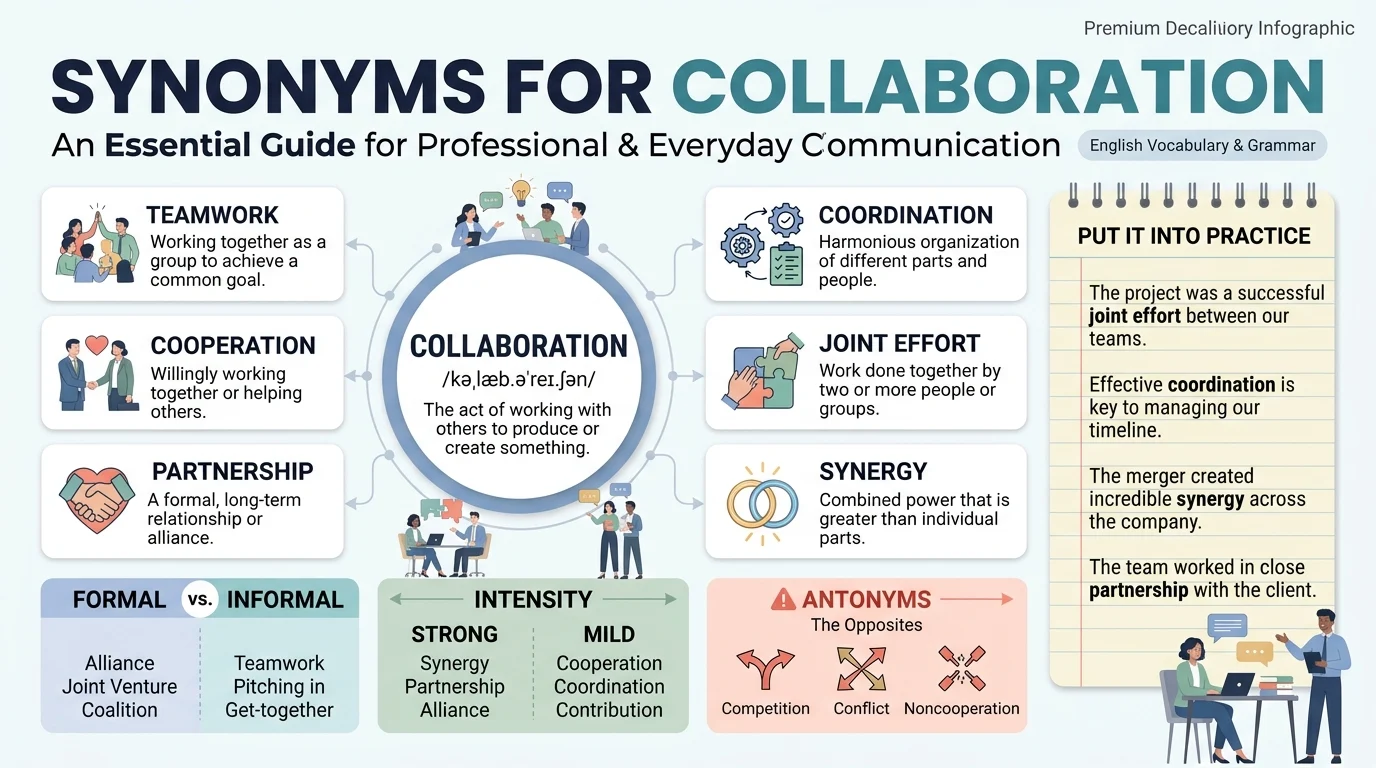
Collaboration means working together with another person or group to achieve a shared goal. Common synonyms include teamwork, cooperation, partnership, coordination, joint effort, alliance, and collective work. The best alternative depends on whether the situation is professional, academic, casual, or creative.
Meaning, Tone and Context
What Does Collaboration Mean?
Collaboration refers to the process of two or more people, organizations, or groups working together to accomplish something. It usually involves sharing ideas, responsibilities, knowledge, resources, or skills.
For example, when employees from different departments develop a marketing campaign together, their shared work is a form of collaboration.
Part of Speech
Collaboration is a noun. It describes the activity, process, or relationship of working together.
Related word forms:
| Word | Part of Speech | Meaning |
|---|---|---|
| Collaboration | Noun | The act of working together |
| Collaborate | Verb | To work jointly with others |
| Collaborative | Adjective | Involving shared work or effort |
| Collaborator | Noun | Someone who works with others |
| Collaboratively | Adverb | In a cooperative manner |
Tone and Connotation
Collaboration generally has a positive and neutral tone. It suggests shared responsibility, communication, creativity, and a common purpose.
Its tone can change slightly depending on the situation. In business, it often communicates professionalism and productivity. In education, it highlights shared learning. creative projects, it suggests combining different talents and ideas.
Formality Level
Collaboration is a moderately formal word. It works naturally in professional emails, academic papers, business presentations, project descriptions, and everyday conversations.
Common Uses of Collaboration
The word frequently appears in:
- Business projects involving multiple departments.
- Academic research conducted by different scholars.
- Creative projects involving writers, designers, and artists.
- Educational activities involving students and teachers.
- Community initiatives involving local organizations.
- Technology projects involving developers and engineers.
- Professional relationships between companies.
When and How to Use “Collaboration”
Use collaboration when you want to emphasize that multiple people or organizations are contributing toward a shared objective.
It is particularly appropriate when the process involves communication, shared ideas, combined expertise, and mutual responsibility.
Here are seven realistic examples.
1. Professional Context
The marketing and sales departments established a strong collaboration to improve customer engagement.
2. Academic Context
The research project benefited from collaboration between experienced scientists and university students.
3. Personal Context
Our collaboration helped us organize the community event more successfully.
4. Creative Context
The collaboration between the photographer and designer produced an impressive visual campaign.
5. Email Context
Thank you for your collaboration throughout the planning and implementation process.
6. Resume Context
Demonstrated effective collaboration with cross functional teams to complete projects within established deadlines.
7. Social Media Context
Great things happen when creativity, passion, and collaboration come together.
Another Word for Collaboration
The best single replacement for collaboration is teamwork when describing people working together toward a shared objective.
However, other alternatives may communicate more specific meanings depending on the situation.
Here are useful choices for different writing styles.
| Context | Best Alternative | Why It Works |
|---|---|---|
| Professional writing | Cooperation | Highlights working together effectively |
| Academic writing | Joint research | Describes shared academic investigation |
| Casual conversation | Teamwork | Sounds natural and familiar |
| Emotional writing | Mutual support | Emphasizes encouragement and understanding |
| Creative writing | Co creation | Highlights shared creativity |
| Resume or workplace | Cross functional teamwork | Demonstrates working across departments |
| Social media captions | Team effort | Sounds engaging and conversational |
| Stronger meaning | Strategic partnership | Suggests an intentional professional relationship |
| Softer meaning | Cooperation | Communicates a friendly willingness to work together |
Quick recommendation: Choose teamwork for general situations, cooperation for shared action, partnership for established relationships, and coordination when organizing different people or activities is the main focus.
When Not to Use “Collaboration”
Although collaboration is useful, it does not fit every situation.
Sometimes, a more specific word communicates the intended meaning more effectively.
1. When Describing Simple Assistance
If someone provides occasional help rather than participating in shared work, collaboration may sound exaggerated.
Better choice: Assistance.
Example: My colleague provided assistance with the presentation.
2. When Describing an Established Business Relationship
If two companies have an ongoing professional relationship, partnership may be more accurate.
Better choice: Partnership.
Example: The two companies established a long term partnership.
3. When Describing Organized Activities
When the main focus is arranging people, schedules, or resources, coordination is more precise.
Better choice: Coordination.
Example: Effective coordination helped the departments complete the project.
4. When Describing Shared Academic Work
If researchers are specifically working on a study, joint research may communicate the activity more clearly.
Better choice: Joint research.
Example: The universities conducted joint research on renewable energy.
5. When Describing Friendly Support
If people are encouraging one another rather than completing a shared project, mutual support is more appropriate.
Better choice: Mutual support.
Example: Mutual support helped the team overcome a difficult period.
Words Commonly Confused With Collaboration
Several words are closely related to collaboration, but their meanings are not identical.
Understanding these distinctions prevents awkward word choices.
| Word | Meaning | Difference from Collaboration | Best Used For |
|---|---|---|---|
| Cooperation | Working willingly with others | Focuses on willingness to help or work together | Shared activities |
| Coordination | Organizing people or activities | Emphasizes planning and organization | Project management |
| Partnership | A relationship between two or more parties | Suggests an established or ongoing relationship | Business relationships |
| Teamwork | People working as a team | Focuses on collective effort | Workplace and group activities |
| Communication | Sharing information and ideas | Describes exchanging information, not necessarily working jointly | Discussions and information sharing |
| Association | A connection between people or organizations | Describes a relationship rather than a shared working process | Professional connections |
For example, communication may support collaboration, but simply exchanging messages does not necessarily mean people are collaborating.
Similarly, a partnership can exist without both parties actively working together on a particular project.
Best Synonym by Context for Collaboration
The best synonym depends on the purpose of your sentence, the relationship between participants, and the level of formality.
Use the following table to identify the most suitable alternative.
| Context | Best Synonym | Why It Works | Example |
|---|---|---|---|
| Formal writing | Cooperation | Professional and clear | Cooperation between departments improved efficiency. |
| Academic writing | Joint research | Specifically describes shared investigation | Joint research produced valuable findings. |
| Business communication | Partnership | Highlights professional relationships | The partnership created new opportunities. |
| Resume writing | Teamwork | Demonstrates the ability to work with others | Applied teamwork to complete complex projects. |
| Casual conversation | Working together | Natural and straightforward | We enjoyed working together on the project. |
| Creative writing | Co creation | Highlights shared creative contributions | Their co creation attracted widespread attention. |
| Emotional writing | Mutual support | Emphasizes encouragement | Mutual support strengthened their relationship. |
| Strong professional relationship | Strategic alliance | Suggests an intentional shared objective | The companies formed a strategic alliance. |
| Soft or moderate tone | Cooperation | Communicates willingness without exaggeration | Cooperation made the process easier. |
| Social media captions | Team effort | Short and engaging | A successful launch powered by team effort. |
| Project management | Coordination | Highlights organization | Better coordination reduced project delays. |
| Community activities | Collective effort | Emphasizes participation from many people | The park renovation was a collective effort. |
| International business | Cross border partnership | Describes cooperation across countries | The cross border partnership expanded operations. |
| Research publications | Coauthorship | Identifies shared authorship | Their coauthorship resulted in a detailed study. |
| Creative industries | Creative partnership | Highlights shared artistic work | The creative partnership produced an original campaign. |
Which Synonym Should You Choose?
Choosing the right synonym involves more than replacing one word with another. Consider the intended meaning, audience, relationship, and tone.
1. Consider the Meaning
First, identify what you want to communicate.
If you mean people are working toward a common objective, teamwork is suitable. If you mean they are willingly helping each other, cooperation may be better.
2. Consider Formality
Formal writing benefits from precise and professional vocabulary.
Use cooperation, partnership, joint research, or strategic alliance in reports, academic writing, and business documents.
For casual conversations, teamwork and working together sound more natural.
3. Consider Emotional Intensity
Some alternatives emphasize positive relationships more strongly than others.
Mutual support suggests encouragement and trust, while collective effort focuses on combined contributions.
Choose the word that matches the emotional message.
4. Consider Professional Value
When writing a resume, highlight the skills that demonstrate your contribution.
For example, teamwork, cross functional coordination, and strategic partnerships can communicate different professional strengths.
5. Consider the Sentence Context
A synonym should fit naturally into the sentence.
For instance, cooperation works well when describing shared action, while coordination is more suitable when discussing organization and scheduling.
Practical tip: Read your sentence after replacing collaboration. If the original meaning becomes unclear or changes, choose a more precise alternative.
Real Life Examples of Collaboration in Sentences
These examples demonstrate how different synonyms can improve everyday and professional communication.
1. School
Students used teamwork to complete their science project before the deadline.
2. Workplace
Effective coordination between departments improved the company’s productivity.
3. Professional Writing
The organization developed a strategic partnership with an international technology company.
4. Conversation
We accomplished more by working together than we could have managed individually.
5. Social Media
A beautiful team effort deserves to be celebrated.
6. Resume
Successfully coordinated with cross functional teams to deliver multiple projects on schedule.
7. Email
I appreciate your cooperation and continued support throughout this project.
8. Storytelling
Their shared determination and mutual support helped them overcome every obstacle.
9. Academic Research
The publication resulted from joint research conducted by specialists from three universities.
10. Business Presentation
Our alliance combines industry knowledge, technical expertise, and shared resources.
25 Synonyms for Collaboration
Here are 25 useful alternatives to collaboration, with their meanings, appropriate contexts, and natural example sentences.
| Synonym | Simple Meaning | Best Used For | Example Sentence |
|---|---|---|---|
| 1. Teamwork | Working together as a team | Workplace and group projects | Strong teamwork helped us achieve our target. |
| 2. Cooperation | Willingness to work together | Formal and everyday situations | Your cooperation made the project successful. |
| 3. Partnership | A relationship involving shared interests or goals | Business and professional relationships | The partnership opened new opportunities. |
| 4. Coordination | Organizing people or activities effectively | Management and planning | Better coordination improved project delivery. |
| 5. Joint effort | An achievement involving combined work | General and professional writing | The renovation was a joint effort. |
| 6. Alliance | An agreement or relationship between parties | Business and strategic relationships | The companies formed an alliance to expand their reach. |
| 7. Coalition | A group united for a common purpose | Political and community activities | A coalition of organizations supported the initiative. |
| 8. Collective effort | Contributions from several people | Community and organizational projects | Their collective effort transformed the neighborhood. |
| 9. Synergy | Combined contributions producing greater results | Business and creative environments | The team’s synergy generated innovative ideas. |
| 10. Joint venture | A business activity undertaken by multiple parties | Commercial projects | The companies launched a joint venture. |
| 11. Co creation | Creating something together | Creative and digital industries | The campaign was an example of successful co creation. |
| 12. Cooperation agreement | A formal arrangement to work together | Institutional and business settings | Both organizations signed a cooperation agreement. |
| 13. Mutual support | Helping and encouraging one another | Personal and professional relationships | Mutual support strengthened the entire team. |
| 14. Association | A connection or relationship between parties | Professional and organizational contexts | Their association created valuable opportunities. |
| 15. Engagement | Active involvement in an activity | Workplace and educational settings | Employee engagement improved project participation. |
| 16. Consultation | Sharing knowledge or advice | Professional and academic situations | The design improved after consultation with experts. |
| 17. Coauthorship | Joint responsibility for writing or publishing | Academic and creative writing | Their coauthorship produced a valuable research paper. |
| 18. Joint research | Research conducted by multiple participants | Scientific and academic work | Joint research revealed important findings. |
| 19. Concerted effort | A coordinated and determined attempt | Formal and persuasive writing | A concerted effort helped resolve the problem. |
| 20. Collective work | Work completed by a group | Educational and creative settings | The exhibition represented collective work. |
| 21. Coordination effort | An attempt to organize different activities | Project management | A coordination effort brought the departments together. |
| 22. Cross functional cooperation | Cooperation between different departments or specialties | Business and workplace writing | Cross functional cooperation improved product development. |
| 23. Creative partnership | A relationship built around shared creative work | Art, design, and entertainment | Their creative partnership produced an original collection. |
| 24. Joint undertaking | An activity carried out by multiple parties | Formal and organizational writing | The restoration became a joint undertaking. |
| 25. Working together | People combining their efforts | Informal and general communication | Working together made the challenge easier. |
Important usage note: These alternatives are related to collaboration, but they are not interchangeable in every sentence. For example, consultation may involve giving advice without sharing responsibility for the final work. Choose the term that accurately describes the relationship or activity.
Synonym Groups and Usage Differences
Professional vs. Personal Synonyms
Professional and personal situations often require different alternatives.
In the workplace, collaboration usually describes people combining their expertise to achieve organizational goals.
The most useful professional alternatives include:
- Strategic partnership
- Cooperation
- Cross functional teamwork
- Coordination
- Joint effort
In personal situations, the emphasis is often on helping, understanding, and supporting one another.
Suitable alternatives include mutual support, teamwork, working together, and shared effort.
Example:
Professional: The departments established a strategic partnership to improve operational efficiency.
Personal: Mutual support helped the family manage a challenging situation.
Formal vs. Conversational Synonyms
Formal writing requires vocabulary that communicates ideas precisely and professionally.
For reports, academic papers, presentations, and official emails, consider cooperation, partnership, joint undertaking, and concerted effort.
Conversational writing benefits from simpler alternatives such as teamwork, working together, and team effort.
Example:
Formal: The initiative was completed through a concerted effort involving several departments.
Conversational: Everyone worked together to finish the project.
Both sentences communicate shared effort, but their tones are different.
Academic Synonyms
Academic writing often discusses research, knowledge sharing, group learning, and joint investigations.
The following alternatives are particularly useful:
Joint research: Appropriate when researchers investigate a subject together.
Coauthorship: Suitable when multiple individuals contribute to a publication.
Cooperative learning: Describes an educational approach in which students learn through shared activities.
Collective inquiry: Emphasizes a group investigating questions or exploring ideas.
Interdisciplinary cooperation: Describes participation from different academic fields.
Example: Interdisciplinary cooperation helped researchers examine the issue from several perspectives.
Professional and Business Synonyms
In business communication, the best alternative depends on the relationship and the activity being described.
| Business Situation | Recommended Word | Example |
|---|---|---|
| Employees working as a group | Teamwork | Teamwork improved overall productivity. |
| Two companies working together | Partnership | The partnership expanded both businesses. |
| Departments organizing activities | Coordination | Coordination reduced operational delays. |
| Companies combining strategic interests | Alliance | The alliance strengthened market opportunities. |
| Several specialists developing a product | Joint effort | The product resulted from a joint effort. |
| Experts providing advice | Consultation | Consultation improved the final strategy. |
| Different departments sharing knowledge | Cross functional cooperation | Cross functional cooperation encouraged innovation. |
For resumes, use specific descriptions of your contributions instead of relying on collaboration alone.
For example, write “Coordinated with five departments to deliver a customer focused project” rather than simply saying “Participated in collaboration.”
Creative or Literary Synonyms
Creative industries often involve combining different talents, perspectives, and artistic approaches.
Useful alternatives include:
- Co creation
- Creative partnership
- Collective work
- Joint effort
- Artistic association
These expressions help describe projects involving writers, photographers, musicians, designers, filmmakers, and other creative professionals.
Example: Their creative partnership brought together storytelling, photography, and innovative design.
Slang or Modern Synonyms
Collaboration does not have many direct slang equivalents, but some informal expressions are commonly used in modern communication.
Team up: Work together with another person or group.
Example: We decided to team up for the competition.
Work together: A simple and widely understood expression.
Example: Let’s work together to finish the assignment.
Join forces: Combine abilities or resources to achieve something.
Example: Two local organizations joined forces to support the community.
These expressions work well in casual conversations, social media captions, and informal emails. For academic papers and formal business reports, use more precise professional alternatives.
Strongest vs. Weaker Synonyms
Not all synonyms communicate the same level of commitment or intensity.
The following scale organizes useful alternatives according to the strength of the relationship or shared effort they often suggest.
| Intensity | Synonym | Meaning |
|---|---|---|
| Mild | Consultation | Sharing advice or opinions |
| Mild | Association | A general connection |
| Moderate | Cooperation | Willingness to work together |
| Moderate | Teamwork | Combined effort within a team |
| Moderate | Coordination | Organized joint activities |
| Strong | Joint effort | Shared responsibility for an objective |
| Strong | Partnership | An established working relationship |
| Strong | Concerted effort | A focused and determined group attempt |
| Strong | Alliance | An intentional relationship between parties |
| Strong | Strategic partnership | A purposeful relationship built around important shared goals |
This is a practical scale, not a strict ranking. For example, a partnership may be more formal than a concerted effort, but the two expressions describe different things.
Emotional vs. Neutral Synonyms
Some alternatives communicate emotional connection, while others simply describe how people work together.
Emotional alternatives:
- Mutual support
- Shared commitment
- Team spirit
- Collective determination
These words are useful when describing trust, encouragement, and a sense of belonging.
Neutral alternatives:
- Coordination
- Cooperation
- Joint research
- Collective work
These expressions focus more on the activity than the emotional relationship.
Example:
Emotional: Mutual support helped everyone remain motivated.
Neutral: Coordination between the departments improved efficiency.
Antonyms of “Collaboration”
Collaboration describes people working together, so its opposites generally involve separation, competition, resistance, or a lack of cooperation.
Some antonyms are direct opposites in particular contexts, while others describe situations that contrast with collaborative behavior.
| Antonym | Meaning | Example Sentence |
|---|---|---|
| 1. Noncooperation | Refusal to work together | Noncooperation delayed the project. |
| 2. Competition | Trying to outperform others | Competition between the companies increased. |
| 3. Conflict | A serious disagreement or clash | Conflict prevented the teams from reaching an agreement. |
| 4. Opposition | Resistance to an idea or activity | Opposition weakened support for the proposal. |
| 5. Rivalry | Competition between individuals or groups | Rivalry affected their professional relationship. |
| 6. Isolation | Separation from others | Isolation limited opportunities for shared learning. |
| 7. Disagreement | A difference of opinion | Disagreement interrupted the planning process. |
| 8. Discord | A lack of harmony | Discord created tension within the organization. |
| 9. Resistance | Refusal to accept or support something | Resistance slowed the implementation process. |
| 10. Obstruction | Deliberately preventing progress | Obstruction made the project difficult to complete. |
| 11. Division | A state of separation or disagreement | Division weakened the team’s effectiveness. |
| 12. Independence | Operating without relying on others | Independence allowed the department to manage its own projects. |
| 13. Separation | Being apart rather than working jointly | Separation between the groups reduced communication. |
| 14. Hostility | Unfriendly or aggressive behavior | Hostility damaged their working relationship. |
| 15. Self interest | Prioritizing personal benefit over shared goals | Self interest prevented the members from reaching a compromise. |
Usage note: These words are contextual opposites rather than 15 exact dictionary antonyms. Noncooperation is one of the closest direct opposites, while competition, independence, and conflict describe different ways of contrasting with collaborative activity.
Comparison: Collaboration vs. Similar Words
Understanding the difference between collaboration and similar words makes your writing more accurate.
Collaboration vs. Cooperation
Main difference: Collaboration involves actively working together on a shared task, often by combining skills and ideas. Cooperation focuses on willingness to help or support another person’s efforts.
Which is stronger? Collaboration often suggests more active joint involvement.
Which is more formal? Both are suitable for professional and academic writing.
Examples:
Collaboration: The designers and developers collaborated to create the new application.
Cooperation: The employees showed cooperation during the office renovation.
Collaboration vs. Teamwork
Main difference: Collaboration describes the process of working jointly, while teamwork emphasizes the combined effort of people functioning as a team.
Which is stronger? Neither is universally stronger. Teamwork emphasizes group performance, while collaboration emphasizes joint contribution.
Which is more formal? Collaboration often sounds more suitable for formal reports, although both are widely accepted.
Examples:
Collaboration: Their collaboration produced a new business strategy.
Teamwork: Excellent teamwork helped the employees meet their deadline.
Collaboration vs. Partnership
Main difference: Collaboration describes working together, whereas partnership usually refers to an established relationship between individuals or organizations.
Which is stronger? Partnership may suggest a longer term or more structured relationship.
Which is more formal? Both are professional, but partnership can carry a stronger organizational meaning.
Examples:
Collaboration: The two companies collaborated on a marketing campaign.
Partnership: The two companies entered a long term partnership.
Collaboration vs. Coordination
Main difference: Collaboration involves contributing together, while coordination focuses on organizing activities, people, or resources.
Which is stronger? Collaboration suggests shared participation, while coordination emphasizes organization.
Which is more formal? Both work well in professional communication.
Examples:
Collaboration: The engineers collaborated on the new product.
Coordination: The project manager handled coordination between departments.
Collaboration vs. Cooperation Agreement
Main difference: Collaboration is the activity of working together, while a cooperation agreement is a formal arrangement describing how parties intend to cooperate.
Which is stronger? An agreement can establish formal commitments, but it does not automatically mean active collaboration is taking place.
Which is more formal? Cooperation agreement is more formal and specific.
Examples:
Collaboration: The universities collaborated on a research project.
Cooperation agreement: The universities signed a cooperation agreement to support future research.
Collaboration vs. Synergy
Main difference: Collaboration refers to the process of working together. Synergy describes the added value or improved results that can emerge when contributions combine effectively.
Which is stronger? Synergy can suggest an especially productive combined outcome.
Which is more formal? Both appear in business writing, but synergy is particularly common in strategic discussions.
Examples:
Collaboration: The departments collaborated to improve customer service.
Synergy: The combination of their expertise created valuable synergy.
Common Phrases and Expressions with “Collaboration”
These expressions are useful in business writing, academic work, professional communication, and everyday English.
1. Close Collaboration
Meaning: Working together regularly and maintaining strong communication.
Example sentence: The designers worked in close collaboration with the engineering team.
2. Effective Collaboration
Meaning: Working together successfully to achieve a particular objective.
Example sentence: Effective collaboration helped the organization complete the project ahead of schedule.
3. Collaborative Effort
Meaning: A task or achievement involving contributions from multiple people.
Example sentence: The successful event was the result of a collaborative effort.
4. Foster Collaboration
Meaning: Encourage people to work together and share ideas.
Example sentence: The manager introduced weekly meetings to foster collaboration.
5. Cross Departmental Collaboration
Meaning: Joint work involving different departments within an organization.
Example sentence: Cross departmental collaboration improved the company’s product development process.
6. Collaboration Opportunities
Meaning: Chances for people or organizations to work together.
Example sentence: The conference created new collaboration opportunities for small businesses.
7. Collaborative Environment
Meaning: A setting that encourages teamwork, communication, and shared contributions.
Example sentence: The company provides a collaborative environment where employees can exchange ideas freely.
8. Successful Collaboration
Meaning: A productive working relationship that achieves its intended goals.
Example sentence: Their successful collaboration resulted in an innovative educational program.
Common Mistakes to Avoid
Using synonyms correctly requires understanding their meanings and the situations in which they work best.
Here are seven common mistakes to avoid.
1. Using Collaboration When Cooperation Is More Accurate
Collaboration generally involves active joint work, while cooperation can simply mean willingly helping someone.
Incorrect: Thank you for your collaboration in answering my quick question.
Better: Thank you for your cooperation in answering my quick question.
2. Confusing Collaboration With Coordination
Coordination focuses on organization, while collaboration involves shared contributions.
Incorrect: Our collaboration of meeting schedules improved efficiency.
Better: Our coordination of meeting schedules improved efficiency.
3. Using Casual Expressions in Academic Writing
Expressions such as team up and work together are understandable, but they may sound too conversational in formal research papers.
Better: Use joint research, cooperation, or collaborative work when appropriate.
4. Using an Overly Dramatic Synonym
Not every shared activity deserves terms such as strategic alliance or major partnership.
For a small classroom assignment, teamwork is usually more appropriate.
5. Repeating Collaboration Too Often
Using the same word in every paragraph makes writing sound repetitive.
Instead, consider teamwork, cooperation, partnership, or joint effort when the meaning supports the replacement.
6. Choosing the Wrong Emotional Tone
Mutual support suggests encouragement, while coordination describes organization.
Do not use them interchangeably when describing a relationship.
7. Using Business Terminology in Casual Conversations
Expressions such as strategic partnership and cross functional cooperation may sound unnecessarily complicated in everyday communication.
Instead, say working together or joining forces.
FAQs
1. What Is the Best Synonym for Collaboration?
Teamwork is one of the best general synonyms for collaboration. Cooperation, partnership, and joint effort are also useful depending on the situation.
2. What Is a Formal Synonym for Collaboration?
Cooperation, strategic partnership, and concerted effort are suitable formal alternatives. Choose according to whether you mean shared action or an established relationship.
3. What Is an Informal Synonym for Collaboration?
Working together, teaming up, and joining forces are natural informal alternatives. They work well in everyday conversations and casual messages.
4. What Is Another Word for Collaboration in Professional Writing?
Partnership, cooperation, coordination, and cross functional teamwork are useful professional alternatives for describing shared workplace responsibilities and organizational projects.
5. What Is the Difference Between Collaboration and Cooperation?
Collaboration involves actively contributing to shared work, while cooperation emphasizes willingness to help or work alongside others.
6. What Is the Opposite of Collaboration?
Noncooperation is one of the closest opposites of collaboration. Other contextual opposites include competition, conflict, opposition, and isolation.
Conclusion
Collaboration describes the process of working together to accomplish a shared objective. It is useful in professional communication, academic writing, creative projects, and everyday conversations.
However, choosing the right synonym makes your writing more precise. Teamwork works well for group activities, cooperation emphasizes willingness to help, partnership describes established relationships, and coordination highlights organization.
The most important vocabulary tip is to consider what you actually want to communicate before replacing a word. A synonym should improve clarity without changing the original meaning.
Whether you are writing a resume, preparing a business presentation, completing an academic assignment, or creating social media captions, the right alternative can make your communication more natural, professional, and effective.
Discover More Post:
- 50+ Synonyms for School | Expert Word Choices to Make Your …
- 50+ Synonyms for School | Expert Word Choices to Make Your …
- 50+ Synonyms for Correct | Meanings, Examples, and Best …