Wisdom is a valuable quality, but using the same word repeatedly can make your writing feel predictable. Whether you are preparing an academic essay, writing a professional email, creating an inspirational caption, or sharing personal advice, choosing the right alternative can make your message more meaningful.
Understanding synonyms for wisdom helps you express different aspects of knowledge, experience, good judgment, and thoughtful decision making. Some alternatives emphasize practical intelligence, while others highlight deep understanding, careful thinking, or the ability to make sensible choices. This guide explores 25 useful alternatives, explains their meanings, and shows how to use them naturally in everyday American English.
What Does “Wisdom” Mean?
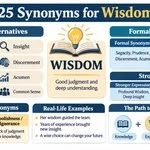
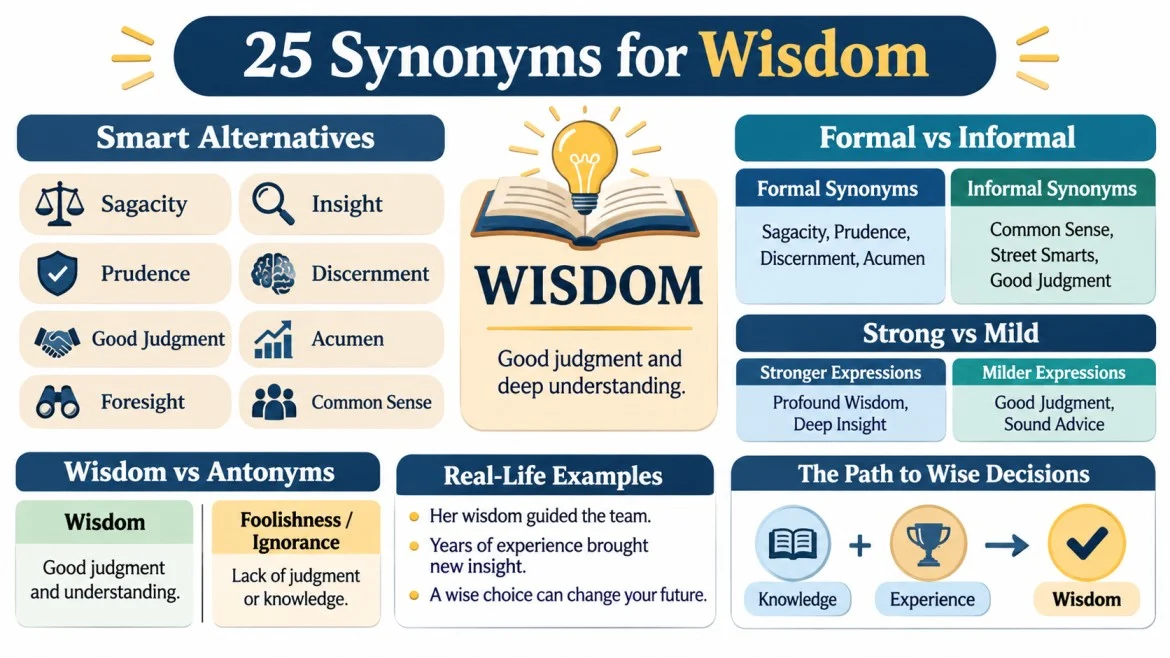
Wisdom means the ability to make good decisions using knowledge, experience, understanding, and sound judgment. The best synonyms include sagacity, insight, prudence, discernment, good judgment, and understanding, depending on the situation.
Meaning, Tone and Context
What Does Wisdom Mean?
Wisdom is the ability to understand situations deeply, recognize what matters, and make sensible decisions based on knowledge, experience, and careful thought.
It goes beyond simply knowing facts. A wise person understands how to apply knowledge effectively in real situations.
Simple Definition: The ability to make thoughtful, sensible, and well informed decisions.
Part of Speech: Noun.
Tone: Positive and respectful.
Formality: Neutral to formal.
Common Uses:
- Giving thoughtful advice.
- Making difficult decisions.
- Learning from personal experiences.
- Demonstrating emotional maturity.
- Solving complicated problems.
- Showing professional judgment.
- Understanding life lessons.
Important Word Forms
| Word Form | Meaning | Example |
|---|---|---|
| Wisdom | Good judgment and understanding | Her wisdom helped the team. |
| Wise | Showing good judgment | That was a wise decision. |
| Wisely | In a sensible manner | He invested his money wisely. |
| Unwise | Showing poor judgment | Ignoring the warning was unwise. |
| Wisehearted | Not a common standard form | Prefer wise or thoughtful instead. |
When and How to Use “Wisdom”
Use wisdom when discussing thoughtful decisions, valuable life lessons, practical understanding, or the ability to handle difficult situations sensibly.
The word is particularly useful when you want to communicate respect for someone’s experience or judgment.
Examples of Wisdom in Different Contexts
- Professional: The manager demonstrated wisdom by listening to every team member before making a decision.
- Personal: My grandmother’s wisdom has helped me through many difficult moments.
- Academic: The study explores how wisdom develops through experience and reflection.
- Emotional: It takes wisdom to forgive someone without ignoring your own feelings.
- Creative: The old storyteller shared wisdom through tales of courage and kindness.
- Social Media: True wisdom begins when you learn to understand yourself.
- Email: I appreciate your wisdom and guidance throughout this important project.
Another Word for Wisdom
The best replacement for wisdom depends on what you want to communicate. Some words emphasize experience, while others highlight intelligence, careful thinking, or the ability to recognize the right decision.
Here are useful alternatives for different situations.
| Context | Best Alternative | Why It Works |
|---|---|---|
| Professional writing | Sound judgment | Highlights sensible decisions. |
| Academic writing | Discernment | Emphasizes careful evaluation. |
| Casual conversation | Common sense | Sounds natural and familiar. |
| Emotional writing | Understanding | Communicates empathy and awareness. |
| Creative writing | Sagacity | Adds an intellectual and literary tone. |
| Resume or workplace | Strategic thinking | Highlights practical decision making. |
| Social media captions | Insight | Short, meaningful, and expressive. |
| Stronger meaning | Sagacity | Suggests exceptional practical intelligence. |
| Softer meaning | Thoughtfulness | Emphasizes consideration and care. |
Best Synonym for Wisdom by Situation
If you need one general replacement, good judgment is an excellent choice because it communicates the practical decision making aspect of wisdom.
For more formal writing, consider sagacity or discernment. For everyday conversations, common sense is usually more natural.
When Not to Use “Wisdom”
Although wisdom is a versatile word, it does not fit every situation. Sometimes it sounds too broad when a more specific term would communicate your meaning better.
Here are situations where another word may be more effective.
1. When discussing factual knowledge
Wisdom is not exactly the same as knowing information.
Instead of: Her wisdom about American history is impressive.
Better: Her knowledge of American history is impressive.
2. When describing technical ability
Wisdom does not necessarily mean professional expertise.
Instead of: His wisdom in software development is exceptional.
Better: His expertise in software development is exceptional.
3. When describing quick understanding
Wisdom may sound too broad when you mean the ability to recognize something immediately.
Better: Her insight helped us identify the problem.
4. When describing careful decisions
Use prudence when you specifically mean caution and sensible risk management.
5. When describing emotional awareness
Understanding or emotional intelligence may be more appropriate when discussing empathy and relationships.
6. When writing casual messages
Wisdom can sound overly serious in ordinary conversations. Common sense or good advice may feel more natural.
Words Commonly Confused With Wisdom
Several related words describe different aspects of intelligence and understanding. However, they are not always interchangeable.
| Word | Meaning | Difference From Wisdom |
|---|---|---|
| Knowledge | Information and facts a person has learned | Wisdom involves applying knowledge effectively. |
| Intelligence | Ability to learn, reason, and solve problems | Intelligence focuses on mental ability, while wisdom emphasizes sound judgment. |
| Insight | Deep understanding of a situation | Insight can be one component of wisdom. |
| Experience | Knowledge gained through activities and events | Experience can develop wisdom but does not guarantee it. |
| Prudence | Careful and sensible decision making | Prudence emphasizes caution and avoiding unnecessary risks. |
| Understanding | Ability to comprehend something | Understanding can involve facts, emotions, or situations without necessarily showing good judgment. |
Best Synonym by Context for Wisdom
Choosing an alternative becomes easier when you understand the situation, tone, and intended meaning.
The following table highlights the most useful options for different writing purposes.
| Context | Best Synonym | Why It Works | Example |
|---|---|---|---|
| Formal writing | Sagacity | Sounds refined and intellectual. | Her sagacity impressed the committee. |
| Academic writing | Discernment | Emphasizes thoughtful evaluation. | Discernment is essential when interpreting evidence. |
| Professional communication | Sound judgment | Highlights responsible decisions. | His sound judgment strengthened the project. |
| Resume | Strategic thinking | Demonstrates practical decision making. | Applied strategic thinking to resolve complex challenges. |
| Casual conversation | Common sense | Easy to understand and natural. | Sometimes common sense is all you need. |
| Creative writing | Insight | Adds depth to an idea. | His insight changed the direction of the story. |
| Emotional writing | Understanding | Highlights awareness and empathy. | Her understanding brought comfort to everyone. |
| Strong meaning | Sagacity | Suggests exceptional judgment. | The leader’s sagacity guided the organization. |
| Soft or moderate tone | Thoughtfulness | Emphasizes careful consideration. | I appreciated her thoughtfulness. |
| Social media captions | Insight | Short and expressive. | A little insight can change everything. |
| Business presentations | Acumen | Communicates sharp professional judgment. | Her business acumen helped the company grow. |
| Life advice | Prudence | Highlights sensible choices. | Prudence matters when making major decisions. |
| Personal development | Maturity | Suggests growth through experience. | Maturity comes with reflection and patience. |
| Literature | Enlightenment | Suggests deeper awareness. | The journey brought him enlightenment. |
| Decision making | Discernment | Highlights the ability to distinguish wisely. | Good discernment prevents unnecessary mistakes. |
Which Synonym Should You Choose?
Selecting the right synonym for wisdom requires more than finding a similar definition. Consider the exact meaning you want to express.
1. Consider the Meaning
Ask yourself what aspect of wisdom you want to emphasize.
- Use knowledge when referring to learned information.
- Use insight when describing deep understanding.
- Use prudence when emphasizing caution.
- Use discernment when highlighting careful evaluation.
- Use sagacity when describing exceptional judgment.
2. Match the Formality
Your audience determines which alternative sounds appropriate.
For academic papers and professional reports, choose discernment, sagacity, or sound judgment.
For everyday conversations, common sense, experience, and good judgment are more natural.
3. Consider Emotional Intensity
Some alternatives communicate intellectual ability, while others express personal growth or emotional awareness.
For example, maturity sounds more personal, while acumen sounds more professional.
4. Think About Professional Value
When describing workplace performance, choose words that demonstrate practical abilities.
Strategic thinking, sound judgment, business acumen, and discernment can communicate professional strengths more clearly than wisdom alone.
5. Check the Complete Sentence
Read the sentence after replacing wisdom. If the meaning changes, the replacement may not be accurate.
The best synonym should improve clarity without changing the original message.
Real Life Examples of Wisdom in Sentences
These examples show how to replace wisdom with more precise alternatives in everyday situations.
| Situation | Example Sentence |
|---|---|
| School | Her insight helped the students understand the difficult concept. |
| Workplace | The director used sound judgment when managing the crisis. |
| Writing | The author’s observations reveal a deeper understanding of human behavior. |
| Conversation | My father always shares good advice when I need it. |
| Social media | Experience teaches lessons that knowledge alone cannot provide. |
| Resume | Demonstrated strategic thinking while managing complex projects. |
| Thank you for your thoughtful guidance and valuable advice. | |
| Storytelling | The elderly traveler shared his sagacity with the younger generation. |
25 Synonyms for Wisdom
The following 25 words and expressions represent different aspects of wisdom. Some are direct alternatives, while others are context dependent replacements that emphasize specific qualities.
| Synonym | Simple Meaning | Best Used For | Example Sentence |
|---|---|---|---|
| 1. Sagacity | Exceptional practical judgment | Formal and literary writing | Her sagacity helped the community overcome difficult challenges. |
| 2. Prudence | Careful and sensible decision making | Financial and personal decisions | Prudence encouraged him to save before investing. |
| 3. Insight | Deep understanding | Academic and creative writing | Her insight revealed the real cause of the problem. |
| 4. Discernment | Ability to judge accurately | Professional and academic contexts | Good discernment helps leaders recognize reliable information. |
| 5. Good judgment | Ability to make sensible decisions | Everyday and professional communication | His good judgment prevented a costly mistake. |
| 6. Sound judgment | Reliable and thoughtful decision making | Business and formal writing | The board appreciated her sound judgment. |
| 7. Acumen | Sharp practical intelligence | Business and workplace communication | His financial acumen helped the company grow. |
| 8. Perspicacity | Ability to understand things quickly and accurately | Formal and intellectual writing | Her perspicacity uncovered an overlooked detail. |
| 9. Astuteness | Sharp awareness and practical intelligence | Professional writing | The negotiator’s astuteness impressed both parties. |
| 10. Foresight | Ability to anticipate future consequences | Planning and leadership | Their foresight helped them prepare for future challenges. |
| 11. Experience | Knowledge gained through life or practice | Personal and professional contexts | Years of experience taught her valuable lessons. |
| 12. Maturity | Emotional and intellectual development | Personal development | His maturity showed in the way he handled criticism. |
| 13. Enlightenment | Deeper awareness or understanding | Philosophical and spiritual writing | Reading the book brought her a new sense of enlightenment. |
| 14. Understanding | Ability to comprehend something deeply | Personal and academic contexts | Her understanding of human behavior was impressive. |
| 15. Knowledge | Information gained through learning | Educational and professional writing | Knowledge gives people a foundation for better decisions. |
| 16. Learning | Knowledge acquired through study or experience | Educational contexts | Lifelong learning encourages thoughtful choices. |
| 17. Erudition | Extensive knowledge gained through study | Academic and literary writing | His erudition was evident throughout the lecture. |
| 18. Discretion | Ability to act carefully and appropriately | Workplace and personal situations | She used discretion when discussing confidential matters. |
| 19. Common sense | Practical understanding of everyday situations | Casual conversation | Common sense helped him avoid an unnecessary argument. |
| 20. Perception | Ability to notice and understand things | Psychological and creative writing | Her perception of the situation was remarkably accurate. |
| 21. Clear sightedness | Ability to understand situations objectively | Analytical and professional writing | His clear sightedness helped the team make a difficult choice. |
| 22. Levelheadedness | Ability to remain calm and sensible | Everyday and professional situations | Her levelheadedness kept everyone focused during the emergency. |
| 23. Thoughtfulness | Careful consideration of others and situations | Emotional and personal writing | His thoughtfulness made the decision easier for everyone. |
| 24. Reason | Logical thinking and sound argument | Academic and philosophical writing | Reason should guide important decisions. |
| 25. Expertise | Advanced knowledge or skill in a subject | Professional and technical writing | Her expertise helped the organization solve the problem. |
Important usage note: These alternatives are related to wisdom, but they are not interchangeable in every sentence. For example, expertise describes specialized ability, while prudence emphasizes caution and good judgment.
Synonym Groups and Usage Differences
Understanding synonym groups makes it easier to select the right expression without changing your intended meaning.
Professional vs. Personal Synonyms
Professional writing often emphasizes practical decision making and intellectual ability.
Useful professional alternatives include:
- Business acumen
- Strategic thinking
- Sound judgment
- Discernment
- Foresight
Personal writing often focuses on experience, growth, and emotional understanding.
Useful personal alternatives include:
- Maturity
- Thoughtfulness
- Understanding
- Insight
- Common sense
Example:
Professional: Her strategic thinking helped the company manage unexpected challenges.
Personal: Her maturity helped her handle difficult relationships.
Formal vs. Conversational Synonyms
Formal language works well in reports, essays, presentations, and professional documents.
Consider sagacity, discernment, prudence, and perspicacity.
Conversational alternatives include common sense, good judgment, experience, and good advice.
Example:
Formal: The professor demonstrated remarkable discernment.
Conversational: My uncle always has good advice.
Academic Synonyms
Academic writing benefits from words that communicate precise intellectual qualities.
Consider these alternatives:
- Discernment: Careful evaluation of information.
- Insight: A deeper understanding of a topic.
- Erudition: Extensive knowledge gained through study.
- Understanding: Comprehension of a subject.
- Reason: Logical thinking and analysis.
Example: Critical discernment is important when evaluating competing research arguments.
Professional and Business Synonyms
In business communication, wisdom often refers to practical leadership and effective decisions.
The following alternatives can make professional writing more specific:
| Synonym | Professional Application |
|---|---|
| Business acumen | Understanding business opportunities and challenges |
| Strategic thinking | Developing effective long term plans |
| Sound judgment | Making responsible workplace decisions |
| Foresight | Anticipating future risks |
| Discernment | Evaluating choices carefully |
| Expertise | Demonstrating advanced subject knowledge |
Resume example: Demonstrated strong strategic thinking and sound judgment while leading cross functional projects.
Creative or Literary Synonyms
Creative writing can benefit from words that suggest intellectual depth, personal discovery, and thoughtful reflection.
Useful choices include:
- Sagacity
- Enlightenment
- Insight
- Perception
- Erudition
Example: Through years of hardship, the traveler developed an understanding that no classroom could provide.
Slang or Modern Synonyms
Wisdom does not have many exact slang equivalents. However, some informal expressions can communicate similar ideas.
| Expression | Meaning | Best Context |
|---|---|---|
| Street smarts | Practical knowledge of real world situations | Casual conversation |
| Life lessons | Knowledge gained through personal experiences | Personal writing |
| Good sense | Ability to make sensible choices | Everyday communication |
| Know how | Practical ability to do something | Informal and professional contexts |
| Words of wisdom | Helpful advice | Conversations and captions |
Avoid using street smarts or know how as replacements in formal academic writing.
Strongest vs. Weaker Synonyms
Different alternatives communicate different levels and types of intellectual ability.
Here is a practical scale from general to more specialized or impressive expressions.
| Level | Synonym | Meaning |
|---|---|---|
| Mild | Thoughtfulness | Careful consideration |
| Mild | Understanding | Basic or deep comprehension |
| Moderate | Common sense | Practical everyday judgment |
| Moderate | Experience | Knowledge gained over time |
| Strong | Discernment | Accurate evaluation |
| Strong | Prudence | Careful decision making |
| Very strong | Acumen | Sharp practical intelligence |
| Very strong | Perspicacity | Exceptional ability to understand |
| Very strong | Sagacity | Outstanding practical judgment |
This is a guide to expressive strength, not a universal ranking. The best choice depends on the quality you want to emphasize.
Emotional vs. Neutral Synonyms
Some alternatives communicate personal warmth, while others remain more objective.
Emotional alternatives:
- Thoughtfulness
- Maturity
- Understanding
- Life lessons
- Enlightenment
Neutral or analytical alternatives:
- Knowledge
- Discernment
- Reason
- Insight
- Acumen
For example, thoughtfulness sounds personal and caring, while discernment sounds more analytical.
Antonyms of Wisdom
Antonyms of wisdom describe poor judgment, limited understanding, careless decisions, or a lack of practical experience.
Not every opposite has exactly the same meaning. The following 15 words are useful contextual antonyms.
| Antonym | Meaning | Example Sentence |
|---|---|---|
| 1. Foolishness | Lack of good judgment | His foolishness created unnecessary problems. |
| 2. Folly | An unwise action or decision | Spending everything on unnecessary purchases was pure folly. |
| 3. Ignorance | Lack of knowledge | Ignorance of the rules caused confusion. |
| 4. Naivety | Lack of experience or awareness | Her naivety made her trust the stranger too quickly. |
| 5. Recklessness | Acting without considering risks | Recklessness put the entire team in danger. |
| 6. Imprudence | Lack of careful judgment | His imprudence resulted in financial difficulties. |
| 7. Rashness | Making decisions too quickly | Rashness prevented her from considering other options. |
| 8. Impulsiveness | Acting without sufficient thought | Impulsiveness often leads to unnecessary mistakes. |
| 9. Shortsightedness | Failure to consider future consequences | The company’s shortsightedness damaged its reputation. |
| 10. Gullibility | Readiness to believe things too easily | Gullibility made him vulnerable to false promises. |
| 11. Stupidity | Extremely poor judgment or understanding | The decision was criticized as an act of stupidity. |
| 12. Obtuseness | Slowness to understand something | His obtuseness prevented him from recognizing the warning. |
| 13. Thoughtlessness | Failure to consider others or consequences | Her thoughtlessness hurt a close friend. |
| 14. Heedlessness | Failure to pay attention or exercise caution | Heedlessness caused the driver to overlook the warning. |
| 15. Inexperience | Lack of practical knowledge or familiarity | Inexperience made the task more difficult. |
Comparison: Wisdom vs. Similar Words
The following comparisons explain six important differences between wisdom and related vocabulary.
Wisdom vs. Knowledge
Main Difference: Knowledge refers to information and facts, while wisdom involves using information and experience to make sensible decisions.
Which Is Stronger? Wisdom is more focused on practical judgment.
Which Is More Formal? Both work in formal writing.
Examples:
Wisdom: Her wisdom helped her choose the right solution.
Knowledge: Her knowledge of science impressed the researchers.
Wisdom vs. Intelligence
Main Difference: Intelligence describes the ability to learn and reason. Wisdom emphasizes making thoughtful decisions.
Which Is Stronger? Neither is universally stronger. They describe different qualities.
Which Is More Formal? Both are appropriate for academic and professional writing.
Examples:
Wisdom: His wisdom helped him resolve the disagreement peacefully.
Intelligence: Her intelligence helped her solve the complex equation.
Wisdom vs. Insight
Main Difference: Insight is a deep understanding of a particular situation, while wisdom is a broader ability to apply knowledge and judgment.
Which Is Stronger? Wisdom is broader, while insight can be more specific.
Which Is More Formal? Both are suitable for formal writing.
Examples:
Wisdom: Experience gave him the wisdom to handle difficult situations.
Insight: Her insight revealed the real problem.
Wisdom vs. Prudence
Main Difference: Wisdom involves broad understanding and sound judgment. Prudence specifically emphasizes caution and sensible decision making.
Which Is Stronger? Wisdom is broader, while prudence is more focused on avoiding unnecessary risks.
Which Is More Formal? Both work in professional and academic contexts.
Examples:
Wisdom: Her wisdom helped her understand the situation.
Prudence: Her prudence encouraged her to avoid unnecessary financial risks.
Wisdom vs. Experience
Main Difference: Experience comes from participating in activities and situations. Wisdom develops when someone learns meaningful lessons from those experiences.
Which Is Stronger? Wisdom emphasizes the ability to apply lessons.
Which Is More Formal? Both are suitable for formal communication.
Examples:
Wisdom: His wisdom helped him guide younger employees.
Experience: His experience made him an effective manager.
Wisdom vs. Common Sense
Main Difference: Common sense refers to practical everyday judgment, while wisdom can include deeper understanding, experience, and thoughtful reflection.
Which Is Stronger? Wisdom generally covers a wider range of intellectual qualities.
Which Is More Formal? Wisdom is more appropriate for formal writing, although common sense is acceptable in many professional situations.
Examples:
Wisdom: Her wisdom helped her make a difficult life decision.
Common sense: Common sense tells us to check the information before sharing it.
Common Phrases and Expressions with Wisdom
These expressions are useful in conversations, articles, speeches, captions, and professional communication.
1. Words of Wisdom
Meaning: Helpful advice based on knowledge or experience.
Example Sentence: My grandfather always shares words of wisdom during family gatherings.
2. Wisdom of Experience
Meaning: Understanding developed through real life situations.
Example Sentence: The wisdom of experience helped her become a better leader.
3. Conventional Wisdom
Meaning: Beliefs or opinions commonly accepted by society.
Example Sentence: Conventional wisdom suggests that preparation improves performance.
4. Ancient Wisdom
Meaning: Valuable knowledge and teachings passed down through generations.
Example Sentence: The book explores ancient wisdom from different cultures.
5. A Piece of Wisdom
Meaning: A useful thought or lesson that can guide someone.
Example Sentence: She shared a piece of wisdom that changed my perspective.
6. Practical Wisdom
Meaning: The ability to apply knowledge effectively in everyday situations.
Example Sentence: Practical wisdom is essential when managing a busy household.
7. Gain Wisdom
Meaning: To develop better judgment and understanding.
Example Sentence: People often gain wisdom by learning from their mistakes.
8. Wisdom Comes With Age
Meaning: People may develop better judgment through years of experience.
Example Sentence: Wisdom comes with age, patience, and a willingness to learn.
Common Mistakes to Avoid
Using synonyms correctly requires understanding their differences. Here are seven mistakes to avoid when writing about wisdom.
1. Treating Knowledge and Wisdom as Identical
Knowledge means having information, while wisdom involves applying that information sensibly.
Incorrect: He has wisdom about every historical event.
Better: He has extensive knowledge of historical events.
2. Using Sagacity in Casual Conversations
Sagacity is a formal and relatively uncommon word. It can sound unnatural in everyday messages.
Instead of: That was an impressive display of sagacity.
Use: That was a really smart decision.
3. Confusing Prudence With Intelligence
Prudence emphasizes caution and good judgment, not general intellectual ability.
Choose intelligence when discussing mental ability and prudence when discussing careful decisions.
4. Using an Overly Dramatic Alternative
Words such as enlightenment may sound exaggerated when discussing ordinary situations.
Use insight or good judgment when the situation does not require a more philosophical tone.
5. Repeating Wisdom Too Frequently
Repeating the same word makes writing less engaging.
Use appropriate alternatives such as discernment, experience, insight, and good judgment when their meanings fit.
6. Choosing the Wrong Emotional Tone
Thoughtfulness suggests consideration, while acumen suggests practical intelligence.
Do not replace one with the other without checking the sentence.
7. Using Slang in Academic Writing
Expressions such as street smarts may work in informal discussions but usually do not suit research papers or formal essays.
Choose discernment, understanding, or sound judgment instead.
FAQs
1. What Is the Best Synonym for Wisdom?
Good judgment is an excellent general synonym for wisdom. Other useful choices include sagacity, insight, prudence, and discernment, depending on context.
2. What Is a Formal Synonym for Wisdom?
Sagacity, discernment, and perspicacity are formal alternatives. They communicate exceptional judgment, careful evaluation, and the ability to understand situations deeply.
3. What Is an Informal Synonym for Wisdom?
Common sense, good advice, and life experience are natural informal alternatives. They work particularly well in everyday conversations and personal writing.
4. What Is Another Word for Wisdom in Professional Writing?
Sound judgment, strategic thinking, business acumen, and discernment are useful professional alternatives when describing leadership and responsible decision making.
5. What Is the Difference Between Wisdom and Knowledge?
Knowledge involves learning information and facts, while wisdom involves applying knowledge and experience to make sensible decisions in different situations.
6. What Is the Opposite of Wisdom?
Foolishness is a common opposite of wisdom. Other contextual antonyms include ignorance, recklessness, imprudence, naivety, and poor judgment.
Conclusion
Wisdom describes the ability to apply knowledge, experience, and understanding when making thoughtful decisions. However, the best synonym depends on the specific meaning and tone you want to communicate.
Use sagacity for exceptional judgment, prudence for careful decisions, insight for deep understanding, discernment for accurate evaluation, and common sense for everyday conversations.
When choosing synonyms for wisdom, focus on clarity rather than complexity. A precise word makes your writing more natural, meaningful, and effective.
Discover More Post:
- 50+ Synonyms for Luxury | From Understated Elegance to …
- 50+ Synonyms for Phenomenon | From Everyday Events to …